
Most American accounting firms are missing out on the chance to break into the 7 or even 8-figure monthly revenue club. As technology sweeps through the world of finance, Miami CPAs who cling to traditional models risk falling behind. Embracing business transformation means more than just upgrading tools—it sets you up to deliver the high-value advisory services clients demand, building a more profitable and future-ready practice.
Table of Contents
- Business Transformation Defined for CPAs
- Types of Business Transformation Strategies
- Core Technologies Driving CPA Innovation
- Compliance and Security in Digital Change
- Risks, Costs, and Common Pitfalls
- Steps to Successful Transformation in Miami
Key Takeaways
| Point | Details |
|---|---|
| Transformation to Advisory Roles | CPAs should evolve from compliance-focused tasks to technology-enabled strategic advisory services to enhance client value. |
| Invest in Technology and Training | Firms must allocate resources to continuous technology training and upskilling to stay competitive in a rapidly changing environment. |
| Prioritize Compliance and Security | Establish robust cybersecurity measures and comply with regulatory standards to protect client data during digital transformation. |
| Address Financial and Organizational Risks | Carefully manage financial investments and prepare for workforce challenges to ensure a successful transition in accounting practices. |
Business Transformation Defined for CPAs
Business transformation represents a fundamental reimagining of how accounting firms operate and deliver value to clients. At its core, this strategic approach moves CPAs from traditional compliance work toward becoming technology-enabled strategic advisors. Digital transformation fundamentally changes the accounting profession by leveraging emerging technologies and expanding service models.
The transformation process involves several critical shifts for modern accounting practices. CPAs must rethink their traditional service delivery by adopting advanced digital tools like artificial intelligence, cloud solutions, and data analytics platforms. This technological integration allows firms to move beyond basic number-crunching and tax preparation toward providing high-value strategic consulting that directly impacts client business performance.
Successful business transformation requires CPAs to develop new capabilities and mindsets. This means investing in continuous learning, understanding emerging technologies, and redesigning service offerings to meet evolving client expectations. Modernizing the traditional accounting model involves reimagining client relationships, developing new pricing strategies, and creating more dynamic, technology-driven workflows.
Pro tip: Start your business transformation journey by conducting a comprehensive technology and skills audit to identify immediate opportunities for digital integration and service expansion.
Types of Business Transformation Strategies
Business transformation strategies for CPA firms encompass a multifaceted approach to reimagining service delivery and organizational capabilities. Proactive leadership and technology integration are fundamental components that drive meaningful change across accounting practices. These strategies go beyond superficial updates, representing a comprehensive redesign of how firms create and deliver value to clients.
The primary transformation strategies can be categorized into several key areas. First, service model transformation involves shifting from traditional compliance work to strategic advisory services. This means developing capabilities in data analytics, technology consulting, and providing forward-looking business insights. Second, operational transformation focuses on streamlining internal processes through automation, implementing advanced technological tools, and creating more efficient workflows that reduce administrative overhead and increase productivity.
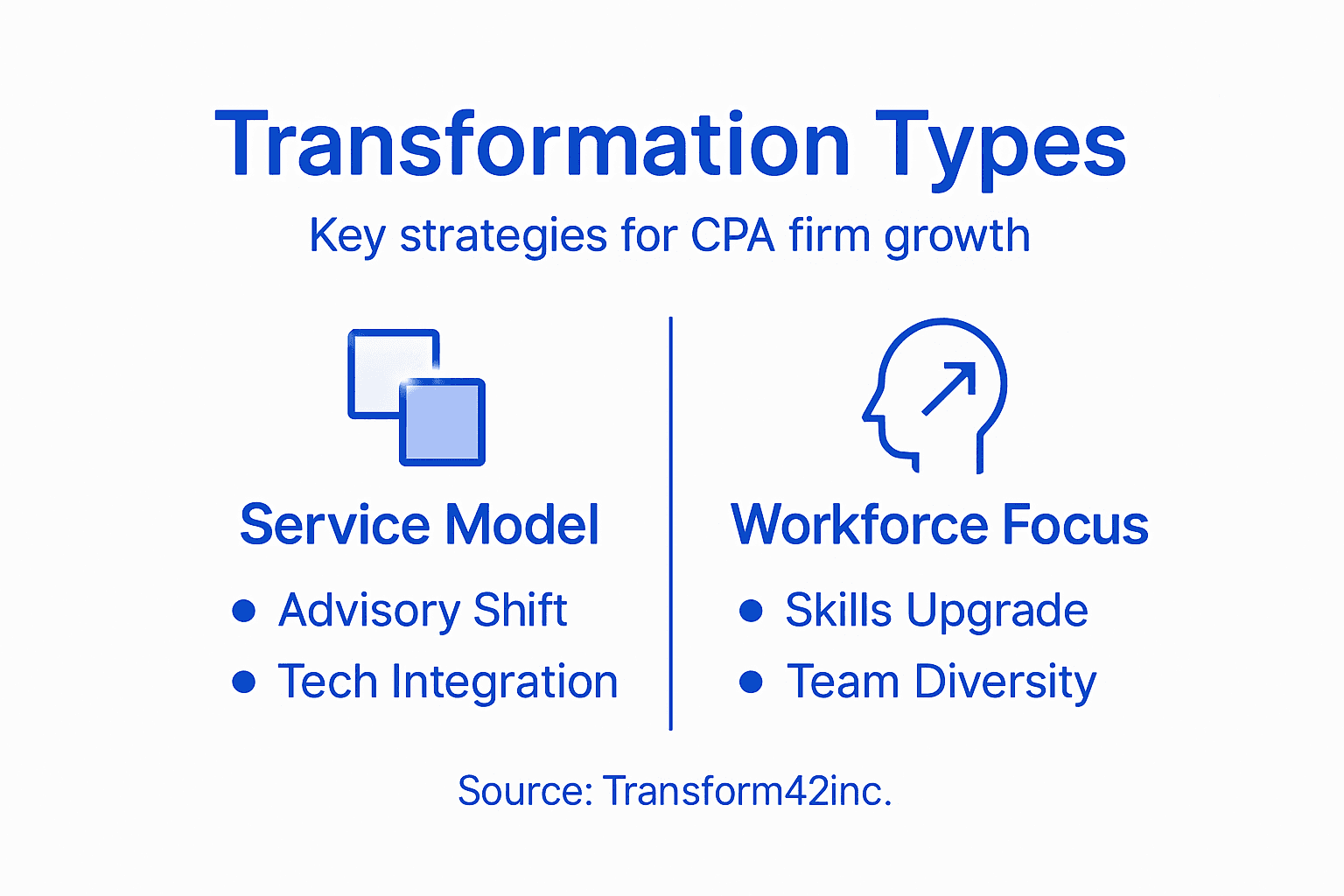
Strategic workforce development represents another critical transformation strategy. This involves continuous talent upskilling, redesigning recruitment approaches, and creating environments that attract technology-savvy professionals who can drive innovation. Firms must invest in training programs that help existing staff adapt to new technologies and develop consulting skills that complement emerging digital tools.
Pro tip: Create a comprehensive transformation roadmap that prioritizes technology integration, skill development, and client-centric service redesign to ensure sustainable growth and competitive advantage.
Here’s a comparison of key business transformation strategies and their primary effects for CPA firms:
| Strategy Focus | Main Objective | Typical Outcome |
|---|---|---|
| Service Model Transformation | Shift to strategic advisory roles | Higher-value client engagements |
| Operational Transformation | Streamline processes with automation | Increased efficiency, lower costs |
| Workforce Development | Upskill for new technologies | Enhanced innovation capacity |
Core Technologies Driving CPA Innovation
Artificial Intelligence and advanced automation technologies are fundamentally transforming the accounting profession, reshaping how CPAs deliver value to their clients. AI is rapidly changing professional requirements by taking over repetitive tasks and enabling more strategic work. These technological advances are pushing CPAs beyond traditional number-crunching into roles that demand higher-level analytical and strategic thinking.

The core technologies driving innovation include sophisticated data analytics platforms, cloud computing solutions, and machine learning algorithms. These tools enable CPAs to process massive amounts of financial information rapidly, identify complex patterns, and generate predictive insights that were previously impossible. Advanced optical character recognition and natural language processing technologies now allow instant document analysis, dramatically reducing time spent on manual data entry and compliance work.
Moreover, emerging technologies like blockchain and predictive analytics are creating new service opportunities for forward-thinking accounting firms. These platforms enable real-time financial monitoring, fraud detection, and strategic forecasting that go far beyond traditional accounting services. CPAs who master these technologies can position themselves as strategic business advisors rather than mere record-keepers, offering high-value consulting services that directly impact their clients’ bottom line.
Pro tip: Invest at least 10% of your annual budget in continuous technology training and skill development to stay ahead of rapidly evolving digital transformation trends.
Below is a summary of core technologies transforming CPA firms and their strategic impact:
| Technology | Core Function | Strategic Benefit |
|---|---|---|
| Artificial Intelligence | Automates repetitive accounting tasks | Frees time for value-added work |
| Data Analytics | Processes and analyzes large datasets | Delivers predictive insights |
| Cloud Computing | Enables secure remote access | Promotes flexible collaboration |
| Blockchain | Provides real-time transaction tracking | Enhances trust and transparency |
Compliance and Security in Digital Change
Digital transformation in the accounting profession demands a sophisticated approach to compliance and security that goes beyond traditional risk management. Updated regulatory frameworks guide technology adoption by establishing stringent standards to protect client data and maintain professional integrity. These frameworks create a structured pathway for CPAs to integrate advanced technologies while preserving the fundamental trust clients place in their financial advisors.
The critical components of compliance and security during digital change include robust data protection protocols, comprehensive cybersecurity training, and adaptive risk management strategies. CPA firms must implement multi-layered security architectures that protect sensitive financial information from emerging digital threats. This involves developing sophisticated encryption methods, creating secure cloud storage solutions, and establishing strict access control mechanisms that prevent unauthorized data breaches.
Workforce transformation requires comprehensive security training to ensure that technological advancements do not compromise client confidentiality. Firms must invest in continuous education programs that teach staff about evolving cybersecurity risks, compliance requirements, and best practices for secure technology implementation. This approach transforms security from a passive defensive strategy to an active, dynamic component of professional service delivery.
Pro tip: Develop a comprehensive digital security certification program for your team that includes quarterly training updates and mandatory cybersecurity assessments.
Risks, Costs, and Common Pitfalls
Business transformation for CPA firms involves navigating complex challenges that can derail even the most well-intentioned change initiatives. Business transformation risks include leadership misalignment and insufficient understanding of organizational dynamics. These risks can create substantial financial and operational obstacles that prevent successful technology integration and strategic growth.
Financial constraints represent a significant pitfall for accounting firms attempting digital transformation. The initial investment in new technologies, training programs, and infrastructure can be substantial, often requiring months or years before realizing meaningful returns. CPAs must carefully balance immediate cost considerations with long-term strategic investments, understanding that transformation is not a one-time expense but an ongoing process of technological and organizational adaptation.
CPA firms face workforce transformation challenges that extend beyond simple technological implementation. These include managing staff resistance, maintaining productivity during transition periods, and developing comprehensive training programs. Overwhelmed employees, limited internal support, and slow technology adoption can create friction that undermines transformation efforts, making strategic change management critical to success.
Pro tip: Develop a comprehensive transformation budget that includes not just technology costs, but also allocates resources for staff training, change management, and potential productivity dips during transition periods.
Steps to Successful Transformation in Miami
Business transformation requires a strategic and methodical approach tailored to the unique dynamics of the Miami accounting market. Developing a clear transformation strategy involves understanding local business ecosystems and identifying precise technological opportunities that create competitive advantages for CPA firms.
The first critical steps involve comprehensive organizational assessment and leadership alignment. CPA firms must conduct thorough internal evaluations to map existing capabilities, technology infrastructures, and skill gaps. This diagnostic phase helps create a targeted transformation roadmap that addresses specific operational challenges while leveraging Miami’s dynamic professional landscape. Strategic planning should include detailed workforce analysis, technology readiness evaluation, and client service model reimagination.
Talent-first transformation strategies are particularly crucial in Miami’s competitive professional environment. This means investing heavily in upskilling programs focused on emerging technologies like data analytics, artificial intelligence, and advanced automation tools. Successful transformation requires creating a culture of continuous learning where employees are empowered to develop new skills and embrace technological innovation as a core professional competency.
Pro tip: Create a dedicated transformation team with representatives from different organizational levels to ensure comprehensive input and build internal momentum for change initiatives.
Unlock Real Revenue Growth Through Strategic Business Transformation in Miami
The challenge for CPAs today is clear. To thrive in Miami’s competitive market, you must move beyond traditional compliance work and embrace technology-enabled strategic advisory roles. This means overcoming pain points like workforce resistance, costly technology investments, and the need for continuous skill development. By implementing proven business transformation strategies like operational automation and service model redesign, your firm can land bigger clients, scale efficiently, and reclaim valuable time.
Take control of this journey with our expert guidance. Explore how tailored digital transformation solutions and streamlined process optimizations make compliance and growth easier. Leadership that understands your unique challenges is critical to success.
Start your firm’s transformation today and build the capabilities your clients expect. Visit https://www.transform42inc.com/ to partner with Miami’s premier strategic IT consultants for accountants. Don’t wait — position your firm for lasting revenue growth now.
Frequently Asked Questions
What is business transformation for CPAs?
Business transformation for CPAs refers to a comprehensive reimagining of how accounting firms operate, shifting from traditional compliance roles to becoming technology-enabled strategic advisors that leverage emerging technologies and innovative service models.
What are the key strategies for transforming a CPA firm?
Key strategies include service model transformation, where firms shift to strategic advisory services; operational transformation, which focuses on streamlining processes through automation; and strategic workforce development, emphasizing continuous skill enhancement and talent acquisition for technology integration.
How can emerging technologies impact CPAs during business transformation?
Emerging technologies like artificial intelligence, cloud computing, and data analytics significantly enhance CPAs’ ability to provide high-value consulting services. These tools automate mundane tasks, allowing firms to deliver predictive insights and strategic recommendations that improve client business performance.
What are common pitfalls in the business transformation process for CPA firms?
Common pitfalls include leadership misalignment, financial constraints related to technology investments, and workforce resistance. Firms must proactively manage these challenges through effective change management, proper budgeting, and continuous training to ensure a smooth transition.