Every independent CPA in Miami knows how quickly a poorly managed IT system can slow down client work and impact revenue. As local firms rely more on technology to serve their accounting clients efficiently, Information Technology Service Management (ITSM) is becoming a crucial business strategy instead of just a technical support tool. This article explores how adopting structured ITSM principles helps CPAs create more reliable workflows, protect sensitive data, and improve client satisfaction right here in Miami.
Table of Contents
- Defining IT Service Management for CPAs
- Common ITSM Models and Service Types
- How ITSM Streamlines Accounting Workflows
- Compliance, Data Security, and ITSM Standards
- Maximizing ROI and Avoiding Costly ITSM Mistakes
Key Takeaways
| Point | Details |
|---|---|
| Importance of ITSM for CPAs | IT Service Management (ITSM) is vital for CPA firms to align technology with business objectives, enhancing operational efficiency and client service quality. |
| Structured Frameworks | Key ITSM models like ITIL and COBIT provide structured approaches that help CPA firms optimize service delivery and manage compliance effectively. |
| Focus on Security and Compliance | Implementing robust ITSM security measures is essential for protecting sensitive financial data and meeting industry-specific regulatory requirements. |
| Continuous Improvement | Regular assessments and stakeholder engagement are crucial for maximizing ROI and avoiding costly mistakes in ITSM implementation. |
Defining IT Service Management for CPAs
Information Technology Service Management (ITSM) represents a strategic framework designed specifically to help accounting professionals transform their technological capabilities. At its core, ITSM focuses on aligning IT services with organizational needs through systematic processes that enhance operational efficiency.
For Miami CPA firms, ITSM is not just a technical concept but a critical business strategy. It provides structured methodologies to manage technology resources, ensuring that every digital tool and system supports core accounting functions seamlessly. Strategic planning and continual improvement become central to delivering reliable, high-performance IT solutions that directly impact financial processes and client service quality.
The key components of ITSM for accounting professionals typically include service design, implementation, operational management, and ongoing optimization. These processes help CPA firms address complex technological challenges by creating standardized approaches to IT support, reducing system downtime, enhancing cybersecurity, and maintaining regulatory compliance. By adopting ITSM principles, accounting practices can transform their technological infrastructure from a potential liability into a strategic competitive advantage.
Pro tip: Conduct a quarterly technology audit to ensure your ITSM strategy remains aligned with your firm’s evolving business objectives and client needs.
Common ITSM Models and Service Types
Information Technology Service Management (ITSM) encompasses several established frameworks that provide structured approaches to managing IT services for professional organizations like CPA firms. The primary models include ITIL, COBIT, and ISO/IEC 20000, each offering unique methodologies for standardizing IT service delivery with precision and reliability.
These frameworks define multiple service types critical for accounting practices, including incident management, change management, problem management, and service request processes. Incident management focuses on quickly resolving technical disruptions, while change management ensures systematic approaches to implementing new technologies or modifications. Problem management takes a proactive stance by identifying and addressing underlying causes of recurring technical issues before they escalate.
Service Integration and Management (SIAM) represents an advanced approach particularly valuable for Miami CPA firms managing complex technological ecosystems. SIAM enables organizations to coordinate multiple service providers, maintaining centralized governance and ensuring seamless integration across different technological platforms. This model helps accounting firms maintain comprehensive control over their IT infrastructure, reducing potential vulnerabilities and enhancing overall operational efficiency.
Here’s how key ITSM frameworks support CPA firm needs:
| Framework | Primary Focus | CPA Benefit | Typical Use Case |
|---|---|---|---|
| ITIL | Service best practices | Streamlined processes | Incident resolution |
| COBIT | IT governance | Regulatory alignment | Compliance audits |
| ISO/IEC 20000 | Service quality standards | Reliable IT delivery | Client data protection |
| SIAM | Provider integration | Unified infrastructure | Multi-vendor management |
Pro tip: Regularly map your current ITSM framework against your firm’s specific technological requirements to ensure ongoing alignment and optimal performance.
How ITSM Streamlines Accounting Workflows
Information Technology Service Management (ITSM) fundamentally transforms accounting workflows by creating systematic approaches to technological support and service delivery. Integrating IT services with accounting processes enables CPA firms to dramatically improve operational efficiency, reduce system errors, and maintain consistent performance across complex technological ecosystems.
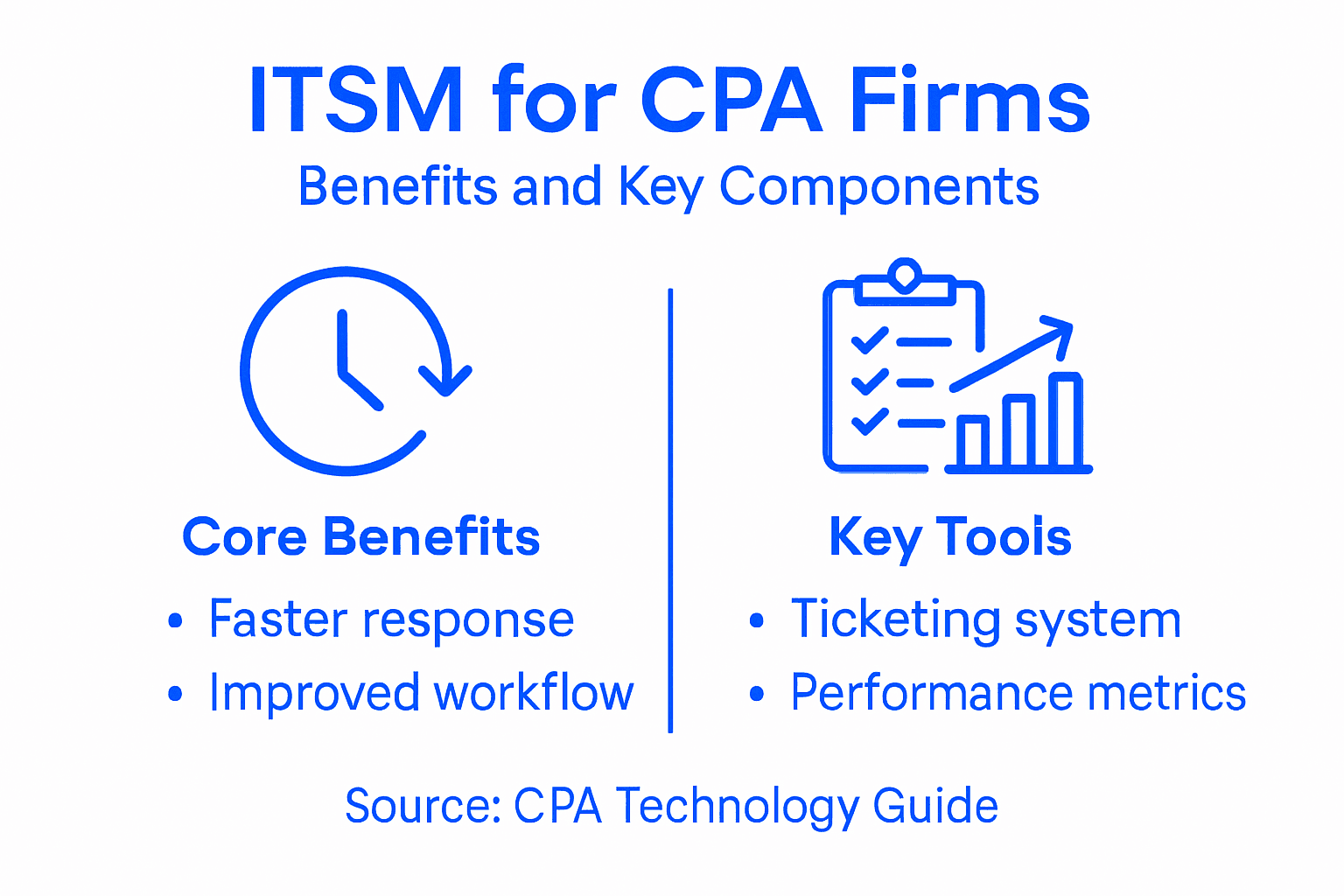
The core mechanisms of ITSM that streamline accounting workflows include advanced incident management, proactive problem resolution, and structured change management protocols. These processes ensure that technical disruptions are minimized, system updates are implemented smoothly, and potential technological challenges are identified and addressed before they can impact critical financial reporting or client service capabilities. By establishing clear escalation paths and standardized response procedures, accounting firms can maintain uninterrupted access to essential digital resources.

Performance monitoring and metrics play a crucial role in this optimization strategy. Operational standards for accounting applications are continuously tracked, allowing firms to identify potential bottlenecks, optimize system performance, and ensure compliance with stringent regulatory requirements. This data-driven approach enables Miami CPA firms to make informed technological decisions, allocate resources more effectively, and create more resilient IT infrastructures that support rapid business growth.
Pro tip: Implement a quarterly ITSM performance review to systematically assess and realign your technological workflows with your firm’s evolving business objectives.
Compliance, Data Security, and ITSM Standards
Compliance and data security represent critical foundations for Miami CPA firms navigating increasingly complex technological landscapes. Information Security within ITSM frameworks provides comprehensive strategies to protect sensitive financial data, ensuring that technological infrastructure meets rigorous regulatory requirements specific to accounting practices.
The primary components of robust ITSM security standards include multi-layered protection mechanisms designed to shield confidential client information. These encompass advanced access controls, encryption protocols, continuous threat monitoring, and systematic risk assessment processes. Fortifying finance through strategic security architecture enables accounting firms to establish comprehensive defense strategies that anticipate and mitigate potential technological vulnerabilities.
The table below summarizes critical ITSM security controls and their impact for CPAs:
| Security Control | Main Purpose | Benefit to CPA Firms |
|---|---|---|
| Access Control | Restrict unauthorized access | Protects sensitive client records |
| Encryption | Secure data in transit/storage | Safeguards financial information |
| Threat Monitoring | Detect suspicious activity | Prevents data breaches |
| Risk Assessment | Identify potential vulnerabilities | Improves regulatory compliance |
Regulatory compliance demands meticulous attention to detail, requiring CPA firms to implement sophisticated technological frameworks that align with industry-specific guidelines. Navigating complex accounting compliance requirements involves developing dynamic ITSM approaches that can adapt to evolving legal standards. This means creating flexible technological ecosystems capable of maintaining data integrity, supporting audit trails, and ensuring transparency across all digital interactions while protecting client confidentiality.
Pro tip: Conduct comprehensive quarterly security assessments to proactively identify and address potential technological vulnerabilities within your firm’s IT infrastructure.
Maximizing ROI and Avoiding Costly ITSM Mistakes
Maximizing return on investment in Information Technology Service Management requires a strategic approach that goes beyond basic technological implementation for Miami CPA firms. Successful ITSM adoption depends on understanding critical success factors that directly impact financial performance and operational efficiency.
The most common and expensive mistakes CPA firms make involve insufficient stakeholder engagement, inadequate planning, and resistance to continuous improvement. Strategic ITSM implementation demands comprehensive leadership support, clear technological scope definition, and ongoing training programs. By aligning IT services precisely with accounting business objectives, firms can transform potential technological challenges into competitive advantages that drive significant operational cost reductions and enhanced service delivery.
Leveraging metrics and feedback loops becomes crucial in refining IT service strategies. Advanced frameworks like ITIL and COBIT provide structured guidance for optimizing service delivery, enabling accounting practices to develop flexible technological ecosystems that adapt quickly to evolving business requirements. This approach helps Miami CPA firms reduce inefficiencies, minimize downtime, and create more predictable, scalable technological infrastructure.
Pro tip: Develop a comprehensive quarterly technology performance review process that systematically evaluates your ITSM strategy against key business performance indicators.
Elevate Your Miami CPA Firm with Strategic IT Service Management
Miami CPA firms face the constant challenge of aligning technology with rigorous compliance demands while streamlining workflows and safeguarding sensitive client data. The article highlights how implementing robust IT Service Management (ITSM) frameworks like ITIL and SIAM can minimize costly disruptions, enhance cybersecurity, and build a scalable technology infrastructure. If you are striving to transform your IT from a headache into a strategic advantage that wins larger clients and powers efficient growth then adopting a proven ITSM strategy is critical.
Take control of your firm’s technology with expert guidance designed specifically for accounting professionals. At Transform42, we specialize in helping Miami accountants build the capabilities and compliance their clients expect without hiring more staff. Explore proven process optimization strategies that align IT services precisely with your business objectives.
Don’t wait until an IT failure disrupts your client service or compliance obligations. Visit Transform42’s homepage now to discover how our comprehensive IT solutions can streamline your operations and maximize technology ROI. Take the first step toward reclaiming your time and growing your revenue securely today.
Frequently Asked Questions
What is IT Service Management (ITSM) and how does it benefit CPA firms?
IT Service Management (ITSM) is a strategic framework that aligns IT services with organizational needs. For CPA firms, it enhances operational efficiency by providing systematic processes for managing technology resources, ultimately improving financial processes and client service quality.
Which ITSM frameworks are commonly used by CPA firms?
Common ITSM frameworks include ITIL, COBIT, ISO/IEC 20000, and Service Integration and Management (SIAM). Each framework offers structured methodologies for standardizing IT service delivery, managing incidents, ensuring compliance, and integrating multiple service providers effectively.
How does ITSM streamline accounting workflows in CPA firms?
ITSM streamlines accounting workflows by implementing systematic approaches such as incident management, change management, and proactive problem resolution. This minimizes technical disruptions, ensures smooth updates, and efficiently addresses potential technological issues, supporting critical financial reporting and service activities.
How can CPA firms ensure compliance and data security through ITSM?
CPA firms can enhance compliance and data security by adopting robust ITSM security standards, including access controls, encryption, threat monitoring, and risk assessments. These measures protect sensitive financial data and ensure that the firm’s technological infrastructure meets stringent regulatory requirements.