Competing against national firms and specialized boutique practices in Miami can make it tough for independent CPA firm owners to stand out and grow. Client expectations, technology gaps, and finding specialized talent are daily challenges. Strategy consulting offers targeted solutions that drive both revenue growth and operational efficiency by pinpointing profitable service lines, optimizing workflows, and aligning technology investments with your firm’s specific goals. This approach helps Miami CPAs build a more competitive, streamlined practice that delivers measurable results.
Table of Contents
- Defining Strategy Consulting For CPA Firms
- Core Roles And Specializations In Miami
- Key Technology Solutions For Accounting Practices
- Revenue Growth And Operational Efficiency Enhancements
- Mitigating Risks And Navigating Compliance
- Common Misconceptions And Pitfalls To Avoid
Key Takeaways
| Point | Details |
|---|---|
| Focus on Strategy, Not Just Compliance | Strategy consulting enhances CPA firms by addressing growth and operational efficiency, focusing on long-term success rather than immediate compliance. |
| Leverage Technology Integration | Implementing integrated technology solutions can streamline workflows and enhance client service, directly impacting profitability. |
| Understand Your Unique Market | Miami CPA firms face distinct challenges, and consultants should tailor strategies to navigate this competitive landscape effectively. |
| Commit to Change for Impact | Successful consulting engagements require firms to be open to making uncomfortable changes for long-term benefits, emphasizing the need for a proactive approach. |
Defining Strategy Consulting for CPA Firms
Strategy consulting for CPA firms is fundamentally different from traditional accounting services. While your standard CPA handles tax returns, bookkeeping, and compliance work, a strategy consultant focuses on the bigger picture: how your firm operates, generates revenue, and competes in the market. Think of it this way. Your accountants keep the lights on. Strategy consultants help you build a brighter future. They examine your business model, identify bottlenecks, and recommend structural changes that increase profitability without requiring you to hire proportionally more staff.
For Miami CPA firms specifically, strategy consulting addresses the real challenges you face daily. Your clients expect sophisticated technology and seamless integrations. You’re competing against larger firms with bigger budgets. You’re struggling to attract talent in a competitive market. You want to land bigger clients but aren’t sure how to position yourself. Understanding the role of consulting services in accounting reveals that most successful firms don’t solve these problems alone. They bring in experts who understand both accounting and business growth. These consultants audit your entire operation, from client management systems to billing structures to service delivery workflows. They identify which processes are eating up your team’s time without generating proportional revenue. Then they design solutions that scale your firm’s capacity without scaling your headcount proportionally.
What makes strategy consulting different from general business consulting is the specialized knowledge required. A strategy consultant working with your firm needs to understand CPA industry dynamics, client expectations, regulatory requirements, and the unique economics of accounting practices. They know that automating tax return preparation looks good on paper but fails if it doesn’t integrate with your client communication system. They understand that bringing on new service offerings only works if you have the right operational foundation underneath. They recognize that technology investments need clear ROI tied to your specific firm goals. When done right, strategy consulting for CPA firms produces measurable outcomes: firms report adding 7 to 8 figures in annual revenue, reclaiming time for themselves instead of being tied to daily operations, and building systems that actually function.
Pro tip: Before hiring a strategy consultant, identify your single biggest business pain point, whether that’s profitability per client, team burnout, or inability to attract larger accounts, so you can measure whether the consultant’s recommendations actually address what matters most to you.
Here is a comparison of traditional CPA services versus strategy consulting for CPA firms:
| Aspect | Traditional CPA Services | Strategy Consulting for CPAs |
|---|---|---|
| Focus | Tax, compliance, bookkeeping | Growth, efficiency, competitiveness |
| Approach | Transactional, routine processes | Holistic, business transformation |
| Impact Measurement | Regulatory compliance met | Revenue, profit, team leverage |
| Main Benefit | Keeps operations running smoothly | Drives sustainable firm growth |
Core Roles and Specializations in Miami
When a strategy consultant walks into your Miami CPA firm, they’re not coming in to do accounting work. They’re coming in to understand your specific competitive position and then build a roadmap to strengthen it. The roles a consultant takes on depend entirely on where your firm stands and what’s holding you back. Some firms need help redesigning their entire service delivery model. Others need someone to architect a talent acquisition strategy. Still others need a consultant to identify which service lines are actually profitable and which ones are draining resources. The consultant’s job is to diagnose the real problem, not assume they know what it is.
Miami CPA firms operate in a unique environment that demands specialized expertise. Your clients range from small family businesses to multinational corporations with complex compliance needs across different jurisdictions. You’re competing against national firms with deep pockets and boutique firms with laser focused specializations. Strategy consultants working in this market understand these dynamics. They recognize that successful firms aren’t generalists anymore. CPA firms increasingly specialize in niche areas such as sustainability, forensic accounting, personal financial planning, and audit and assurance services. Your consultant helps you determine which specializations make sense for your firm’s strengths and market position. They analyze which niches your current team can dominate. They identify gaps where you could differentiate. They ensure your specializations actually align with the clients you want to attract and retain.
Beyond service line strategy, consultants focus heavily on operational transformation and talent strategy. They map out your current workflows and identify where manual processes are eating up billable hours without generating proportional revenue. They evaluate your technology stack to see whether your systems are working together or creating data silos. They assess your team’s capabilities and recommend where you need to invest in specialized talent for compliance, advisory, and technology integration. They design compensation models that retain top performers instead of pushing them out to competitors. They build organizational structures that scale your capacity without requiring you to hire a proportional number of new staff members. For many Miami firms, this is where the biggest value emerges. A consultant doesn’t just tell you what to do differently. They help you understand why each change matters and how it connects to your revenue goals.

What makes a strategy consultant’s specialization valuable in Miami specifically is their ability to navigate the complexity of your market while focusing on business outcomes rather than just technical accuracy. They understand that automating a process that shouldn’t exist in the first place is a waste of time and money. They recognize that technology investments only matter if they directly improve your profitability or free up capacity for higher value work. They know that bringing on a new service line only succeeds if you have the operational foundation, the right talent, and clear positioning in the market. When they recommend changes, those recommendations come with specific metrics for measuring success. You’ll know whether a change is working because you’ll track the impact on revenue per employee, client acquisition cost, average client value, and team capacity utilization.
Pro tip: Identify the three biggest operational bottlenecks in your firm right now, then ask a potential strategy consultant how they would specifically address each one, not just what general improvements they might suggest.
Key Technology Solutions for Accounting Practices
Here’s the uncomfortable truth: most Miami CPA firms are operating with outdated technology stacks that are actively holding them back. You’ve got accounting software from five years ago that doesn’t talk to your client portal. Your tax preparation system doesn’t integrate with your time tracking tool. Your billing system is separate from your project management platform. Your team is manually copying data between systems, introducing errors and wasting hours every week. When a strategy consultant evaluates your technology infrastructure, they’re not looking at what software you’re using. They’re looking at whether your systems work together as an integrated whole or whether they’re creating friction that slows everything down.
The most impactful technology solutions for accounting practices center on integration and automation. Your consultant will recommend consolidating redundant systems and building a connected technology ecosystem where data flows seamlessly from client intake through service delivery to billing and reporting. This might involve implementing a modern accounting platform that connects with your client relationship management system, your time and billing software, your tax software, and your document management system. It might include robotic process automation for repetitive tasks like data entry, invoice processing, and compliance document preparation. It might involve setting up workflows that automatically generate client deliverables without manual intervention. Managed IT services for accounting firms extend beyond just keeping your systems running. They provide strategic oversight of your entire technology ecosystem, ensuring security, compliance, and performance while freeing your team to focus on client work instead of troubleshooting technical problems.
The specific technology solutions your consultant recommends will depend on your current state and your goals. Some firms need better client communication platforms that let clients upload documents, view work in progress, and receive deliverables electronically. Others need workflow automation that reduces manual touches on routine engagements. Still others need advanced analytics dashboards that show real time visibility into project profitability, team capacity, and client metrics. Many firms need all three. What’s critical to understand is that technology investments only matter when they directly connect to business outcomes. A new software platform that doesn’t reduce manual work or enable you to serve more clients isn’t a technology solution. It’s a distraction. Your consultant ensures that every technology recommendation translates into either increased revenue per engagement, reduced time per engagement, or the ability to scale to higher value clients without proportional staffing increases.
The real power of technology solutions comes when they’re combined with process redesign and team restructuring. Automating a broken process doesn’t fix it. Implementing new software without training your team on how to use it creates frustration, not efficiency. This is where many firms get stuck. They buy the software but don’t get the outcomes because they didn’t redesign the workflows around it. A strategy consultant ensures that technology decisions are paired with operational changes and team capability development. They help you understand which team members need training, which roles might change, and how to phase in new tools without disrupting client service. They track metrics before and after implementation to confirm that the technology investment actually delivered the expected business results. For Miami CPA firms competing against larger national firms and specialized boutiques, technology that’s properly implemented becomes a genuine competitive advantage. It lets you deliver faster, serve more clients, and generate higher revenue per employee than competitors still stuck with disconnected legacy systems.
Pro tip: Before implementing any new technology, define exactly what business outcome you expect to achieve (like reducing tax return completion time from 14 hours to 8 hours per client), then measure that specific metric for three months before and three months after implementation to prove the technology actually delivered value.
The table below summarizes common technology improvements and their direct benefits for CPA firms:
| Technology Solution | Primary Function | Business Benefit |
|---|---|---|
| Integrated Accounting Suite | Centralizes client data | Reduces errors, saves staff hours |
| Workflow Automation | Automates repetitive tasks | Increases billable capacity |
| Advanced Analytics | Real-time performance metrics | Informs profitability decisions |
| Digital Client Portal | Secure document sharing | Enhances client responsiveness |
Revenue Growth and Operational Efficiency Enhancements
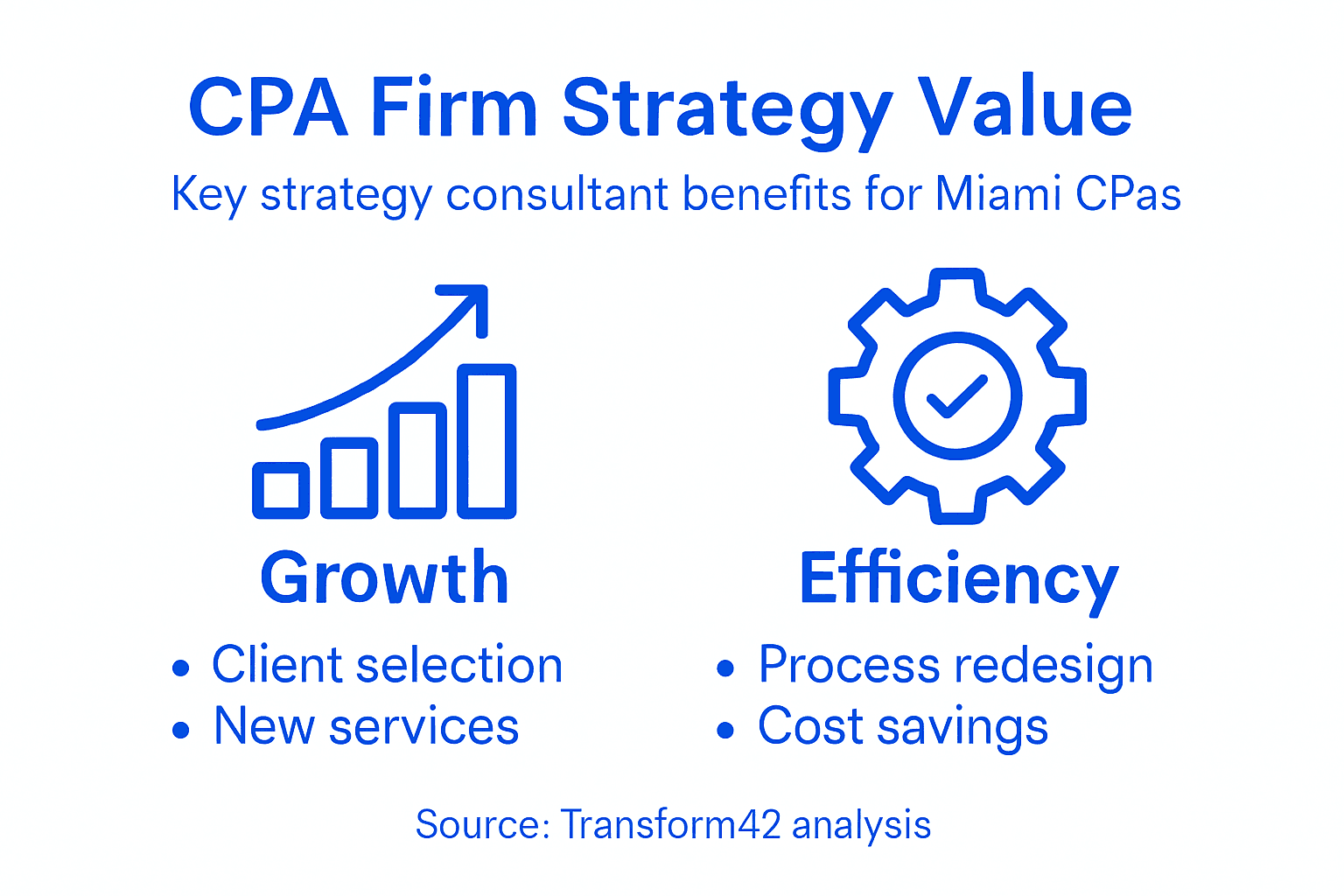
Most Miami CPA firm owners think revenue growth means landing more clients. That’s only half the equation. A strategy consultant knows that sustainable revenue growth comes from a combination of three things: acquiring more profitable clients, maximizing revenue from existing clients, and reducing the cost to deliver services. Many firms get stuck trying to do all three at once without a clear priority. Your consultant helps you understand which lever will have the biggest impact on your bottom line right now. For some firms, it’s improving client selection. For others, it’s restructuring service delivery. For still others, it’s implementing better pricing models that capture the value you’re actually delivering instead of charging by the hour.
The foundation of revenue growth is strategic positioning paired with profitable client selection. Top performing firms don’t chase every client who walks through the door. They’re selective about which clients they pursue based on profitability, fit with their expertise, and growth potential. Your consultant helps you analyze your current client base to identify which clients are generating strong revenue margins and which ones are eating up resources without generating proportional income. They help you define your ideal client profile so you stop pursuing business that doesn’t fit your model. They work with you to redesign your pricing and service delivery around your most profitable client segments. This isn’t about abandoning small clients. It’s about ensuring that every engagement, regardless of size, is structured to be profitable. Many firms discover they’re serving clients at prices that barely cover costs because they never took time to analyze actual delivery costs versus what they’re charging.
Operational efficiency enhancements directly drive profitability without requiring you to bring in new revenue. When a strategy consultant audits your operations, they’re looking for time leaks and process redundancies. They measure how much time your team actually spends on billable work versus administrative tasks. They identify which processes are manual when they could be automated. They map out your service delivery workflows to find steps that don’t add value to the client but consume your team’s time anyway. They analyze your staffing model to see whether you’re deploying talent efficiently. For many Miami CPA firms, the efficiency gains alone translate to 25 to 40 percent more capacity without hiring additional staff. That’s a direct increase in profit margin on every engagement. When efficiency improvements are paired with better client selection and optimized pricing, the revenue impact becomes significant. Firms often add multiple millions in annual profit within 12 to 18 months through operational optimization alone, without growing the team size proportionally.
Strategy consultants also guide firms through bigger structural decisions like mergers and acquisitions, outsourcing arrangements, or service line expansions. These decisions carry more risk than process optimization, so they require a clear decision making framework. Your consultant helps you evaluate whether an acquisition makes sense based on your strategic goals and current operational capacity. They help you determine whether outsourcing specific functions like bookkeeping or tax preparation would improve profitability or create client satisfaction issues. They assess whether adding new service lines would leverage your existing team and client relationships or stretch your resources thin. Consultants provide decision making frameworks that ensure each major decision aligns with your long term revenue goals rather than just addressing short term pressures. For example, a merger might look attractive because it brings in new clients, but if it doesn’t improve your operational efficiency or profitability per employee, it’s not actually a good strategic move. Your consultant helps you see past the surface level numbers to understand the real impact on your firm’s economics.
Pro tip: Calculate your current revenue per full time employee equivalent, then set a specific target for improvement (like increasing it by 30 percent), and use that as your North Star metric for evaluating which operational changes and revenue strategies to prioritize.
Mitigating Risks and Navigating Compliance
Compliance isn’t optional for CPA firms, and neither is risk management. Yet most Miami CPA firms handle these two areas reactively instead of strategically. You comply when regulators require it. You manage risks when something goes wrong. A strategy consultant flips this approach on its head by building proactive compliance and risk management into your operations from the ground up. This isn’t just about avoiding fines or regulatory sanctions. It’s about structuring your firm so that compliance actually becomes a competitive advantage rather than a burden. When you’re managing compliance and risk strategically, you’re building client trust, protecting your reputation, and creating operational efficiency at the same time.
The compliance landscape for accounting firms is complicated and constantly changing. You’re dealing with IRS regulations, state licensing requirements, professional standards, data privacy laws, and client specific compliance obligations. Add in the complexity of different client industries and jurisdictions, and the compliance burden multiplies. A strategy consultant helps you build a compliance framework that covers all your bases without creating unnecessary bureaucracy. They help you implement automation in accounting compliance processes so that compliance requirements are built into your workflows rather than treated as separate checkboxes. They establish documentation systems that prove you’re following professional standards. They create review processes that catch issues before they become problems. They set up monitoring systems that alert you when regulations change in your key practice areas. For Miami firms serving diverse client populations with varying compliance needs, this systematic approach prevents the chaos of everyone doing compliance their own way.
Risk management for strategy consultants goes beyond just compliance. It includes operational risks like key person dependencies, technology vulnerabilities, and service delivery gaps. It includes business risks like client concentration, pricing pressure, and talent retention. It includes strategic risks like market shifts that make your current service offerings less relevant. Your consultant helps you identify which risks could actually impact your firm’s ability to operate and generate revenue. They help you prioritize which risks to address first based on likelihood and potential impact. They help you design mitigation strategies that reduce risk without paralyzing your ability to grow. For example, if your firm is too dependent on one partner to serve your biggest clients, that’s a major operational risk. Your consultant helps you document that person’s client relationships, train other team members, and restructure client accounts so the firm isn’t vulnerable if that person leaves. If you’re overly dependent on one client for a large percentage of revenue, that’s a business risk. Your consultant helps you develop strategies to diversify your client base and increase revenue from other sources.
What makes risk and compliance work effective is integrating it with your business strategy rather than treating it as separate. Many firms create compliance procedures that actually slow down client service or make it harder to serve clients profitably. A strategy consultant ensures that your compliance framework enables business rather than inhibiting it. They help you understand that risk management best practices actually improve your ability to deliver consistent quality to clients. They help you see that building strong documentation systems creates efficiency, not overhead. They help you recognize that managing key person risks actually frees up time for partners because other team members can handle more client work independently. When risk and compliance are properly integrated with your business operations, they become invisible to your clients while protecting your firm. That’s the mark of truly strategic risk and compliance management.
Pro tip: Document your three biggest operational and business risks right now, assign a probability and potential impact to each one, then prioritize which risk mitigation strategy will have the biggest impact on your firm’s revenue and stability in the next 12 months.
Common Misconceptions and Pitfalls to Avoid
When CPA firm owners first consider hiring a strategy consultant, they often get stuck in misconceptions that prevent them from taking action. The most dangerous misconception is that strategy consulting is a luxury expense for large firms with excess cash. This couldn’t be further from the truth. Firms at every size benefit from strategic guidance, and smaller firms often see bigger percentage improvements because every operational gain compounds faster. Another common misconception is that a consultant will come in and immediately tell you exactly what to do. Real strategy consulting is a collaborative process where the consultant asks tough questions, helps you analyze your situation, and then guides you toward decisions that fit your specific firm. If a consultant walks in with a one size fits all playbook, they’re not doing strategy work. They’re just selling a packaged solution.
One major pitfall to avoid is hiring a consultant and then not implementing their recommendations because they require uncomfortable changes. Strategy consultants often recommend things like restructuring client relationships, eliminating unprofitable service lines, or changing compensation models. These recommendations make sense logically, but they feel risky emotionally because they require letting go of business you’re used to. The firms that see the best results are the ones willing to make these uncomfortable changes. The firms that struggle are the ones that listen to the recommendations but keep doing things the old way. If you’re going to hire a consultant, commit to actually implementing what you learn. Otherwise you’re just paying for an expensive audit that changes nothing. Another pitfall is expecting results too quickly. Meaningful change in a CPA firm typically takes 6 to 12 months to fully implement and show measurable impact. If you’re looking for quick wins, you’ll be disappointed. If you’re looking for sustainable transformation, strategy consulting delivers.
Many firms also make the mistake of treating strategy consulting as separate from their day to day operations. They work with a consultant for a few months, get a report full of recommendations, and then go back to running the firm the same way they always have. The real value comes when strategic thinking becomes embedded in how you run your firm. This means regular review of your key metrics. It means making hiring and service line decisions based on strategic priorities rather than just filling immediate needs. It means having honest conversations about which clients are actually profitable. It means being willing to say no to business that doesn’t fit your strategy. Understanding the role of consulting services in accounting reveals that the most successful engagements are those where the consultant helps the firm develop its own strategic thinking capability rather than just dictating what to do. After the consultant leaves, your leadership team should be able to make strategic decisions more effectively than before.
A final pitfall is failing to communicate your strategic direction to your team. If you work with a consultant and develop a clear strategy but don’t help your team understand why changes are happening, you’ll face resistance and resentment. Your team members are smart. They want to know why you’re restructuring client relationships or investing in new technology or changing compensation models. When you explain the logic and connect it to outcomes like better work life balance or higher revenue per person, they understand and support the changes. When you just announce changes without context, they assume it’s arbitrary and fight back. The firms that implement strategic changes successfully are the ones where leadership is transparent about the reasoning and outcomes.
Pro tip: Before hiring a consultant, be honest with yourself about your willingness to make uncomfortable changes, and set specific metrics upfront for what success looks like so you can measure whether the consulting engagement actually delivered value for your firm.
Unlock Strategic Growth for Your Miami CPA Firm with Transform42
Miami CPA firms face the challenge of balancing complex compliance, operational bottlenecks, and the need for scalable growth. If you’re struggling with inefficiencies, technology integration issues, or attracting profitable clients, strategic consulting paired with tailored technology solutions can transform your practice. Our experts understand your industry dynamics and can help you streamline processes, enhance leadership capabilities, and optimize your team to reclaim your time and increase revenue.
Explore how aligning your operations with growth objectives through effective Processes and empowered Leadership can make all the difference.
Take the next step toward sustainable growth and operational excellence. Visit Transform42 today to discover how we partner with Miami CPA firms like yours to build the capabilities and compliance your clients expect while helping you land bigger clients and scale without proportional hiring. Don’t wait to reclaim your life and maximize your firm’s potential.
Frequently Asked Questions
What is the difference between traditional CPA services and strategy consulting for CPA firms?
Strategy consulting focuses on growth, efficiency, and competitiveness, while traditional CPA services handle tax, compliance, and bookkeeping tasks. Consultants work on transforming business operations to drive sustainable growth.
How can strategy consultants help improve operational efficiency in CPA firms?
Strategy consultants analyze current workflows to identify inefficiencies, streamline processes, and reduce manual tasks. They implement technology solutions and design organizational structures that improve capacity without proportional staffing increases.
What are the key benefits of hiring a strategy consultant for a CPA firm?
Consultants help CPA firms increase profitability, reclaim management time, and build scalable systems. They provide tailored strategies that align with firm goals and drive measurable outcomes, such as revenue growth and improved client acquisition.
Why should CPA firms invest in technology solutions recommended by a strategy consultant?
Technology solutions are essential for integrating systems and automating processes that save time and reduce errors. Properly implemented technology leads to improved client service, higher revenue per engagement, and a competitive edge in the market.