Every independent CPA in Miami knows that juggling client demands and compliance requirements can quickly turn IT services into a daily headache. The real challenge is not just keeping technology running, but aligning it with your firm’s business goals so every system supports revenue and growth. By applying ITIL service management principles, you move beyond the chaos of ad hoc fixes and start building a framework that increases efficiency, reduces errors, and makes scaling your practice possible.
Table of Contents
- Defining ITIL Service Management Principles
- Core ITIL Processes and Lifecycle Stages
- How ITIL Drives Value for CPA Firms
- Role Clarity and Typical Responsibilities in ITIL
- Risks, Compliance, and Common Missteps for CPAs
Key Takeaways
| Point | Details |
|---|---|
| ITIL Aligns Technology with Business Goals | ITIL provides a framework that ensures technology supports revenue objectives, allowing your practice to grow sustainably. |
| Lifecycle Stages Enhance Operational Efficiency | The five ITIL lifecycle stages create a continuous improvement cycle that optimizes IT operations and boosts client satisfaction. |
| Clear Roles Improve Accountability | Defining roles and responsibilities within ITIL prevents confusion and ensures efficient service delivery in CPA firms. |
| ITIL Reduces Risks and Compliance Issues | Implementing ITIL systematically helps identify and mitigate potential IT risks, protecting against compliance violations and enhancing operational integrity. |
Defining ITIL Service Management Principles
ITIL stands for Information Technology Infrastructure Library, and it’s essentially a playbook for how your IT operations should function. Think of it as a set of best practices that align your technology with your actual business goals, not the other way around. When most CPAs think about IT management, they picture servers and software. What they often miss is that ITIL is really about creating a system where technology serves your practice’s revenue objectives. That distinction matters more than you’d think.
At its core, ITIL provides what amounts to an organizational blueprint. It defines the structural arrangements your firm needs, identifies the specific skills your team requires, and establishes operational procedures that work across all your technology infrastructure. The beauty of ITIL is that these procedures are supplier independent, meaning you’re not locked into specific vendors or platforms. They apply whether you’re using accounting software from one company or another. Understanding the role of IT service management helps you see how this framework directly impacts your bottom line.
What makes ITIL different from random IT advice you might find online is its emphasis on alignment and continuous improvement. You’re not just managing IT for IT’s sake. You’re structuring everything to deliver genuine value through your services, then constantly finding ways to improve that delivery. This is where revenue growth enters the picture. When your IT operations are properly organized using ITIL’s core service management principles, you can land bigger clients who expect professional infrastructure. You can scale your practice without hiring proportionally more staff. Most importantly, you reclaim your time to focus on what you actually enjoy about running your practice.
For independent CPAs in Miami managing multiple client relationships and compliance requirements, ITIL prevents the chaos that kills profitability. Without it, you’re constantly firefighting technology problems. With it, you’re running a systematized operation.
Pro tip: Start by mapping one core business process (like tax preparation or client reporting) and identify exactly which IT services support it—this reveals where ITIL improvements will have the biggest revenue impact.
Core ITIL Processes and Lifecycle Stages
ITIL’s framework is built around five interconnected lifecycle stages that work together like gears in a machine. Each stage serves a specific purpose, and when they work in harmony, your practice runs like a well-oiled operation. The stages are service strategy, service design, service transition, service operations, and continual service improvement. You don’t just implement these once and forget about them. They create a continuous cycle that keeps your IT infrastructure aligned with your business growth.
Let’s break down what actually happens at each stage. Service strategy is where you define what your clients need and what services your firm should offer to meet those needs. This is the planning phase where you think about your competitive advantage and how technology supports it. Service design follows next, taking those strategic goals and actually designing the services that deliver them. Think of this as the blueprint stage. Service transition manages the messy middle part where you move from design to reality, handling all the change management that comes with deploying new systems or upgrading existing ones. Service operations is the day-to-day management where your IT infrastructure actually serves your clients and your team. Finally, continual service improvement means you’re always looking for ways to make things better, faster, and cheaper. This is where CPAs discover they can handle more clients without proportionally more headaches.
When you map ITIL’s five lifecycle stages to your actual business processes, something powerful happens. You stop treating IT as a cost center and start seeing it as a revenue driver. A properly structured service strategy means you know exactly which technology investments generate client satisfaction and retention. Good service design prevents the chaos of ad hoc implementations. Smooth service transitions mean less downtime during critical periods like tax season. Well-managed service operations reduce errors and client complaints. Digital transformation through detailed scrutiny of business process management metrics shows you where your processes create bottlenecks that kill profitability.

The real benefit for independent CPAs is that this lifecycle approach removes the guesswork. You’re not making decisions based on what some IT vendor wants to sell you. You’re making decisions based on what your business needs at each stage. You measure success at every step. You have visibility into what’s working and what isn’t. That visibility translates directly into the ability to scale your practice and increase revenue without burning out.
Pro tip: Identify which lifecycle stage your practice currently skips or handles poorly, then focus improvement efforts there first because the biggest revenue gains come from fixing the weakest link in your service lifecycle.
Here’s how ITIL lifecycle stages align with common CPA firm objectives:
| ITIL Stage | Main Focus | CPA Business Objective | Typical Outcome |
|---|---|---|---|
| Service Strategy | Define services and value | Match client needs | Improved client retention |
| Service Design | Create service blueprints | Ensure consistency and quality | Fewer errors and risks |
| Service Transition | Manage changes and deployments | Minimize disruptions during upgrades | Less downtime |
| Service Operations | Deliver daily IT services | Support ongoing client work | Faster issue resolution |
| Continual Service Improvement | Optimize processes | Increase efficiency and scalability | Sustainable growth |
How ITIL Drives Value for CPA Firms
Here’s what happens when a CPA firm implements ITIL properly. Your IT services stop being a constant source of headaches and start becoming a competitive weapon. Instead of your team spending hours troubleshooting software crashes or dealing with security breaches, they focus on client work that actually generates revenue. That shift alone changes your bottom line. When your IT infrastructure is structured around ITIL principles, you deliver consistent service quality that clients notice and appreciate. They trust you more. They stay longer. They refer other businesses to you. That’s how ITIL directly fuels revenue growth.
The real power of ITIL for CPA firms comes from alignment. Your IT services are no longer disconnected from your business strategy. Instead, every technology decision supports your firm’s goals, whether that’s handling more clients, improving accuracy, or reducing compliance risk. ITIL’s structured framework enables delivering consistent service quality while managing the risks that keep you awake at night. When your operations are transparent and measured, you see exactly where money is being wasted on technology that doesn’t serve clients. You see where investments generate real returns. You stop making IT decisions based on what sounds good and start making them based on data.
Consider what happens operationally. Your clients expect professional infrastructure. If your systems are unreliable, they move their business to someone else. If your processes are manual and error prone, they notice increased costs in their own services. If you can’t scale without hiring three new people for every new client, you hit a ceiling that caps your revenue. ITIL prevents all of this by creating repeatable, measurable processes. It helps you align IT and business goals while reducing operational costs, which directly improves your competitive position. You can land bigger clients who demand professional IT management. You can scale without proportional hiring. You can reclaim your life because your practice isn’t constantly on fire.
For independent CPAs in Miami competing against larger firms and national providers, ITIL gives you the operational maturity of a much larger organization without the bloat. Your clients get enterprise level service management. You get the efficiency gains that come with systematized operations. That combination is how you grow from managing 30 clients to managing 100 while actually enjoying the process.
Pro tip: Measure one critical metric right now, like average time to resolve a client issue or number of system outages per quarter, then implement ITIL practices specifically targeting that metric because the fastest path to revenue growth is fixing your biggest operational pain point first.
Role Clarity and Typical Responsibilities in ITIL
One of the biggest problems CPAs face with IT management is confusion about who does what. Someone’s email gets hacked and nobody knows if it’s the IT person’s job to prevent it, the manager’s job to respond, or everyone’s shared responsibility. Work gets duplicated. Critical tasks fall through cracks. Accountability disappears. ITIL solves this by defining specific roles with clear responsibilities. When everyone knows exactly what they own and who they answer to, things actually get done.
ITIL defines several key roles that map to real people in your organization. The Service Owner is responsible for a specific service from end to end, making sure it delivers value and meets client expectations. The Process Owner manages a specific process like incident management or change management, ensuring it runs smoothly and improves over time. The Service Manager coordinates across multiple services and processes to deliver the overall service portfolio. Think of it like this: the Service Owner owns the tax preparation service and makes sure clients are happy. The Process Owner owns the change management process and makes sure changes happen safely. The Service Manager makes sure all services work together without conflicts. ITIL defines specific roles like Service Owner and Process Owner with clear accountability for different aspects of service delivery. This structure prevents the chaos where everyone assumes someone else is handling something critical.
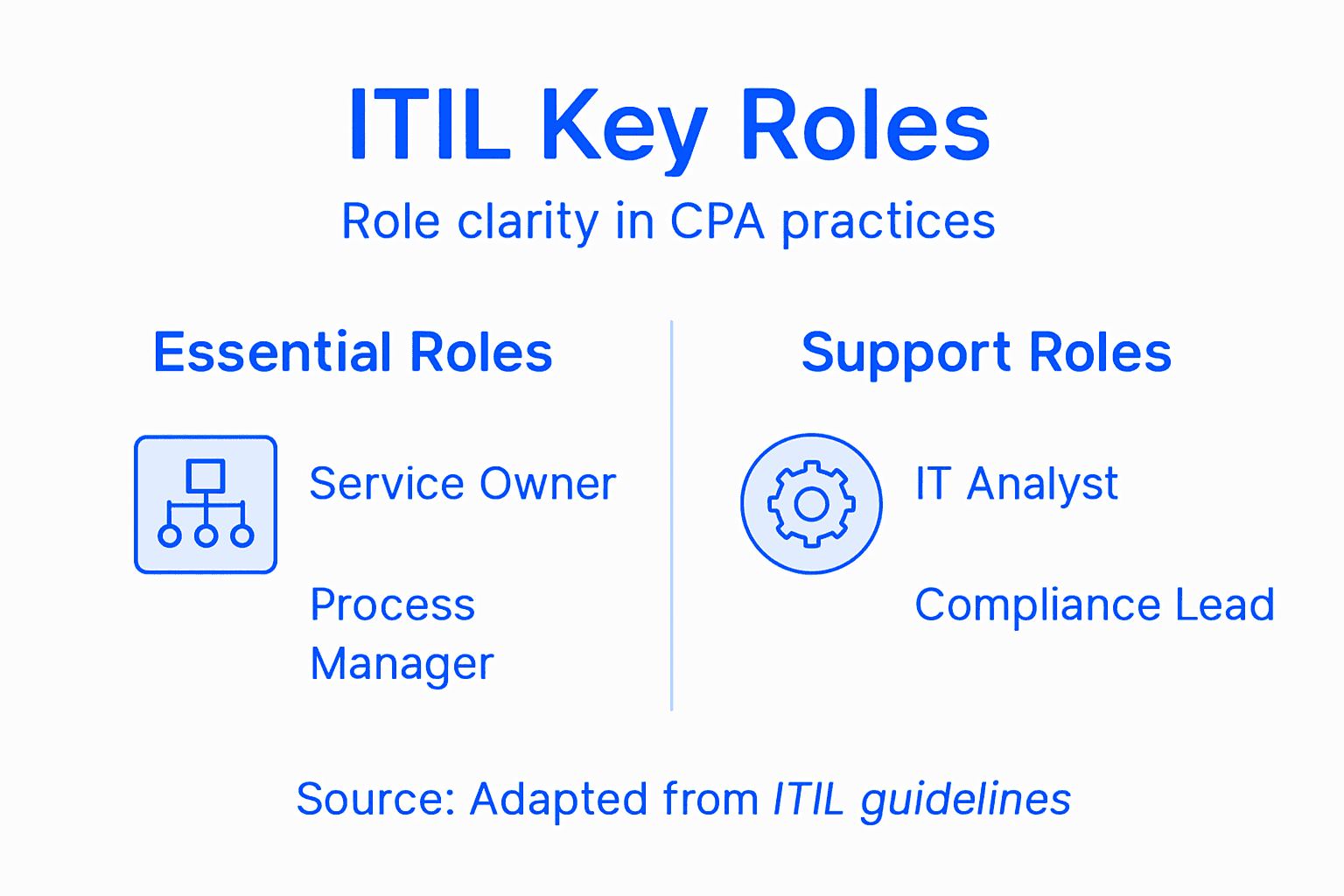
What matters for your practice is that roles detail responsibilities and accountabilities within processes, creating organized and efficient service delivery. You don’t need a massive IT department to make this work. In a smaller CPA firm, one person might hold multiple roles. Your office manager could be the Service Owner for client communication systems. Your lead accountant could be the Service Owner for accounting software. Someone designated could be the Process Owner for change management. What matters is that people know what they’re accountable for and what authority they have to make decisions.
Without this clarity, your practice bleeds money and goodwill. A client calls with an urgent tax question and can’t reach anyone because nobody knew they were supposed to be monitoring email that day. A critical software update fails because nobody had authority to approve it. A security issue gets discovered and nobody knew who to report it to. With ITIL role clarity, everyone knows their job. Decisions get made faster. Clients get better service. Your team doesn’t waste time arguing about who’s responsible for what. That clarity directly improves your profitability because you’re no longer paying people to figure out their own job descriptions.
Pro tip: Create a simple one-page document right now listing three to five key ITIL roles that apply to your firm, assign actual people to each role, and define one specific accountability per role—this removes ambiguity that costs you revenue every single day.
Risks, Compliance, and Common Missteps for CPAs
CPAs operate in a world where mistakes cost money and destroy reputations. A single data breach exposes client information. A compliance violation triggers audits and penalties. A failed system during tax season means lost revenue and angry clients. Yet many CPAs implement IT management haphazardly, creating more risk than protection. They rely on manual processes instead of automated systems. They have no visibility into what’s actually happening in their technology infrastructure. They don’t manage changes properly, so updates break critical systems. These aren’t just operational annoyances. They’re compliance violations waiting to happen. ITIL prevents these missteps by forcing you to think systematically about risk instead of hoping nothing goes wrong.
The biggest risk CPAs face is inadequate risk assessment. You don’t know what could fail because you never documented the dependencies in your systems. You don’t know who has access to sensitive data because nobody maintained an access control list. You don’t have evidence that you’re following compliance requirements because your processes aren’t documented. Key IT risks for CPAs include inadequate risk assessment and lack of proper controls. When an auditor asks to see your controls, you can’t produce evidence because nothing was recorded. When a client asks if their data is secure, you can only guess. These knowledge gaps create regulatory exposure that regulators love to find.
Common ITIL implementation mistakes make this worse instead of better. CPAs try to implement ITIL without automating workflows, so people still manage everything manually. They lack transparency into what’s actually happening, so problems don’t surface until they become crises. They fail to align ITIL processes with their actual business and compliance requirements, treating it like a checkbox exercise instead of a genuine operational improvement. Common missteps in ITIL implementation include reliance on manual processes and lack of transparency. They implement change management but don’t enforce it, so people bypass the process when they’re in a hurry. They build IT service management in isolation from their compliance strategy, creating a situation where neither part works properly. Understanding IT risk management principles helps you see how ITIL reduces the exact risks that keep regulators and clients concerned about your firm.
The antidote is implementing ITIL deliberately with compliance at the center. Document your processes so you know what depends on what. Automate workflows so manual errors disappear. Establish who has access to what data and audit it regularly. Create change management procedures and actually follow them. Make your IT management transparent so you can see problems coming before they arrive. Track evidence of your controls so auditors find proof of compliance instead of evidence of negligence. These steps cost time upfront but save enormous amounts of money, stress, and risk down the road.
Pro tip: Conduct a one-hour risk assessment right now identifying three specific things that could go wrong in your IT systems, then create one simple control to address the highest risk—this turns vague compliance anxiety into concrete, manageable action.
Compare common IT risks for CPAs and how ITIL helps address each:
| CPA IT Risk | Typical Consequence | ITIL Mitigation Approach |
|---|---|---|
| Inadequate risk assessment | Compliance violations | Systematic documentation and reviews |
| Lack of proper access controls | Data breaches | Defined roles and audit trails |
| Manual IT management | Frequent errors and waste | Automated workflows and monitoring |
| Poor change management | System failures and outages | Structured change procedures |
| Limited transparency | Undetected issues escalate | Regular reporting and measurement |
Transform Your CPA Practice with Strategic ITIL Implementation
Managing IT the right way is essential for CPAs aiming to grow revenue, reduce operational chaos, and deliver consistent client service. If you struggle with unclear IT roles, frequent system outages, or costly manual processes described in the ITIL framework, you are not alone. Aligning your IT services with clear processes and business objectives can unlock efficiency and scale without adding staff. Key pain points like risk management, service consistency, and compliance demand a trusted partner to help you navigate the complexity.
Elevate your firm today with expert guidance from Transform42. We specialize in helping Miami CPAs implement ITIL principles to build professional, scalable, and compliant IT infrastructures that land bigger clients and reclaim your valuable time. Discover how understanding the role of IT service management and applying digital transformation through business process management can turn your technology from a headache into a strategic advantage. Start building the capabilities and compliance your clients expect with all your technology in one partner and take the first step toward sustainable revenue growth now.
Frequently Asked Questions
What is ITIL in the context of CPA firms?
ITIL, or Information Technology Infrastructure Library, is a set of best practices designed to align IT services with business goals, enhancing the efficiency and effectiveness of IT operations within CPA firms.
How can ITIL drive revenue growth for CPA firms?
By implementing ITIL principles, CPA firms can improve service quality, reduce operational costs, and enhance client satisfaction, all of which can lead to increased revenue through client retention and acquiring new clients.
What are the core lifecycle stages of ITIL service management?
The core ITIL lifecycle stages include service strategy, service design, service transition, service operations, and continual service improvement, each serving to optimize IT service delivery and alignment with business objectives.
How does ITIL framework help in risk management for CPA firms?
ITIL promotes systematic documentation, established access controls, and structured change management processes, which collectively enhance visibility, improve compliance, and mitigate risks associated with IT management.