Protecting confidential client data is now a firmwide priority for Miami CPAs, as cybersecurity oversight has evolved into a leadership responsibility. With new regulations and frameworks including the updated National Institute of Standards and Technology Cybersecurity Framework, every independent CPA faces the challenge of aligning technical controls with organizational strategy. This guide highlights how effective IT security governance ensures robust data protection, regulatory compliance, and a proactive culture of cybersecurity accountability across your practice.
Table of Contents
- IT Security Governance Defined for CPAs
- Key Frameworks and Governance Models
- Legal and Regulatory Requirements in Miami
- Role-Based Responsibilities and Firmwide Obligations
- Common Pitfalls and Practical Security Solutions
Key Takeaways
| Point | Details |
|---|---|
| Strategic Importance of IT Security Governance | IT security governance should be viewed as a business priority, requiring involvement from firm leadership to effectively protect sensitive financial data. |
| Integration of Cybersecurity Frameworks | CPA firms should adopt comprehensive governance frameworks like COSO, COBIT, and CIS Controls to strengthen their cybersecurity strategies. |
| Role-Based Accountability | Clearly defined responsibilities at all organizational levels are essential to create a culture of security and ensure effective protection of client data. |
| Continuous Training and Policy Updates | Ongoing employee training and regular updates to security policies are crucial for adapting to evolving cyber threats and maintaining compliance. |
IT Security Governance Defined for CPAs
IT security governance represents a strategic approach that transforms cybersecurity from a technical function into a critical business priority for Miami CPA firms. At its core, this framework establishes systematic processes to protect sensitive financial data while aligning technological controls with organizational objectives.
The National Institute of Standards and Technology (NIST) provides a comprehensive blueprint for understanding security governance, which emphasizes three fundamental components:
- Leadership accountability for cybersecurity strategy
- Risk management integration across organizational levels
- Continuous policy development and improvement
Under the updated NIST Cybersecurity Framework, governance is no longer just an IT department responsibility. Instead, it requires active participation from firm leadership to establish clear security expectations, define risk tolerance, and create robust protective mechanisms for client information.
CPA firms must recognize that effective security governance goes beyond technical controls. It involves creating a culture of security awareness, implementing comprehensive policies, and ensuring that every team member understands their role in maintaining data protection. This means developing clear protocols for data handling, establishing incident response procedures, and regularly training staff on emerging cybersecurity threats.
Cybersecurity Accountability becomes a firm-wide commitment, not just a technical checkbox. Leadership must actively demonstrate their commitment to protecting client data by:
- Establishing clear security responsibilities
- Allocating appropriate resources for protection
- Regularly reviewing and updating security strategies
- Promoting a proactive security mindset across the organization
Pro tip: Conduct quarterly security governance reviews to ensure your CPA firm’s protective strategies remain current and comprehensive.
Key Frameworks and Governance Models
CPA firms navigating the complex landscape of IT security must understand the critical governance frameworks that provide structured approaches to managing technological risks. These frameworks serve as comprehensive blueprints for establishing robust cybersecurity strategies that protect sensitive financial data and ensure regulatory compliance.
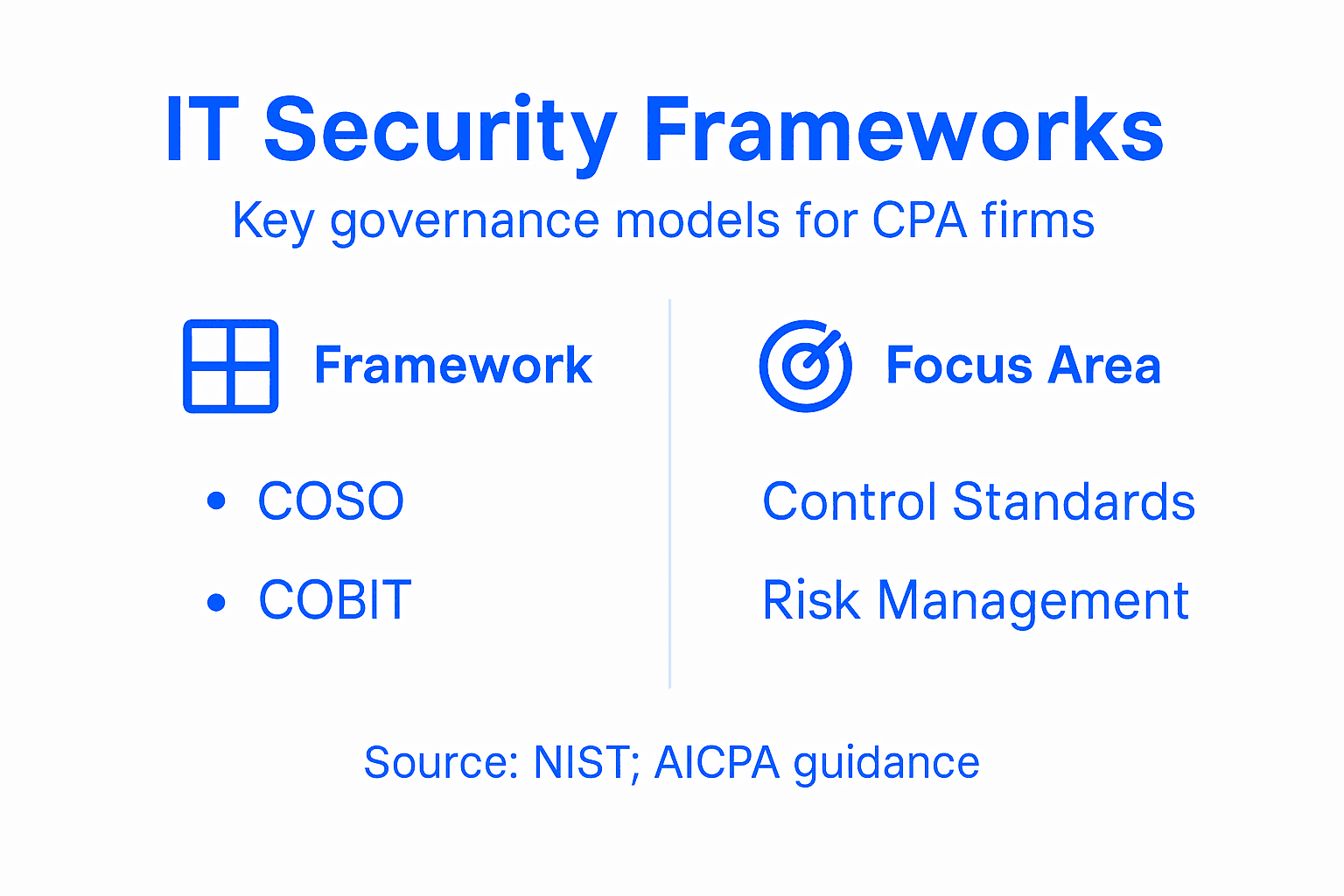
The AICPA Information Systems and Controls Blueprint integrates multiple essential governance models, including:
- COSO (Committee of Sponsoring Organizations)
- COBIT (Control Objectives for Information and Related Technologies)
- ITIL (Information Technology Infrastructure Library)
- PCI DSS (Payment Card Industry Data Security Standard)
Each framework contributes unique perspectives to creating a holistic approach to IT security governance. COSO focuses on internal controls and risk management, COBIT provides detailed IT governance guidelines, ITIL emphasizes service management, and PCI DSS offers specific security standards for financial transactions.
Cybersecurity Control Standards play a crucial role in defining organizational security postures. The Center for Internet Security (CIS) Controls v8.1 provides a prioritized set of actions that help organizations defend against the most prevalent cyber attacks. These controls enable CPA firms to systematically address vulnerabilities and establish a proactive security approach.
Implementing these frameworks requires more than technical implementation. It demands a strategic approach that aligns technological controls with business objectives, creating a comprehensive security ecosystem that protects client data while maintaining operational efficiency.
Here’s a summary on how major IT security governance frameworks differ in their approach to CPA firm cybersecurity:
| Framework Name | Primary Focus | Business Benefit | Implementation Challenge |
|---|---|---|---|
| COSO | Risk assessment & controls | Enhances audit and oversight | Requires firmwide risk awareness |
| COBIT | IT governance guidelines | Aligns IT with goals | Demands continuous policy updates |
| ITIL | Service management processes | Streamlines process efficiency | Needs staff training investment |
| PCI DSS | Payment security standards | Protects transaction data | Ongoing compliance monitoring needed |
| CIS Controls | Actionable security practices | Reduces vulnerability exposure | Prioritizing controls for resources |
Pro tip: Develop a cross-framework implementation strategy that combines best practices from multiple governance models to create a comprehensive, adaptive security approach.
Legal and Regulatory Requirements in Miami
Navigating the complex landscape of legal and regulatory requirements is crucial for Miami CPA firms seeking to maintain robust cybersecurity protocols and protect sensitive client information. Regulatory compliance has become increasingly sophisticated, demanding comprehensive and proactive approaches to data protection and security management.
Data security mandates for Miami CPA firms encompass multiple critical regulatory frameworks:
- Securities and Exchange Commission (SEC) cybersecurity rules
- Updated Safeguards Rule effective June 2023
- Florida state-specific data protection regulations
- Federal Trade Commission (FTC) information security guidelines
The SEC’s recent cybersecurity regulations require CPA firms to develop and maintain comprehensive information security programs that include:
- Annual cyber risk assessments
- Documented security protocols
- Appropriate client data protection mechanisms
- Regular vulnerability monitoring
Compliance Documentation represents a critical aspect of meeting legal requirements. Miami CPA firms must develop meticulous records demonstrating their commitment to protecting client information, including detailed risk management strategies, incident response plans, and ongoing security improvement protocols.

Understanding these regulatory requirements goes beyond mere technical compliance. It represents a fundamental commitment to maintaining client trust, protecting sensitive financial information, and demonstrating professional responsibility in an increasingly complex digital landscape.
Pro tip: Conduct quarterly comprehensive compliance audits to ensure your CPA firm remains current with evolving legal and regulatory security requirements.
Role-Based Responsibilities and Firmwide Obligations
Cybersecurity governance in Miami CPA firms requires a strategic approach to defining role-based responsibilities that create a comprehensive and integrated security ecosystem. Each organizational level plays a critical part in maintaining robust information protection and risk management strategies.
Cybersecurity governance demands clear accountability across multiple organizational layers:
- Board of Directors: Strategic oversight and risk approval
- Executive Leadership: Policy implementation and resource allocation
- IT Department: Technical execution and security infrastructure
- Staff Members: Awareness and compliance with security protocols
The AICPA Information Systems and Controls (ISC) framework outlines specific responsibilities for each organizational tier:
- Leadership Governance Responsibilities
- Operational Security Roles
- Workforce Cybersecurity Awareness
- Continuous Monitoring and Reporting
Firmwide Obligations extend beyond individual role assignments. CPA firms must create a culture of security that integrates proactive risk management, continuous training, and collaborative accountability across all departments.
Effective cybersecurity governance requires more than just technical controls. It demands a holistic approach where every team member understands their role in protecting sensitive client information and maintaining the firm’s professional integrity.
Role clarity ensures cybersecurity is everyone’s responsibility. Here is how different positions contribute to firmwide protection:
| Organizational Role | Main Security Responsibility | Impact on Firmwide Security |
|---|---|---|
| Board of Directors | Sets risk appetite | Drives strategic priorities |
| Executive Leadership | Allocates resources | Ensures policy enforcement |
| IT Department | Manages technical controls | Prevents breaches and downtime |
| Staff Members | Follows security procedures | Maintains daily data protection |
Pro tip: Develop a comprehensive role-based security training program that clearly defines responsibilities and expectations for each organizational level.
Common Pitfalls and Practical Security Solutions
Miami CPA firms face numerous cybersecurity challenges that can compromise their client data and professional reputation. Understanding these common vulnerabilities is the first step toward developing a robust, proactive security strategy that protects sensitive financial information.
Data security practices reveal critical pitfalls that CPA firms must address:
- Underestimating evolving cyber risks
- Inadequate documentation of security practices
- Limited employee cybersecurity training
- Outdated or static security policies
- Inconsistent compliance monitoring
Practical security solutions require a multi-layered approach that goes beyond basic technical controls:
- Conduct comprehensive risk assessments
- Implement multi-factor authentication
- Develop ongoing staff training programs
- Create adaptive security policies
- Establish incident response protocols
Cybersecurity Resilience demands more than just technological solutions. CPA firms must cultivate a security-aware culture where every team member understands their role in protecting client data and maintaining the firm’s professional integrity.
The most effective security strategies integrate continuous improvement, regular vulnerability assessments, and a proactive approach to emerging technological threats. This means staying current with regulatory changes, investing in advanced security technologies, and maintaining a flexible, responsive security governance framework.
Pro tip: Implement a quarterly security review process that includes technical assessments, policy updates, and comprehensive staff training to maintain a dynamic and robust cybersecurity posture.
Strengthen Your Miami CPA Firm’s Cybersecurity Governance Today
IT security governance is a critical focus for Miami CPA firms aiming to safeguard sensitive client data and comply with evolving regulations. If you are concerned about leadership accountability, risk management, or creating a firmwide culture of security awareness, you are not alone. Many firms struggle with integrating frameworks like NIST, COSO, and CIS Controls while ensuring continuous policy updates and comprehensive staff training.
Partnering with a trusted strategic IT consulting firm can help you overcome these challenges. At Transform42, we specialize in empowering accountants with unified technology solutions that build robust security postures and align IT governance with your business goals. Explore our tailored insights on Security and GRC to see how we translate complex frameworks into manageable actions.
Take control of your firm’s cybersecurity governance now. Visit Transform42 to discover how we help Miami CPA firms land bigger clients, scale confidently without adding excessive staff, and reclaim your peace of mind by meeting all compliance demands effortlessly.
Frequently Asked Questions
What is IT security governance for CPA firms?
IT security governance is a strategic framework that transforms cybersecurity from a technical function into a critical business priority, protecting sensitive financial data and aligning technological controls with organizational goals.
Why is cybersecurity accountability important in CPA firms?
Cybersecurity accountability ensures that all levels of the organization are committed to protecting client data, establishing clear security responsibilities, and promoting a culture of security awareness throughout the firm.
What role do governance frameworks play in managing cybersecurity risks?
Governance frameworks, such as COSO or COBIT, provide structured approaches to manage technological risks, offering guidance on internal controls, IT governance, and compliance with security standards to safeguard sensitive financial information.
How can CPA firms ensure compliance with legal and regulatory requirements?
CPA firms can ensure compliance by developing comprehensive information security programs that include annual risk assessments, documented security protocols, and meticulous records demonstrating their commitment to data protection.