
Every Independent CPA and Tax Attorney in Miami faces the challenge of scaling revenue while maintaining strong client relationships. Focusing on core strengths gets harder when administrative and support functions demand constant attention. By integrating Business Process Services, professionals can outsource non-critical tasks, simplify operations, and position themselves for 7 to 8 figures in monthly revenue growth. This guide clarifies BPS fundamentals, explores outsourcing types, and shares actionable strategies for transforming efficiency into measurable financial success.
Table of Contents
- What Are Business Process Services?
- Core Types Of Process Outsourcing
- How BPS Drives Revenue For CPAs
- Compliance, Security, And Regulatory Factors
- Cost, Risk, And Common Pitfalls
Key Takeaways
| Point | Details |
|---|---|
| Business Process Services (BPS) Optimize Efficiency | BPS allows organizations to outsource non-core functions, reducing costs and improving operational focus on primary business objectives. |
| Types of Outsourcing Tailored Solutions | Understanding the various outsourcing types helps organizations select the right model to meet specific operational needs and maximize efficiency. |
| Technological Integration Drives Growth | Modern businesses must leverage advanced technologies like AI for improved service delivery and increased efficiency in operations. |
| Strategic Risk Management is Essential | Effective risk management involves identifying potential pitfalls and implementing strategies to mitigate financial and operational risks. |
What Are Business Process Services?
Business Process Services (BPS) represent a strategic approach where organizations outsource specific non-core business functions to specialized third-party providers. By leveraging external expertise, companies can focus their internal resources on primary business objectives while maintaining operational efficiency.
Typical BPS functions encompass critical administrative and support areas such as:
- Accounting and financial management
- Human resources administration
- Payroll processing
- Customer service operations
- Marketing support
- Sales administration
- Information technology services
The core purpose of Business Process Services is transforming traditional operational models. Instead of managing every internal function, companies can strategically delegate specialized tasks to experts who can execute them more efficiently and cost-effectively. This approach allows organizations to reduce overhead expenses, access advanced technological capabilities, and redirect strategic focus toward core competencies.
Efficiency becomes the primary driver when implementing Business Process Services. Organizations gain multiple advantages by outsourcing non-critical functions, including:
- Reduced operational costs
- Access to specialized talent
- Improved process standardization
- Enhanced scalability
- Faster technological adaptation
Pro tip: Carefully evaluate potential BPS providers by examining their track record, technological capabilities, and alignment with your specific business requirements.
Core Types of Process Outsourcing
Business process outsourcing represents a complex landscape of strategic service delivery, with multiple approaches designed to meet diverse organizational needs. Outsourcing strategies vary widely depending on specific business requirements and operational contexts.
The primary categories of process outsourcing can be comprehensively classified into several key types:
- Business Process Outsourcing (BPO)
- Front-Office BPO (client-facing services)
- Back-Office BPO (internal support processes)
- Information Technology Outsourcing
- Offshore Outsourcing
- Nearshore Outsourcing
- Project-Based Outsourcing
Each outsourcing type offers unique advantages and challenges. Front-Office BPO typically involves customer-facing functions like sales support, technical support, and marketing coordination. Back-Office BPO concentrates on internal operational processes such as accounting, human resources, and administrative management.
To clarify the different types of process outsourcing, here is a side-by-side comparison of their focus and use cases:
| Outsourcing Type | Main Focus | Typical Use Case |
|---|---|---|
| Front-Office BPO | Customer interaction | Sales or technical support |
| Back-Office BPO | Internal operations | Payroll or HR management |
| Information Technology | Technology services | Software development |
| Offshore Outsourcing | Cost-efficient regions | Large-scale support centers |
| Nearshore Outsourcing | Regional proximity | Time zone-aligned support |
| Project-Based Outsourcing | Temporary initiatives | Short-term IT implementation |
Strategic considerations play a crucial role in selecting appropriate outsourcing models. Organizations must carefully evaluate their specific needs, potential cost savings, technological capabilities, and long-term business objectives before committing to any outsourcing strategy.
Successful outsourcing requires a comprehensive understanding of your organization’s core competencies and potential external service provider capabilities.
Technological integration remains a critical factor in modern process outsourcing. Companies increasingly seek providers who can seamlessly blend advanced technological solutions with traditional service delivery models, ensuring efficiency and scalability.

Pro tip: Conduct a thorough vendor assessment that includes technological capabilities, industry reputation, and alignment with your specific business processes before finalizing any outsourcing partnership.
How BPS Drives Revenue for CPAs
Business Process Services offer strategic pathways for CPAs to transform traditional revenue models and unlock unprecedented growth opportunities. CPA firms are reporting significant revenue gains by leveraging advanced service delivery approaches that extend beyond conventional accounting practices.
Key revenue enhancement strategies through Business Process Services include:
- Client Advisory Expansion
- Providing strategic financial guidance
- Offering predictive financial analysis
- Developing comprehensive business strategy support
- Technology-Enabled Service Delivery
- Implementing AI-driven insights
- Automating complex financial processes
- Enhancing reporting capabilities
- Value-Based Pricing Models
- Moving beyond hourly billing
- Creating fixed-price service packages
- Demonstrating tangible client value
Technological integration represents a critical driver of revenue growth for modern CPAs. By adopting advanced automation and artificial intelligence technologies, accounting professionals can dramatically increase service efficiency while simultaneously creating higher-value client interactions.
Successful CPAs view Business Process Services not as cost centers, but as strategic revenue generation platforms that transform traditional accounting practices.
Strategic service diversification enables CPAs to capture additional market segments and develop more comprehensive client relationships. This approach allows accounting professionals to transition from transactional service providers to strategic business partners who deliver measurable financial insights and operational improvements.
Pro tip: Invest in continuous technological education and develop a service model that emphasizes strategic advisory capabilities rather than traditional compliance-based offerings.
Compliance, Security, and Regulatory Factors
Navigating the complex landscape of compliance requires sophisticated strategies that go beyond traditional risk management approaches. Compliance management involves systematically addressing legal and regulatory requirements through integrated technological and procedural frameworks.
Key compliance and security considerations for CPAs include:
- Regulatory Framework Management
- Understanding industry-specific regulations
- Implementing comprehensive control mechanisms
- Maintaining audit trail documentation
- Data Protection Strategies
- Encrypting sensitive financial information
- Establishing secure data transmission protocols
- Implementing multi-factor authentication
- Risk Mitigation Techniques
- Conducting regular compliance assessments
- Developing proactive risk management strategies
- Creating contingency response plans
Technological integration plays a critical role in modern compliance strategies. Advanced software solutions enable real-time monitoring, automated reporting, and seamless adaptation to changing regulatory landscapes, allowing CPAs to maintain robust compliance infrastructures.
Effective compliance is not about avoiding penalties, but about creating a culture of transparency, accountability, and continuous improvement.
Strategic compliance frameworks require CPAs to develop holistic approaches that align technological capabilities with regulatory expectations. This involves creating flexible systems that can quickly adapt to emerging regulatory requirements while maintaining operational efficiency and client trust.
Pro tip: Invest in comprehensive compliance training and leverage technology-driven solutions that provide real-time regulatory insights and automated compliance tracking.
Cost, Risk, and Common Pitfalls
Business Process Services demand strategic financial management and risk mitigation to ensure sustainable implementation. Cost management remains a critical aspect of process optimization that requires sophisticated financial analysis and ongoing evaluation.
Common risks and pitfalls in Business Process Services include:
- Financial Risks
- Unexpected implementation costs
- Hidden technological investment requirements
- Potential revenue disruption during transition
- Operational Challenges
- Process complexity
- Resistance to technological change
- Insufficient stakeholder engagement
- Strategic Implementation Risks
- Misalignment with organizational goals
- Inadequate performance measurement
- Limited scalability of processes
Technological complexity significantly impacts cost and risk management strategies. CPAs must develop comprehensive frameworks that balance technological innovation with financial prudence, ensuring that process improvements deliver measurable value without creating unsustainable economic burdens.
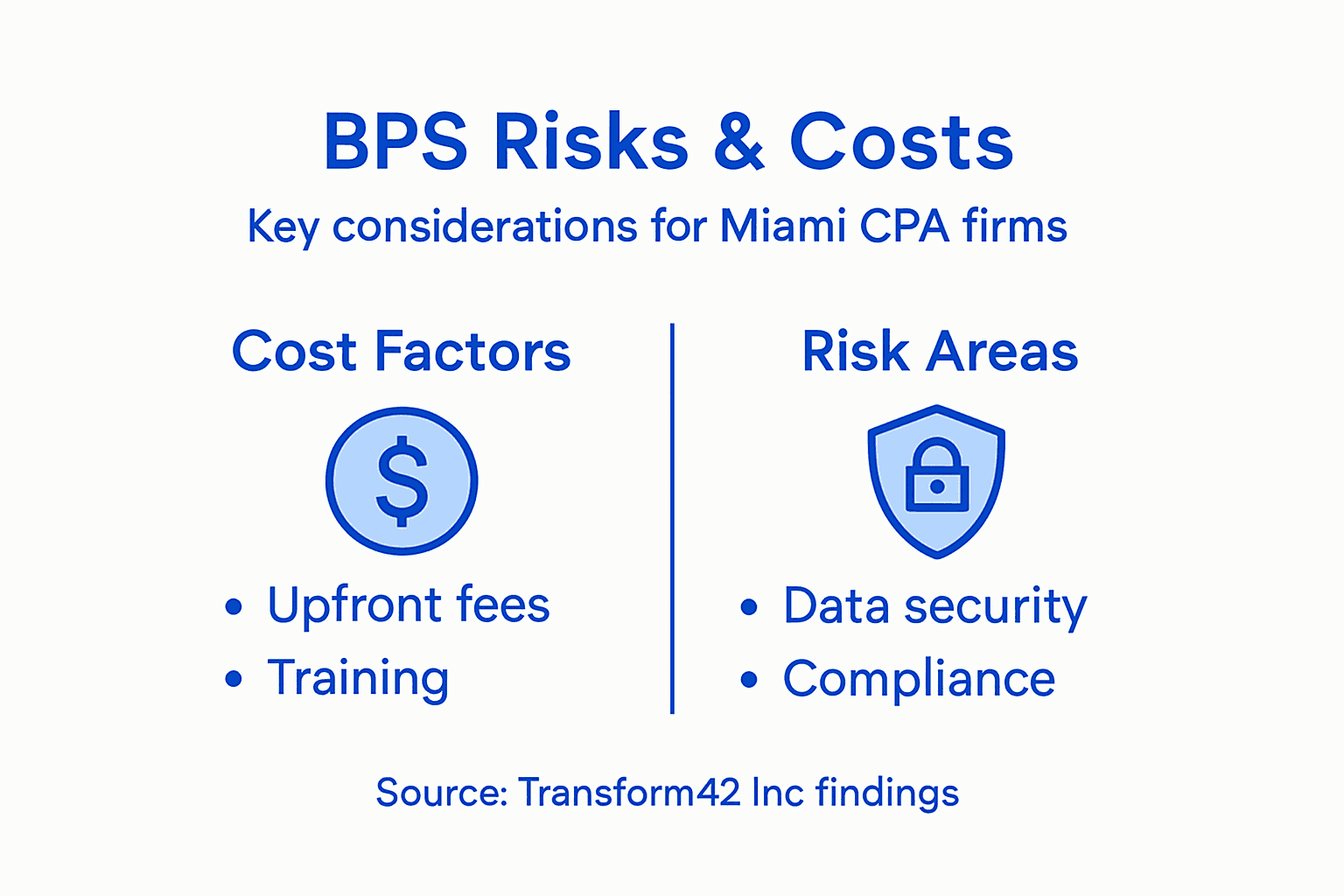
The following summary outlines primary risk types and effective mitigation tactics in BPS:
| Risk Category | Example Challenge | Recommended Mitigation |
|---|---|---|
| Financial | Unexpected implementation costs | Robust budgeting and forecasting |
| Operational | Resistance to technology change | Active change management |
| Strategic | Misaligned business objectives | Clear goal setting and metrics |
Effective risk management transforms potential challenges into strategic opportunities for organizational growth and efficiency.
Strategic risk mitigation requires a holistic approach that integrates financial analysis, technological capabilities, and organizational culture. Successful implementation depends on creating adaptive systems that can evolve with changing business requirements while maintaining cost-effectiveness and operational integrity.
Pro tip: Conduct thorough financial and technological due diligence before implementing any Business Process Service, focusing on long-term value creation rather than short-term cost reduction.
Unlock Your CPA Firm’s Growth with Strategic Business Process Services
Business Process Services present clear challenges for Miami CPAs aiming to drive revenue growth while managing complex compliance and operational efficiency. This article highlights the pain points of technology integration, process scalability, and shifting from traditional accounting to strategic advisory roles. If you want to overcome resistance to change, reduce operational risks, and build a technology-driven, scalable service model that attracts larger clients, you need a trusted partner who understands these dynamics.
At Transform42 Inc, we specialize in empowering CPA firms with tailored process optimization and digital transformation strategies. Our expertise helps you streamline internal workflows, ensure compliance, and apply cutting-edge technology to reclaim your time and increase your firm’s bottom line. Learn how to harness the power of business process services and embrace digital transformation designed specifically for accounting professionals.
Don’t let operational bottlenecks limit your growth. Visit Transform42 Inc today to build the capabilities your clients expect. Land bigger accounts, scale effortlessly without proportional hiring, and reclaim control over your work and life. The time to redefine your CPA firm’s future is now.
Frequently Asked Questions
What are Business Process Services (BPS)?
Business Process Services (BPS) are strategic solutions where organizations outsource specific non-core functions to expert third-party providers, enabling them to focus on their primary business objectives while improving operational efficiency.
How can Business Process Services benefit CPA firms?
BPS can help CPA firms enhance revenue by expanding client advisory services, implementing technology-driven service delivery, and utilizing value-based pricing models, transforming traditional accounting practices into strategic revenue generation platforms.
What are the core types of process outsourcing?
Core types of process outsourcing include Business Process Outsourcing (BPO) with front-office and back-office services, Information Technology Outsourcing, Offshore and Nearshore Outsourcing, and Project-Based Outsourcing, each offering unique advantages depending on the business needs.
What are the common risks associated with implementing Business Process Services?
Common risks include unexpected implementation costs, operational challenges like resistance to technology change, and strategic misalignment with organizational goals. Effective risk management involves thorough financial analysis and stakeholder engagement to mitigate these challenges.
Recommended
- Business Process Automation Guide for Miami CPAs – Stratgetic IT Consultants for Accountants
- Business Process Change: Driving Growth For Miami CPAs
- Business Process Automation Steps for Miami Accounting Firms – Stratgetic IT Consultants for Accountants
- Business Process Automation Software For Miami CPAs
- Why Automate Business Processes: Complete Guide | Reddog Consulting Group