The number of connected IoT devices is projected to grow from 18.8 billion in 2024 to 40 billion by 2030. Yet many accountants still view IoT as technology meant for manufacturers or tech companies, not financial professionals. This misconception costs Miami accounting firms valuable opportunities to streamline operations, enhance client services, and unlock new revenue streams. This guide walks you through practical IoT applications that transform how independent accountants and CPAs work, helping you leverage connected devices and real-time data to gain a strategic advantage in Miami’s competitive financial consulting market.
Table of Contents
- Understanding IoT And Its Evolving Role In Business
- How IoT Enhances Operational Efficiency In Accounting Firms
- The Revenue Impact Of IoT Adoption For Miami Financial Consultants
- Overcoming Challenges And Best Practices For IoT Implementation In Accounting
- Discover Tailored IoT And Digital Transformation Solutions For Miami Accountants
- Frequently Asked Questions
Key takeaways
| Point | Details |
|---|---|
| Operational efficiency | IoT integration with accounting systems enables real-time data capture, automated workflows, and enhanced accuracy that reduce manual tasks |
| Networking fundamentals | Understanding device-to-device, device-to-gateway, and device-to-cloud architectures helps accountants leverage IoT data effectively |
| Revenue growth | IoT adoption creates new client service opportunities, faster reporting capabilities, and improved compliance that drive measurable income increases |
| Strategic implementation | Phased IoT deployment with robust security measures and staff training ensures successful adoption without overwhelming existing operations |
Understanding IoT and its evolving role in business
IoT, or the Internet of Things, refers to physical devices embedded with sensors, software, and network connectivity that collect and exchange data without human intervention. For accountants, this means expense tracking devices, automated time logging systems, smart office equipment, and client monitoring tools that feed information directly into your financial platforms. The technology has moved far beyond smart thermostats and fitness trackers.
The explosive growth of IoT creates unprecedented opportunities for financial professionals willing to adapt. With connected IoT devices projected to grow from 18.8 billion in 2024 to 40 billion by 2030, the volume of business data available for analysis will multiply exponentially. Miami accounting firms that position themselves to capture and interpret this data gain significant competitive advantages over peers still relying on manual data entry and quarterly reporting cycles.
IoT networking architecture determines how devices communicate and share information. Device-to-device, device-to-gateway, and device-to-cloud represent the three primary connection models. Device-to-device allows direct communication between smart tools, like expense scanners syncing with mobile accounting apps. Device-to-gateway routes data through a central hub before reaching your systems, offering better security control. Device-to-cloud sends information directly to cloud platforms, enabling remote access and real-time collaboration across your team.
Networking protocols and infrastructure form the foundation that makes IoT valuable for accounting businesses. Without proper connectivity standards, devices cannot reliably share data with your core systems. Understanding these technical elements helps you make informed decisions when selecting IoT tools and ensures seamless integration with existing accounting software. This knowledge also positions you as a trusted technology advisor when clients ask about their own IoT implementations.
Miami accountants who grasp these IoT fundamentals can leverage IoT for competitive advantage by designing smarter workflows and offering cutting-edge services. The firms that thrive in 2026 and beyond will be those that view IoT not as optional technology but as essential infrastructure. Explore more insights in our technology archives for accountants to stay ahead of industry trends.
Key IoT networking concepts for accountants:
- Communication protocols determine how devices exchange data and maintain security
- Network infrastructure includes routers, gateways, and cloud platforms that connect your IoT ecosystem
- Data flow patterns affect real-time reporting capabilities and system responsiveness
- Integration points with accounting software require careful planning to ensure data accuracy
How IoT enhances operational efficiency in accounting firms
Integrating IoT with your core accounting systems transforms how you capture financial data, monitor client accounts, and deliver services. IoT in banking delivers measurable value when integrated as part of core operational systems, not as isolated hardware deployments. The same principle applies to accounting firms. Standalone smart devices provide minimal benefit, but connected systems that feed directly into your workflow automation and client management platforms create exponential efficiency gains.
Real-time data capture eliminates the lag between financial events and their recording in your systems. Smart receipt scanners automatically categorize expenses and populate client accounts within seconds. Connected mileage trackers log business travel without manual entry. Automated time tracking devices record billable hours as work happens, reducing the administrative burden on your team and improving billing accuracy. These capabilities free your staff to focus on high-value analysis and client advisory work rather than data entry tasks.
Automated workflows powered by IoT reduce errors and accelerate processing times. When client devices send transaction data directly to your systems, you eliminate transcription mistakes and duplicate entries. Automated reconciliation tools flag discrepancies immediately rather than during month-end reviews. This speed and accuracy strengthen client relationships because you can answer questions and provide insights faster than competitors still using manual processes.

Remote monitoring and asset management capabilities extend your service reach beyond traditional boundaries. IoT sensors tracking client inventory, equipment usage, or facility operations provide data streams you can analyze for cost savings and efficiency improvements. Miami financial consultants using these tools position themselves as strategic business partners rather than just compliance providers. This evolution opens doors to digital innovation examples for Miami accountants that differentiate your practice.
Pro Tip: Start with one high-impact IoT integration rather than attempting a complete technology overhaul. Choose a pain point in your current workflow where automation would save significant time, implement an IoT solution for that specific problem, and measure results before expanding to additional areas.
Five practical IoT applications for accounting firms:
- Smart document scanners that automatically classify receipts, invoices, and financial documents by client and category
- Connected time tracking devices that record billable hours across multiple client sites without manual logging
- Automated expense monitoring systems that capture and categorize business spending in real time
- IoT-enabled security systems that protect client data while providing detailed access logs for compliance audits
- Smart office equipment that monitors usage patterns and optimizes resource allocation across your practice
Implementing these tools requires thoughtful planning and integration with your existing digital transformation workflow for accountants. The goal is seamless data flow from IoT devices through your processing systems to client deliverables, creating efficiency gains that compound over time.
The revenue impact of IoT adoption for Miami financial consultants
IoT enables new service offerings that command premium fees and attract larger clients. Financial consultants who provide real-time dashboards, predictive analytics, and continuous monitoring deliver more value than those offering only quarterly reports. Clients increasingly expect their accountants to act as strategic advisors who spot opportunities and risks as they emerge. IoT gives you the data infrastructure to meet these expectations and justify higher billing rates.
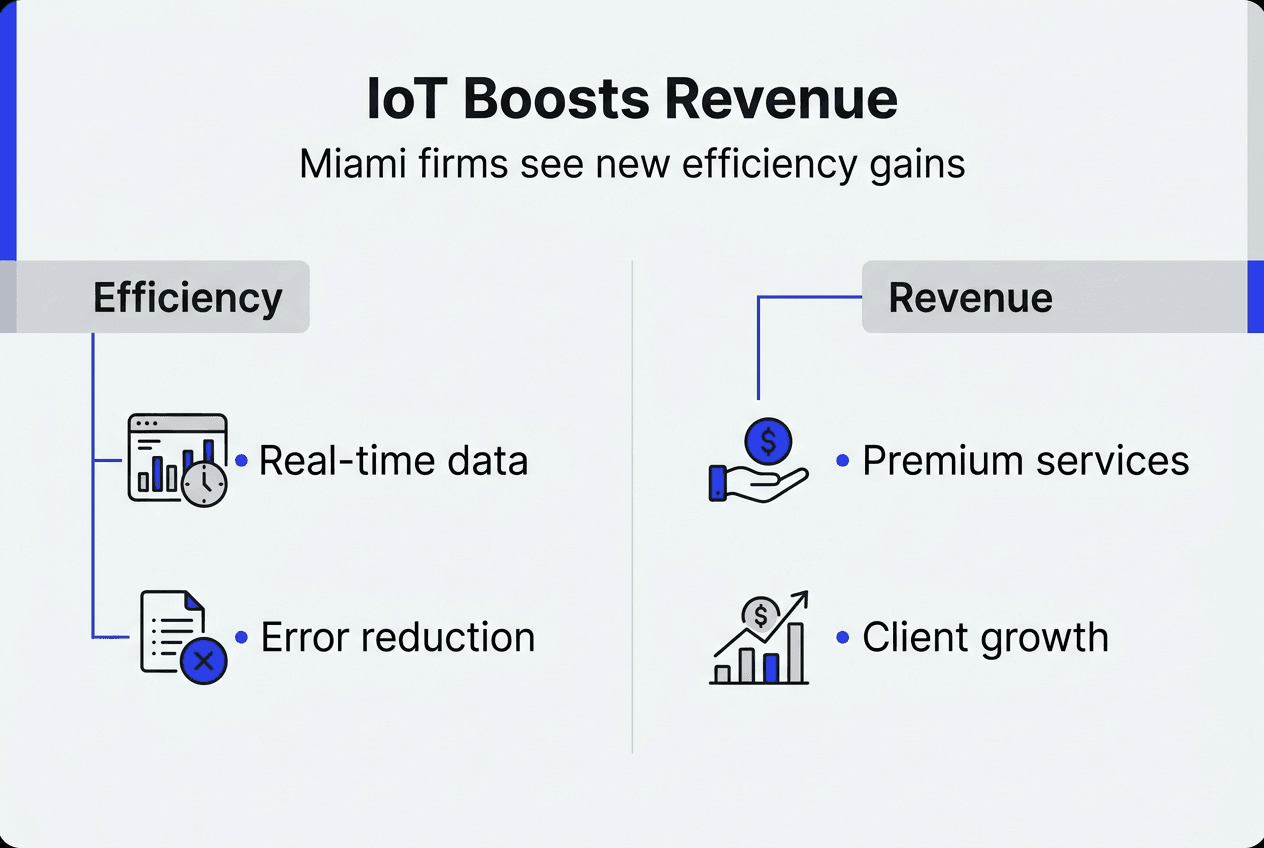
The synergy between cloud adoption and IoT creates powerful capabilities for remote and scalable services. 25% of accountants have already adopted cloud technology specifically to enable remote work. When you combine cloud platforms with IoT data streams, you can serve clients anywhere while maintaining real-time visibility into their financial operations. This flexibility allows Miami firms to expand their geographic reach without proportional increases in overhead costs.
| Workflow Aspect | Traditional Approach | IoT-Driven Approach | Revenue Impact |
|---|---|---|---|
| Data Collection | Manual entry, weekly batches | Automated real-time capture | 30% reduction in processing time, enabling 40% more clients per staff member |
| Client Reporting | Monthly or quarterly statements | Continuous dashboards with alerts | Premium pricing for real-time insights, 25% higher average client fees |
| Error Detection | Month-end reconciliation | Immediate automated flagging | Fewer compliance issues, reduced liability insurance costs by 15% |
| Advisory Services | Reactive problem solving | Proactive opportunity identification | New revenue streams from strategic consulting, 35% increase in advisory income |
Faster reporting cycles improve client satisfaction and retention rates. When clients can access current financial data anytime through IoT-powered dashboards, they feel more connected to their numbers and more confident in your services. This transparency builds trust and reduces the likelihood of clients switching to competitors. Higher retention rates directly impact your bottom line by reducing the costs and effort required to replace lost accounts.
Improved compliance capabilities protect both you and your clients while opening doors to regulated industries. IoT systems that automatically log data access, maintain audit trails, and flag potential compliance issues demonstrate your commitment to security and regulatory adherence. Miami accounting firms serving healthcare providers, legal practices, or financial services companies need these capabilities to compete for high-value contracts. The ability to prove compliance through automated systems rather than manual processes gives you credibility with sophisticated clients.
Pro Tip: Implement IoT solutions in phases aligned with specific revenue goals rather than adopting technology for its own sake. Start with tools that directly support your highest-value services, measure the impact on client acquisition and retention, then expand to additional applications based on proven ROI.
Explore how to automate business processes for revenue growth and discover additional accounting technology solutions that complement your IoT strategy.
Key revenue benefits of IoT adoption:
- Premium service offerings that justify 20-30% higher fees than traditional accounting packages
- Expanded client capacity without proportional staff increases through automated data processing
- New advisory revenue streams based on real-time insights and predictive analytics
- Improved client retention rates due to enhanced service quality and responsiveness
- Competitive advantages when pursuing larger, more sophisticated clients with complex needs
Overcoming challenges and best practices for IoT implementation in accounting
Security risks represent the most significant concern when adopting IoT in financial services. Connected devices create additional entry points for cyber threats, and compromised financial data can destroy client trust and expose your firm to liability. Data breaches through unsecured IoT devices have cost businesses millions in remediation and lost reputation. Miami accountants must prioritize security from the initial planning stages rather than treating it as an afterthought.
Data overload presents another challenge as IoT devices generate massive information streams. Without proper filtering and analysis tools, you risk drowning in data while missing critical insights. The goal is actionable intelligence, not raw data volume. Successful IoT implementations include clear protocols for which data matters, how it flows through your systems, and who acts on specific information types.
Integration complexity can derail IoT projects when new devices cannot communicate effectively with existing accounting platforms. IoT networking refers to the system of communication protocols, infrastructure, and services that connect smart devices in the Internet of Things ecosystem. Incompatible protocols, proprietary data formats, and legacy system limitations create technical hurdles that require careful planning and sometimes custom development work.
| Networking Method | Best Use Case | Advantages | Disadvantages |
|---|---|---|---|
| WiFi | Office-based devices with high data needs | High bandwidth, easy setup, widely supported | Higher power consumption, limited range, security vulnerabilities if not properly configured |
| Cellular (4G/5G) | Mobile devices and remote monitoring | Wide coverage, reliable connectivity, built-in security | Ongoing data costs, potential latency issues, dependent on carrier infrastructure |
| Bluetooth Low Energy | Short-range device communication | Minimal power use, low cost, simple pairing | Limited range, lower data transfer rates, potential interference |
| Ethernet | Fixed location devices requiring reliability | Maximum security, consistent performance, no wireless interference | Requires physical cabling, limited flexibility, higher installation costs |
Best practices for successful IoT implementation:
- Choose scalable platforms that grow with your practice rather than requiring replacement as client numbers increase
- Implement robust encryption for all data transmission between IoT devices and your core systems
- Segment IoT devices on separate network zones to contain potential security breaches
- Establish clear data governance policies defining who accesses what information and for what purposes
- Train staff thoroughly on new IoT tools and workflows before full deployment
- Conduct regular security audits of your IoT infrastructure to identify and address vulnerabilities
- Partner with vendors who provide ongoing support and security updates rather than one-time installations
Change management proves critical for IoT adoption success. Your team must understand not just how to use new tools but why they matter and how they improve daily work. Resistance to technology changes often stems from fear of job displacement or frustration with learning curves. Address these concerns directly by emphasizing how IoT eliminates tedious tasks and enables staff to focus on more rewarding analytical and advisory work.
Proactive planning prevents common IoT implementation pitfalls. Define clear objectives before selecting devices or platforms. Identify integration requirements with existing systems early in the process. Budget for ongoing maintenance and updates, not just initial purchases. Test thoroughly in limited scenarios before organization-wide rollouts. These steps reduce the risk of costly mistakes and ensure your IoT investments deliver expected returns.
Learn more about digital innovation best practices and explore change management steps Miami CPAs can follow for smooth technology transitions.
Discover tailored IoT and digital transformation solutions for Miami accountants
Navigating IoT implementation while maintaining your current client workload requires expert guidance and proven frameworks. Transform42Inc specializes in helping Miami accountants, CPAs, and financial consultants integrate technology that drives measurable efficiency gains and revenue growth. Our approach focuses on practical solutions aligned with your specific business goals rather than generic technology recommendations.
Explore our comprehensive technology solutions for accountants designed specifically for independent practices and small firms in Miami. We help you build the capabilities and compliance your clients expect, enabling you to land bigger accounts without proportional hiring increases. Our digital transformation strategies provide step-by-step roadmaps for adopting IoT and related technologies at a pace that works for your practice. Discover how process automation for CPA growth can help you scale efficiently while reclaiming your life outside the office.
Frequently asked questions
What is the role of IoT in improving accounting workflows?
IoT automates data collection from multiple sources, eliminating manual entry and reducing errors in financial records. Connected devices capture transactions, time logs, and expenses in real time, feeding information directly into your accounting systems. This automation accelerates processing cycles and frees your team to focus on analysis and client advisory services. Real-time monitoring capabilities also enable proactive problem identification rather than reactive troubleshooting during month-end closes. Learn more about leveraging IoT advantages in your practice.
How can small accounting firms in Miami start adopting IoT technology?
Begin by assessing your current workflow pain points where automation would deliver immediate value, such as expense tracking or time logging. Select simple IoT solutions that integrate seamlessly with your existing accounting software rather than requiring complete system overhauls. Partner with technology consultants who understand accounting operations and can design phased implementation plans aligned with your budget and capacity. Starting small with one high-impact application builds confidence and demonstrates ROI before expanding to additional IoT tools. Review digital innovation best practices for implementation guidance.
What are the main security concerns with IoT in accounting, and how can they be mitigated?
Data breaches through unsecured IoT devices and unauthorized access to financial information represent the primary risks for accounting firms. Each connected device creates a potential entry point for cyber threats if not properly secured. Mitigation strategies include implementing robust encryption for all data transmission, segmenting IoT devices on separate network zones, and conducting regular security audits. Establish strict access controls defining who can view or modify data from specific devices. Partner with vendors who provide ongoing security updates and support rather than static installations. Follow comprehensive change management process steps to ensure security protocols are understood and followed by all team members.
Can IoT help accounting firms serve clients remotely?
Yes, IoT combined with cloud platforms enables comprehensive remote service delivery without sacrificing data visibility or client communication quality. Connected devices at client locations send financial data directly to your cloud-based systems, allowing you to monitor operations, generate reports, and provide advisory services from anywhere. This capability proved essential during recent shifts toward remote work and continues to offer competitive advantages for firms serving geographically dispersed clients. Remote monitoring also reduces the need for on-site visits while maintaining or improving service quality through real-time insights.