Tech-integrated accounting firms are 53% more likely to experience high growth, yet many Miami CPAs still struggle to harness digital tools effectively. The difference lies not in technology adoption alone, but in strategic digital leadership. This guide reveals how Miami tax professionals can lead digital transformation to boost practice efficiency, strengthen client relationships, and unlock revenue growth. You’ll discover practical frameworks for balancing cutting-edge technology with critical thinking, overcome common implementation barriers, and learn actionable strategies tailored to Miami’s unique regulatory landscape.
Table of Contents
- Key takeaways
- Understanding digital leadership in Miami CPA practices
- Overcoming challenges to digital leadership in Miami CPA firms
- Balancing technology and critical thinking for effective digital leadership
- Applying digital leadership to boost efficiency and client engagement in Miami
- How Transform42 empowers Miami CPAs in digital leadership
- Frequently asked questions
Key Takeaways
| Point | Details |
|---|---|
| Strategic digital leadership | Strategic digital leadership blends technology governance with change management to boost efficiency, advisory growth, and client value in Miami CPA practices. |
| Local cybersecurity and compliance | Miami firms must navigate cybersecurity risks and complex state and federal regulations that shape technology choices and data protection. |
| Upskilling balance | Closing digital skill gaps and balancing cutting edge tools with critical thinking is essential for effective adoption and sustainable performance. |
| Agile transformation | An agile approach to digital transformation improves firm efficiency and strengthens client relationships by aligning technology with business goals. |
Understanding digital leadership in Miami CPA practices
Digital leadership means strategically adopting and governing technology to enhance service delivery, operational efficiency, and client value in CPA firms. For Miami tax professionals, this involves integrating cloud platforms, artificial intelligence tools, and secure client portals while navigating complex regulatory requirements and diverse client needs. Strong digital leaders don’t just implement technology. They align digital investments with business goals, ensure data security compliance, and foster a culture of continuous innovation.
Cloud computing forms the foundation of modern CPA practice management. 92% of accounting firms see cloud as essential, and half expect AI will become critical to their operations. These technologies enable real-time collaboration, automated workflows, and data-driven insights that transform client service delivery. Miami CPAs face additional considerations around international client data protection, bilingual communication needs, and state-specific compliance requirements that demand thoughtful technology governance.
Effective digital transformation requires leadership that balances innovation with risk management. Consider how different technologies impact your practice:
| Technology | Primary Benefit | Implementation Complexity | ROI Timeline |
|---|---|---|---|
| Cloud platforms | Remote access and collaboration | Medium | 6-12 months |
| AI-powered analytics | Automated insights and forecasting | High | 12-18 months |
| Secure client portals | Enhanced communication and document sharing | Low | 3-6 months |
| Blockchain verification | Audit trail integrity | Very High | 18-24 months |
Miami CPA firms encounter specific challenges that make digital leadership even more critical:
- Cybersecurity threats targeting financial data, especially with international client bases
- Bilingual client communication requirements for diverse Miami populations
- Complex state and federal compliance overlays affecting technology choices
- Competition from larger firms with established digital infrastructure
- Staff resistance to workflow changes and new technology adoption
Addressing these challenges requires leaders who understand both technology capabilities and human change dynamics. The most successful Miami CPAs view digital transformation as an ongoing journey rather than a one-time project.
Overcoming challenges to digital leadership in Miami CPA firms
The path to digital leadership faces significant obstacles that can derail even well-intentioned transformation efforts. Skills gaps represent the most pressing challenge, with 70% of firms reporting digital skill gaps that impact hiring and operational effectiveness. Miami’s competitive talent market and unique regulatory environment compound this issue. Many experienced CPAs excel at tax strategy but lack confidence with emerging technologies, creating a knowledge divide that hinders adoption.
Resistance to change emerges when staff perceive technology as threatening job security or disrupting comfortable workflows. This psychological barrier often proves more difficult to overcome than technical implementation challenges. Miami firms serving diverse client bases face additional complexity around language preferences, cultural expectations, and varying comfort levels with digital tools. Leaders must address these human factors alongside technical considerations.
Cybersecurity concerns loom large for Miami CPAs handling sensitive financial data for international clients. The city’s position as a gateway to Latin American markets increases exposure to sophisticated cyber threats. Implementing robust IT security governance requires investment in both technology and expertise that many small to mid-size firms struggle to afford. Data breach risks, regulatory penalties, and reputational damage create high stakes for security decisions.
Financial constraints limit technology adoption for practices operating on tight margins:
- High upfront costs for enterprise software licenses and infrastructure
- Ongoing subscription fees that strain cash flow during implementation
- Training expenses for staff learning new systems and workflows
- Temporary productivity losses during transition periods
- Consultant fees for specialized implementation support
Operational disruption during technology transitions can impact client service quality and staff morale. Balancing daily responsibilities with transformation initiatives requires careful planning and realistic timelines. Many firms underestimate the change management effort required, leading to incomplete implementations and technology abandonment.

Pro Tip: Prioritize continuous upskilling through micro-learning modules that fit into daily workflows rather than lengthy training sessions. Partner with technology vendors offering agile implementation support and consider digital transformation tips that emphasize gradual adoption to reduce resistance and maintain service quality during transitions.
Balancing technology and critical thinking for effective digital leadership
Successful digital leadership requires integrating advanced technologies while preserving the human judgment that defines quality advisory services. AI and automation handle routine tasks brilliantly, but strategic tax planning, client relationship management, and ethical decision-making demand human expertise. Miami CPAs must determine which activities benefit from technology and which require irreplaceable human insight.
Consider the tradeoffs between different technological approaches:
| Approach | Key Benefits | Potential Risks | Best Use Cases |
|---|---|---|---|
| AI-driven automation | Speed, consistency, cost reduction | Over-reliance, missed nuances | Data entry, compliance checks, pattern recognition |
| Blockchain verification | Transparency, immutability, trust | Complexity, limited adoption | Audit trails, multi-party transactions |
| Traditional manual review | Human judgment, flexibility, relationship building | Time-intensive, inconsistent | Complex advisory, client counseling, ethical decisions |
| Hybrid technology-human model | Efficiency with oversight, scalable quality | Requires skilled staff, ongoing training | Most CPA services combining automation with expert review |
Only 47% of firms have implemented a digitalization strategy despite widespread recognition of its importance. This gap reflects the difficulty of balancing innovation with traditional strengths. Effective digital leaders follow a structured approach:
- Assess current digital maturity across people, processes, and technology dimensions
- Identify high-impact opportunities where technology enhances rather than replaces human expertise
- Pilot new tools with small client segments before firm-wide rollout
- Establish governance frameworks defining when human review overrides automated recommendations
- Invest in continuous learning programs that build both technical and advisory skills
- Measure outcomes using balanced metrics covering efficiency, quality, and client satisfaction
- Iterate based on feedback, adjusting the technology-human balance as capabilities evolve
Critical thinking skills become more valuable, not less, as technology handles routine work. Miami CPAs who develop strong analytical capabilities, ethical reasoning, and strategic advisory skills differentiate themselves in an increasingly automated marketplace. Technology should free professionals to focus on high-value activities requiring judgment, creativity, and interpersonal skills.
Pro Tip: Use digital maturity models to benchmark your firm’s progress and identify gaps. These frameworks help you measure technology adoption, process optimization, and cultural readiness across multiple dimensions, providing a roadmap for balanced advancement that maintains your competitive edge while preserving client relationships.
Explore proven digital transformation tips that emphasize gradual capability building rather than disruptive overhauls.
Applying digital leadership to boost efficiency and client engagement in Miami
Translating digital leadership principles into practice requires concrete actions that deliver measurable improvements. Miami CPAs can implement several high-impact initiatives:
- Migrate core practice management and tax software to cloud platforms for remote access and real-time collaboration
- Deploy AI-powered tools for automated data extraction, compliance checking, and preliminary analysis
- Implement secure client portals enabling document sharing, real-time communication, and self-service access
- Establish cybersecurity protocols including multi-factor authentication, encryption, and regular security audits
- Create bilingual digital communication channels serving Miami’s diverse client base
- Develop advisory service offerings leveraging data analytics and predictive modeling
Frameworks like SMART goals and digital maturity models help track progress systematically. Set specific targets such as reducing tax return processing time by 30%, increasing advisory revenue by 25%, or achieving 90% client portal adoption within 12 months. Digital maturity assessments reveal capability gaps and prioritize investments for maximum impact.
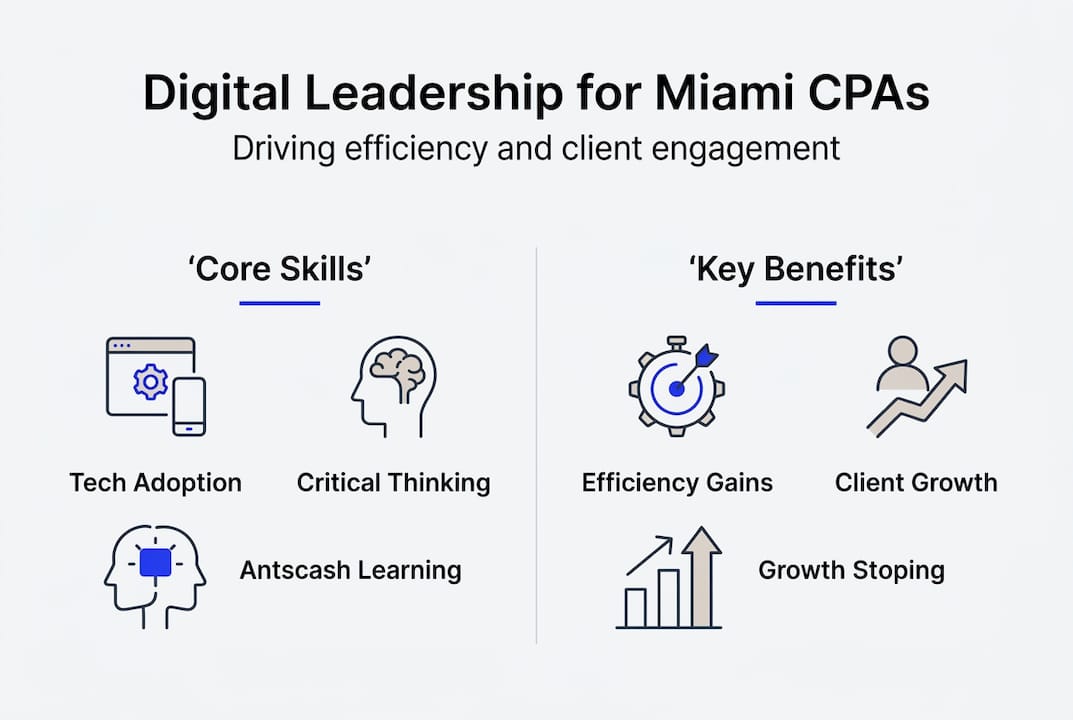
Digital leadership fundamentally shifts CPA practices from compliance-focused to advisory-driven business models. Digital transformation led to 20-30% revenue growth for Miami practices shifting toward advisory services. Automation handles routine compliance work efficiently, freeing professionals to provide strategic tax planning, business consulting, and financial advisory services that command premium fees. This transition requires both technology investment and skills development.
Miami-specific applications demonstrate digital leadership impact. A mid-size firm serving Latin American business clients implemented bilingual client portals with encrypted document sharing, reducing email volume by 60% while improving response times. Another practice deployed AI-powered tax research tools that cut research time by 40%, allowing staff to handle 25% more clients without additional hiring. These improvements directly enhance client satisfaction and practice profitability.
Client engagement transforms when digital tools enable proactive, personalized service. Real-time dashboards showing tax liability projections, automated alerts for filing deadlines, and video conferencing for convenient consultations create superior client experiences. Business process optimization streamlines operations while enhancing service quality, positioning Miami CPAs as trusted advisors rather than transactional service providers.
Successful digital leaders measure both operational and client-facing metrics. Track processing efficiency, error rates, and staff productivity alongside client satisfaction scores, retention rates, and advisory revenue growth. This balanced approach ensures technology investments deliver business value while maintaining the relationship quality that differentiates professional services.
Learn more about navigating digital transformation through strategic technology architecture that aligns with your practice goals and client needs.
How Transform42 empowers Miami CPAs in digital leadership
Transform42 specializes in helping Miami CPAs develop and execute digital leadership strategies that drive measurable practice growth. Our tailored digital transformation services address the unique challenges facing accounting professionals in Miami’s competitive, diverse marketplace. We combine deep technology expertise with understanding of CPA practice operations to deliver solutions that enhance efficiency without disrupting client service.
Our technology consulting for accountants includes strategic planning, implementation support, and ongoing optimization across cloud platforms, AI tools, and cybersecurity infrastructure. We help you close skills gaps through practical training and change management that reduces staff resistance. Our business process services streamline operations, automate routine tasks, and position your practice for advisory service expansion. Partner with Transform42 to build the digital capabilities and compliance framework your clients expect while scaling without proportional hiring. Contact us today to discuss how strategic technology gives your practice a competitive advantage.
Frequently asked questions
What skills define a strong digital leader in a Miami CPA firm?
Strong digital leaders combine technological proficiency in cloud platforms, AI tools, and cybersecurity with critical thinking, strategic planning, and change management abilities. They understand how to align technology investments with business goals while addressing Miami-specific challenges like bilingual client communication and international compliance requirements. Continuous learning, adaptability, and the ability to balance innovation with risk management distinguish effective digital leaders from those who simply adopt technology.
How can Miami CPAs address resistance to digital transformation among staff?
Implement clear communication explaining how technology enhances rather than replaces human expertise, emphasizing career development opportunities. Involve staff in technology selection and implementation decisions to build ownership and reduce anxiety. Provide hands-on training with realistic timelines that accommodate learning curves. Use agile governance allowing gradual adoption and course correction based on feedback. Celebrate early wins to build momentum and demonstrate tangible benefits. Explore digital transformation tips for proven change management strategies.
What technologies should Miami CPAs prioritize for digital leadership?
Prioritize cloud platforms, AI-driven tools, and secure client portals as foundational technologies delivering immediate efficiency and security improvements. Cloud computing enables remote work and real-time collaboration essential for modern practice operations. AI automates data extraction, compliance checking, and preliminary analysis, freeing professionals for advisory work. Secure portals enhance client communication while meeting data protection requirements. Align technology choices with your specific firm goals, client needs, and budget constraints rather than adopting tools simply because competitors use them.
How does digital leadership improve client engagement for Miami tax professionals?
Digital leadership enables real-time interactions through client portals, providing convenient access to documents, tax projections, and personalized insights. Technology facilitates proactive communication with automated alerts, deadline reminders, and strategic planning opportunities. Data analytics tools generate actionable recommendations that position CPAs as trusted advisors rather than compliance processors. Robust cybersecurity builds client trust by protecting sensitive financial information. Bilingual digital channels serve Miami’s diverse population effectively. These capabilities create superior client experiences that strengthen relationships and increase retention. Learn more about customer engagement strategies that differentiate your practice.