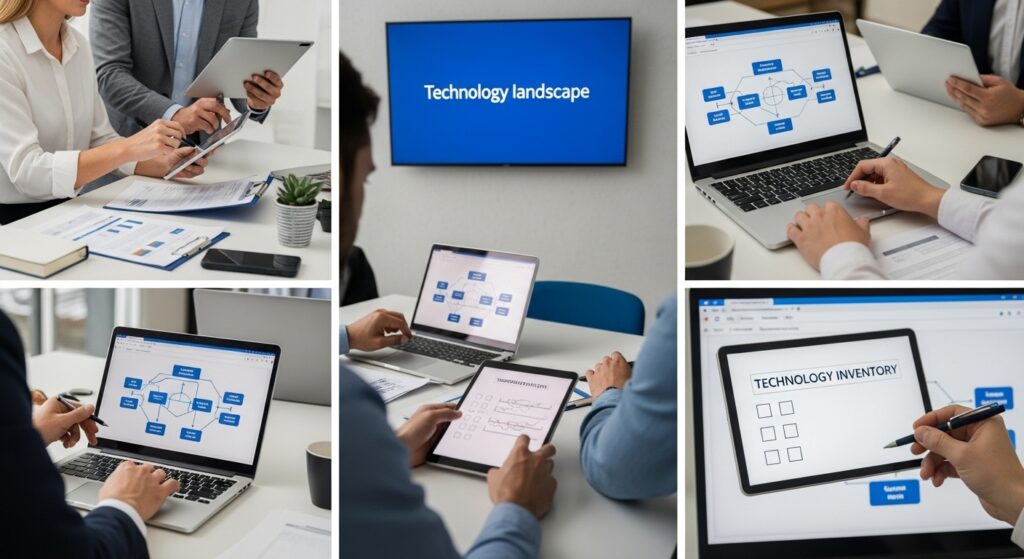
Examples of smart government tech driving efficiency
Accountants in Miami face a critical challenge: identifying smart government technologies that genuinely boost efficiency and transparency for their clients. With countless platforms promising transformation, separating hype from real impact is essential. This article equips you with evaluation frameworks, quantified global success stories, and practical insights into digital ID systems, AI automation, and IoT infrastructure. You’ll discover how leading governments achieve measurable gains and learn to leverage these examples to enhance your practice and deliver strategic value to public and private sector clients.
Table of Contents
- Key takeaways
- Evaluating smart government tech: key criteria and challenges
- Global examples of smart government technology boosting efficiency
- Technologies transforming city infrastructure and public services
- Emerging integrated technologies and their future impact
- How Transform42 empowers accountants with government tech expertise
- Frequently asked questions
Key Takeaways
| Point | Details |
|---|---|
| Evaluation framework | Use a clear framework that weighs interoperability, security, scalability, total cost of ownership, and vendor track record before adopting smart government technology. |
| Digital ID enablers | Digital identity platforms enable secure data sharing across agencies and support the once only principle, reducing repeated data requests. |
| Legacy system hurdle | Outdated databases and fragmented platforms limit integration, forcing workarounds that erode efficiency and raise costs. |
| Estonia X Road | Estonia’s X Road saves about 1,400 years of total working time annually by enabling secure data exchanges and proactive service delivery. |
| New Brunswick gains | Automation and digital workflows save 20 minutes per request and free 26 full time equivalents for higher value work. |
Evaluating smart government tech: key criteria and challenges
When assessing smart government technologies for clients, start with a clear framework. Edge cases require digital ID enablers, legacy systems hinder effectiveness, and AI needs domain integration and oversight to avoid costly errors. Digital identity platforms unlock seamless data sharing across agencies, enabling the once only principle where citizens provide information just once. Without this foundation, even sophisticated systems deliver limited value.
Legacy infrastructure presents a major barrier. Outdated databases and fragmented systems prevent full integration, forcing workarounds that undermine efficiency gains. You need to evaluate whether a client’s existing technology stack can support new platforms or requires foundational upgrades first. This assessment prevents expensive implementations that fail to deliver promised results.
AI and ML in public services demand careful scrutiny. Algorithms trained on incomplete or biased data produce unreliable outputs. Human oversight remains essential for complex decisions, particularly in permitting, compliance, and financial reporting. When evaluating AI tools, verify they integrate domain-specific knowledge and include validation workflows.
Political and workforce factors significantly impact adoption success. Staff resistance, inadequate training budgets, and shifting policy priorities can derail well-designed initiatives. Consider these realities when advising clients on public sector digital transformation.
Pro Tip: Ask vendors for quantified performance data from comparable implementations. Vague promises of efficiency gains mean nothing without specific metrics like processing time reductions or cost savings percentages.
Key evaluation criteria include:
- Interoperability with existing systems and data standards
- Security architecture and compliance with privacy regulations
- Scalability to handle growing transaction volumes
- Vendor track record with measurable client outcomes
- Total cost of ownership including maintenance and training
Global examples of smart government technology boosting efficiency
Estonia’s X-Road platform exemplifies how digital infrastructure transforms government operations. Nearly all public services now operate through secure data exchanges, eliminating redundant data entry and enabling proactive service delivery. Citizens receive automatic notifications for relevant benefits, tax filings pre-populate with verified income data, and agencies collaborate seamlessly without manual information requests. This architecture saves an estimated 1,400 years of working time annually across the country’s population.
The once only principle drives these gains. When a citizen updates their address, every connected agency instantly receives the change. No forms to complete, no verification delays, no duplicate records. For accountants advising clients on compliance systems, this model demonstrates how proper data architecture eliminates administrative overhead.
New Brunswick’s digital transformation delivers quantifiable results. The province’s platform saves 20 minutes per request and frees 26 full-time equivalents for higher value work. Automated workflows route applications to appropriate reviewers, flag incomplete submissions immediately, and provide real-time status updates. Processing times dropped 40% within the first year.
These examples share common success factors: executive commitment, user-centered design, and phased implementation. New Brunswick started with high-volume, low-complexity services before tackling intricate processes. This approach built staff confidence and demonstrated value quickly.
| Implementation | Time savings per transaction | Staff redeployment | Citizen satisfaction |
|---|---|---|---|
| Estonia X-Road | 15-30 minutes | 1,400 years annually | 95% digital adoption |
| New Brunswick platform | 20 minutes | 26 FTE equivalents | 40% faster processing |
| Singapore MyInfo | 10-15 minutes | Not disclosed | 98% user satisfaction |
Pro Tip: When evaluating digital innovation for government solutions for clients, prioritize platforms that enable proactive service models. Systems that anticipate citizen needs and automate routine interactions deliver exponentially greater efficiency than simple digitization of paper forms.
Technologies transforming city infrastructure and public services
Smart city IoT platforms revolutionize asset management with measurable financial impact. Maintenance costs dropped 31%, response times accelerated 52%, and asset lifespan extended 28% when cities integrated IoT sensors with computerized maintenance management systems. Sensors monitor infrastructure conditions continuously, triggering work orders automatically when parameters exceed thresholds. This predictive approach prevents costly emergency repairs and optimizes crew scheduling.

For accountants advising municipal clients, these systems provide audit trails and performance metrics that strengthen budget justifications. Real-time data on equipment utilization, maintenance histories, and failure patterns support evidence-based capital planning. You can help clients demonstrate ROI through reduced downtime and extended replacement cycles.
AI-powered consolidation transforms citizen-facing services. Miami uses Oracle OPAL AI to unify permitting applications across building, zoning, and business licensing. The platform automates data validation, flags conflicts with existing regulations, and routes complex cases to specialized reviewers. Cycle times improved 35% while data accuracy increased significantly. Staff focus on exceptions and customer service rather than manual data entry.
This local example offers powerful benchmarking opportunities. When clients question AI adoption feasibility, you can reference Miami’s measurable outcomes and implementation timeline. The city’s experience demonstrates that AI delivers value in high-stakes regulatory contexts when properly integrated.
| Technology | Primary benefit | Cost impact | Implementation complexity |
|---|---|---|---|
| IoT-CMMS integration | Predictive maintenance | 31% reduction | Moderate (sensor deployment) |
| AI permitting platform | Faster processing | 35% cycle time improvement | High (data integration) |
| Digital identity system | Seamless data sharing | 40-50% admin time savings | Very high (cross-agency coordination) |
Key considerations for city infrastructure tech:
- Sensor networks require reliable connectivity and power infrastructure
- AI platforms demand clean, standardized data across legacy systems
- Staff training determines whether automation enhances or disrupts workflows
- Privacy safeguards must address continuous monitoring concerns
- Vendor lock-in risks increase with proprietary platforms
Pro Tip: Encourage clients to study digital transformation case studies from comparable jurisdictions. Miami’s AI permitting success provides a local benchmark for Florida accountants advising government clients. Even Italian government tax exemptions for charter yachts demonstrate how policy changes intersect with technology adoption in specialized sectors.
Emerging integrated technologies and their future impact
Next-generation government systems combine AI, blockchain, and IoT for unprecedented efficiency. Decentralized architectures achieve response times under 400ms, AI accuracy up to 95%, and recovery from failures within 250ms. These integrated platforms process transactions across distributed nodes, eliminating single points of failure while maintaining security through cryptographic verification. Smart contracts automate complex multi-party workflows that traditionally required extensive coordination.
For accountants, these systems promise radical improvements in audit trails and compliance verification. Blockchain-based records provide immutable transaction histories that simplify forensic accounting and regulatory reporting. AI algorithms detect anomalies in real-time, flagging potential fraud or errors before they cascade through systems. IoT sensors feed continuous operational data that validates financial reporting accuracy.
However, integration challenges remain substantial. Legacy systems rarely support the APIs and data standards required for seamless interoperability. Staff need entirely new skill sets to manage distributed architectures and interpret AI-generated insights. Human oversight remains critical for high-stakes decisions despite impressive accuracy metrics.
“Organizations should approach AI adoption with realistic expectations. While the technology offers significant benefits, successful implementation requires addressing data quality, staff training, and governance frameworks. Hype often outpaces practical deployment readiness.”
Advantages of integrated government tech:
- Real-time data validation across multiple agencies and systems
- Automated compliance checking reduces manual review workload
- Immutable audit trails simplify investigations and regulatory reporting
- Predictive analytics identify risks before they materialize
- Citizen-facing services operate 24/7 without human intervention
Implementation obstacles:
- Expensive infrastructure upgrades to support distributed computing
- Regulatory frameworks lag behind technological capabilities
- Privacy concerns intensify with continuous data collection
- Vendor ecosystems remain fragmented with limited standardization
- Change management complexity increases exponentially with system integration
When advising clients on emerging technologies, emphasize phased adoption. Start with standalone applications that deliver quick wins, then gradually connect systems as staff capabilities and infrastructure mature. The AI in consulting guide offers frameworks for evaluating readiness and prioritizing initiatives.
Pro Tip: Help clients distinguish between proof-of-concept demonstrations and production-ready systems. Many vendors showcase impressive pilots that fail to scale due to data quality issues, integration costs, or operational complexity. Demand evidence of sustained performance in comparable environments.
How Transform42 empowers accountants with government tech expertise
Navigating smart government technology options requires specialized expertise that most accounting firms lack internally. Transform42 delivers technology consulting for accountants in Miami, translating complex technical capabilities into strategic business advantages. We help you evaluate platforms against your clients’ specific needs, avoiding costly missteps and accelerating time to value.
Our digital transformation consulting guides you through the entire adoption lifecycle. We assess your current technology stack, identify integration requirements, and develop phased implementation roadmaps that minimize disruption. You gain the capabilities to advise public and private sector clients on efficiency-driving technologies with confidence.
Business transformation for CPAs extends beyond technology selection. We help you build service offerings around smart government tech expertise, positioning your firm as a strategic advisor rather than a commodity provider. This differentiation attracts larger clients and commands premium fees while you reclaim time from routine tasks. Our partnership model scales your capabilities without proportional hiring, delivering the compliance and innovation your clients expect.
Frequently asked questions
What are the best examples of smart government technology?
Estonia’s X-Road digital identity platform, Miami’s Oracle OPAL AI permitting system, and New Brunswick’s automated service platform represent leading implementations. These systems deliver quantified efficiency gains including 31% cost reductions, 35% faster processing, and elimination of redundant data entry.
How does smart government technology improve efficiency?
Smart tech automates routine processing, enables data sharing across agencies, and provides real-time status visibility. Processing times drop 40-50% while staff redirect effort from manual tasks to complex problem-solving and citizen service.
What challenges do governments face implementing smart technology?
Legacy system integration, staff training requirements, and data quality issues present major obstacles. Political priorities shift, budgets constrain upgrades, and privacy concerns complicate data sharing. Successful implementations address these factors through phased rollouts and executive commitment.
Can accountants leverage smart government tech for private clients?
Absolutely. Principles from government digital transformation apply directly to private sector compliance, reporting, and operational efficiency. Accountants who understand these technologies advise clients on automation opportunities, audit trail improvements, and strategic technology investments.
What ROI can organizations expect from smart government technology?
Quantified examples show 31% maintenance cost reductions, 20-minute time savings per transaction, and 26 full-time equivalent staff redeployments. ROI depends on implementation quality, existing infrastructure, and process complexity. Phased approaches with clear metrics deliver most reliable returns.
Recommended
- Evolving Governance: AI, ML, And The Future Of Public Services – Stratgetic IT Consultants For Accountants
- Pioneering Public Sector Progress: A Digital Transformation Journey – Stratgetic IT Consultants For Accountants
- Understanding Types Of Government Technology For CPAs – Stratgetic IT Consultants For Accountants
- Understanding Digital Innovation For Government – Stratgetic IT Consultants For Accountants
- AI Voice Agents for Government Services