
Independent CPAs and financial consultants in Miami face unprecedented pressure to grow revenue while delivering exceptional client service. Digital transformation yields up to 28% revenue growth and 42% cost savings for accounting firms, yet many professionals remain unaware of these measurable benefits. Digital consultancy provides the strategic roadmap to leverage technology for competitive advantage, automate routine processes, and scale without proportional hiring increases. This guide explains what digital consultancy means for CPAs and delivers practical frameworks to apply it effectively in your practice.
Table of Contents
- Key takeaways
- What is the role of digital consultancy for CPAs?
- Addressing challenges in technology adoption for independent CPAs
- Balancing technology and human judgment in CPA digital transformation
- Practical strategies to leverage digital consultancy for revenue growth and client service
- How Transform42 can help Miami CPAs drive digital growth
- What are common questions about digital consultancy for CPAs?
Key Takeaways
| Point | Details |
|---|---|
| Revenue growth from digital consultancy | Digital consultancy drives revenue growth by expanding service offerings and automating routine tasks. |
| Automation and cloud savings | Automation and cloud adoption reduce costs while improving profitability. |
| AI augments human judgment | Artificial intelligence tools should augment human judgment while requiring careful integration to manage risk. |
| Tech aligned with strategy | Align technology initiatives with the firm strategy to maximize impact. |
| Change management and skills development | Change management and skills development lower resistance and boost adoption across staff. |
What is the role of digital consultancy for CPAs?
Digital consultancy guides independent CPAs through the complex landscape of technology adoption to improve efficiency, profitability, and client service delivery. Rather than simply purchasing software, digital transformation encompasses strategic planning, tool selection, process automation, AI integration, cloud migration, and comprehensive change management. For Miami CPAs competing in a sophisticated market, digital consultancy provides the expertise to navigate these choices without costly missteps.
The measurable benefits are substantial. 78% of accounting firms accelerated digital transformation after COVID-19, with adopters achieving 28% revenue growth and 42% cost savings compared to peers. These gains stem from new digital advisory services that command premium fees and automation that reduces labor-intensive tasks like data entry and reconciliation. Typical consulting outcomes include 20-30% cost reductions from cloud migration and 26% higher profitability for firms that prioritize technology adoption.
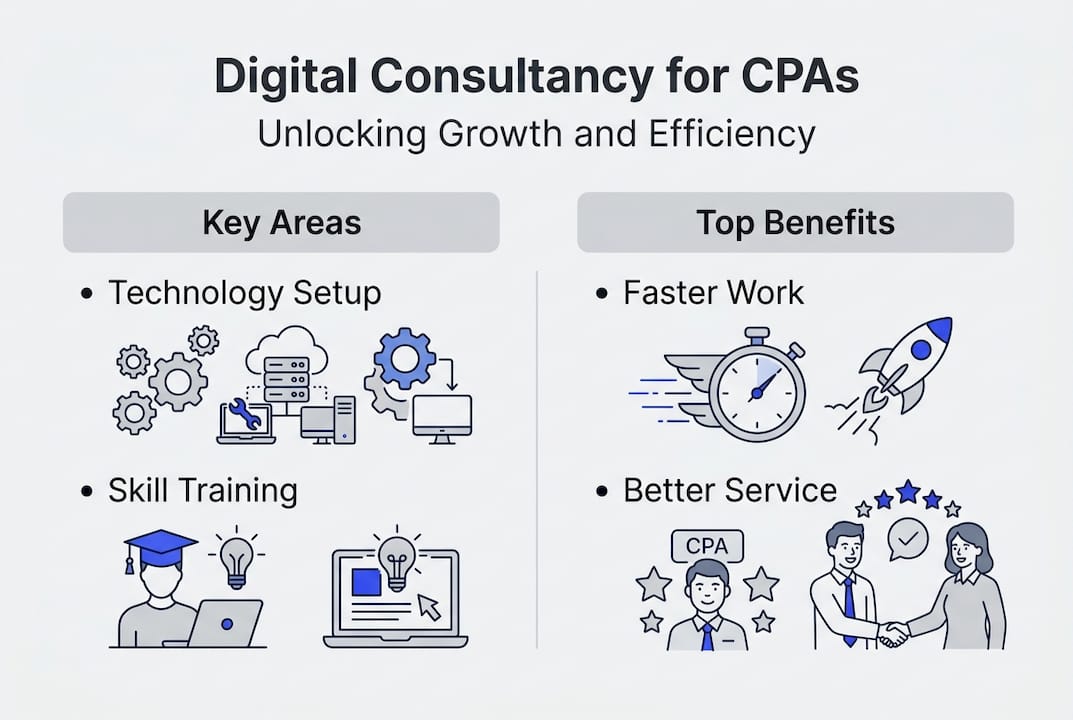
Digital consultancy addresses three core areas that drive CPA firm growth:
- Strategic technology planning aligned with your firm’s unique service mix and client base
- Implementation support for cloud accounting platforms, AI tools, and automation workflows
- Change management programs that ensure staff adoption and minimize disruption
- Compliance and security frameworks that protect client data while enabling remote work
- Performance measurement systems that track ROI and guide ongoing optimization
The digital innovation for CPAs landscape evolves rapidly, making external expertise valuable for staying current. Consultants bring cross-industry insights and implementation experience that internal teams lack, accelerating time to value. They also provide objective assessment of which technologies genuinely fit your practice versus vendor hype.
Pro Tip: Prioritize staff training and adoption metrics over pure ROI calculations early in your transformation journey. Technology only delivers value when your team uses it effectively, and behavioral change takes longer than technical implementation.
Addressing challenges in technology adoption for independent CPAs
Independent CPAs face distinct obstacles that larger firms can absorb more easily. Fragmented technology adoption and skill gaps create inefficiencies where different staff members use incompatible tools, duplicating work and preventing seamless collaboration. Without a unified technology strategy, firms invest in multiple platforms that fail to integrate, leading to incomplete benefits and staff frustration.
Skill gaps represent another significant barrier. Many experienced CPAs built their expertise before cloud computing and AI became standard, creating natural resistance to unfamiliar workflows. Younger staff may embrace technology more readily but lack the professional judgment to apply it appropriately. This generational divide requires targeted training programs and continual learning initiatives that digital consultants design specifically for accounting practices.

AI introduces powerful capabilities but also serious risks. Studies report error rates of 17-58% in AI-generated tax and accounting outputs, with models sometimes producing confident but completely incorrect answers. These hallucinations pose compliance risks when staff trust AI outputs without verification. Automation without human judgment can lead to tax filing errors, missed deductions, and audit exposure that damages client relationships and firm reputation.
Digital consultants implement structured approaches to overcome these challenges:
- Conduct technology audits to identify redundant tools and integration gaps
- Develop phased adoption roadmaps that match your firm’s capacity for change
- Design role-specific training programs that address actual workflow needs
- Establish validation protocols requiring human review of all AI outputs
- Create feedback loops where staff report issues and suggest improvements
- Measure adoption rates and intervene early when resistance patterns emerge
Digital change management addresses the human side of technology adoption, which often determines success more than technical factors. Consultants facilitate conversations about workflow changes, address staff concerns directly, and build internal champions who model effective use. This structured approach reduces the resistance that derails many technology initiatives.
The firms that succeed with digital transformation treat it as an organizational change program, not just a technology project. Leadership commitment, clear communication, and patience with the learning curve make the difference between adoption and abandonment.
Technology architecture innovation requires thinking beyond individual tools to how systems work together. Consultants help CPAs design integrated technology stacks where client data flows seamlessly between engagement management, time tracking, document management, and billing systems. This eliminates manual data transfer and the errors it introduces.
Balancing technology and human judgment in CPA digital transformation
The relationship between AI capabilities and professional judgment defines successful digital transformation for CPAs. AI models augment ethics and client relationships by handling routine analysis and freeing CPAs to focus on strategic advisory work that clients value most. Technology excels at processing large data sets, identifying patterns, and flagging anomalies for review. Human expertise remains essential for interpreting context, applying professional skepticism, and making judgment calls that balance competing priorities.
Critics warn that overreliance on AI without maintaining core competencies risks eroding the strategic thinking skills that distinguish CPAs from bookkeepers. When professionals delegate too much analysis to algorithms, they lose the deep understanding that enables sound advice. The optimal approach treats AI as a tool that enhances rather than replaces human judgment, similar to how calculators improved accuracy without eliminating the need for mathematical understanding.
| Capability | AI Strengths | Human Judgment |
|---|---|---|
| Data processing | Analyzes thousands of transactions instantly | Understands business context and client intent |
| Pattern recognition | Identifies anomalies and trends across datasets | Applies professional skepticism to unusual patterns |
| Compliance checking | Flags potential rule violations automatically | Interprets gray areas and makes reasoned exceptions |
| Client communication | Generates draft reports and summaries | Builds trust through empathy and relationship skills |
| Strategic planning | Models multiple scenarios with complex variables | Weighs qualitative factors and long-term implications |
The most effective digital transformation consulting approaches emphasize augmentation over replacement. CPAs use AI to handle repetitive tasks like categorizing transactions, reconciling accounts, and generating standard reports. This automation creates capacity for higher-value advisory services where human judgment drives client outcomes. Technology handles the routine, humans handle the exceptional.
Successful implementation requires clear protocols for when to trust AI outputs and when to apply additional scrutiny. Simple, high-volume transactions with clear rules work well for automation. Complex situations involving interpretation, estimates, or significant client impact demand human review. Digital consultants help firms develop these decision frameworks and train staff to apply them consistently.
Pro Tip: Always validate AI outputs with professional experience and ethical review before finalizing client deliverables. Treat AI suggestions as a first draft requiring your expert refinement, not a finished product. This mindset protects quality while capturing efficiency gains.
Practical strategies to leverage digital consultancy for revenue growth and client service
Successful digital transformation starts with aligning technology investments to clear firm-wide strategic goals. Only 27% of firms align usage with firm strategy despite 93% of leaders investing more in technology. This misalignment wastes resources on tools that address symptoms rather than root causes. Digital consultants facilitate strategic planning sessions that identify your firm’s growth priorities, then map technology initiatives directly to those objectives.
Cloud computing and automation deliver the fastest returns for most CPA firms. Cloud platforms eliminate server maintenance costs, enable remote work, and provide automatic updates that keep you current with tax law changes. Automation reduces time spent on data entry, bank reconciliations, and report generation, freeing senior staff for client-facing advisory work. These foundational technologies create the platform for more advanced AI applications.
A phased digital transformation roadmap prevents overwhelming your team while maintaining momentum:
- Phase 1: Migrate to cloud accounting and document management platforms
- Phase 2: Implement automation for routine tasks like data entry and reconciliation
- Phase 3: Integrate AI tools for analysis, research, and draft document generation
- Phase 4: Develop new advisory services leveraging your technology capabilities
- Phase 5: Continuously optimize based on performance data and staff feedback
Each phase should include measurable metrics that demonstrate progress and justify continued investment. Track time savings, error reduction, client satisfaction scores, and revenue from new services. Business transformation consulting helps establish these measurement frameworks and adjust your roadmap based on results.
Staff training and organizational change management deserve equal attention to technical implementation. Schedule regular training sessions that address actual workflow challenges, not just feature demonstrations. Create internal documentation that captures your firm’s specific procedures and best practices. Recognize and reward early adopters who help colleagues navigate changes.
| Technology Type | Typical ROI Timeline | Primary Benefits | Investment Range |
|---|---|---|---|
| Cloud accounting platforms | 6-12 months | Remote access, automatic updates, reduced IT costs | $50-200 per user monthly |
| Audit automation tools | 3-6 months | Time savings, error reduction, consistency | $5,000-25,000 annually |
| AI research and analysis | 12-18 months | Enhanced insights, capacity for advisory work | $100-500 per user monthly |
| Document management systems | 6-9 months | Faster retrieval, better organization, compliance | $30-100 per user monthly |
Technology modernization steps require careful sequencing to avoid disruption during busy season. Plan major implementations for slower periods when staff have capacity to learn new systems. Build buffer time into your schedule for unexpected issues and learning curves. Consultants bring implementation experience that helps anticipate problems and develop contingency plans.
The IT budgeting process should allocate 15-20% of revenue to technology investments for firms pursuing growth through digital services. This includes software subscriptions, training, consulting fees, and staff time for implementation. While this seems substantial, the revenue growth and cost savings typically generate positive returns within 18-24 months.
How Transform42 can help Miami CPAs drive digital growth
Transform42 specializes in digital transformation services tailored specifically for Miami CPAs and financial consultants facing the unique challenges of independent practice. We understand that you need technology solutions that deliver measurable revenue growth and improved client service without requiring massive IT departments or disrupting your current operations. Our consultants bring deep expertise in accounting workflows, regulatory requirements, and the Miami professional services market.
We help design and implement customized technology roadmaps that align with your strategic goals, whether you’re focused on scaling without proportional hiring, landing bigger clients, or reclaiming work-life balance. Our business transformation for CPAs approach addresses both technical implementation and organizational change management, ensuring your team adopts new tools effectively. We guide the entire journey from initial assessment through ongoing optimization, providing the expertise you need at each stage.
Our process begins with understanding your firm’s current state, growth objectives, and pain points. We then develop a phased roadmap with clear milestones and ROI projections. Throughout implementation, we provide hands-on support, training, and troubleshooting. Our technology modernization steps methodology has helped Miami accounting firms achieve 7-8 figure revenue growth through strategic technology adoption.
Pro Tip: Early consultation reduces costly missteps and accelerates ROI realization by avoiding the trial and error that consumes time and budget when firms navigate digital transformation alone.
What are common questions about digital consultancy for CPAs?
What makes digital consultancy vital for independent CPAs?
Digital consultancy provides the strategic expertise and implementation support that independent CPAs need to compete effectively without large IT departments. Consultants bring cross-industry insights, help avoid costly technology mistakes, and accelerate time to value. The digital transformation consulting impact typically delivers 20-30% cost savings and enables new revenue streams that justify the investment.
How can I mitigate risks when implementing AI tools in my firm?
Establish clear validation protocols requiring human review of all AI outputs before client delivery. Start with low-risk applications like research and draft generation rather than final tax calculations. Train staff to recognize AI hallucinations and maintain professional skepticism. Document your quality control procedures to demonstrate due diligence if issues arise.
What are the first steps in starting a digital transformation?
Begin with a technology audit identifying your current tools, integration gaps, and staff pain points. Define clear strategic goals for what you want to achieve through technology. Develop a phased roadmap that prioritizes quick wins to build momentum. Secure leadership commitment and allocate adequate budget for both technology and training.
How does digital consultancy improve client service?
Digital tools enable faster turnaround times, more accurate work, and proactive insights that clients value highly. Automation handles routine tasks, freeing you to focus on strategic advisory services. Cloud platforms provide clients with real-time access to their financial data. Enhanced capabilities allow you to serve larger, more sophisticated clients who expect modern technology integration.
Can small CPA firms realistically afford digital consultancy?
Yes, because the ROI typically justifies the investment within 18-24 months through cost savings and revenue growth. Many consultants offer phased engagements that spread costs over time and align with your cash flow. The real question is whether you can afford not to invest, given that competitors adopting digital strategies will capture market share. Starting small with focused initiatives builds momentum without overwhelming your budget.