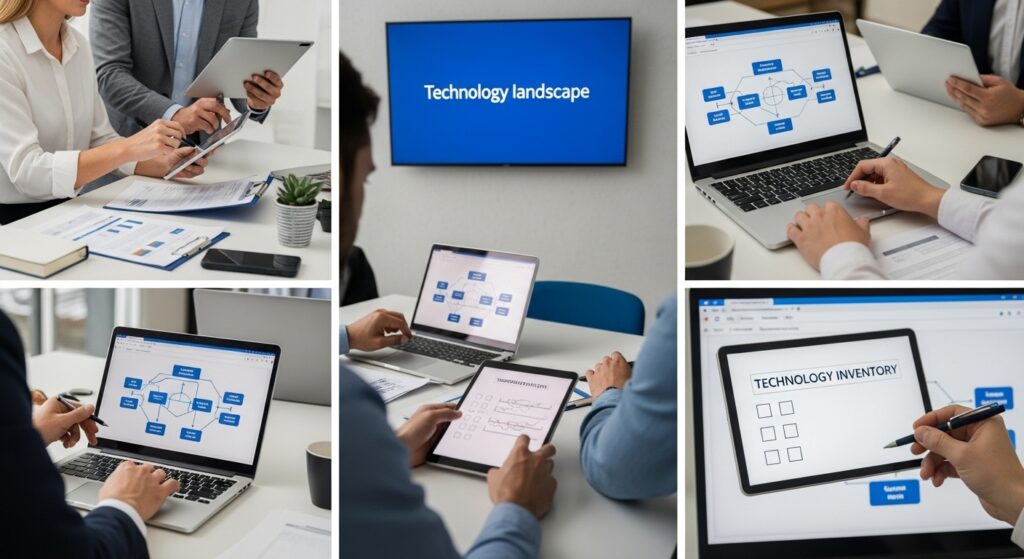
Most Miami doctors, lawyers, and accountants treat IT as a necessary expense, something to fix when it breaks and forget about the rest of the time. That mindset is quietly costing you revenue. SMEs with strategic IT planning show up to 20% improvement in operational efficiency, cost reduction, and competitive advantage. This guide walks you through what strategic IT planning actually means, why it matters for your practice in Miami’s competitive market, and how to build a plan that turns your technology into a genuine profit driver.
Table of Contents
- What is strategic IT planning?
- Why Miami professionals need IT strategy: Key business impacts
- The critical components of a strategic IT plan
- Common pitfalls and edge cases in IT planning
- Agility vs. long-term planning: Choosing the right strategic approach
- Getting started: Steps for effective strategic IT planning in Miami
- Expert support for Miami’s strategic IT journey
- Frequently asked questions
Key Takeaways
| Point | Details |
|---|---|
| Strategic IT drives profit | With planning, technology shifts from being a cost to a growth driver for Miami professionals. |
| Proven business impact | Case studies reveal up to 300% productivity growth and doubled turnover through IT strategy. |
| Plan beats reaction | Reactive IT causes cost overruns, while structured planning ensures efficiency and scalability. |
| Modern methods work best | Agile, outcome-focused approaches now outperform rigid long-term IT roadmaps. |
What is strategic IT planning?
Strategic IT planning is a long-term, systematic approach to aligning your technology with your business goals. It is not calling your IT guy when the server goes down. It is not buying new software because a vendor pitched it well. It is a deliberate process of evaluating where your practice is, where you want it to go, and mapping the technology investments that get you there.
Most professionals operate in reactive mode, also called “firefighting.” Something breaks, you fix it. A client complains about slow service, you upgrade a tool. This approach is expensive and unpredictable. Strategic IT planning replaces that chaos with a roadmap.
Here is what a strategic approach actually covers:
- Current state assessment: An honest audit of your systems, workflows, and gaps
- Business alignment: Connecting every technology decision to a revenue or efficiency goal
- Prioritization: Ranking investments by ROI, not urgency
- Phased roadmap: A sequenced plan with milestones and measurable outcomes
- Ongoing review: Regular check-ins to adapt as your practice grows
“Strategic IT planning is not a one-time project. It is a continuous discipline that keeps your technology working for your business, not against it.”
Firms that commit to this approach access essential IT services that go far beyond technical support, including growth enablement, compliance readiness, and innovation capacity. The 20% efficiency improvement documented in SME research is not accidental. It is the direct result of planning over patching.
Why Miami professionals need IT strategy: Key business impacts
Miami is not a slow market. The competition among accounting firms, law practices, and medical groups is intense, and small operational gaps translate directly into lost clients and lost revenue. Strategic IT planning closes those gaps before they cost you.
Consider what happened to one accounting firm that committed to a full IT transformation. The results were striking: a 300% productivity increase, doubled turnover without adding office space or headcount, and near-zero downtime. That is not a technology story. That is a business growth story enabled by technology.
What strategic IT delivers for Miami professionals:
- Operational cost reduction of up to 20%
- Faster client service and higher retention rates
- Compliance readiness for HIPAA, legal data protection, and financial regulations
- Scalability to take on larger clients without proportional hiring
- Resilience against outages, breaches, and data loss
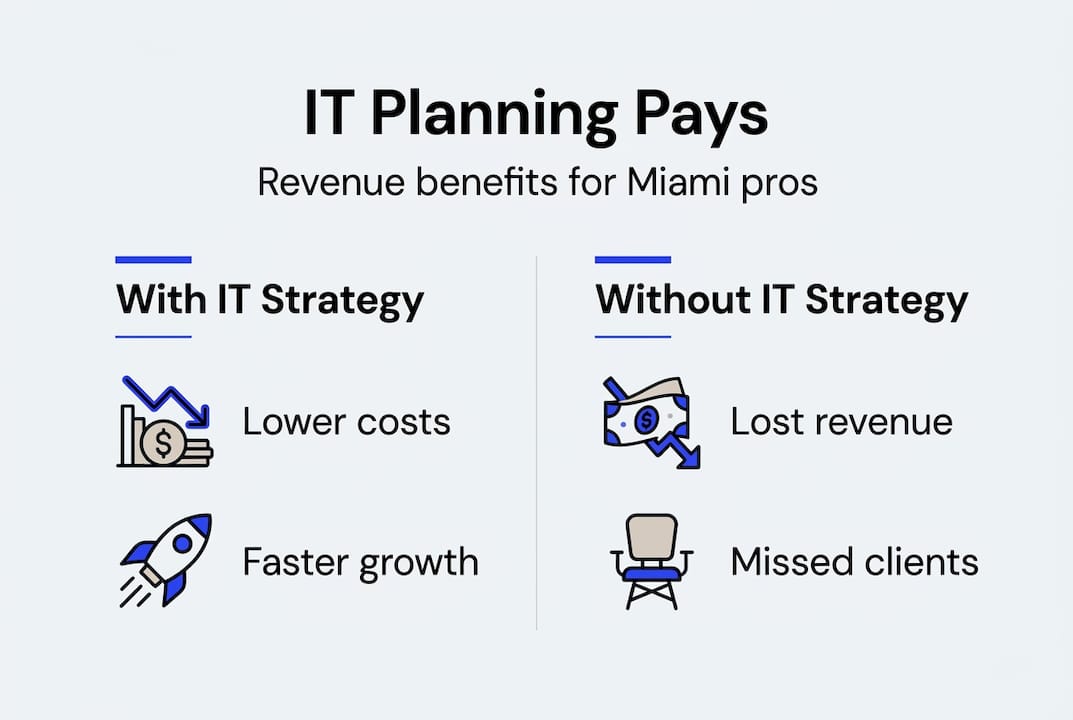
| Business area | Without IT strategy | With IT strategy |
|---|---|---|
| Operational costs | Unpredictable, reactive | Reduced by up to 20% |
| Client service speed | Inconsistent | Streamlined and reliable |
| Compliance posture | Reactive and risky | Proactive and documented |
| Growth capacity | Limited by current systems | Scalable on demand |
| Downtime risk | Frequent and costly | Near-zero with planning |
For Miami professionals exploring business transformation consulting, the data is clear: technology strategy is not optional if you want to compete at the highest level. Understanding business transformation efficiency and applying a digital transformation workflow are the practical next steps after recognizing the opportunity.
The critical components of a strategic IT plan
Those impressive results only come from a plan built on proven components. There is no shortcut here. A checklist approach, where you tick boxes without connecting decisions to outcomes, produces mediocre results at best.
A proven strategic IT plan follows this sequence:
- SWOT analysis and IT audit: Identify strengths, weaknesses, opportunities, and threats in your current technology environment. Find the bottlenecks before they find you.
- Business alignment with a vCIO: A virtual Chief Information Officer (vCIO) bridges the gap between your business goals and your technology decisions. This is the step most firms skip, and it is the most important one.
- ROI-based prioritization: Not every improvement is equal. Score each initiative by its expected return, and fund the highest-impact items first.
- Phased roadmap creation: Break the plan into stages: quick wins, core infrastructure, and long-term expansion. Each phase has clear milestones.
- Iterative implementation with KPIs: Launch in stages, measure results, and adjust. Methodical frameworks like this ensure you stay on track and can prove the value of every investment.
Pro Tip: Do not wait until your practice is struggling to start the audit phase. The best time to assess your IT environment is when things are running smoothly, because that is when you can see clearly what is working and what is quietly holding you back.
Working with vCIO services gives your firm access to executive-level technology strategy without the cost of a full-time hire. For most Miami professionals, this is the single highest-leverage investment in their IT planning process.

Common pitfalls and edge cases in IT planning
Even the best intentions fail when common traps take over. Knowing what to avoid is just as important as knowing what to do.
The numbers here are sobering. Reactive IT planning causes an average of 45% cost overruns compared to proactive planning. And 70% of IT transformations fail due to poor data quality, lack of stakeholder buy-in, or missing change management. Without CIO-level input, the odds are stacked against you.
Here are the pitfalls that derail Miami professionals most often:
- Skipping the audit: Jumping to solutions without understanding the current state wastes money and creates new problems
- Tool-first thinking: Buying software before mapping your workflow guarantees misalignment
- No executive sponsorship: IT projects without leadership buy-in stall at implementation
- Ignoring scalability: A system that works for 10 clients may collapse under 50
- Treating compliance as an afterthought: For doctors, lawyers, and accountants, regulatory risk is business risk
“The firms that struggle most with IT are not the ones with bad technology. They are the ones with no strategy guiding their technology decisions.”
Pro Tip: Before committing to any new IT investment, ask one question: which specific business outcome does this support? If you cannot answer clearly, the investment is not ready.
For practices that want to avoid these traps, working with IT consulting for CPA firms or accessing broader IT consulting services provides the outside perspective that prevents costly mistakes. Smart IT budgeting insights also help you allocate resources where they generate the highest return.
Agility vs. long-term planning: Choosing the right strategic approach
Here is a debate worth having: should you build a rigid five-year IT master plan, or stay flexible and adapt as you go? The answer is neither extreme.
Tool-first approaches fail consistently, while workflow-audit-first approaches succeed. Rigid five-year roadmaps often become outdated before they are finished. Agile frameworks using OKRs (Objectives and Key Results) and VRIO analysis (Value, Rarity, Imitability, Organization) are outperforming traditional long-range planning in professional services firms.
| Approach | Strengths | Weaknesses |
|---|---|---|
| Rigid 5-year plan | Clear long-term vision | Becomes outdated quickly |
| Pure agile iteration | Highly adaptable | Can lose strategic direction |
| Hybrid (recommended) | Balances vision with flexibility | Requires disciplined review cycles |
For Miami professionals, the hybrid model works best. You maintain a North Star vision, which is the business outcome you are building toward, while pursuing small, high-impact wins in 90-day cycles. This keeps your team motivated, your clients satisfied, and your strategy relevant.
- Set a clear 2 to 3 year technology vision tied to revenue goals
- Break it into quarterly priorities with measurable outcomes
- Review and adjust every 90 days based on real performance data
- Use each win to build momentum and internal confidence in the strategy
Firms using IT services for scaling find that this hybrid approach lets them grow without the chaos of reactive decision-making.
Getting started: Steps for effective strategic IT planning in Miami
Ready to move from reactive to strategic? Here is a practical sequence that works for Miami doctors, lawyers, and accountants.
- Conduct a full IT audit: Document every system, workflow, and pain point. Be honest about what is working and what is not.
- Align with a vCIO: Bring in executive-level strategy to connect your technology decisions to your business goals. Virtual CIO services make this accessible without a full-time hire.
- Score initiatives by ROI: Rank every potential improvement by its expected business impact. Fund the top items first.
- Build a phased roadmap: Create a sequenced plan with quick wins in the first 90 days, core improvements in months four through nine, and expansion initiatives beyond that.
- Launch iteratively: Implement in stages, measure KPIs at each milestone, and adjust based on real data. Methodical implementation with defined KPIs is what separates successful transformations from expensive experiments.
- Schedule regular reviews: Set quarterly check-ins to assess progress, reprioritize, and keep the strategy aligned with your evolving business goals.
Pro Tip: Your first 90 days should focus entirely on quick wins, improvements that are low cost, high impact, and visible to your team and clients. Early momentum builds the internal confidence that sustains the longer-term strategy.
Miami professionals who follow this sequence consistently report faster client onboarding, fewer operational bottlenecks, and stronger revenue growth within the first year.
Expert support for Miami’s strategic IT journey
If this guide has shown you one thing, it is that strategic IT planning is not a solo project. It requires the right frameworks, the right expertise, and a partner who understands both technology and the business realities of running a professional practice in Miami.
We work exclusively with doctors, lawyers, and accountants in Miami to build technology strategies that drive real revenue growth. Our clients have seen productivity triple, turnover double, and compliance risks eliminated, all without proportional increases in headcount or overhead. Whether you need Miami technology solutions to modernize your infrastructure or a full business transformation for Miami CPAs and professional practices, we bring the strategic expertise and hands-on support to make it happen. Reach out for a tailored IT assessment and start building the technology advantage your practice deserves.
Frequently asked questions
What is the main goal of strategic IT planning for independent professionals?
The main goal is to align your technology with your business objectives, driving revenue, efficiency, and long-term growth. SMEs with strategic IT planning consistently show measurable improvements in both operational performance and competitive positioning.
How does strategic IT planning reduce costs for small firms?
By proactively identifying inefficiencies and prioritizing high-impact improvements, costs can drop by up to 20%. Reactive IT, by contrast, generates unpredictable expenses and frequent emergency spending.
What is the biggest risk of skipping strategic IT planning?
The biggest risks are cost overruns and stalled projects. 70% of IT transformations fail without proper planning, stakeholder buy-in, and executive-level guidance.
What frameworks or methodologies support successful IT planning?
Effective approaches include SWOT analysis, business alignment with a vCIO, ROI-based prioritization, and KPI monitoring at every phase. These methodologies create a structured path from audit to measurable business outcomes.