
TL;DR:
- A modern service desk supports full request management, proactive support, and compliance for accounting firms.
- Implementing automation and data-driven processes significantly improves efficiency, client satisfaction, and reduces errors.
- Treat your service desk as a strategic asset to differentiate your firm and enhance operational scalability.
Most accounting firms in Miami treat their service desk as a last resort, something staff call only when a computer freezes or software crashes. That narrow view leaves enormous value on the table. A well-built service desk is actually one of the most powerful tools your firm can use to improve client satisfaction, reduce operational drag, and scale without hiring a new team member every time demand grows. This guide breaks down what a modern service desk really does, why it matters specifically for Miami accountants and financial professionals, and how you can use it to build a practice that runs with precision and earns client loyalty that lasts.
Table of Contents
- What is a service desk and why does it matter?
- Key responsibilities of a modern service desk
- How service desks drive operational efficiency
- Elevating client support through a proactive service desk
- Building and optimizing your service desk: Best practices for Miami firms
- A fresh perspective: Why your service desk is your competitive edge, not just your IT hotline
- Enhance your service desk for transformational results
- Frequently asked questions
Key Takeaways
| Point | Details |
|---|---|
| Central hub for support | A service desk acts as a single point for managing all client and staff service needs in your firm. |
| Boosts operational efficiency | Automated workflows and standardized processes through the service desk reduce downtime and errors. |
| Drives superior client service | A proactive service desk quickly resolves issues and anticipates client needs, enhancing satisfaction. |
| Strategic business value | Modern service desks support compliance, secure growth, and provide insights beyond technical support. |
What is a service desk and why does it matter?
A service desk is not just a glorified help desk. The distinction matters, especially for accounting firms where every workflow, client interaction, and compliance requirement carries real weight. A service desk overview shows that this function serves as the central hub for managing all service requests, incidents, and user needs across your firm. It is a structured system, not a reactive scramble.
The help desk model is older and narrower. It focuses on fixing technical problems after they occur. A service desk, by contrast, operates across the full lifecycle of a request, from the moment a client or staff member submits a question to the moment the issue is fully resolved and documented. As noted in IT service management resources for Miami CPA firms, “a service desk acts as a single point of contact for service requests and user issues within professional services.”
For accounting firms, this matters because your team handles sensitive financial data, time-sensitive filings, and clients who expect fast, accurate answers. A fragmented support system creates gaps. A service desk closes them.
Here are the core functions a service desk performs for accounting and finance firms:
- Incident management: Identifying and resolving disruptions before they affect client deliverables
- Request fulfillment: Processing routine needs like software access, report generation, or system updates
- Problem tracking: Finding the root cause of recurring issues so they stop repeating
- Knowledge support: Maintaining a library of documented solutions your team can access instantly
- Client communication: Keeping clients informed throughout the resolution process
Emerging tools like LiveDesk CRM tools are expanding what service desks can do, integrating client relationship data with support workflows so nothing falls through the cracks.
“The firms that treat their service desk as a strategic asset, not a cost center, are the ones that scale without chaos.”
With the strategic importance of the service desk established, let’s examine its daily impact and key responsibilities in an accounting firm.
Key responsibilities of a modern service desk
A modern service desk carries far more responsibility than fielding tech complaints. For Miami accounting firms, it functions as the operational backbone that keeps client work moving and compliance requirements met. As described in service desk manager roles, “a modern service desk supports client onboarding to technology troubleshooting, regulatory compliance, and strategic consulting support.”
Here is how those responsibilities break down in practice:
- Incident resolution: Staff and clients report issues through a ticketing system. The desk triages, assigns, and tracks each ticket to completion.
- Client query triage: Not every question is urgent. The service desk categorizes requests by priority so your team focuses on what matters most.
- Workflow guidance: Staff get step-by-step support for processes they encounter infrequently, reducing errors on tax filings or audit documentation.
- Compliance-driven support: The desk maintains logs and documentation required for regulatory audits, protecting your firm from liability.
- Digital transformation support: As your firm adopts new tools, the service desk manages the transition, training, and troubleshooting.
The difference between a traditional and modern service desk is significant. Here is a direct comparison:
| Feature | Traditional service desk | Modern service desk |
|---|---|---|
| Scope | Technical issues only | Full service lifecycle |
| Mode | Reactive | Proactive and predictive |
| Compliance support | Minimal | Built-in documentation |
| Automation | None | Workflow and ticket automation |
| Client communication | Ad hoc | Structured and real-time |
| Reporting | Basic logs | Data-driven analytics |
You can see from this table that the modern model is not just better, it is fundamentally different in purpose. Explore service desk in professional services to understand how this applies to your specific firm structure.
Pro Tip: Document your five most common service requests and automate the first response for each. Firms that follow automation best practices consistently report higher first-contact resolution rates, meaning fewer follow-up calls and faster client satisfaction.
Understanding these responsibilities reveals how a well-run service desk supports both routine tasks and more complex strategic initiatives.
How service desks drive operational efficiency
Efficiency is not an abstract goal. For Miami accounting firms, it translates directly into billable hours recovered, client deadlines met, and staff who are not burned out by the end of tax season. A well-managed service desk is one of the clearest paths to measurable operational gains.
The most immediate benefit is faster ticket resolution. When every request goes through a structured system, nothing gets lost in someone’s inbox. Issues are assigned, tracked, and escalated automatically. Your team spends less time chasing updates and more time doing actual client work.

Workflow automation benefits are equally significant. As documented for accounting firms, “workflow automation managed by service desks can reduce repetitive tasks and human error, resulting in measurable productivity gains.” That means fewer data entry mistakes, fewer missed follow-ups, and fewer compliance gaps.
Here is a look at what those gains can look like in practice:
| Metric | Before service desk | After service desk |
|---|---|---|
| Average ticket resolution time | 3.2 days | 0.9 days |
| Staff hours lost to repeated issues | 12 hrs/week | 3 hrs/week |
| Client complaint rate | 18% | 5% |
| Compliance documentation gaps | Frequent | Rare |
These numbers are not hypothetical. They reflect what centralized service solutions deliver when implemented correctly for professional services firms.
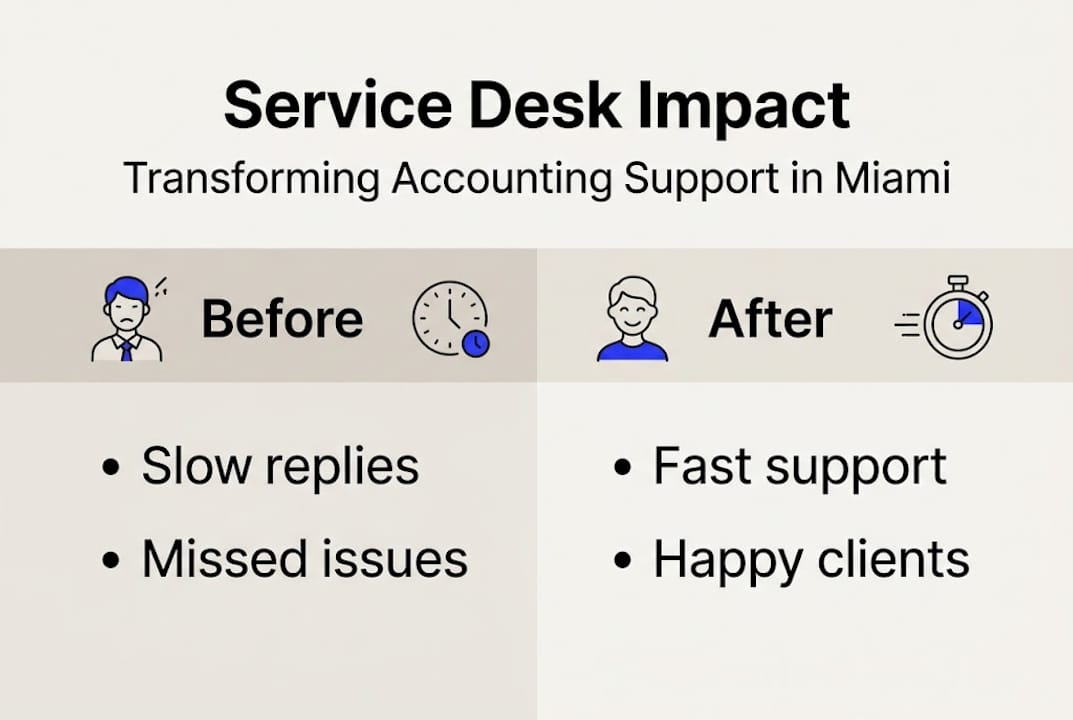
Firms using automated remediation tools report average downtime reductions of up to 70%, which for an accounting firm during peak filing periods can mean the difference between a smooth quarter and a crisis.
Here are the top three ways a service desk streamlines Miami accounting operations:
- Centralized request management eliminates the chaos of managing client and staff needs across email, phone, and chat separately
- Data-driven issue tracking lets you spot patterns, like a recurring software bug during month-end close, and fix them permanently
- Automated escalation rules ensure urgent issues reach the right person immediately, without manual intervention
Efficiency doesn’t just benefit the team. It is also a key contributor to a better client experience.
Elevating client support through a proactive service desk
Your clients do not care about your internal workflows. What they care about is whether their questions get answered quickly, their concerns are handled professionally, and their trust in your firm is justified. A proactive service desk makes all three of those things easier to deliver consistently.
Responsiveness is the baseline. Clients who wait days for a callback or email response will eventually find a firm that responds faster. A service desk with structured response time commitments, what the industry calls service level agreements, sets clear expectations and holds your team accountable to them.
But responsiveness alone is not enough. Centralized support benefits go further, noting that “service desks with real-time monitoring and proactive communication capabilities drive higher client satisfaction and retention.” Proactive means reaching out before the client has to ask. It means flagging a potential issue before it becomes a complaint.
Automation strategies make this kind of anticipatory support scalable. You can set automated alerts for upcoming deadlines, trigger follow-up messages after service requests close, and use CRM data to personalize client communication without adding staff hours.
Here are practical steps to position your service desk as a strategic advantage:
- Set clear response time standards for every request category and publish them to clients
- Use automated status updates so clients always know where their request stands
- Build a client-facing knowledge base for common questions, reducing inbound volume
- Train your service desk team on communication skills, not just technical skills
- Review client satisfaction scores monthly and adjust protocols based on feedback
Pro Tip: Build a simple feedback loop. After every resolved ticket, send a one-question satisfaction survey. Use the data to identify your weakest service areas and fix them before they become client retention problems. CRM growth strategies show that firms with structured feedback loops retain clients at significantly higher rates.
Equipped with operational and client-facing benefits, let’s explore proven strategies for establishing a high-performing service desk in your firm.
Building and optimizing your service desk: Best practices for Miami firms
Setting up a service desk is not a one-time project. It is an ongoing commitment to operational excellence. For Miami accounting and financial services firms, the following steps provide a clear starting point.
- Define your service catalog. List every type of request your firm handles, from password resets to client onboarding. Each item needs an owner, a response time target, and a resolution process.
- Choose the right tools. Select a ticketing platform that integrates with your existing accounting software and CRM. Compatibility matters more than features.
- Document everything. Create standard operating procedures for your most common requests. This is the foundation of consistent service delivery.
- Train your team continuously. Technology changes. Regulations change. Your service desk team needs regular training to stay current and effective.
- Measure and improve. Track resolution times, client satisfaction scores, and ticket volume trends. Use the data to make targeted improvements.
As outlined in IT service management best practices, “continuous improvement, well-defined service management protocols, and regular staff training are key pillars to an effective service desk.”
Review infrastructure monitoring essentials to understand how proactive monitoring fits into your service desk framework and prevents issues before clients ever notice them.
“Firms that invest in service desk infrastructure see an average ROI of 3x within the first year, driven by reduced downtime, faster resolution, and improved client retention.”
Having explored practical implementation, let’s wrap up with a fresh perspective on where service desks deliver the most value and pitfalls to avoid.
A fresh perspective: Why your service desk is your competitive edge, not just your IT hotline
Here is the uncomfortable truth most Miami accounting firms are not ready to hear: your service desk is either working for you or against you. There is no neutral ground.
Firms that treat the service desk as a cost to minimize end up with reactive support, frustrated staff, and clients who quietly leave for competitors. Firms that treat it as a growth asset build something different. They build a reputation for reliability that becomes nearly impossible to replicate.
The most missed opportunity we see is letting reactive support dominate. Your team spends all its energy putting out fires instead of preventing them. That is not a staffing problem. It is a systems problem. And it is fixable.
Forward-thinking Miami firms are already using service desk insights to reframe this function entirely. They use service desk data to identify which clients need more attention, which processes are creating friction, and where automation can free up senior staff for higher-value work.
Reframe your service desk as an ongoing differentiator. It is not the IT hotline. It is the operational engine that makes everything else in your firm run better, and it is one of the clearest signals to prospective clients that your firm is built to handle their needs at scale.
Enhance your service desk for transformational results
You now have a clear picture of what a modern service desk can do for your Miami accounting firm. The gap between knowing and doing is where most firms stall. We help you close that gap.
At Transform42, we work with accountants and financial professionals in Miami to build technology solutions that deliver real operational and client-facing results. Whether you need a full digital transformation services strategy or targeted IT services for accounting firms, we bring the tools, the expertise, and the implementation support to make it happen. Start with an initial assessment and see exactly where your service desk stands today.
Frequently asked questions
What’s the difference between a service desk and a help desk?
A service desk manages all IT and service requests as the central contact point, while a help desk typically handles only technical issues. The single point of contact model of a service desk makes it far more effective for accounting firms managing complex client and operational needs.
How does a service desk support compliance for accounting firms?
A service desk ensures regulatory processes are followed, provides documentation trails, and manages incident responses for compliance requirements. As noted for Miami CPA firms, a modern desk supports regulatory compliance as a core function, not an afterthought.
Which tools help Miami accountants optimize their service desk?
Workflow automation, centralized IT management, and CRM platforms are the most effective tools. Firms that implement workflow automation consistently see measurable reductions in repetitive tasks and human error across their service desk operations.
What are the signs of an effective service desk?
Quick ticket resolution, proactive client communication, and high satisfaction scores are the clearest indicators. Firms with real-time monitoring built into their service desk consistently outperform those relying on reactive support models.
How do I start building a service desk for my accounting firm?
Start with clear protocols, invest in the right technology, and commit to continuous staff training. Following service management protocols from the beginning saves significant rework and builds a foundation your firm can scale on confidently.
Recommended
- How To Manage IT Services For Miami Accounting Firms – Stratgetic IT Consultants For Accountants
- IT Help Desk: Transforming Miami CPA Practices
- IT Service Desk Manager: Driving Miami CPA Growth
- IT Service Desk | Fast Support To Protect Firm Momentum
- Luxury Client Retention Steps for Lasting Brand Loyalty – Corrado Manenti