TL;DR:
- Zero trust security offers Miami CPAs a high ROI and significantly reduces breach risks.
- Implementing zero trust involves phased steps like identity management, device security, microsegmentation, and monitoring.
- Adopting zero trust enhances trust, compliance, and opens new revenue opportunities for accounting firms.
Zero trust security was once considered the exclusive domain of Fortune 500 IT departments. That assumption is costing independent CPAs and financial advisors real money. 210% ROI over three years and an 80% reduction in breach exposure are numbers your firm can realistically achieve, regardless of size. This guide breaks down what zero trust actually means for Miami accounting professionals, how it aligns with your compliance obligations, and how to roll it out in phases without disrupting your practice. You will also see how advanced security can become a direct driver of revenue growth, not just a line item on your IT budget.
Table of Contents
- What is zero trust security and why does it matter for CPAs?
- Key business and compliance benefits for Miami professionals
- Zero trust implementation: Best practices for small firms
- Overcoming challenges: Practical tips for Miami CPAs
- Why zero trust security is the revenue growth secret Miami CPAs underestimate
- Get expert help accelerating zero trust adoption in your firm
- Frequently asked questions
Key Takeaways
| Point | Details |
|---|---|
| ROI and breach reduction | Zero trust delivers strong financial returns and slashes security incidents for Miami CPAs. |
| Practical phased adoption | A staged rollout beginning with high-risk assets makes zero trust achievable for even small firms. |
| Compliance advantages | Zero trust frameworks clarify and simplify audit and regulatory processes. |
| Revenue growth opportunity | Firms with visible zero trust controls can differentiate and monetize premium security for clients. |
What is zero trust security and why does it matter for CPAs?
Zero trust is a security model built on one core rule: never trust, always verify. Every user, device, and access request is treated as potentially compromised until proven otherwise. There are no free passes based on being inside the office network or using a company laptop.
Traditional perimeter security assumes that anything inside your network is safe. That model made sense when everyone worked from one office and data lived on a single server. Today, your staff accesses QuickBooks from home, clients upload documents through a web portal, and your tax software runs in the cloud. The perimeter no longer exists.
“Zero trust focuses on ‘never trust, always verify’—every user, device, and request must be authenticated and authorized before gaining access to any resource.”
For Miami CPAs, the stakes are especially high. You handle Social Security numbers, tax returns, bank statements, and business financials for dozens or hundreds of clients. A single breach can trigger IRS reporting obligations, Florida data breach notification laws, and potential liability claims. Remote staff and contract workers add more access points that traditional security simply cannot cover.
Here is what zero trust protects in a typical CPA or advisory firm:
- Client portals used for secure document exchange
- Tax preparation software like Drake, Lacerte, or UltraTax
- Cloud storage containing financial records and workpapers
- Email systems where sensitive data is frequently transmitted
- Staff devices, including personal laptops used for remote work
If you want a deeper look at how this applies specifically to your practice, the zero trust for accountants guide covers the full picture. Understanding the model is the first step. Seeing the business case is what makes it worth acting on.
Key business and compliance benefits for Miami professionals
Let’s talk numbers first. According to empirical benchmarks, Miami CPAs can see 210% ROI, 80% fewer breaches, and 63% lower risk exposure from zero trust adoption over a three-year period. That is not a theoretical projection. Those figures reflect real-world deployments across financial services firms.
Zero trust ROI snapshot for small accounting firms
| Metric | Without zero trust | With zero trust |
|---|---|---|
| Breach exposure | High | Reduced by up to 80% |
| Threat detection time | Days to weeks | Up to 40% faster |
| InfoSec workload | Reactive, high cost | Proactive, streamlined |
| Compliance audit prep | Manual, time-intensive | Documented, audit-ready |
| Client trust level | Assumed | Demonstrable |
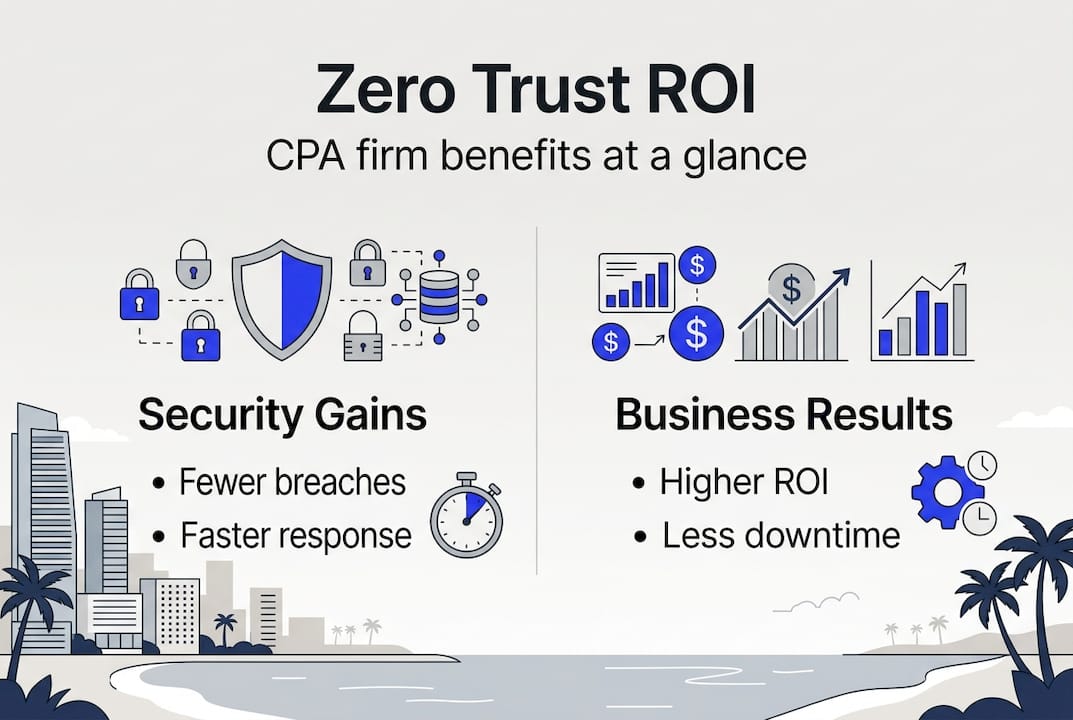
From a regulatory standpoint, zero trust maps directly to requirements under IRS Publication 4557 (safeguarding taxpayer data), the FTC Safeguards Rule, and Florida’s data breach notification statute. Documented access controls and continuous monitoring give you concrete evidence during audits instead of scrambling to reconstruct logs after the fact.
Here is how zero trust creates compounding business value for your firm:
- Faster threat detection reduces the window of exposure, cutting potential liability and client downtime.
- Documented controls make compliance audits faster and less stressful.
- Visible security posture builds client confidence, supporting retention and referrals.
- Premium service positioning lets you offer compliance-aware advisory services at higher fees.
- Reduced breach costs protect your firm from the average $4.45 million cost of a data breach in financial services.
For context on what local firms are actually facing, the Florida CPAs breach stats page shows how exposure is trending in your market. The compliance and financial case is clear. Now let’s look at how to actually build it.
Zero trust implementation: Best practices for small firms
The most common mistake small firms make is trying to implement everything at once. Zero trust is not a product you install. It is a strategy you build in layers, and the sequence matters.
Industry experts recommend phased adoption: start with identity, then move to device posture, then microsegmentation, then continuous monitoring. Each phase builds on the last and delivers standalone value, so you are protected even before the full model is in place.
Here is a practical rollout sequence for a Miami CPA firm:
- Phase 1: Identity and access management (IAM). Deploy multi-factor authentication (MFA) across all systems. Set role-based access so staff only reach the data they need. This alone eliminates a large share of credential-based attacks.
- Phase 2: Device security. Implement endpoint detection and response (EDR) tools to monitor and control devices accessing firm data. Enforce minimum security standards for remote devices.
- Phase 3: Microsegmentation. Divide your network into isolated zones so a breach in one area cannot spread to client data or financial systems.
- Phase 4: Continuous monitoring. Use security information and event management (SIEM) tools to detect anomalies in real time and automate alerts.
For prioritization, start with high-risk assets like client portals and tax software before expanding to lower-sensitivity systems. This keeps your most valuable data protected from day one.

Tool comparison for small CPA firms
| Tool category | Purpose | Example tools |
|---|---|---|
| MFA/IAM | Identity verification | Microsoft Entra, Okta |
| EDR | Device protection | CrowdStrike, SentinelOne |
| ZTNA | Secure remote access | Zscaler, Cloudflare Access |
| SIEM | Monitoring and alerts | Microsoft Sentinel, Splunk |
Pro Tip: Do not try to measure progress by tools deployed. Measure by access policies enforced and incidents detected. A firm with three tools used correctly outperforms one with ten tools configured poorly.
For a full breakdown of what each phase involves, the zero trust explained for CPAs resource walks through each layer in plain language.
Overcoming challenges: Practical tips for Miami CPAs
Even with a solid plan, most firms hit the same three roadblocks: cost concerns, staff resistance, and technical gaps. None of these are deal-breakers if you approach them strategically.
Cost is usually the first objection. The good news is that small firms can leverage managed IT and prioritize high-value assets to keep initial investment manageable. MFA tools, for example, often cost less than $5 per user per month and deliver immediate risk reduction. You do not need to build a security operations center to start benefiting from zero trust principles.
Staff resistance is real, especially when new login requirements feel like friction. The fix is framing. When your team understands that these controls protect client data and the firm’s reputation, adoption improves significantly. A one-hour training session covering why zero trust exists and what it means day-to-day goes a long way.
Here are the quick wins that deliver the fastest return:
- Enable MFA on all email, tax software, and client portal accounts immediately
- Implement privileged access management (PAM) to restrict admin-level access
- Document your current access policies in writing, even if they are informal
- Review and revoke access for former staff or contractors right away
- Set a quarterly review schedule for access permissions
Technical gaps are best addressed through a managed service provider (MSP) that specializes in financial services. You should not need to become a cybersecurity expert to protect your firm. The right partner handles configuration, monitoring, and updates while you focus on client work.
Pro Tip: Start your zero trust rollout during a slower period in your tax calendar, not during busy season. January or the post-October extension period gives your team time to adjust without pressure.
For a step-by-step walkthrough of the full process, the in-depth zero trust guide covers every stage. If you are also thinking about broader technology upgrades, scaling CPA firm technology shows how security fits into a larger modernization strategy.
Why zero trust security is the revenue growth secret Miami CPAs underestimate
Most CPAs treat security as a compliance checkbox. Pay for it, document it, and move on. That mindset leaves significant revenue on the table.
We have seen firms in Miami use their zero trust posture as a direct marketing asset. When you can tell a prospective client, “We use enterprise-grade access controls and continuous monitoring to protect your financial data,” you are no longer competing on price. You are competing on trust. That is a much better position.
Clients who view your firm as a security-conscious partner are less likely to shop around and more likely to refer you to peers. The tech strategy for revenue growth framework we use with Miami professionals shows that documented security controls directly support premium fee structures and advisory service expansion.
Zero trust also enables new service lines. Compliance-as-a-service, data stewardship advisory, and cybersecurity risk assessments for small business clients are all offerings that a zero trust-enabled firm can credibly provide. Security is not overhead. It is infrastructure for growth.
Get expert help accelerating zero trust adoption in your firm
Ready to turn zero trust into a business asset? We work with independent CPAs and financial advisors in Miami to build tailored zero trust frameworks that align security upgrades with real revenue growth.
Our team handles the technical heavy lifting so you can focus on your clients. From identity management and device security to compliance documentation and staff training, we integrate everything into one cohesive strategy. Explore the full range of essential IT services for accounting firms or browse our digital transformation resources to see how Miami professionals are scaling smarter. Contact us to schedule a consultation and take the first step toward a more secure, more profitable practice.
Frequently asked questions
Can small CPA firms afford to implement zero trust security?
Yes. Phased zero trust adoption focused on high-risk assets lets even small firms capture meaningful protection without large upfront costs, especially when paired with a managed IT partner.
How fast can zero trust reduce breach risks for Miami CPAs?
Many firms see measurable results within months. Annual benchmarks show 80% breach exposure reduction and 40% faster threat detection after implementing core zero trust controls.
What are the first zero trust steps for a CPA firm?
Begin with identity verification by deploying MFA and IAM, then secure high-risk assets like client portals and tax software before expanding to other systems.
Does zero trust security help with compliance audits?
Absolutely. Zero trust produces documented access controls and audit logs that make it far easier to prove compliance with IRS, FTC, and Florida state requirements during formal reviews.