
TL;DR:
- Managed services help Miami legal and medical practices reduce downtime, improve compliance, and protect revenue. They offer proactive IT management, tailored local support, and clear contracts to prevent operational and regulatory risks. Partnering with a local provider enhances response times and aligns technology with your practice’s growth goals.
Running a medical practice or law firm in Miami means every hour counts. Yet most doctors and lawyers in this city quietly bleed time and money each month on IT disruptions, compliance tasks, and system failures they never budgeted for. Studies show that unplanned downtime costs businesses an average of $5,600 per minute in lost productivity and missed revenue. The professionals who switch to managed services stop absorbing these losses and start redirecting that energy toward clients, patients, and growth. This article breaks down exactly what managed services offer, why local expertise matters in Miami, and how to choose the right fit for your practice.
Table of Contents
- The hidden costs of managing IT and compliance in-house
- What managed services actually deliver: More than just IT support
- Local Miami advantages: Rapid response and tailored compliance
- Key contract factors: Fees, clinical/legal control, and compliance
- What most Miami professionals miss when choosing managed services
- Enhance your practice with Miami-focused managed services
- Frequently asked questions
Key Takeaways
| Point | Details |
|---|---|
| Managed services save time | They eliminate operational headaches so professionals can focus on growing their practice. |
| Compliance made easy | Specialized providers reduce risk by handling HIPAA and legal rules without in-house burden. |
| Local expertise matters | Miami-based managed service providers deliver faster support and tailored compliance solutions. |
| Choose contracts carefully | Flat fees and retained decision authority shield you from common legal and medical pitfalls. |
The hidden costs of managing IT and compliance in-house
To understand why managed services make such a difference, let’s first look at the burden of handling IT and compliance inside your firm or practice.
Most doctors and lawyers underestimate what in-house IT management actually costs. It is not just the hourly rate of a technician or the price of software licenses. It is the cumulative drag on your most valuable resource: your time. Every hour you spend troubleshooting a server issue, chasing a compliance deadline, or training staff on a new system is an hour you are not billing or treating patients.
Consider a realistic monthly breakdown:
| Task | Hours lost per month | Estimated cost at $400/hr billable rate |
|---|---|---|
| IT troubleshooting | 6 hours | $2,400 |
| Compliance documentation | 5 hours | $2,000 |
| Staff IT training | 3 hours | $1,200 |
| Vendor management | 2 hours | $800 |
| Security reviews | 2 hours | $800 |
| Total | 18 hours | $7,200 |
That is over $86,000 in potential annual revenue walking out the door, simply because your team is handling tasks that could be managed elsewhere. And this does not account for downtime events, data breaches, or failed audits, which carry their own steep penalties.
In-house management also creates skills gaps that are hard to close. Healthcare and legal compliance evolve constantly. HIPAA and regulatory requirements grow more demanding each year, and the average IT generalist simply does not have the specialized knowledge to keep pace. A law firm that relies on a single in-house tech person is one employee departure away from a compliance crisis.
“Organizations without dedicated compliance support face up to 3x greater risk of a reportable data breach, according to IBM’s 2023 Cost of a Data Breach Report. For regulated industries like healthcare and law, the financial fallout extends far beyond IT remediation costs.”
The opportunity costs are equally significant. A medical practice that experiences even two hours of EHR system downtime in a week may miss four to six patient appointments. A law firm that loses access to its document management platform during a filing deadline faces far worse consequences. Understanding the basics of managed IT services is the first step to recognizing how much of this risk is preventable.
Common signs your practice is absorbing too much operational drag:
- Staff regularly interrupt clinical or legal work to report tech problems
- Your compliance documentation is inconsistent or handled ad hoc
- You rely on one person who “handles IT” in addition to other duties
- You have experienced at least one unplanned system outage in the past 12 months
- Your cybersecurity practices have not been formally audited in over a year
If three or more of these describe your practice, the cost of doing nothing is almost certainly higher than the cost of change.
What managed services actually deliver: More than just IT support
Now that you have seen the hidden downsides of the DIY approach, let’s clarify what professional managed services can cover.
The word “managed services” gets used loosely, so it is worth being specific. For Miami doctors and lawyers, a strong managed services provider does not just fix computers. They take on the operational infrastructure of your practice so you can focus entirely on your professional work.
Here is a direct comparison of what in-house handling looks like versus a managed services model:
| Function | In-house approach | Managed services |
|---|---|---|
| IT support | Reactive, single point of failure | Proactive, 24/7 monitoring |
| HIPAA/Bar compliance | Inconsistent, staff-dependent | Documented, audited, reported |
| Cybersecurity | Basic antivirus and firewall | Multi-layer threat detection |
| Data backup | Manual or unverified | Automated and tested regularly |
| Software updates | Delayed or missed | Scheduled and enforced |
| Cost structure | Unpredictable, spike-prone | Flat monthly fee |
| Scalability | Slow and costly | On-demand, built in |
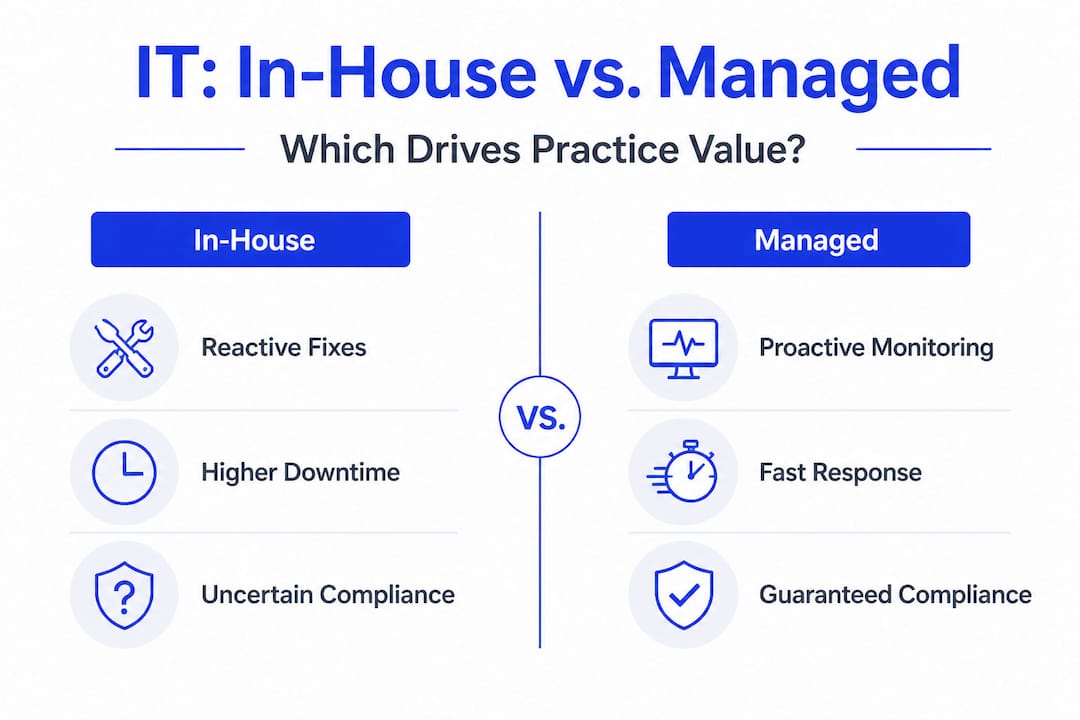
The difference is not just operational, it is strategic. When compliance and IT are managed proactively, your practice becomes more attractive to larger clients, insurance partners, and institutional referrals. You project stability, not risk.
The core functions that a quality managed services provider takes off your plate include:
- Proactive monitoring and maintenance of all hardware, software, and network infrastructure
- HIPAA compliance management including risk assessments, audit trails, and breach notification protocols
- Florida Bar technology standards compliance for law firms, including secure client communication and data retention
- Cybersecurity with endpoint protection, email filtering, and zero-trust access controls
- Data backup and disaster recovery with tested restoration protocols
- Cloud and productivity platform management such as Microsoft 365 or Google Workspace
- Vendor coordination so you stop managing 12 different tech relationships yourself
- Technology advisory to align IT investments with your business growth goals
Exploring a detailed managed services guide will show you how each of these functions translates directly into revenue protection and growth capacity. For real-world context, reviewing Miami managed IT examples can help you visualize what these outcomes look like in practices similar to yours.
Pro Tip: When evaluating managed service providers, ask specifically about compliance dashboards. A credible provider should offer real-time reporting on SOC 2 or HIPAA compliance status, not just quarterly summaries. If a vendor cannot show you a live compliance view, that is a red flag.
Local Miami advantages: Rapid response and tailored compliance
Managed services are not one-size-fits-all: location and specialization matter more than many professionals expect.
A national IT company may offer impressive branding and a long service catalog. But when your EHR system goes down at 8:45 a.m. before a full patient schedule, you need someone who can be on-site in 30 minutes, not someone in a call center routing your ticket to a remote technician in another time zone. This is where local Miami managed service providers have a genuine, measurable edge.

Local IT providers in Miami understand the regulatory landscape that shapes your daily operations. They know the specific requirements of Florida’s healthcare privacy rules. They know the Florida Bar’s technology guidelines for law firms. They also understand the cultural and business dynamics of serving a diverse, fast-moving market like Miami, where client expectations are high and competition is intense.
The practical benefits of working with a local Miami MSP include:
- On-site response times that national providers cannot match, often critical during compliance audits or system failures
- Established relationships with local regulators, healthcare networks, and legal technology vendors
- Bilingual support capabilities that reflect Miami’s diverse patient and client population
- Knowledge of Miami-specific risks including hurricane preparedness protocols for data protection
- Cultural alignment with the local business community, which affects communication style and client service standards
When it comes to choosing Miami IT services, one of the most overlooked questions professionals ask is about average response time guarantees. According to industry data, businesses that experience IT downtime lose an average of $137,000 to $427,000 per hour depending on size and sector. For a busy medical practice or law firm in Miami, even a one-hour outage during peak hours can cost thousands in lost revenue and client trust.
Pro Tip: Before signing with any MSP, ask for at least two references from Miami-based medical or legal clients. Then ask those clients specifically about response times during actual incidents, not just routine service. Real performance under pressure tells you more than any sales pitch.
Key contract factors: Fees, clinical/legal control, and compliance
Even with the right managed service provider, contract details can make or break your experience. Here is what to watch for.
The managed service agreement you sign is not just a vendor contract. For doctors and lawyers, it has professional and regulatory implications. A poorly structured agreement can create compliance exposure, fee arrangement violations, or worse, an erosion of your clinical or legal authority over your own practice.
Here is what you need to review carefully before signing:
- Fee structure: Insist on flat, fixed monthly fees rather than percentage-of-revenue models. Percentage-based billing structures can trigger fee-splitting or corporate practice of medicine (CPOM) violations in regulated professions.
- Scope of authority: The agreement must explicitly state that all clinical decisions remain with licensed medical staff and all legal decisions remain with the attorney of record. No technology provider should have authority over professional judgment.
- Data ownership: Confirm in writing that all patient or client data belongs to your practice, not the vendor, and that data is returned to you in full upon contract termination.
- Compliance responsibilities: Define exactly which party is responsible for which compliance functions. Ambiguity here creates risk for both sides.
- SLA (service level agreement) terms: Spell out guaranteed response times, uptime commitments, and remedies if those standards are not met.
- Exit clauses: Avoid long lock-in periods without performance benchmarks. A quality provider will not be afraid of short-term contracts or milestone-based renewals.
For a deeper look at how these considerations play out in real practices, reviewing examples of Miami managed IT agreements can give you a practical reference point before you enter negotiations.
“When structuring a managed service agreement, healthcare and legal professionals should insist on fixed-fee arrangements and clear contractual language preserving clinical and legal independence. Percentage-of-revenue models may expose physicians and attorneys to fee-splitting liability under Florida law, creating serious compliance and licensing risk.” — Healthcare compliance and legal advisory guidance, 2026
The fee-splitting issue deserves special attention. Florida has strict regulations around how physicians and attorneys can share revenue with non-licensed entities. A technology vendor whose compensation is tied to your revenue, even indirectly, may cross a regulatory line. Your malpractice carrier and state licensing board are not forgiving about these distinctions. Get a healthcare or legal regulatory attorney to review any managed service agreement before signing.
What most Miami professionals miss when choosing managed services
While it is easy to get lost in features and pricing, the real difference is often in areas most professionals never think to evaluate.
Most Miami doctors and lawyers approach the MSP search like a software purchase: compare feature lists, ask about pricing, and choose the cheapest option that checks the most boxes. This approach almost always leads to frustration within 12 months.
The providers who deliver the most value are not always the ones with the longest service catalogs. They are the ones who show up as genuine business partners. They learn how your practice operates, proactively flag risks before they become problems, and bring ideas that help you grow. That kind of relationship does not appear in a service brochure.
Here is an uncomfortable truth: the biggest ROI from managed services is not cost savings, it is continuity. When your systems work reliably, your staff performs better, your clients and patients trust you more, and your ability to scale is no longer limited by operational firefighting. That is the real business case, and most professionals only realize it after they have experienced one serious IT or compliance failure.
We have seen practices where the managed service provider’s proactive monitoring caught a ransomware attempt before any data was touched. We have seen law firms avoid six-figure sanctions because their MSP maintained proper document retention policies automatically. These outcomes do not show up as line items in a cost comparison spreadsheet. Insights from IT service management research consistently show that the firms with the best long-term outcomes prioritize ongoing relationship quality over initial contract pricing.
The smartest professionals interview their MSP candidates for values and communication style, not just technical certifications. Ask how they handle conflict when service falls short. Ask what their client retention rate is. Ask what they do when a client’s needs outgrow the current agreement. The answers reveal more about the working relationship than any technical spec sheet.
Pro Tip: Build a formal quarterly review into your managed service contract from day one. Set agenda items that include performance metrics, upcoming compliance changes, and technology recommendations. This keeps your provider accountable and ensures the relationship stays aligned with your growth goals, not just your support tickets.
Enhance your practice with Miami-focused managed services
For Miami doctors and lawyers ready to streamline, the next step is partnering with experts who understand your unique regulatory and business needs.
The right managed services partner does not just keep your systems running. They protect your revenue, reduce your risk, and give you back the hours you need to grow. That is exactly what we do at Transform42.
We help medical practices and law firms in Miami build the operational infrastructure their clients expect, using technology as a strategic advantage. From Miami technology solutions to specialized IT for law firms, our approach is tailored to your professional environment, not adapted from a generic playbook. If you are ready to see what streamlined, compliant, and growth-focused IT looks like for your practice, explore our efficiency examples and take the first step toward reclaiming your time and your revenue potential.
Frequently asked questions
What makes managed services different from regular IT support?
Managed services include proactive maintenance, compliance management, and business strategy, far beyond standard tech support. Where traditional IT support waits for something to break, managed services prevent disruptions before they happen and align your technology with your business goals.
How do I ensure my MSP understands medical or legal compliance in Miami?
Choose providers with proven local expertise in HIPAA or Florida Bar rules, and ask for Miami-based client references. Local IT providers with direct experience in your professional sector will already have compliance frameworks built into their service model rather than treating it as an add-on.
What contract terms should I watch for to avoid compliance headaches?
Look for flat-fee models and clear language that preserves your clinical or legal decision authority. Fee-splitting and CPOM risks are real for Florida professionals, so having a regulatory attorney review your MSA before signing is a smart precaution.
Can managed services really increase revenue for my practice?
Yes. By eliminating downtime and freeing up staff time, managed services reduce revenue loss from IT disruptions and let you serve more clients or patients with the same headcount. For high-billing professionals in Miami, even recovering 10 hours per month at your billing rate translates directly into significant annual revenue gains.
Recommended
- Top Managed IT Examples For Miami Professionals: Boost Efficiency
- IT Outsourcing: Boost Efficiency And Profits For Miami Professionals
- How Managed Cloud Services Empower Miami Accountants
- Examples Of Managed IT Services For Miami Accounting Firms
- Prime-Ready IT Modernization Partner for Public Sector