
TL;DR:
- Digital transformation spending is projected to reach $2.8 trillion by 2025, yet most executives feel unprepared due to strategy issues. Success depends on digital discipline that emphasizes governance, measurable goals, and workforce upskilling, not just technology adoption. Organizations that adopt strategic frameworks and ongoing leadership practices will outperform their competitors significantly.
The numbers should make any business leader stop and think. Global digital transformation spending is projected to hit $2.8 trillion by 2025, yet only 44% of executives feel prepared for the disruption that spending is supposed to prevent. That is not a funding problem. That is a strategy problem. The trends in digital transformation 2025 reveal a hard truth: buying technology is easy. Knowing how to use it to actually grow your business is where most organizations fall apart. This guide breaks down what is really happening, what is coming next, and what you need to do before you get left behind.
Table of Contents
- Key Takeaways
- Top Digital Transformation Trends Shaping 2025
- Common challenges in digital transformation
- The shift from digital transformation to digital discipline
- Strategic approaches for business leaders in 2025
- Emerging technologies to watch beyond 2025
- My honest take on digital transformation in 2025
- How Transform42inc can support your digital transformation
- FAQ
Key Takeaways
| Point | Details |
|---|---|
| Spending is not the same as readiness | Trillions are being invested, yet most executives admit they are not prepared for digital disruption. |
| AI agents are compressing timelines | GenAI tools are cutting modernization timelines by up to 50%, making early adoption a real competitive advantage. |
| The pilot trap is real | Nearly half of all companies cannot move digital initiatives beyond the testing phase into full deployment. |
| Digital discipline beats digital hype | Success comes from governance, cost accountability, and measurable goals, not from chasing the newest technology. |
| Leadership must evolve | Tech leaders are shifting from system operators to enterprise value orchestrators who tie technology directly to revenue. |
Top Digital Transformation Trends Shaping 2025
The word “AI” is everywhere right now, but the specific ways it is being applied in 2025 are more precise and more consequential than most people realize. GenAI-driven AI agents are reducing application modernization timelines by up to 50% and cutting delivery costs by 40%. That means a technology overhaul that would have taken your firm three years can now realistically happen in eighteen months. That is a massive shift in what is possible.
Here is a breakdown of the dominant trends hitting industries right now:
- AI agents and automation: Intelligent agents handle complex, multi-step tasks with minimal human oversight. Law firms are using them to review contracts. Accounting firms are deploying them for anomaly detection in financial data. Medical practices are using them to pre-authorize insurance claims.
- Machine learning for forecasting: Retailers and healthcare systems are using machine learning to predict demand, patient volume, and cash flow. The accuracy gains reduce waste and improve scheduling significantly.
- RPA 2.0: Robotic process automation has matured. The newer generation combines AI with traditional automation to handle unstructured data, something the older tools could not touch.
- Biometrics and edge computing: Hospitals and financial firms are implementing biometric authentication to reduce fraud and improve patient data security. Edge computing brings data processing closer to the source, reducing latency in real-time applications.
- Blockchain for secure transactions: Beyond cryptocurrency, blockchain is being used in supply chain management and legal record verification to create tamper-proof audit trails.
The table below shows how these technologies map to key industries:
| Industry | Primary Technology Trend | Business Impact |
|---|---|---|
| Healthcare | AI agents, biometrics | Faster claims, reduced fraud |
| Financial services | Machine learning, blockchain | Better forecasting, secure transactions |
| Legal | AI contract review, RPA 2.0 | Faster turnaround, lower error rates |
| Retail | Machine learning, edge computing | Demand prediction, real-time inventory |
| Manufacturing | Edge computing, automation | Reduced downtime, predictive maintenance |
| Education | AI agents, analytics | Personalized learning, early intervention |
Understanding the 2025 digital trends hitting professional services is particularly relevant for doctors, lawyers, and accountants operating in competitive markets like Miami. The firms adopting these tools now are building advantages that will be very hard for slower-moving competitors to close.
Common challenges in digital transformation
Here is what nobody wants to say out loud: most digital transformation efforts fail quietly. They do not collapse dramatically. They just never deliver what was promised. And the reasons are consistent across every industry.
72% of companies report data quality or availability problems that prevent them from getting full value out of their technology investments. You can buy the best AI platform on the market, but if your data is scattered across outdated systems and inconsistent spreadsheets, that platform will not save you. It will just give you faster wrong answers.
The other major obstacles include:
- The pilot trap: Nearly 48% of organizations struggle to scale digital and AI initiatives beyond initial pilots. A small proof-of-concept works in a controlled environment, then dies when it meets the complexity of real operations.
- AI fluency gaps in leadership: You cannot govern what you do not understand. Many executives are approving AI investments without understanding the governance and oversight those investments require.
- Employee resistance: Technology adoption fails when people feel threatened rather than empowered. Workforce transformation is just as critical as the technology itself.
- Underestimated costs: Change management, training, integration work, and data cleaning are almost always budgeted too low. The technology license is the cheapest part of most transformations.
Less than half of digital initiatives meet their original business outcome targets. That statistic should concern every executive reading this. It means the odds are not in your favor unless you approach this differently than most organizations do.
Pro Tip: Before approving any new technology spend, ask your team to demonstrate where your current data is stored, how clean it is, and who owns it. If you cannot answer those three questions, the technology investment will underperform no matter how good the vendor’s demo looked.
The shift from digital transformation to digital discipline
There is a quiet but significant change happening in how the most successful organizations think about technology. The old model was transformation as a project: launch it, complete it, declare victory. The new model is transformation as ongoing discipline.

Only 35% of C-suite executives report genuinely improved technology stacks despite years of heavy investment. The failure is not technological. It is organizational. Companies chase new tools without fixing the structural problems that make those tools ineffective.
The shift to digital discipline requires:
- Clear cost ownership: Every technology initiative needs a named owner who is accountable for costs and outcomes. No owner means no accountability, and no accountability means money disappears into overhead.
- Governance frameworks: AI and data governance are not optional in 2025. Regulators are watching, clients are demanding transparency, and the legal exposure from ungoverned AI decisions is real.
- Measurable ROI milestones: Set specific revenue or efficiency targets before you launch any initiative. If you cannot measure it, you cannot manage it.
- Continuous iteration: Organizations treating transformation as an ongoing process with clear orchestration roles navigate costs and complexity far better than those treating it as a one-time project.
- Legacy system integration: New tools built on top of broken old systems just move problems around. Structural constraints have to be addressed, not avoided.
“Tech leaders must evolve from system operators to orchestrators managing enterprise-wide value, requiring new leadership skills and operating models.” — Deloitte’s 2026 Global Technology Leadership Study
79% of tech leaders now say driving business outcomes is their top priority. That means the CTO or IT director who only talks about uptime and infrastructure is already falling behind. The new mandate is business impact, not system management.
Strategic approaches for business leaders in 2025
Getting digital transformation right requires more than a technology budget. It requires a decision-making framework that connects tools to outcomes from day one. Here is how the organizations succeeding with digital strategy trends 2025 are doing it differently.
Companies with strong digital strategies see an average annual revenue increase of 23% compared to peers without clear strategies. That is not a marginal difference. That is a compounding competitive gap that gets harder to close every year you wait.
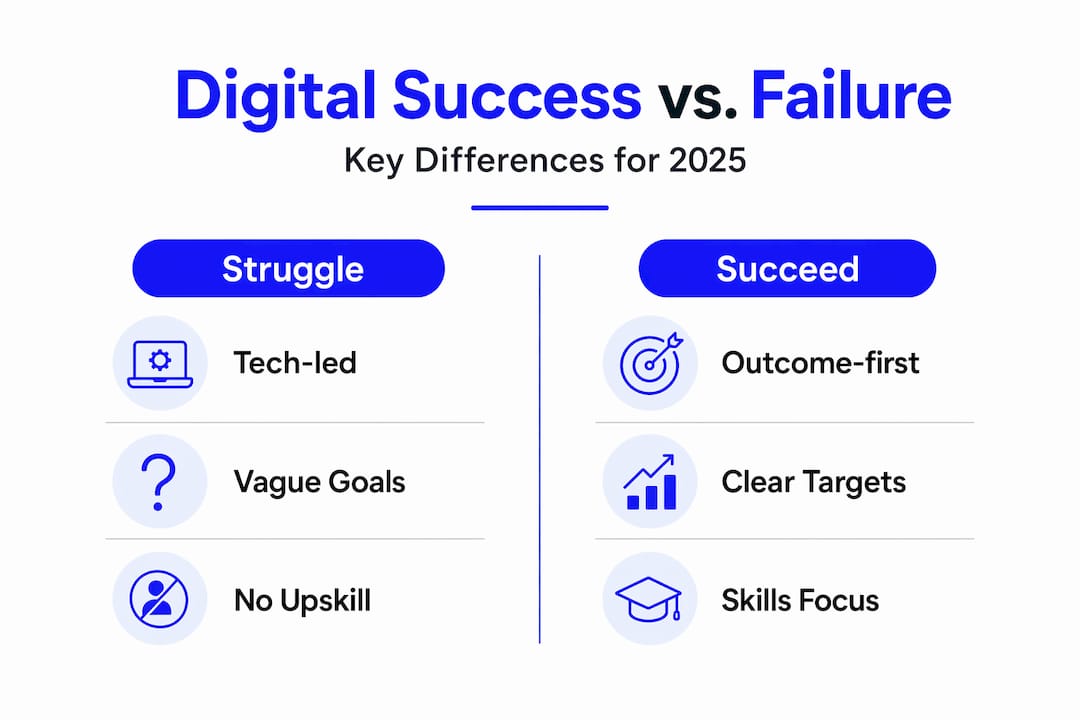
The comparison below shows the difference between organizations that struggle and those that succeed:
| Area | Organizations that struggle | Organizations that succeed |
|---|---|---|
| Strategy | Technology first, then figure out the use case | Business goal first, then select technology |
| Governance | Ad hoc decisions, no clear ownership | Named owners, defined approval frameworks |
| Workforce | Training happens after deployment | Upskilling runs parallel to implementation |
| Measurement | Vague success criteria | Specific revenue and efficiency benchmarks |
| Iteration | One-time project mindset | Continuous improvement cycles built in |
The practical steps that matter most:
Develop a roadmap that ties every technology decision to a specific business goal. “We want AI” is not a strategy. “We want to reduce billing errors by 30% in the next six months using AI verification” is a strategy.
Embed phased implementation from the start. Break large initiatives into smaller deployments that can be measured and adjusted. This reduces the pilot trap by creating natural checkpoints.
Prioritize workforce upskilling. Neglecting organizational culture is one of the top reasons transformations fail. Your people have to understand and trust the tools they are expected to use.
Pro Tip: Map your top five revenue-generating workflows before your next technology review. Identify where human error, delay, or manual processing costs you money. That map is your technology investment priority list.
Emerging technologies to watch beyond 2025
The future of digital transformation 2025 and beyond is taking shape right now. The organizations paying attention to these emerging technologies will have first-mover advantages that compound quickly.
- Spatial computing and augmented reality: Law firms are exploring AR for courtroom presentation. Medical training programs are replacing cadaver labs with immersive AR simulations. The cost of these tools is dropping faster than most people expect.
- Quantum-safe cryptography: As quantum computing advances, the encryption methods protecting your client data today will become vulnerable. This is not a distant problem. Preparing your data security architecture now is a decision that protects you years from now.
- AI governance platforms: Regulators in financial services, healthcare, and legal are beginning to require documented AI decision trails. Purpose-built AI governance platforms that track, audit, and explain AI decisions will go from optional to mandatory.
- Tokenized loyalty and blockchain treasury operations: Real-time blockchain applications are moving beyond concept into practical use. Tokenized loyalty programs and treasury automation are live in financial services and expanding into professional services.
- 5G and micro data centers: Faster networks combined with localized data processing allow real-time decision-making at the point of care, transaction, or service delivery. This is especially valuable for medical practices and multi-location professional service firms.
The role of AI in consulting and professional services is accelerating faster than most small and mid-sized firms are prepared for. The gap between AI adopters and non-adopters is already measurable. Firms that aggressively adopt AI are seeing significantly higher revenue growth and shareholder returns. Waiting for the technology to mature further is itself a risk.
My honest take on digital transformation in 2025
I have watched a lot of organizations spend serious money on technology and come out the other side with less confidence than when they started. The technology was fine. The execution was not.
In my experience, the single biggest mistake leaders make is treating digital transformation as a technology problem. It is not. It is a leadership problem with a technology component. When the strategy comes from IT without alignment from operations, finance, and the people doing the actual work, the tools never get used the way they were intended.
The pilot trap I keep seeing is avoidable. Organizations get excited about a proof-of-concept, show it to leadership, and then cannot figure out why the full rollout does not work. It is almost always because the pilot ran in ideal conditions with hand-picked data and motivated champions. Real deployment meets legacy systems, skeptical staff, and data that nobody cleaned in years.
What I have learned is that the organizations that succeed treat technology like a long-term operating discipline, not a project to complete. They measure constantly. They adjust without ego. And they invest in their people before they invest in their platforms. The high stakes of falling behind on AI adoption are real, but panic-driven purchasing is worse than doing nothing. Get the strategy right first.
— Joe
How Transform42inc can support your digital transformation
At Transform42inc, we work with doctors, lawyers, and accountants in Miami who are serious about growing their monthly revenue. We have seen firsthand what happens when professional service firms try to implement technology without a clear strategy. It is expensive, frustrating, and slow.
We bring all your technology together under one partner. That means you get AI integration, compliance-ready systems, and IT support that actually understands your industry. You stop managing vendors and start managing outcomes. Whether you are trying to understand your options in digital transformation or you are ready to build out a full technology roadmap, we handle the complexity so you can focus on your clients. Talk to our technology team and find out what a real digital strategy looks like for your practice.
FAQ
What are the top trends in digital transformation 2025?
The leading trends include AI agents that cut modernization timelines by up to 50%, machine learning for business forecasting, RPA 2.0 for automating complex workflows, and edge computing for real-time data processing. Blockchain for secure transactions and biometrics for identity verification are also accelerating across healthcare, legal, and financial services.
Why is digital transformation so hard to get right?
Most failures come from data quality problems, leadership misalignment, and the inability to scale pilots into full deployments. 64% of companies with moderate AI ROI still cite governance gaps as a barrier to scaling results further.
What is the difference between digital transformation and digital discipline?
Digital transformation refers to adopting new technology. Digital discipline means governing that technology with clear cost ownership, measurable targets, and ongoing accountability. Organizations that practice digital discipline consistently outperform those that just invest in tools without a governance structure.
How much revenue growth can digital transformation actually deliver?
Companies with strong digital strategies see an average revenue increase of 23% annually compared to peers without clear strategies. AI adopters specifically are achieving 1.7x higher revenue growth and 3.6x shareholder returns compared to slower-moving competitors.
What should business leaders prioritize first in their digital strategy?
Start with your data. Clean, accessible, well-governed data is the foundation every AI and automation tool depends on. After that, map your highest-value workflows and identify where technology can reduce errors or speed up delivery before selecting any platform or vendor.
Recommended
- Innovate, Transform, Lead: The Blueprint For Digital Success – Stratgetic IT Consultants For Accountants
- Digital-transformation Archives – Stratgetic IT Consultants For Accountants
- Digital Transformation: A Roadmap For Billion Dollar Organizations
Transform 42 provides managed IT services for accounting firms in Miami.