
TL;DR:
- Most organizations fail to recognize that digital risk management extends beyond cybersecurity and involves continuous identification, assessment, and treatment of threats across their entire digital environment. Leaders must own and incorporate digital risk strategies into enterprise goals using risk registers, regular reviews, and business-oriented communication to prevent operational, reputational, and regulatory failures. Implementing regulatory frameworks like DORA and establishing practical, ongoing processes helps professional service firms proactively manage digital risks and avoid costly breaches or compliance violations.
Most business leaders assume digital risk management is something their IT department handles. That assumption is costing organizations millions. What is digital risk management, really? It is the structured, ongoing process of identifying, assessing, and treating every threat that touches your organization’s digital world, from cyberattacks and vendor failures to brand fraud and compliance violations. It covers far more than firewalls and antivirus software. If you are responsible for your organization’s growth, reputation, or legal standing, digital risk management is your responsibility too.
Table of Contents
- Key takeaways
- What digital risk management actually means
- Common digital risks your business faces right now
- Aligning digital risk with your business goals
- Regulatory frameworks shaping digital risk programs
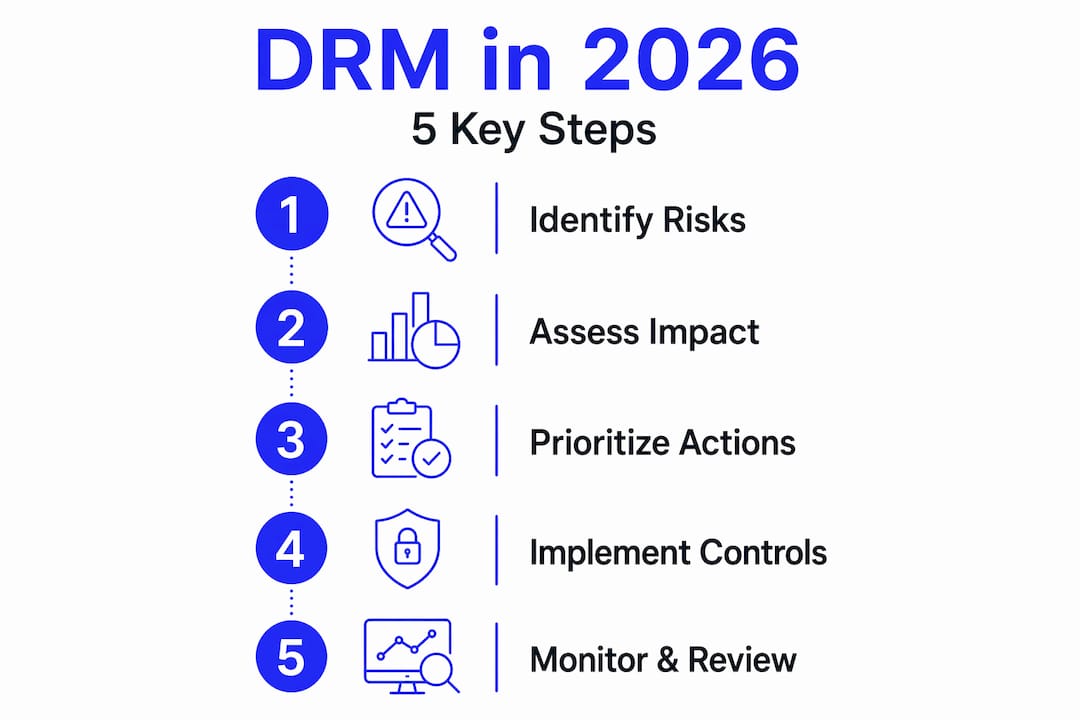
- Practical steps to build your digital risk program
- My honest take on where most firms go wrong
- How Transform42inc helps you take control
- FAQ
Key takeaways
| Point | Details |
|---|---|
| DRM is broader than cybersecurity | It covers vendor risk, brand fraud, compliance failures, and operational disruptions across your full digital environment. |
| Leadership must own it | Digital risk decisions belong in the boardroom, not just the IT department, because the consequences land on the whole business. |
| Compliance frameworks are non-negotiable | Regulations like DORA set mandatory requirements for risk documentation, incident reporting, and third-party oversight. |
| Only 6% of firms are fully prepared | The gap between knowing about digital risk and actually managing it is enormous, and it carries real financial consequences. |
| Continuous monitoring is the only approach that works | A one-time risk assessment is outdated the moment it is completed. Effective programs never stop cycling through assess, treat, and monitor. |
What digital risk management actually means
Digital risk management is a continuous process of identifying, assessing, prioritizing, and treating risks across your organization’s full digital ecosystem. The goal is not just to prevent bad things from happening. It is to keep your organization adaptable and competitive even when bad things do happen.
Think about what “digital” means for your firm right now. You store client data in the cloud. You rely on third-party software for billing, communication, and compliance reporting. Your staff accesses systems from home networks. Your brand exists on social platforms you do not fully control. Every single one of those touch points is a potential exposure point.
Traditional cybersecurity focuses on protecting the network perimeter, blocking attacks at the gate. Digital risk management is different. It asks: what happens to your business if any part of your digital environment fails, gets compromised, or turns against you? That includes:
- Cyber threats: Ransomware, phishing, malware, and unauthorized access to systems and data
- Third-party and vendor risk: When a software provider, cloud host, or payroll platform gets breached, your clients feel it too
- Brand and reputation risk: Domain impersonation, fake social profiles, and fraudulent emails sent in your firm’s name
- Regulatory and compliance risk: Failing to meet data protection or financial reporting requirements, which carries real legal penalties
- Operational risk: System outages, data loss, or technology failures that interrupt your ability to serve clients
DRM goes beyond cybersecurity to protect reputation, operational continuity, and regulatory standing. That is not a minor distinction. It is the difference between treating symptoms and treating the actual disease.
Common digital risks your business faces right now
Most business leaders can picture a data breach. A hacker gets in, steals client information, and you deal with the fallout. That scenario is real, but it represents only one slice of what is actually threatening your organization.

Cybersecurity attacks are still the most visible threat. Ransomware alone shut down hospitals, law firms, and accounting practices across the U.S. in 2025. One click on a convincing phishing email can lock your entire system and expose confidential client files.
Third-party vendor risk is the one that surprises most leaders. You vet your own staff carefully. But do you vet every software platform your practice uses? When a vendor your firm depends on gets breached, many exposures remain unmanaged without a cross-functional inventory that goes beyond standard IT tools. Your clients do not care that the breach happened at a vendor. They care that their data is now exposed.
Brand impersonation and fraud is growing fast. Criminals create lookalike domains, fake LinkedIn profiles, and spoofed email addresses to deceive your clients into wiring money or sharing sensitive information. By the time you find out, the damage to your reputation is already done.
Compliance failures carry consequences that go well beyond a fine. A law firm or accounting practice that fails to meet data protection standards can lose its license to operate. The penalties for regulatory violations in professional services are steep and public.
Here is a number that should alarm you. Only 6% of enterprises have fully implemented all data risk measures. That means 94% of organizations are operating with significant blind spots in their digital risk programs. The question is not whether you are at risk. The question is whether you know where your exposure is.
Aligning digital risk with your business goals
Digital risk management is not a technology project. It is a business strategy. The organizations that get this right are the ones that connect risk decisions directly to enterprise objectives like client trust, regulatory standing, and revenue continuity.
The most practical tool for doing this is a risk register. A risk register is essentially a living document that catalogs every known risk, the potential impact on the business, the likelihood of occurrence, and the steps being taken to address it. NIST guidance instructs organizations to integrate cybersecurity risks within enterprise risk registers so leadership can compare and prioritize risks based on real business impact, not just technical severity.
When you link risk data to business outcomes, the conversation changes. Instead of an IT manager telling the executive team about a vulnerability score, you are talking about a potential $2 million client data exposure that could trigger regulatory investigation. That framing gets attention and drives decisions.
Effective governance looks like this:
- Assign ownership: Every risk category needs a named owner who reports to leadership, not just the IT team
- Set a review cadence: Risk registers should be reviewed quarterly at a minimum, not annually
- Build accountability into leadership: The C-suite and board need to see risk dashboards, not just IT reports
- Communicate in business language: Risk reports should quantify potential financial impact, not just list technical vulnerabilities
Leadership gains measurable value when risk priorities are expressed as business decisions, not technical ones. That is how digital risk management becomes a competitive advantage instead of a compliance burden. You can explore building this kind of structure through a solid digital strategy guide for professional services firms.
Pro Tip: If your risk reports are written by IT staff and only read by IT staff, your governance structure is broken. Reformat every risk summary to answer one question: what does this cost the business if it goes wrong?
Regulatory frameworks shaping digital risk programs
Regulations are no longer optional context. They are legal mandates with real teeth. The EU’s Digital Operational Resilience Act, known as DORA, is the clearest example of where global regulation is heading. Even if your practice is based in Miami, your clients, partners, or software vendors may fall under its scope, which means it affects you.
DORA requires documented ICT risk frameworks built around five core pillars:
- ICT risk management: Documented frameworks for identifying and treating technology risks
- Incident reporting: Mandatory timelines for reporting significant ICT incidents to regulators
- Resilience testing: Regular testing of systems and response capabilities, including penetration testing
- Third-party risk management: Formal oversight of every ICT vendor and supply chain dependency
- Information sharing: Participation in threat intelligence sharing across the sector
| DORA Pillar | What it requires |
|---|---|
| ICT risk management | Written framework with defined risk tolerance and governance roles |
| Incident reporting | Regulatory notification within strict timeframes after a major incident |
| Resilience testing | Annual advanced testing for significant financial entities |
| Third-party oversight | Contractual rights to audit and monitor all ICT vendors |
| Information sharing | Voluntary but encouraged participation in threat intelligence programs |
Regulatory frameworks like DORA turn abstract risk management concepts into specific documentation requirements, governance structures, and testing schedules. Falling short is not just a compliance problem. It is an operational failure waiting to happen. For a closer look at how compliance intersects with daily operations, digital security requirements for professional service firms in Miami are a good place to start.
Practical steps to build your digital risk program
Most organizations know they need to manage digital risk better. The gap is in knowing where to start. Here is a straightforward approach that works for professional service firms without requiring a large internal security team.
-
Map your digital assets: List every system, software platform, cloud service, and vendor your firm uses. You cannot protect what you do not know you have. Include external digital assets and third-party dependencies in that inventory, or you will have blind spots.
-
Run a digital risk assessment: For each asset, ask: what happens if this fails or gets compromised? Rate the likelihood and potential business impact. This does not need to be technically complex. It needs to be honest.
-
Prioritize by business impact: Not every risk deserves equal attention. Focus resources on the risks that could shut down operations, trigger regulatory penalties, or expose client data at scale.
-
Treat the highest-priority risks: Treatment does not always mean eliminating the risk. Sometimes it means accepting it, transferring it through insurance, or reducing it through controls. The ISO/IEC 27005 framework describes this as a continuous cycle: identify, assess, evaluate, treat, accept, and monitor.
-
Build an incident response plan: Know exactly what happens when something goes wrong. Who calls whom? What clients get notified and when? What regulators need to be informed? Practice this before you need it.
-
Review vendor contracts for risk provisions: Make sure every technology vendor you use carries appropriate liability and grants you audit rights. A vendor with no contractual accountability is an unmanaged risk.
Pro Tip: Start your risk assessment with the three things that would most embarrass your firm publicly if they went wrong. Those are almost always your highest-priority risks, and starting there builds momentum.
My honest take on where most firms go wrong
I have watched organizations invest in elaborate risk documentation, produce thick policies that no one reads, and then experience a completely avoidable breach because no one was actually monitoring the systems day to day. The paperwork existed. The governance did not.
What I have learned is that the firms that genuinely protect themselves treat digital risk management the same way they treat client work. There is an owner, a deadline, a deliverable, and someone who checks that it got done. The continuous nature of DRM means it never reaches a finish line. The moment you treat it as a project with an end date, you are already falling behind.
The other thing I see consistently is underestimating third-party exposure. Law firms and accounting practices in particular trust their software vendors implicitly. That trust needs to be structured. A vendor you rely on for billing, document management, or client communication is an extension of your risk profile, whether you acknowledge it or not.
The hardest shift for business leaders is moving from awareness to accountability. Knowing that digital risk exists is not enough. Assigning it, funding it, and reviewing it on a schedule is what actually changes outcomes. The firms I have seen thrive are the ones where the managing partner or practice director reviews risk status the same way they review financial performance.
— Joe
How Transform42inc helps you take control

Managing digital risk is not something you should figure out alone while also running a practice and serving clients. Transform42inc works with doctors, lawyers, and accountants in Miami to put the right technology, governance structures, and compliance support in place so that risk does not become a crisis. From IT consulting and risk strategy to full digital transformation support, the team at Transform42inc builds the capabilities your clients expect and the protection your firm requires. If you are ready to stop hoping your systems are secure and start knowing they are, reach out and let’s build something that actually works.
FAQ
What is digital risk management in simple terms?
Digital risk management is the ongoing process of identifying, assessing, and addressing threats that could harm your organization through its technology, data, vendors, or digital presence. It goes well beyond cybersecurity to include reputation, compliance, and operational risks.
How is digital risk different from cybersecurity?
Cybersecurity focuses on defending your network and systems from attack. Digital risk management is broader and covers third-party vendor failures, brand impersonation, regulatory violations, and operational disruptions that cybersecurity tools alone cannot address.
What is a digital risk assessment?
A digital risk assessment is the process of cataloging your organization’s digital assets and evaluating the likelihood and business impact of potential threats to each one. It forms the foundation of any effective digital risk management program.
Why does digital risk management matter for professional service firms?
Professional service firms hold sensitive client data and operate under strict regulatory requirements. A single breach or compliance failure can trigger legal liability, regulatory penalties, and permanent reputational damage that no marketing campaign can undo.
What frameworks guide digital risk management programs?
Common frameworks include NIST’s enterprise risk management guidance, ISO/IEC 27005 for information security risk, and regulatory mandates like DORA for financial entities. Each provides structure for governing, documenting, and testing your digital risk program on a continuous basis.
Recommended
- Confronting The Digital Battleground: Navigating Cybersecurity Threats In The Defense Industry – Stratgetic IT Consultants For Accountants
- AML 2.0: Redefining Anti-Money Laundering Through Digital Innovation – Stratgetic IT Consultants For Accountants