
TL;DR:
- Agile project management improves efficiency for Miami professionals by delivering value in small, manageable increments. It enhances workflow visibility, promotes continuous prioritization, and reduces coordination waste, leading to increased revenue. Success depends on building daily habits of feedback, prioritization, and limiting work-in-progress, rather than rigid ceremonies.
Agile project management has a reputation problem. Most professionals assume it belongs exclusively to software developers writing code in San Francisco. But if you’re a doctor, lawyer, or accountant running an independent practice in Miami, the same coordination problems that Agile solves in tech are costing you billable hours, client relationships, and revenue every single week. Agile delivers value in smaller increments, gathers feedback earlier, and cuts the kind of process waste that quietly erodes your bottom line. This article breaks down exactly why Agile works for your profession, where it fits best, and how to start using it without overhauling everything overnight.
Table of Contents
- What is Agile project management (and why should professionals care)?
- Real gains: How Agile boosts efficiency and revenue for Miami practices
- Agile vs. traditional project management: When to adapt (and when not to)
- Keys to implementing Agile in your Miami practice
- The uncomfortable truth: Agile success is about habits, not ceremonies
- Agile transformation: Your next step to greater efficiency
- Frequently asked questions
Key Takeaways
| Point | Details |
|---|---|
| Agile delivers incremental value | Small, continuous changes help expose and resolve process bottlenecks quickly. |
| Efficiency boosts revenue | Improved workflow visibility and feedback loops lead to more billable work and higher client satisfaction. |
| Choose the right fit | Agile shines where adaptability is needed, but hybrid approaches are better for strict compliance or highly predictable projects. |
| Simple habits matter most | Short feedback cycles and clear priorities—more than rituals—drive long-term Agile success. |
What is Agile project management (and why should professionals care)?
Most project management methods used in professional service practices are inherited habits. A long intake process, a rigid case or patient workflow, a fixed billing cycle. These methods assume the world stays predictable. It doesn’t.
Agile takes a different approach. Instead of planning every step of a project upfront and executing in one long arc, Agile delivers value in smaller increments and builds in regular checkpoints to catch problems before they compound. Think of it as replacing a six-month project plan with a series of two-week sprints, each one producing a visible, measurable result.
The core principles of Agile that translate directly to professional service practices are:
- Break work into small, manageable increments instead of long project phases
- Prioritize continuously based on client urgency and business value
- Gather feedback often from clients and team members to catch errors early
- Adapt quickly when priorities shift, regulations change, or client needs evolve
- Make work visible so everyone on your team knows what is in progress, blocked, or complete
“Agile is not a technology problem. It’s a workflow and communication discipline. Once you apply its principles to a law firm or medical practice, you start seeing the same bottlenecks Agile was designed to eliminate.” — Experienced Agile consultant in professional services
For a deeper look at how this applies to accounting specifically, the agile methods guide for CPAs provides a profession-specific breakdown that cuts through the tech jargon.
What makes Agile relevant for you is not the terminology. It’s the outcome. Shorter feedback cycles mean you catch a documentation error before it delays a billing cycle. Regular prioritization means urgent client matters don’t get buried under administrative tasks. Visible workflows mean your team stops duplicating effort and starts coordinating with precision.
Real gains: How Agile boosts efficiency and revenue for Miami practices
Understanding the theory is one thing. Seeing what happens when Miami practices apply Agile principles to their operations is where the real motivation comes from.
Agile-style approaches in legal practice have been shown to improve visibility, workload management, and continuous improvement across case teams. Law firm Cuatrecasas used Agile methods to restructure how case managers tracked tasks, communicated bottlenecks, and distributed work. The result was faster case resolution and measurably higher client satisfaction. That is a direct revenue story, not just a productivity anecdote.
For accounting and medical practices, the gains look similar but take a different shape. Consider these common scenarios where Agile changes the outcome:
- A medical practice uses weekly sprint reviews to catch incomplete patient intake data before appointments, reducing rescheduling by 30%
- An accounting firm limits work-in-progress during tax season to three active client files per team member, cutting billing errors nearly in half
- A solo attorney sets up a visual board tracking case stages and identifies that document review is consistently the bottleneck, then schedules dedicated time blocks to address it
Agile implementations improve efficiency when organizations manage work-in-progress, prioritize continuously, and use feedback loops to reduce coordination waste. This isn’t theoretical. The pattern holds across industries where knowledge work creates invisible bottlenecks.
Here’s a direct comparison of outcomes between traditional workflow approaches and Agile-influenced ones in professional service contexts:
| Metric | Traditional workflow | Agile-influenced workflow |
|---|---|---|
| Billing error rate | Higher due to late reviews | Lower due to incremental checks |
| Client onboarding time | Fixed, often slow | Continuously improved |
| Case or file bottlenecks | Invisible until critical | Visible and addressed early |
| Team coordination | Meeting-heavy, reactive | Structured, proactive |
| Revenue leakage from delays | Frequent | Significantly reduced |
Pro Tip: Start by mapping your current workflow on a whiteboard. Identify every step in a typical client engagement from intake to invoice. You will almost certainly find two or three steps where work consistently gets stuck. Those are your Agile starting points, not the entire process.
To build on this, reviewing business automation workflow strategies can help you identify which parts of your current process are good candidates for automation alongside your Agile adoption. When you combine Agile prioritization with smart automation, the efficiency gains multiply quickly.
Building the right team habits is equally important. Guidance on building agile teams for Miami practices walks through the specific staffing and communication dynamics that support Agile adoption without requiring you to hire a project manager. For professionals using Agile in professional services more broadly, these principles apply whether you run a solo practice or a growing team. Structured service workflows can also support the visual tracking that Agile depends on.
Agile vs. traditional project management: When to adapt (and when not to)
Agile is powerful, but it is not universal. Knowing when to use it, when to stick with traditional methods, and when to blend the two is the strategic advantage that separates effective practice managers from frustrated ones.
Agile outperforms traditional approaches in certain conditions, but effectiveness is highly context-dependent. The critical variables are complexity, stakeholder engagement, and how predictable the work actually is.
Here’s how the two approaches compare across dimensions that matter most for your practice:
| Dimension | Agile | Traditional (Waterfall) |
|---|---|---|
| Adaptability | High, built for change | Low, requires change orders |
| Workflow visibility | Continuous | Milestone-based |
| Compliance documentation | Requires adaptation | Strong fit |
| Client feedback integration | Frequent and structured | End-stage only |
| Best for | Complex, evolving cases | Predictable, fixed-scope projects |
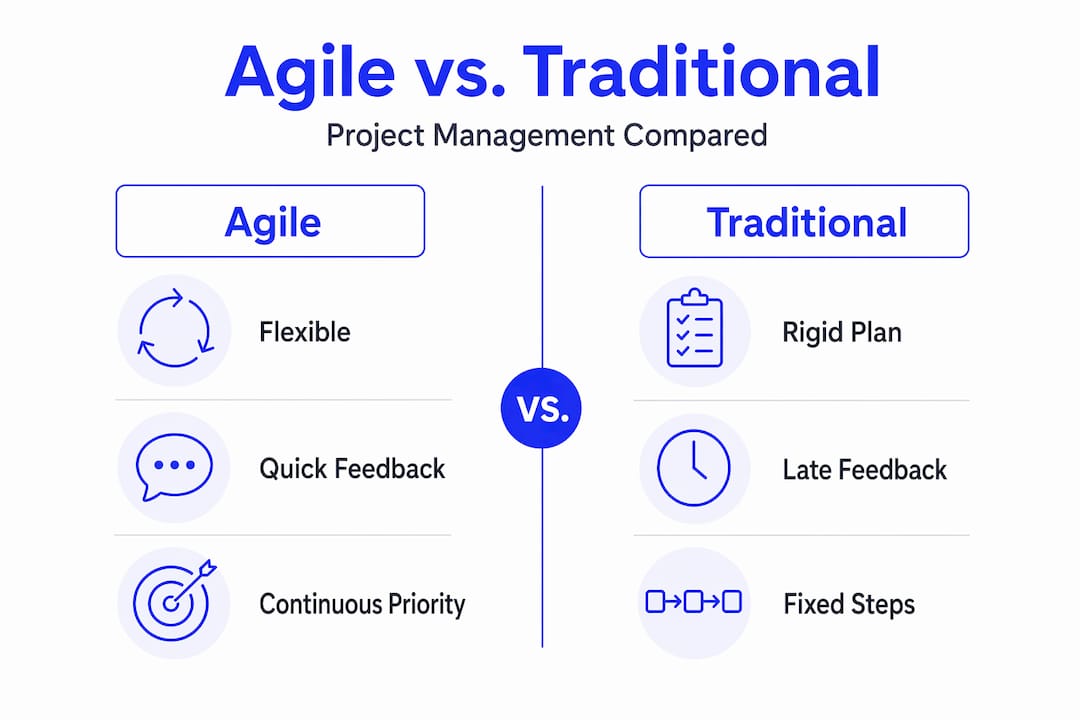
Agile is sometimes misapplied in work that requires heavy upfront planning or strict compliance. A tax audit defense, for example, may require detailed upfront documentation and a fixed sequence of regulatory steps. Applying pure Agile to that context could create compliance gaps. Traditional methods serve that project better.
The smarter path for most Miami practices is a hybrid model. Here is how to build one:
- Identify project type first. Is the work predictable with fixed requirements, or does it involve evolving client needs and uncertain timelines? This single question drives the method choice.
- Use traditional planning for compliance-critical phases. For regulatory filings, court deadlines, or fixed clinical protocols, maintain structured sequencing and documentation.
- Apply Agile to client-facing and coordination work. Intake, communication, feedback collection, and internal task management all benefit from Agile’s flexibility.
- Set a weekly review cadence regardless of method. Even in traditional projects, a short weekly check-in to reprioritize and surface blockers gives you the most valuable Agile habit with minimal overhead.
- Use visual boards to track all work types. Whether the project is Agile or traditional, visibility is always an advantage.
Pro Tip: If you work in a compliance-heavy environment, look at compliance and workflow insights for guidance on how to structure intake and documentation workflows that satisfy both regulatory and Agile requirements simultaneously.
For accountants specifically, resources on Agile for Miami accountants translate these concepts into the specific realities of tax season, audit cycles, and client reporting timelines.
Keys to implementing Agile in your Miami practice
Knowing the theory and knowing when to apply it is only half the work. The other half is the practical setup that makes Agile stick in your day-to-day operations.

Agile team effectiveness is shaped by factors that manage uncertainty. Feedback loops, prioritization, and workflow visibility drive results consistently across industries. The good news is that these three levers are available to any practice, regardless of size or budget.
Here are the highest-leverage implementation steps for independent professionals in Miami:
- Map your current work-in-progress. List every active client matter, case, or patient file currently open. If you cannot answer “what stage is this in?” for every item, you already have a visibility problem that Agile solves.
- Break large tasks into measurable increments. Instead of “complete estate plan,” break it into: client questionnaire, asset inventory, draft review, client sign-off, filing. Each step becomes trackable and handoff-ready.
- Prioritize weekly, not quarterly. Set aside 20 minutes every Monday to rank your open items by urgency and revenue impact. Reprioritize based on what changed last week.
- Limit work-in-progress. This is the single most powerful Agile habit. Set a cap on how many active items any one person handles simultaneously. When work piles up beyond that cap, you surface a bottleneck instead of hiding it.
- Set up a visual board. Use columns: Backlog, In Progress, Blocked, Done. Physical sticky notes work. Digital tools work better for remote or hybrid teams. The format matters less than the discipline of updating it consistently.
- Schedule client feedback check-ins. Build a short, structured check-in with clients at defined milestones. This replaces the end-of-project surprise with continuous course correction.
The Agile model guide for Miami CPAs in 2026 provides a step-by-step implementation framework tailored to accounting practice cycles. For inspiration from practices that have already made the shift, digital innovation examples from Miami accountants show what early-stage Agile adoption looks like in real firms.
Pro Tip: Success in Agile is not about running formal sprint ceremonies or using the right vocabulary. It is about shortening the time between doing work and getting feedback on that work. If you can cut that gap from four weeks to one week, you will see real operational improvement within the first month.
The uncomfortable truth: Agile success is about habits, not ceremonies
Most guides on Agile for professional services will tell you to set up a backlog, run sprint planning, hold retrospectives, and assign a Scrum Master. Some of that is useful. Most of it is a distraction for a solo or small-team practice.
We have worked with enough independent practices in Miami to know what actually moves the needle. It is not the ceremonies. The real mechanism is shortening feedback loops and building learning into your practice’s daily rhythms. Everything else is scaffolding.
The practices that get real results from Agile share three habits. They review their open work weekly and reprioritize ruthlessly. They talk to clients at structured intervals, not just when there is a problem. And they cap how many things are in progress at once, even when it feels counterproductive. Especially then.
The practices that struggle are the ones that spend three months setting up a perfect Agile system and then never consistently update it. They confuse the tool with the outcome. A whiteboard nobody maintains is worse than no system at all, because it creates false confidence.
Our view is direct: pick two Agile habits this quarter, build them into your weekly calendar, and measure what changes in your workflow and client feedback. The simplest version of Agile that you actually do consistently will outperform the elaborate version you abandon after week six. You can always reference case studies on Agile from professional service firms to calibrate your expectations and approach.
Agile transformation: Your next step to greater efficiency
Agile transformation is not a technology project or a management consulting engagement. For independent Miami professionals, it is a set of operational habits backed by the right digital infrastructure. The practices that grow fastest are the ones that stop treating process improvement as a separate initiative and start weaving feedback and prioritization into every client engagement.
We built our technology platform specifically to support doctors, lawyers, and accountants who want to scale without proportional hiring and reclaim the time their processes are currently stealing from them. If you are ready to see how Agile principles, combined with the right technology stack, can move your practice toward additional revenue every month, start by exploring our technology upgrades built for Miami professionals. For a broader view of where to take your practice next, our digital strategy for Miami professionals gives you a clear roadmap grounded in what is actually working for practices like yours in 2026.
Frequently asked questions
Is Agile project management suitable for solo practitioners and small teams?
Yes. Agile is more successful in small teams with uncertain goals and moderate stakeholder engagement, making it a natural fit for solo or small practices that need flexibility without heavy overhead.
How quickly can a Miami legal or accounting practice see results from Agile adoption?
Many practices see workflow clarity improve within weeks. Efficiency and visibility improvements are among the first gains reported when visual boards and regular check-ins are introduced to legal and accounting environments.
Does Agile require special software for implementation?
No. Agile can start with sticky notes and a whiteboard. Digital tools add value as your team grows or works remotely, but the discipline of visibility and feedback matters far more than the specific platform.
When is traditional project management preferred over Agile?
Traditional methods fit best when requirements are fixed and compliance is non-negotiable. Agile is misapplied in highly predictable or compliance-heavy scenarios where strict sequencing and upfront documentation are required by regulation.
Can Agile really help boost revenue for professional service firms?
Absolutely. By reducing process waste, catching errors earlier, and improving client satisfaction at every stage, Agile adoption supports revenue growth for firms that commit to the core habits of prioritization, visibility, and continuous feedback.
Recommended
- Guide To Building Agile Teams For Miami CPA Growth
- What Does Agile Mean For Miami Accountants?
- Agile Model Guide For Miami CPAs In 2026
- Scale Your Miami Practice With Digital Agility
Stay Ahead of IT Risks in Your Industry
Weekly insights on cybersecurity, compliance, and IT strategy for accounting firms, law firms, and medical practices.