Competing for premium clients in Miami means going well beyond routine tax work or compliance. Many independent CPAs and boutique firm owners discover that identifying operational inefficiencies and developing tailored solutions requires a skilled outside perspective. Business analyst consulting firms bring proven expertise in analyzing processes, implementing technology, and driving strategic growth, offering your firm the tools to deliver measurable results clients actually value.
Table of Contents
- Business Analyst Consulting Firms Explained
- Why Miami CPAs Need This Now
- How It Works In Practice
- What Makes A Firm Worth Hiring
- Key Services For Accounting Firms
- Services That Drive Real Value
- Why These Services Matter For Your Bottom Line
- Common Service Engagement Models
- What Sets Quality Firms Apart
- Leveraging Technology For Business Growth
- How Technology Drives Actual Growth
- The Hidden Cost Of Ignoring Technology
- Technology Integration That Actually Works
- Real Results You Can Measure
- Benefits And Risks For Miami CPAs
- Real Benefits You Can Actually Achieve
- The Real Risks To Watch For
- How To Maximize Benefits And Minimize Risks
- Security And Compliance Considerations
- Making The Decision
- Choosing The Right Consulting Partner
- Define Your Problem First
- Industry Experience Matters More Than You Think
- Evaluate Their Approach And Methodology
- Check References And Reputation
- Cultural Fit And Communication Style
- Get Everything In Writing
Key Takeaways
| Point | Details |
|---|---|
| Business Analyst Consultants Enhance Efficiency | They analyze workflows, identify inefficiencies, and provide tailored solutions to improve operations. |
| Consulting Provides Strategic Advantage | Firms gain insights and solutions to address client needs beyond basic compliance, allowing for service expansion and premium pricing. |
| Engagement Models Offer Flexibility | Engagements can vary in duration and scope, allowing firms to access expertise without long-term commitments. |
| Technology Integration is Essential | Leveraging technology through consulting helps streamline operations, drive growth, and enhance client services effectively. |
Business Analyst Consulting Firms Explained
Business analyst consulting firms do one core thing: they help your firm solve specific problems using data and strategic thinking. These firms employ specialists who dig into your operations, identify what’s broken or inefficient, and help you fix it.
Let’s be honest. Most accounting firms handle compliance and tax work well. But competing for higher-value clients? That’s different. Business consulting services exist because companies face real challenges that require specialized expertise beyond traditional accounting.
What Business Analyst Consulting Firms Actually Do
These firms provide structured, time-limited help focused on solving your business problems. Here’s what that looks like:
- Analyze your current workflows and identify bottlenecks
- Study how your clients operate and where they struggle
- Develop practical solutions tailored to your specific challenges
- Plan implementation strategies so changes actually stick
- Support you through the transition period
The key difference from hiring a full-time employee? Consultants bring outside perspective and specialized skills without the long-term salary commitment. They come in, solve the problem, and move on.
Here’s a comparison of full-time employees versus consultants for accounting firms:
| Aspect | Full-Time Employee | Business Analyst Consultant |
|---|---|---|
| Salary Commitment | Ongoing, long-term | Short-term, project-based |
| Perspective | Internal, may miss blind spots | External, offers fresh insights |
| Specialized Skills | May be limited | Focused expertise in specific areas |
| Flexibility | Fixed role, less adaptable | Adaptable to current business needs |
| Impact Duration | Continuous, may lose effectiveness | Defined timeframe, high impact |
Business analyst consulting is defined as professional service delivered by qualified, independent consultants who collaborate with clients to define issues, develop solutions, and plan implementation.
Why Miami CPAs Need This Now
Your clients expect you to do more than file returns. They want strategic guidance on technology, operations, and growth. If you can’t provide that, they’ll find someone who can.
Business analyst firms help you bridge that gap. They enable your firm to:
- Understand client pain points you’re not currently addressing
- Develop service offerings that command premium pricing
- Deliver measurable results that justify higher fees
- Scale your impact without hiring proportionally more staff
Without this capability, you’re stuck competing on tax rates. With it, you become a strategic partner clients can’t afford to lose.
How It Works in Practice
A consulting firm typically starts by interviewing stakeholders—you, your team, and ideally your clients. They observe processes, examine data, and identify patterns you might miss because you’re too close to the work.
Then they synthesize what they’ve learned and present findings. No fluff. Just clear analysis of what’s working, what’s not, and why. From there, they outline a roadmap for improvement and help your team execute it.
The timeline varies. Some engagements take weeks. Others take months. The point is it’s defined upfront, not open-ended.
Professional analysts support problem-solving by studying your business environment, challenges, and collaboratively developing solutions with your team.
What Makes a Firm Worth Hiring
Not all consulting firms are created equal. The ones worth your time have:
- Experience with firms like yours (accounting, professional services)
- Understanding of technology and automation
- Ability to communicate complex findings in simple terms
- Proven track record of implementation, not just recommendations
- Clear fees and timelines upfront
Avoid firms that promise to “transform” your business or use generic playbooks. Real analysts work with your specific situation.
Pro tip: Before hiring a consulting firm, ask for references from accounting or professional services firms they’ve worked with—not generic client lists. Direct conversations with peers who’ve used them will reveal whether they actually deliver results you can measure.
Key Services for Accounting Firms
Business analyst consulting firms provide specific services tailored to help accounting firms compete for bigger clients and scale their operations. These aren’t generic services—they’re built for firms like yours that need strategic advantage.
The core problem is this: you can handle compliance work. You can file taxes. But your clients are asking questions about technology, process efficiency, and growth strategy. If you can’t answer those, they’ll find someone who can.
Services That Drive Real Value
Here’s what business analyst consultants actually deliver for accounting firms:
- Process optimization – Identify which workflows waste time and money, then restructure them
- Technology implementation – Help you select and deploy systems that actually fit your needs
- Client profitability analysis – Show which clients generate profit and which drain resources
- Service design – Develop new offerings that command premium pricing
- Change management – Guide your team through transitions so adoption actually happens
- Scalability planning – Grow your revenue without hiring proportionally more people
Each service addresses a specific pain point your firm likely faces right now. You’re probably losing money on inefficient processes. You might have technology in place that doesn’t talk to each other. And you’re probably stuck with clients you don’t actually want to serve.
The best consulting services solve real business problems, not create busywork. They show measurable impact within defined timeframes.
Why These Services Matter for Your Bottom Line
Let’s be direct. Your time is worth something. If you’re spending hours on tasks that could be automated or delegated, that’s money on the table. Business analysts help you reclaim that time.

They also help you understand the role of consulting services in growing your firm’s strategic capabilities. With proper analysis, you identify which services generate the highest margins and which clients deserve your attention.
Common Service Engagement Models
Consultants typically work in one of these ways:
- Diagnostic phase – They assess your current situation and identify opportunities
- Solution design – They build a specific plan for improvement
- Implementation support – They guide your team through execution
- Training and transition – They ensure your staff can handle the new approach independently
Some firms use all four phases. Others use just one or two, depending on their specific needs. The point is you’re not locked into a long-term contract you can’t escape.
What Sets Quality Firms Apart
A consulting firm worth hiring will:
- Focus on services specific to accounting and professional services
- Ask detailed questions about your actual situation before proposing solutions
- Provide clear timelines and fee structures upfront
- Measure results with specific metrics, not vague improvements
- Stay involved through implementation, not just hand you a report
Many consulting firms will tell you they can “transform” your business. Most can’t. The ones that work focus on specific, achievable outcomes you can measure.
Pro tip: Before engaging a consulting firm, ask them to conduct a free diagnostic assessment of one specific problem you’re facing—like profitability analysis or process bottleneck identification. How they diagnose the problem tells you whether they actually understand your business.
Leveraging Technology for Business Growth
Technology isn’t optional anymore. Your competitors are using it to scale without hiring proportionally. Your clients expect it. And frankly, if you’re not leveraging it strategically, you’re leaving money on the table.
The real issue? Most accounting firms buy technology and hope it works. They don’t integrate it into a growth strategy. That’s where business analyst consultants come in—they help you use technology as a competitive weapon, not just a tool.
How Technology Drives Actual Growth
Let’s be specific about what technology does for accounting firms:
- Automation – Eliminates hours of manual data entry and reduces errors significantly
- Real-time data access – Your team sees current financials instantly, not weeks later
- Client analytics – Identify which clients are profitable and which drain resources
- Scalability – Serve more clients without adding proportional headcount
- Strategic advisory – Free your team to focus on high-value client guidance instead of compliance work
Automation streamlines operations, reduces errors, and enhances compliance while enabling your firm to increase competitive advantage. When routine tasks disappear, your people shift to advisory work that commands premium pricing.
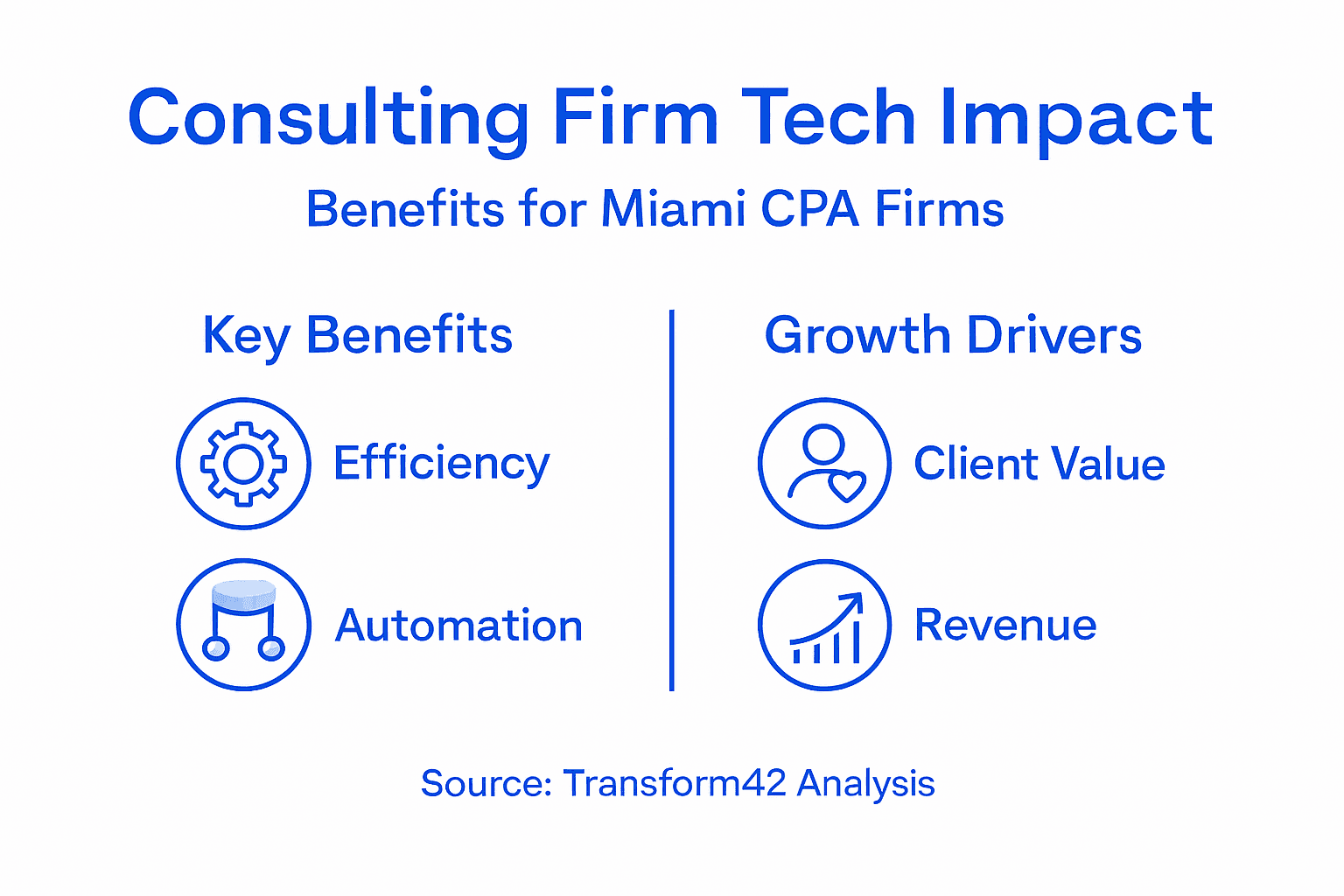
The Hidden Cost of Ignoring Technology
Here’s what happens when you don’t act: your best people quit because they’re doing repetitive work. Your profitability stays flat while your competitors grow. Your clients find advisors who can answer strategic questions about their business.
The firms that succeed treat technology transformation as a business problem, not an IT problem. They ask: “What do we want to accomplish?” then find technology that enables it.
Digital transformation success depends on technology adoption, leadership commitment, workforce adaptation, and organizational changes that leverage technology fully for growth.
Technology Integration That Actually Works
When business analyst consultants help with technology decisions, they follow this approach:
- Assess your current state—what systems exist and how well they work together
- Define your growth goals—revenue targets, service expansion, team size changes
- Identify gaps—where technology is missing or broken
- Design integration—how new systems connect and flow
- Implement with support—ensure adoption, not resistance
This isn’t about having the fanciest tools. It’s about having tools that work together and actually serve your strategy.
Real Results You Can Measure
When technology works right, you see specific outcomes:
- Reduced time on compliance work (typically 20-40% reduction)
- Faster client reporting and insights
- Better profitability visibility
- Ability to take on larger clients with existing staff
- Higher employee satisfaction (people doing meaningful work)
These aren’t theoretical benefits. Accounting firms implementing technology strategically see measurable revenue increases and improved margins within 6-12 months.
Pro tip: Start with your biggest pain point—if it’s data entry taking 30 hours weekly, prioritize automation there first. Showing quick wins builds momentum for larger technology investments across your firm.
Benefits and Risks for Miami CPAs
Business analyst consulting delivers real benefits for accounting firms willing to embrace it. But there are also risks if you don’t approach it carefully. Understanding both sides helps you make smart decisions about whether and how to invest.
The truth is this: consulting can transform your firm’s growth trajectory or waste your money if done poorly. The difference comes down to realistic expectations and proper execution.
Real Benefits You Can Actually Achieve
When consulting works, the benefits are substantial:
- Higher margins – Strategic service redesign typically increases profitability by 15-30%
- Time reclaimed – Automation and process improvements free up 10-20 hours weekly per team member
- Better client selection – Profitability analysis shows which clients to pursue and which to exit
- Competitive positioning – Strategic advisory services let you command premium pricing
- Employee retention – Your team stays longer when doing meaningful work instead of repetitive tasks
- Scalability without chaos – Serve more clients without proportional hiring increases
These benefits compound over time. A firm that gains back 15 hours weekly per person and improves margins by 20% is fundamentally different in three years.
To help accounting firms assess consulting benefits and risks, here’s a summary:
| Benefit | Approximate Impact | Risk | How to Minimize Risk |
|---|---|---|---|
| Higher profit margins | 15-30% margin increase | Implementation failure | Involve staff in execution |
| Time savings | 10-20 hours weekly per member | Change resistance | Communicate early and often |
| Client quality | Profitability guides selection | Technology mismatch | Customize solutions for firm |
| Competitive advantage | Premium pricing opportunities | Cost overruns | Set clear budgets upfront |
| Team retention | Increased engagement, lower turnover | Leadership misalignment | Align priorities before project |
The Real Risks to Watch For
Here’s where firms get into trouble. Consulting can fail if you approach it wrong:
- Implementation failure – Consultants hand you a report. Your team ignores it. Nothing changes.
- Change resistance – Your people feel threatened. They resist new processes actively or passively.
- Technology mismatch – Consultants recommend solutions that don’t actually fit your workflow.
- Cost overruns – Project scope creeps. Costs balloon beyond initial budget.
- Leadership misalignment – You and your partners disagree on priorities. The engagement stalls.
Most consulting failures aren’t about bad recommendations. They’re about poor execution or misaligned expectations.
Risk management protects your investment. Clear decision-making processes, stakeholder alignment, and proper execution oversight prevent costly mistakes.
How to Maximize Benefits and Minimize Risks
The firms that get results do these things:
- Start with clear goals—what specific problem are you solving?
- Get leadership aligned—all partners agree on priorities and commitment
- Involve your team early—they’ll implement the changes, so get their input
- Define success metrics upfront—how will you measure whether it worked?
- Plan for change management—budget time and resources for adoption
- Stay hands-on—consultants guide, but your people execute
Don’t hire consultants to avoid doing the work yourself. Hire them to guide you through doing the work correctly.
Security and Compliance Considerations
When consultants access your systems and data, cybersecurity matters for Miami CPAs. You’re handling sensitive client information. Make sure consulting firms have proper security practices, data handling agreements, and compliance protocols.
This isn’t optional. Your clients’ data is your responsibility, not the consultant’s.
Making the Decision
Consulting makes sense if you have:
- A specific problem you can’t solve internally
- Leadership commitment to implementation
- Budget for both consulting fees and execution costs
- Willingness to make tough decisions (like exiting unprofitable clients)
- Realistic timelines (6-18 months for significant change)
If you’re looking for someone to manage your operations for you or hoping consulting will magically fix everything, it won’t.
Pro tip: Before hiring a consultant, do an internal audit of your last three years—what problems keep recurring? That’s your real problem to solve, not a vague desire to “grow.” Consultants are most effective when solving specific, recurring challenges.
Choosing the Right Consulting Partner
Not all consulting firms are equal. Choosing the wrong partner wastes money and time. Choosing the right one transforms your firm. The difference lies in knowing what to look for before you sign anything.
This decision matters because consultants will influence your strategy, work with your team, and access your sensitive data. You’re not just hiring expertise. You’re bringing someone into your business who shapes its future.
Define Your Problem First
Before you even start looking at consulting firms, get clear on what you actually need. Vague problems lead to vague solutions and wasted money.
Ask yourself these questions:
- What specific challenge is costing you the most right now?
- Which problem keeps recurring despite your efforts to fix it?
- What would success look like in measurable terms?
- How much time and budget can you realistically invest?
- What’s the deadline for needing results?
Write this down. One paragraph describing the real problem. This becomes your filter. Any consulting firm that doesn’t address this specific problem isn’t the right fit.
Industry Experience Matters More Than You Think
A consultant who understands accounting firms operates differently than one who works with manufacturers or tech companies. Your workflows, compliance requirements, and client relationships are unique.
Look specifically for firms with accounting and professional services experience. They understand your billing models, your regulatory constraints, and the challenges boutique firms face competing against larger national firms.
When you interview consultants, ask about past engagements with firms like yours. Ask for specific examples of problems they solved and results they achieved.
The right consulting partner has industry expertise, understands your specific challenges, and demonstrates accountability through clear metrics and measurable business improvements.
Evaluate Their Approach and Methodology
Different consulting firms work differently. Some conduct deep diagnostics. Others use templated approaches they apply to every client. Some focus on technology. Others prioritize process change.
Understand their methodology before you hire them:
- Do they start with diagnosis or jump to recommendations?
- How much will your team be involved in the work?
- What’s their approach to change management?
- How do they measure success?
- What happens after the engagement ends?
A firm that comes in immediately pitching solutions without understanding your situation is a red flag. Good consultants ask lots of questions first.
Check References and Reputation
Don’t accept a client list. Contact actual clients they’ve worked with. Ask about real outcomes, not marketing language.
Specific questions to ask references:
- Did the consultant deliver what they promised?
- How involved was your team in implementation?
- What were the actual business results?
- How would you rate communication and responsiveness?
- What would you do differently if starting over?
These conversations reveal whether a firm actually delivers or just looks good on paper.
Cultural Fit and Communication Style
You’ll be working closely with these people for months. If they don’t communicate well or don’t respect how you operate, the engagement will be frustrating and ineffective.
Pay attention to how they communicate in initial conversations. Are they listening or just talking? Do they ask about your culture and preferences? Can you imagine working with them intensely?
Mismatch in communication style causes more consulting failures than bad recommendations.
Get Everything in Writing
Before you sign, make sure the engagement letter includes:
- Specific deliverables and timeline
- Total fee structure with no surprises
- Success metrics you’ll measure progress against
- Their role and your team’s responsibilities
- Data security and confidentiality agreements
Ambiguous contracts lead to disputes. Clear contracts lead to successful engagements.
Pro tip: Interview at least three consulting firms and ask each one the same questions. Compare not just their answers but how they answered—did they listen, ask follow-up questions, and demonstrate genuine interest in your business, or did they rush to sell you their standard solution?
Unlock Strategic Growth with Expert Business Analyst Consulting and Technology
If you are a Miami CPA struggling with inefficient processes, technology gaps, and the challenge of scaling without adding headcount, you are not alone. The article highlights the critical need to move beyond tax compliance and embrace business analyst consulting to identify bottlenecks, optimize workflows, and integrate technology for real growth. Your clients demand insightful strategic guidance, and the time to act is now
At Transform42, we specialize in partnering with Miami accountants to deliver technology-driven strategic advantages that reclaim your team’s time and elevate your firm’s value. We understand the unique hurdles you face and offer proven solutions to help you land bigger clients, increase profitability, and scale efficiently. Don’t let outdated operations or technology hold you back. Take the first step towards measurable improvement by visiting Transform42 and learn how our tailored services can empower you to build the capabilities and compliance your clients expect.
Explore how business consulting services enable Miami CPAs to transform their operations and leverage best-in-class technology to win in a competitive market. You deserve a partner who knows your industry and delivers results. Contact us today to begin your strategic growth journey.
Frequently Asked Questions
What services do business analyst consulting firms provide for accounting firms?
Business analyst consulting firms help accounting firms enhance their operations by offering services such as process optimization, technology implementation, client profitability analysis, service design, change management, and scalability planning.
How can technology integration benefit Miami CPAs?
Technology integration can lead to significant improvements in accounting firms, including automation of repetitive tasks, real-time data access for decision-making, enhanced client analytics, and the ability to scale operations without proportional hiring.
What should accounting firms consider before hiring a business analyst consulting firm?
Firms should define their specific problems, evaluate the consultant’s industry experience, understand their approach and methodology, check references, and ensure clear contractual agreements regarding deliverables and success metrics.
How do business analyst consultants measure the success of their recommendations?
Success is typically measured through specific metrics agreed upon at the start of the engagement, such as improved profit margins, time savings, better client selection, and overall enhancements in operational efficiency.