
Running an independent accounting practice in Miami means juggling detailed financial workflows while delivering exceptional client results. Staying competitive is tough when manual processes drain your time and slow your growth. Business process efficiency, fueled by new technology and supported by frameworks like Business Process Management, empowers CPAs to transform daily operations. This article shares how adopting modern systems and optimizing workflows can help you work smarter, serve clients better, and achieve greater profitability.
Table of Contents
- Defining Business Process Efficiency in Accounting
- Essential Technologies for Process Automation
- Process Automation Types and Key Workflows
- Compliance and Data Security for Accountants
- Common Efficiency Pitfalls and How to Avoid Them
Key Takeaways
| Point | Details |
|---|---|
| Business Process Efficiency | Focus on optimizing accounting workflows to enhance productivity and reduce resource expenditure. |
| Implementation of Technology | Adopt advanced tools like Robotic Process Automation to streamline repetitive tasks and improve accuracy. |
| Data Security Importance | Establish a strong cybersecurity posture to protect sensitive financial information and comply with regulations. |
| Avoiding Efficiency Pitfalls | Conduct regular audits and ensure thorough process mapping before technology implementation to prevent wasted resources. |
Defining Business Process Efficiency in Accounting
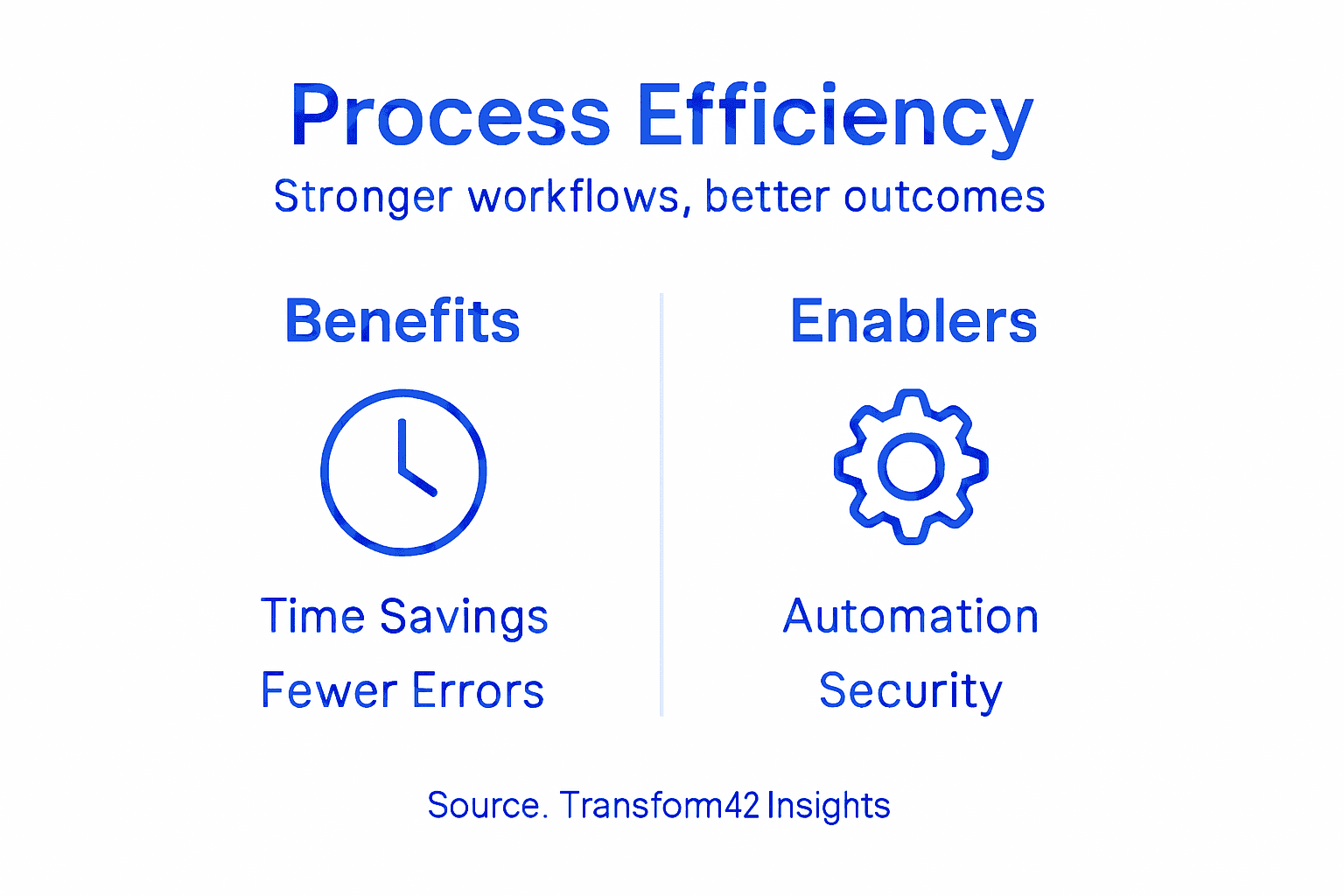
Business process efficiency represents the strategic optimization of accounting workflows to maximize productivity, minimize resource expenditure, and enhance overall organizational performance. At its core, this concept focuses on systematically improving how accounting tasks are completed, leveraging technology and strategic methodologies to streamline complex financial operations.
Understanding business process efficiency requires examining how accounting firms can transform traditional manual workflows into streamlined, technology-enabled systems. Business Process Management serves as a critical framework for achieving this transformation, treating accounting processes as dynamic assets that can be continuously analyzed, measured, and improved.
Key components of business process efficiency in accounting include:
- Automating repetitive financial data entry tasks
- Implementing standardized workflow procedures
- Reducing manual intervention in accounting processes
- Utilizing advanced technological tools for real-time financial tracking
- Creating scalable systems that adapt to changing business requirements
Accounting firms that successfully implement process efficiency strategies can achieve significant competitive advantages. By minimizing time spent on administrative tasks, professionals can redirect their focus toward strategic financial analysis, client relationship management, and value-added services that drive business growth.
Pro tip: Regularly audit your current accounting workflows to identify potential bottlenecks and inefficiencies that could be streamlined through technology and process redesign.
Essential Technologies for Process Automation
Process automation technologies are revolutionizing how Miami CPAs manage accounting workflows, enabling unprecedented levels of efficiency and accuracy. By strategically integrating advanced digital tools, accounting firms can transform traditionally time-consuming manual processes into streamlined, intelligent systems that dramatically reduce administrative overhead.

The landscape of process automation is powered by several key technological innovations. Process automation specialists leverage sophisticated tools like Robotic Process Automation (RPA), artificial intelligence, and advanced software platforms to automate complex accounting tasks with remarkable precision. These technologies can handle repetitive functions such as data entry, invoice processing, financial reconciliation, and reporting with minimal human intervention.
Critical technologies for accounting process automation include:
- Robotic Process Automation (RPA) software
- Cloud-based accounting platforms
- Machine learning algorithms for financial prediction
- Intelligent document processing systems
- Automated workflow management tools
- Real-time financial data integration systems
By implementing these technologies, accounting firms can achieve significant operational improvements. Automated systems reduce human error, accelerate processing times, and free professional accountants to focus on high-value strategic activities like financial analysis, client advisory, and business planning. The result is a more agile, responsive, and competitive accounting practice that can adapt quickly to changing business environments.
Successful process automation isn’t about replacing human professionals, but empowering them to work smarter and more strategically.
Pro tip: Conduct a comprehensive workflow audit to identify the most repetitive and time-consuming tasks that could benefit from automation technologies.
Process Automation Types and Key Workflows
Accounting process automation encompasses diverse strategies that transform traditional manual workflows into intelligent, efficient systems. Miami CPAs can leverage multiple automation approaches to streamline their operational processes, dramatically reducing administrative burden and increasing overall productivity.
Robotic Process Automation (RPA) represents a critical technology for automating rule-based, repetitive accounting tasks with remarkable precision. By implementing RPA, accounting firms can automate complex workflows such as data entry, financial reconciliation, and reporting, ensuring consistent accuracy and freeing professional accountants to focus on high-value strategic activities.
Key types of process automation for accounting workflows include:
- Rule-based Automation
- Repetitive task processing
- Standard data entry
- Invoice matching
- Cognitive Automation
- Complex decision-making processes
- Advanced data analysis
- Predictive financial modeling
- Intelligent Document Processing
- Automated document classification
- Extraction of financial information
- Compliance document management
Successful process automation requires a strategic approach that matches specific technological solutions to unique organizational needs. By carefully selecting and implementing appropriate automation technologies, accounting firms can create more responsive, adaptable, and efficient operational environments that significantly enhance their competitive capabilities.
Here’s a summary of automation types and their business benefits:
| Automation Type | Main Use Case | Business Benefit |
|---|---|---|
| Rule-based Automation | Standard data entry | Reduces errors, speeds workflow |
| Cognitive Automation | Predictive financial modeling | Enhances decision-making accuracy |
| Intelligent Document Processing | Compliance document management | Cuts manual review time |
Effective process automation transforms accounting workflows from transactional to strategic, enabling professionals to deliver more value to their clients.
Pro tip: Develop a comprehensive workflow mapping strategy before implementing automation to identify the most impactful processes for technological intervention.
Compliance and Data Security for Accountants
Data security represents a critical priority for Miami CPAs, where protecting sensitive financial information is not just a best practice but a legal and ethical imperative. Accounting firms handle incredibly complex and confidential financial data, making them prime targets for cybercriminals seeking to exploit vulnerabilities in digital systems.
Professional accountants must prioritize cybersecurity awareness to safeguard client information and maintain organizational integrity. The evolving landscape of digital threats demands a proactive, comprehensive approach to data protection that goes beyond traditional security measures.
Key compliance and data security strategies for accounting firms include:
-
Technological Safeguards
- Advanced encryption protocols
- Multi-factor authentication systems
- Regular security software updates
- Secure cloud storage solutions
-
Operational Security Practices
- Comprehensive employee training programs
- Strict access control mechanisms
- Regular security vulnerability assessments
- Detailed incident response planning
-
Regulatory Compliance Requirements
- Adherence to IRS data protection guidelines
- GDPR and privacy law compliance
- Client data confidentiality protocols
- Transparent reporting mechanisms
Successful data security isn’t just about implementing technology – it’s about creating a culture of vigilance and continuous improvement. Accounting firms must develop adaptive strategies that anticipate emerging threats while maintaining the flexibility to respond quickly to new challenges.
Compare compliance strategies to address key accounting risks:
| Strategy Type | Focus Area | Impact on Data Security |
|---|---|---|
| Technological | Encryption, authentication | Prevents unauthorized access |
| Operational | Staff training, access control | Minimizes human error |
| Regulatory | IRS guidelines, GDPR | Ensures legal data protection |
Cybersecurity is not a destination, but a continuous journey of protection, adaptation, and strategic risk management.
Pro tip: Conduct quarterly comprehensive security audits and maintain an updated incident response plan to stay ahead of potential cybersecurity threats.
Common Efficiency Pitfalls and How to Avoid Them
Accounting firms frequently encounter efficiency challenges that can dramatically undermine their operational performance and strategic potential. Understanding these common pitfalls is crucial for Miami CPAs seeking to optimize their business processes and maintain a competitive edge in an increasingly complex financial landscape.
Workplace process improvement requires systematic analysis that goes beyond superficial solutions. Many accounting firms mistakenly implement technology or tools without thoroughly understanding their existing workflows, which can lead to compounded inefficiencies and wasted resources.
Critical efficiency pitfalls to recognize and address include:
-
Workflow Misalignment
- Lack of clear process documentation
- Inconsistent task routing
- Redundant manual interventions
- Unclear responsibility assignments
-
Technology Implementation Errors
- Adopting tools without comprehensive process mapping
- Insufficient staff training on new systems
- Neglecting integration between different software platforms
- Failing to customize technologies to specific workflow needs
-
Operational Blindspots
- Reactive instead of proactive problem-solving
- Ignoring recurring bottlenecks
- Limited performance measurement
- Resistance to process redesign
Successful efficiency transformation requires a holistic approach that combines technological solutions, strategic process redesign, and a culture of continuous improvement. Accounting firms must develop adaptive frameworks that allow for ongoing workflow optimization and responsive organizational learning.
Efficiency is not about working harder, but about creating smarter systems that amplify professional capabilities.
Pro tip: Conduct quarterly workflow audits and establish cross-functional teams dedicated to identifying and eliminating process inefficiencies.
Unlock Business Process Efficiency to Drive Growth for Your Miami Accounting Firm
The article highlights the challenges Miami CPAs face in streamlining workflows, reducing manual tasks, and improving compliance to stay competitive. If you struggle with inefficient accounting processes or complex technology integrations, it’s time to take control and transform your operations. By embracing strategic process improvements and advanced automation, you can reclaim valuable time, enhance accuracy, and focus on delivering higher value to your clients.
Discover how our expert solutions in Processes and Digital Transformation empower you to build scalable, compliant systems without proportional hiring.
Take the next step toward operational excellence today. Partner with us at Transform42 to leverage technology as your strategic advantage. Land bigger clients, increase monthly revenue, and unlock the growth potential your Miami accounting firm deserves.
Frequently Asked Questions
What is business process efficiency in accounting?
Business process efficiency in accounting refers to the strategic optimization of accounting workflows aimed at maximizing productivity, minimizing resource expenditure, and enhancing overall performance. It involves transforming traditional manual workflows into streamlined, technology-enabled systems.
How can technology improve efficiency in accounting processes?
Technology improves efficiency through automation of repetitive tasks, standardization of workflows, and real-time financial tracking. Tools like Robotic Process Automation (RPA) and cloud-based accounting platforms significantly reduce human error and processing times, allowing accountants to focus on strategic activities.
What types of automation can be implemented in accounting?
Key types of automation in accounting include rule-based automation for repetitive tasks, cognitive automation for complex decision-making, and intelligent document processing for automated data extraction and classification, all aimed at increasing operational efficiency.
What are the common challenges accounting firms face in achieving process efficiency?
Common challenges include workflow misalignment, technology implementation errors, and operational blind spots. Addressing these issues requires a thorough understanding of existing workflows, comprehensive training on new systems, and a proactive approach to measure performance.
Recommended
- 8 Essential Digital Strategy Tips for Miami CPAs
- 8 Essential Digital Strategy Tips for Miami CPAs – Stratgetic IT Consultants for Accountants
- Business Process Automation Steps for Miami Accounting Firms – Stratgetic IT Consultants for Accountants
- Business Process Automation Guide for Miami CPAs – Stratgetic IT Consultants for Accountants
- Pete Ketchum | Organizational Psychologist & Author