
TL;DR:
- Most change initiatives fail in professional services because human factors are overlooked rather than software flaws or timing. Effective change management involves structured preparation, clear communication, role-specific training, and ongoing reinforcement to ensure sustainable adoption. Firms that follow these principles see significantly higher success rates, especially when leadership visibly supports and actively maintains the change process.
Most change initiatives fail before they get traction. Not because of flawed software or bad timing, but because the human side gets ignored. For independent accountants, tax lawyers, and financial consultants in Miami, following the right change management steps is the difference between a practice that scales and one that stalls. Structured change management achieves six times greater success in ERP implementations, with human factors driving outcomes over technical ones at a 6:1 ratio. This guide gives you a clear, actionable change management process guide built specifically for finance professionals ready to grow.
Table of Contents
- Understanding the problem: why change management matters in professional services
- Preparing for change: essential prerequisites before starting
- Executing change: step-by-step actions tailored for Miami finance pros
- Verifying and sustaining change: measurement and reinforcement
- Why most finance firms get change management wrong — and how to fix it
- How Transform42 supports Miami finance pros with change management
- Frequently asked questions
Key Takeaways
| Point | Details |
|---|---|
| Structured approach multiplies success | Following proven steps increases change success rates by up to six times compared to ad hoc efforts. |
| Human factors are critical | People’s awareness, desire, and ability drive adoption much more than technical factors. |
| Leadership and communication matter | Visible leadership support and clear, ongoing communication reduce resistance and build momentum. |
| Measure and reinforce change | Regular feedback and recognizing short-term wins sustain adoption and embed change in culture. |
| Avoid common training mistakes | Tailor training to specific roles and provide continuous support to prevent pushback and failure. |
Understanding the problem: why change management matters in professional services
Change is hard in every industry. In professional services, it is especially hard because your team is trained to minimize risk, which means they treat unfamiliar processes as threats. That instinct protects your clients. It also slows your firm down.
The most common reason change fails in accounting and consulting practices is not resistance itself. It is that leaders treat resistance as a people problem rather than a communication problem. When staff do not understand what is changing, why it matters, and what it means for their day-to-day work, they disengage. That disengagement compounds over weeks until the initiative quietly dies.
Here are the core failure patterns we see in Miami finance firms:
- No clear case for change. Staff are told to adopt a new process but not why the old one was costing the firm clients or revenue.
- Communication that goes one way. Announcements without feedback channels create anxiety, not alignment.
- Training that is too generic. A tax lawyer and a bookkeeper have different workflows and different concerns. One-size-fits-all training misses both.
- Leadership that disappears after launch. Visible, ongoing sponsorship from senior partners is not optional. It is the single biggest predictor of success.
“Organizations that apply structured change management achieve six times greater success in ERP implementations, with human factors driving outcomes over technical ones at a 6:1 ratio.”
Business process change management is not a one-time announcement. It is a sustained effort to move people from where they are to where the firm needs them to be. For change management tips specific to Miami accounting firms, the fundamentals remain consistent: communicate early, communicate often, and close the feedback loop every time.
Having seen why change often fails, next we explore what you need to prepare before starting.
Preparing for change: essential prerequisites before starting
Skipping preparation is like filing a return without the source documents. You can do it, but you will be correcting errors for months. Before you announce any change, you need three things in place: urgency, coalition, and vision.
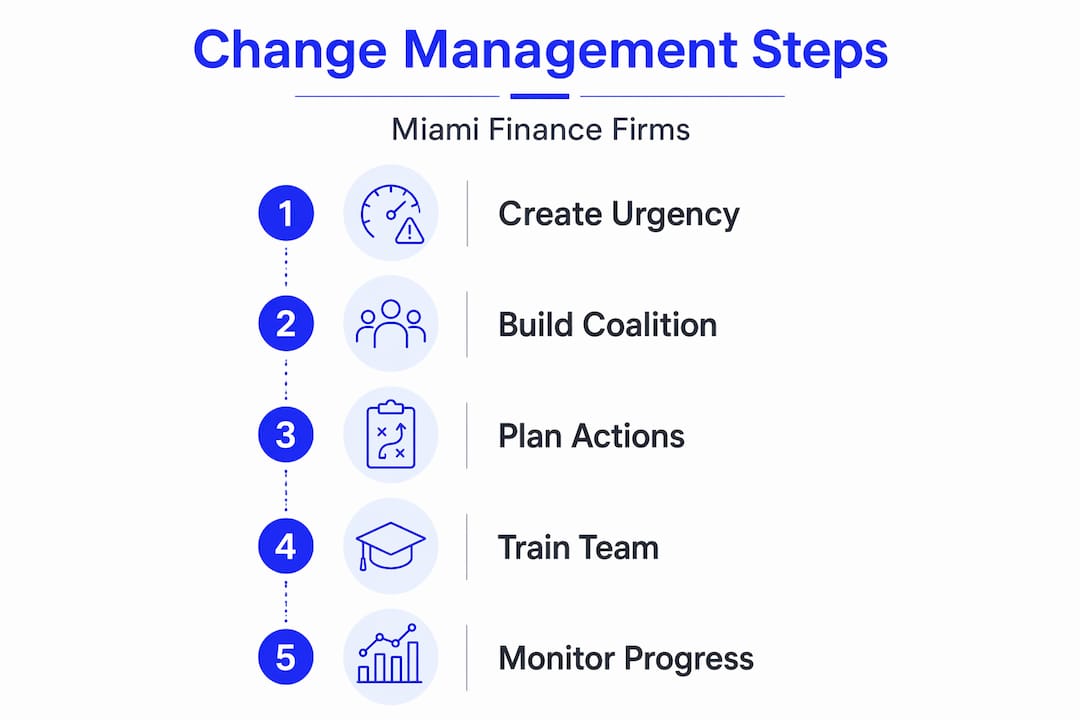
Kotter’s model is the most well-tested change management process guide in use today. Built on decades of research, it identifies eight sequential steps. The first four are all about preparation, and they account for more failed projects than anything else.
Here is how to apply the preparatory steps in your practice:
- Create urgency. Show your team the real cost of staying still. Lost clients, compliance risk, hours wasted on manual processes. Numbers land harder than concepts.
- Build your guiding coalition. Identify two or three credible partners, senior associates, or team leads who believe in the change. Their influence multiplies yours.
- Develop a clear vision. Your team needs to picture what success looks like. “We will cut turnaround time on quarterly reports by 40% using the new workflow” is a vision. “We are going digital” is not.
- Plan early wins. Kotter’s model requires short-term wins within 6 to 18 months to maintain momentum, with full cultural anchoring taking 3 to 5 years.
Pro Tip: Do not wait until the rollout to identify your coalition. Build it during planning so those voices are already aligned when questions start coming in from the rest of the team.
| Preparation step | What it looks like in practice | Common mistake |
|---|---|---|
| Create urgency | Share data on client churn or billing inefficiency | Using vague language like “we need to modernize” |
| Build coalition | Recruit a respected tax partner and a tech-forward associate | Choosing only senior titles, not respected voices |
| Define vision | Write a one-paragraph outcome statement | Building a 40-slide deck no one reads twice |
| Plan short-term wins | Schedule a 60-day process improvement checkpoint | Waiting for the full rollout to show results |
For a detailed look at applying these steps, review our change management process steps resource for Miami CPAs.
With preparation complete, let’s break down the actual steps to execute change effectively.
Executing change: step-by-step actions tailored for Miami finance pros
Execution is where most change management procedures break down. The plan looked good on paper. Then the tax season hit, a key partner checked out, and the training session got skipped. Here is how to keep execution on track.
The ADKAR model (Awareness, Desire, Knowledge, Ability, Reinforcement) is the most practical individual-level framework for change adoption. Each letter represents a milestone your staff must reach before the next one matters. You cannot train someone who does not yet want the change. You cannot reinforce adoption in someone who was never trained. The ADKAR steps are sequential because people are sequential.
Here are the core execution steps:
- Communicate the why before the what. Build awareness first. Send a short, direct message from a senior partner explaining the business reason for the change. Keep it to three paragraphs.
- Create two-way feedback channels. Pulse surveys, short team check-ins, and a shared Q&A document all serve this purpose. Nearly 6 in 10 organizations lack a formal change communication approach, which leads to information overload and staff disengagement.
- Deliver role-specific training. Tax lawyers need training built around their compliance workflows. Bookkeepers need training built around their billing and reconciliation tasks. Mixing these groups into one session wastes everyone’s time.
- Run a pilot program first. Choose a small team or a single service line. Measure what breaks, what slows down, and what feedback comes back. Adjust before the firm-wide rollout.
- Identify and remove barriers. Sometimes the blocker is a manual approval process. Sometimes it is a legacy system that does not connect to the new platform. Your job is to find these and clear them before they kill momentum.
- Assign change champions. These are team members who use the new system confidently and answer questions from peers. They do more for adoption than any memo.
Pro Tip: Build a simple tracking sheet with each staff member’s name and their current ADKAR stage. Reviewing it weekly during implementation tells you exactly where to focus your next conversation.
| ADKAR stage | Signs your team is there | Signs they are stuck |
|---|---|---|
| Awareness | Staff can explain why the change is happening | Staff say “nobody told us about this” |
| Desire | Volunteers for pilot programs | Active avoidance, finding workarounds |
| Knowledge | Correct usage during training | Repeated questions about basic functions |
| Ability | Using the new process independently | Reverting to old process under pressure |
| Reinforcement | New process becomes default | Slipping back after launch excitement fades |

For more on building these habits into your firm, see our change management tips and digital workplace steps guides.
Executing these steps well leads to the next critical phase: verifying and sustaining change.
Verifying and sustaining change: measurement and reinforcement
Launch day is not finish day. It is actually the most vulnerable moment of the entire process. Adoption peaks briefly after training and then drops when the novelty fades and the old habits compete. You need active reinforcement to close that gap.
Here is what a working verification process looks like in a finance firm:
- Run pulse surveys at 30, 60, and 90 days post-launch. Ask three questions: Is the new process clear? Are you getting the support you need? What is your biggest friction point right now?
- Track usage metrics, not just satisfaction scores. If your new billing software shows that 40% of your team is still using the old spreadsheet, you have an adoption gap, not a success story.
- Hold small group reinforcement sessions. These are not more training classes. They are 20-minute conversations where a team lead addresses real questions from real usage. Very different energy.
- Celebrate visible wins publicly. When a tax lawyer cuts their document prep time in half using the new workflow, share that story in your next team meeting. Specific stories beat abstract encouragement every time.
- Revise policies to reflect the new way. If your onboarding checklist, your performance reviews, and your SOPs still reference the old process, your culture will drift back. Update the written record.
Only 11% of organizations reach mature change management embedding for sustained results. That is not because the other 89% lack commitment. It is because they treat reinforcement as optional. It is not.
Pro Tip: Assign each change champion a small group of five to seven colleagues to check in with monthly for the first quarter. Personal accountability at the peer level sustains adoption more than top-down reminders.
For a complete change management guide built for Miami firms, review our resource on change management guide for Miami firms.
With ongoing verification, change becomes part of how your firm operates permanently.
Why most finance firms get change management wrong — and how to fix it
Here is the uncomfortable truth: most Miami finance firms are not failing at change management because they lack resources. They are failing because they are copying what worked for a 10,000-person corporation and applying it to a 12-person practice. The frameworks are right. The application is wrong.
The four blind spots we see most often:
Skipping the pilot. Firms with fewer than 20 staff often think a pilot is unnecessary overhead. So they roll out firm-wide on day one, hit unexpected friction, and spend the next three months firefighting. A two-week pilot with three staff members would have caught every one of those issues.
Neglecting role-specific training. Tax lawyers deal with regulatory timelines, client privilege, and complex documentation. Their resistance to new software is often about compliance anxiety, not stubbornness. Training that ignores those specific concerns will not move them. Training that directly addresses how the new system protects their compliance workflow will.
Ignoring early feedback. Ignoring feedback loops leads to 60% adoption failure. When staff raise concerns and see no visible response, they conclude that leadership is not listening. That conclusion kills trust and adoption simultaneously. You do not need to act on every suggestion. You do need to acknowledge every concern and explain your decision.
Undervaluing visible wins. Announcing that the firm is “on track” is not a win. Announcing that your accounts receivable team reduced collection time by 18 days using the new system is a win. Specific, real, named wins break the negativity cycle that builds during hard rollouts.
The most underused tool in any steps in change management process is also the cheapest: change management tips that keep leadership visible and communicating throughout the full implementation, not just the kickoff.
How Transform42 supports Miami finance pros with change management
You now know what the steps look like, where firms typically stumble, and what reinforcement actually requires. The question is whether you want to navigate all of that alone.
At Transform42, we work exclusively with accountants, tax lawyers, and financial consultants in Miami to design and execute change management strategies that connect directly to your technology infrastructure. From digital transformation services that align your firm’s systems with your growth goals, to technology consulting that keeps your team supported through every phase of adoption, we bring the structure and the hands-on guidance that solo rollouts rarely achieve. We also handle the process automation workflow changes that let you scale without proportional hiring. Your clients expect capability and compliance. We help you build both.
Frequently asked questions
What are the basic steps in effective change management?
Effective change management includes creating urgency, building leadership support, clear communication, role-specific training, removing barriers, and reinforcing new behaviors over time. Kotter’s 8-step model provides a sequential process for leading this kind of change in professional organizations.
Why do most change initiatives fail in accounting firms?
Most fail due to lack of structured planning, ignoring human resistance, and poor communication strategies from the start. 70% of change efforts fail without proper cultural anchoring and sustained momentum after the initial launch.
How can I measure if change is working in my firm?
Use pulse surveys and usage metrics, particularly within the first 90 days, to identify resistance and areas where staff need additional support. Feedback loops in the first 90 days post-change reveal resistance early enough to address it before adoption collapses.
What is a common mistake when training staff during change?
The most frequent error is delivering generic training that does not account for role-specific workflows and concerns, especially for tax lawyers navigating regulatory requirements. Neglecting role-specific training significantly increases resistance during ERP and process changes in finance environments.
Recommended
- Change Management Tips For Miami Accounting Firms
- Streamline Your Change Management Procedure For Miami SMBs
- Change Management Guide For Miami Accountants
- Change Management Guide: 88% Success Rate For Miami Firms
Stay Ahead of IT Risks in Your Industry
Weekly insights on cybersecurity, compliance, and IT strategy for accounting firms, law firms, and medical practices.
Transform 42 provides managed IT services for accounting firms in Miami.