
TL;DR:
- IT consulting in Miami involves strategic advisory services that align technology with business goals, not just technical support. It delivers project-based roadmaps, architecture plans, and governance frameworks that help financial firms grow revenue and improve client satisfaction. Properly scoped engagements separate consulting from ongoing operations, ensuring accountability and maximizing ROI.
If you are an independent financial consultant in Miami and you think the role of consultancy in IT is just about fixing computers or resetting passwords, you are leaving real money on the table. IT consulting is not technical support. It is a strategic function that aligns your technology choices with your business goals, your compliance obligations, and the kind of client experience that justifies premium fees. This guide breaks down what IT consulting actually does, how it works in practice, and how you can use it to grow your revenue and your reputation with bigger, more demanding clients.
Table of Contents
- Understanding the core role of IT consultancy
- Bridging the gap between business goals and technology investments
- Managing cybersecurity risks within financial consultancy
- Structuring IT consulting engagements for financial professionals
- Measuring and growing revenue through IT consulting
- Our perspective: IT consulting is not a cost center, it is a client acquisition tool
- Ready to turn your technology into a growth asset?
- Frequently asked questions
Key Takeaways
| Point | Details |
|---|---|
| IT consulting scope | IT consulting provides expert, project-based advice with clear deliverables and no ongoing operational responsibility. |
| Align technology and goals | Consultants bridge the gap between business objectives and technology investments to maximize ROI. |
| Cybersecurity integration | Effective IT consulting integrates cybersecurity risks into broader enterprise risk management for better governance. |
| Engagement structuring | Clear scoping and deliverable packages prevent scope creep and confusion between consulting and managed services. |
| Measure impact | Tracking technology initiatives with measurable business milestones helps demonstrate real revenue growth. |
Understanding the core role of IT consultancy
IT consultancy is fundamentally advisory work. It is not someone managing your servers day to day. The IT consulting scope covers expert guidance on technology decisions, architecture, implementation planning, and governance, and it ends when the defined scope is complete. You get a deliverable. You get clarity. Then the engagement closes.
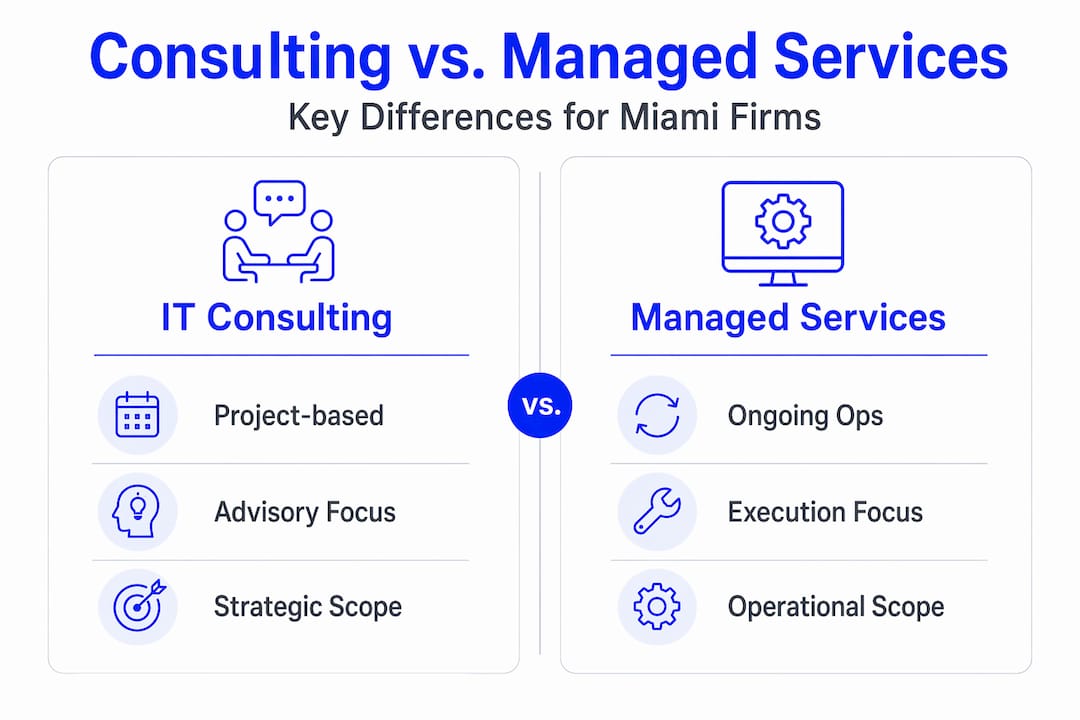
This is different from managed IT services, which provide continuous operational support to keep your systems running. Many Miami financial professionals blur these two together, and that confusion costs them. When a consultant’s scope bleeds into day-to-day support without a separate agreement, accountability disappears and costs climb.
Here is what IT consultancy typically delivers in a project-based engagement:
- Technology roadmaps aligned to where your firm is going in the next 12 to 36 months
- Architecture recommendations for systems like CRM, document management, or client portals
- Implementation plans with defined timelines, owners, and acceptance criteria
- Governance frameworks that set rules for how technology decisions get made in your firm
- Vendor selection analysis so you buy the right tools instead of the popular ones
Understanding the difference between consulting and operations, which you can explore further by comparing managed services vs. in-house IT, is the first step to getting real value from either.
Bridging the gap between business goals and technology investments
Technology projects fail all the time. Not because the technology is bad, but because no one mapped the investment to a real business outcome. The role of IT consulting in business is to align technology investment with business objectives and close the execution gap between strategy and ROI.
For a Miami financial consultant, this is especially high-stakes. Your clients expect you to run a firm that is efficient, secure, and capable of handling their complex financial needs. If your internal technology is fragmented or slow, it shows. It shows in your onboarding time, your response time, and your ability to deliver deliverables when they are needed.
IT consultants create a strategic layer between your business goals and your technology choices. Instead of buying software because a vendor pitched it well, you make purchases based on a documented plan that connects each tool to a specific business outcome. Think of it this way: every technology purchase your firm makes is either an asset or an experiment. IT consulting turns experiments into assets.
Key ways IT consulting closes the execution gap for financial professionals:
- Mapping client onboarding technology to measurable time reductions and satisfaction scores
- Identifying automation opportunities in workflows like document collection, tax prep, or report generation
- Tying software investments to specific revenue milestones, not just productivity theories
- Building phased rollout plans so your firm can absorb change without disruption
Pro Tip: Before your next software purchase, ask your IT consultant to write a one-page business case that connects the tool to a specific revenue or efficiency outcome. If it cannot be written in one page, the goal is not clear enough yet.
For a deeper look at how strategic IT planning directly supports revenue growth, that resource is worth your time.
Managing cybersecurity risks within financial consultancy
Cybersecurity is not a checklist. For a financial consulting firm in Miami, it is a client trust issue and a liability issue. A breach does not just disrupt operations. It ends relationships.

NIST emphasizes documenting likelihood and impact in cybersecurity risk registers integrated into enterprise risk profiles to support prioritization and risk response. That language might sound technical, but the practical meaning is simple: your cybersecurity decisions should be driven by what threatens your business the most, not by what is easiest to fix.
NIST’s Cybersecurity Framework 2.0 is used by organizations to improve how they communicate about cybersecurity risk and to make workforce decisions based on actual risk reality rather than assumptions.
Here is a practical four-step process IT consultants use to embed cybersecurity into a financial firm’s operations:
- Risk identification: Catalog every system that touches client data, from your email to your client portal to your accounting software.
- Likelihood and impact scoring: Rate each threat by how likely it is and how badly it would hurt your firm if it happened.
- Enterprise integration: Connect identified risks to your firm’s overall risk register, not just an IT department list.
- Workforce planning: Decide which risks require training, which require new tools, and which require external support.
“Cybersecurity is not a technology problem. It is a business risk problem that happens to involve technology. The firms that understand this distinction protect themselves far more effectively than those chasing compliance checklists.”
For firms like CPAs and financial advisors, IT consulting for CPA firms covers exactly this intersection of compliance, security, and client trust. Getting a handle on enterprise cybersecurity risk before a breach happens is far less expensive than recovering from one after.
Structuring IT consulting engagements for financial professionals
A poorly scoped consulting engagement is expensive in two directions. You pay for work that drifts, and you lose time on projects that never finish. Independent financial consultants should structure engagements as auditable deliverable packages that align with IT consulting’s bounded, project-oriented nature to prevent scope creep.
A well-structured engagement for a Miami financial firm typically includes four components:
- Current-state assessment: A documented inventory of your technology, processes, and gaps
- Target-state blueprint: A description of where your technology should be in 12 to 24 months
- Roadmap with milestones: A phased plan connecting current state to target state with clear checkpoints
- Governance recommendations: Rules for how technology decisions get made going forward
Here is a table that illustrates the practical difference between IT consulting and managed services in terms of scope and accountability:
| Factor | IT consulting | Managed services |
|---|---|---|
| Nature of work | Project-based advisory | Ongoing operational support |
| Output | Roadmaps, plans, frameworks | System uptime, ticket resolution |
| Duration | Defined start and end | Continuous subscription |
| Accountability | Deliverable acceptance | SLA performance metrics |
| Best used for | Strategy, planning, change | Day-to-day IT operations |
This separation matters. When a consultant is also responsible for ongoing operations, the incentive to recommend expensive infrastructure can cloud their advice. Keeping these roles separate protects your interests.
Pro Tip: Add a simple “boundary clause” to every consulting agreement. It should state explicitly what is in scope, what is out of scope, and that any operational support requires a separate agreement. This one sentence prevents most scope disputes before they start.
If you want to understand how internal consulting ROI works for CPA firms specifically, that resource provides detailed guidance.
Measuring and growing revenue through IT consulting
The most effective revenue growth method via IT consulting is mapping technology initiatives to measurable business value milestones and bridging the execution gap to achieve ROI. That means you should not sign off on a technology project unless you know how you will measure its success in business terms.
For Miami financial professionals, the metrics that matter most tend to cluster around three areas:
- Service delivery speed: How long does it take to onboard a new client? How fast can you produce a report or a tax return? Technology should compress these timelines.
- Disruption frequency: How often do technology failures interrupt your client work? Each disruption has a dollar cost. IT consulting should reduce this number over time.
- Client retention and acquisition: Firms with better technology systems can take on larger, more complex clients without proportional increases in staff. That is where the real revenue growth lives.
Here is a simple framework for tracking IT consulting’s business impact over a 12-month engagement:
| Metric | Baseline | 6-month target | 12-month target |
|---|---|---|---|
| Client onboarding time | 5 days | 3 days | 2 days |
| Monthly IT disruptions | 8 incidents | 4 incidents | 1 to 2 incidents |
| Revenue per client | Current baseline | 10% increase | 20% increase |
| Compliance audit findings | 6 findings | 3 findings | 0 critical findings |
These numbers are not arbitrary. They come from defining, at the start of the engagement, what success looks like. IT consulting earns its fee when you can point to a before-and-after story that your clients and your accountant can both appreciate.
Pro Tip: Build your IT consulting ROI case before the engagement starts, not after. Ask your consultant to define three measurable business outcomes that the project will deliver. If they cannot answer that question clearly, find someone who can.
For more on how IT consulting unlocks revenue for financial professionals, that page goes into specific service delivery improvements you can expect.
Our perspective: IT consulting is not a cost center, it is a client acquisition tool
Here is something most articles on this topic will not tell you. The financial professionals in Miami who grow fastest are not the ones with the best technical knowledge. They are the ones whose firms look the most capable to the clients they are trying to land.
Big clients, whether that is a family office, a growing private equity firm, or a multi-entity business owner, do not just evaluate your credentials. They evaluate your operations. They ask: can this firm handle our complexity? Do they have systems that protect our data? Can they communicate clearly and deliver on time?
IT consulting gives you the operational infrastructure to answer “yes” to all of those questions. It is not just about efficiency. It is about signaling capacity. When your firm has a documented technology roadmap, a cybersecurity governance policy, and a clean client-facing portal, you look like the kind of firm that handles serious clients. Because you are.
We have seen Miami accountants and financial advisors add significant new client revenue not because they hired more staff, but because they invested in the right technology infrastructure first. The consulting engagement paid for itself before the ink was dry. The IT consultant role in business is not overhead. It is a growth engine when executed correctly. That reframe is worth sitting with.
Ready to turn your technology into a growth asset?
At Transform42, we work with independent financial professionals and consultants in Miami to build the technology capabilities and compliance infrastructure their most demanding clients expect.
We are not a help desk. We are your technology partner. We help you land bigger clients, scale without proportional hiring, and build a firm that runs the way it should. From IT consulting and cybersecurity governance to automation and AI integration, everything your firm needs is handled in one place. If you are ready to build the kind of infrastructure that turns technology from a cost into a competitive advantage, contact us and let’s build your roadmap together.
Frequently asked questions
What exactly does IT consulting involve versus managed IT services?
IT consulting advises and plans technology projects with a defined scope and deliverables, while managed IT services handle ongoing operations and support. IT consulting is project-based, delivering recommendations and designs, whereas managed services provide continuous operational accountability.
How can IT consulting help financial professionals improve client revenue?
By aligning technology investments with clear business goals and defining measurable outcomes, IT consulting ensures digital initiatives deliver real service improvements that drive client growth and retention. Mapping technology initiatives to business value milestones bridges the execution gap and achieves ROI.
Why is cybersecurity risk management critical in IT consulting for financial consultants?
Effective cybersecurity consulting links technical risks to business impact and governance, enabling financial firms to prioritize protections that safeguard client data and maintain trust. NIST’s guidance integrates cybersecurity risk into enterprise risk profiles, supporting prioritization and governance oversight.
How do I avoid scope creep when hiring an IT consultant?
Define a clear, auditable deliverable package with specific assessments, roadmaps, and governance plans to keep consulting work bounded and separate from ongoing support contracts. Structuring consulting as bounded packages prevents scope creep into operational support.
Recommended
Stay Ahead of IT Risks in Your Industry
Weekly insights on cybersecurity, compliance, and IT strategy for accounting firms, law firms, and medical practices.
Transform 42 provides managed IT services for accounting firms in Miami.