
Most independent accountants and CPAs in Miami assume that buying the right software is the finish line. It is not even close to the starting line. True digital operations mean weaving automation, AI, analytics, and cloud technology into every layer of how your firm runs, not just swapping spreadsheets for QuickBooks. The firms that figure this out early are handling more clients, making fewer errors, and earning significantly more revenue each month. This guide breaks down exactly what digital operations are, why they matter for your Miami practice, and how you can start using them to scale without burning out.
Table of Contents
- Understanding digital operations: Beyond basic software
- Core components of digital operations for accountants
- Real-world benefits: Efficiency, scalability, and revenue growth
- How to get started: A Miami CPA’s action plan
- The uncomfortable truth: Why most digital operations fail (and how you can succeed)
- Accelerate your transformation with expert help
- Frequently asked questions
Key Takeaways
| Point | Details |
|---|---|
| Beyond software adoption | Digital operations mean integrating automation, AI, and cloud tools into every accounting process. |
| Tangible business benefits | Miami accountants see measurable gains like higher efficiency, scalability, and monthly revenue. |
| Strategic implementation is key | A step-by-step plan and cultural buy-in make digital operations succeed where most fail. |
| Start small for big impact | Begin with simple automations before expanding for quick wins and momentum. |
Understanding digital operations: Beyond basic software
Let’s clear up the confusion right away. Digital operations are not a product you buy. They are a way of running your entire firm. Digital operations refers to the integration and optimization of digital technologies, processes, and tools, including automation, AI, data analytics, and cloud computing, to improve efficiency, agility, and effectiveness in operational activities.
That definition matters because it shifts the conversation from “what software do I use” to “how does my entire firm operate.” Think of it as the difference between owning a car and running a logistics company. One is a tool. The other is a system.
Here is a quick comparison to make this concrete:
| Capability | Software adoption | Digital operations |
|---|---|---|
| Data access | Desktop or local server | Real-time, cloud-based, anywhere |
| Task handling | Manual with software assist | Automated workflows |
| Client insights | Reactive reporting | AI-driven proactive alerts |
| Scalability | Limited by headcount | Scales without proportional hiring |
| Error rate | Human-dependent | Significantly reduced |
The gap between these two columns is where your revenue opportunity lives. Firms stuck in the left column are trading time for money. Firms operating on the right column are building leverage.
Key benefits you can expect when you make this shift:
- Faster service delivery with automated workflows replacing manual steps
- Lower operating costs because fewer hours go to repetitive tasks
- Higher client satisfaction from faster turnaround and fewer mistakes
- Scalable capacity to take on more clients without hiring proportionally
“The question is not whether to adopt digital operations. The question is how fast you can do it before your competitors do.”
For a broader look at why this shift is accelerating, the digital transformation overview on our site explains the strategic context clearly.
Core components of digital operations for accountants
Now that you know what digital operations are, let’s break down their most important components for accountants.
Key methodologies include real-time monitoring, AI-driven automation of workflows, process optimization, cloud-native technologies, and incident management. For a Miami CPA, each of these translates into something practical and profitable.
Automation handles the repetitive work that drains your day. Reconciliations, invoice generation, payment reminders, and data entry can all run on autopilot. That frees you to focus on advisory work, which commands higher fees.

Cloud-native technology means your firm runs from anywhere. Miami’s market is dynamic. Clients travel, deals move fast, and remote access is no longer optional. Cloud platforms give you and your team full access to client data and workflows from any device.
AI-driven monitoring watches your client accounts continuously. It flags anomalies, potential compliance issues, or unusual patterns before they become expensive problems. This is the kind of proactive service that retains clients and generates referrals.
Here is a side-by-side comparison of traditional versus digital operation approaches:
| Process | Traditional approach | Digital operations approach |
|---|---|---|
| Client onboarding | Paper forms, manual entry | Automated intake and e-signature |
| Monthly reconciliation | Manual review | AI-assisted, flagged exceptions only |
| Tax deadline tracking | Calendar reminders | Automated alerts and workflow triggers |
| Reporting | Static monthly reports | Real-time dashboards |
Essential components for a basic digital operation setup:
- Cloud accounting platform (integrated, not siloed)
- Workflow automation tool for recurring tasks
- Client portal for secure document exchange
- AI-powered analytics for proactive insights
- Cybersecurity layer for client data protection
Understanding AI in consulting can help you see how these tools apply specifically to professional service firms. You can also explore digital transformation tips to prioritize where to start.
Real-world benefits: Efficiency, scalability, and revenue growth
Knowing the components is important, but what results can Miami accountants expect from embracing digital operations?
The answer is direct: more clients, more revenue, and more time. Automation reduces manual tasks while AI detects issues proactively, which means your team spends less time firefighting and more time delivering value.
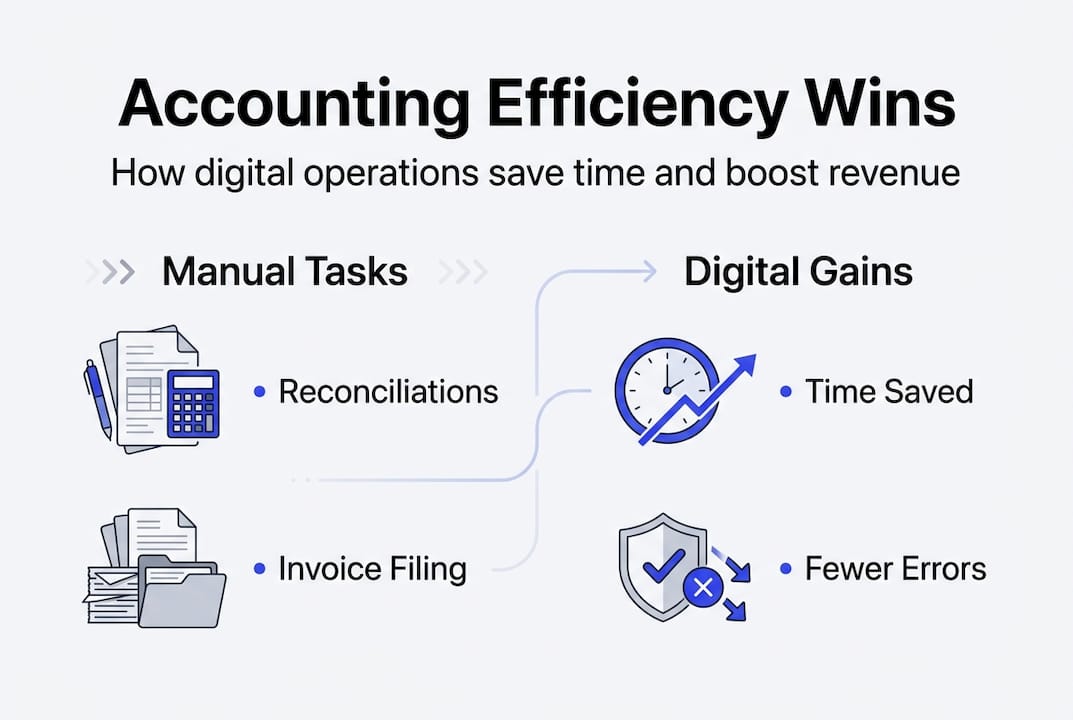
Accountants using full digital operations commonly report handling 30 to 50 percent more clients per month without adding staff. That is not a small gain. For an independent CPA billing $5,000 per client monthly, adding even five more clients represents $25,000 in additional monthly revenue.
Direct benefits you will see:
- Time saved on manual processes, often 10 to 20 hours per week per staff member
- Improved accuracy with automation eliminating common data entry errors
- Faster turnaround on deliverables, which clients notice and appreciate
- Elevated client experience through proactive communication and real-time reporting
- Higher-value services become possible when routine work is automated
- Scalable revenue without the linear cost of hiring additional staff
The revenue growth piece is worth emphasizing. When your time is freed from low-value tasks, you can offer CFO advisory services, tax strategy consulting, or financial planning, all of which carry premium pricing. Digital operations create the capacity to sell these services.
For a deeper look at how this plays out in practice, the digital transformation consulting impacts page covers real scenarios for Miami CPAs specifically.
Pro Tip: Before buying any new tool, map your current processes on paper first. Identify every step that is manual, repetitive, or error-prone. Those are your highest-value automation targets, and starting there builds momentum fast.
How to get started: A Miami CPA’s action plan
Inspired by the benefits? Here is a clear action plan to launch your digital operations journey.
Key methodologies include process optimization, automation, and cloud adoption, and your action plan should reflect that sequence. You do not need to do everything at once. You need to do the right things in the right order.
- Assess your current state. Document every core process in your firm. Note which ones are manual, which are error-prone, and which consume the most time. This is your baseline.
- Identify your biggest pain points. Pick the top two or three processes that, if automated, would free the most time or reduce the most errors. Start there.
- Choose scalable tools. Select platforms that integrate with each other and can grow with your firm. Avoid point solutions that create new silos.
- Train your staff. Technology without adoption is wasted money. Invest in training so your team uses the tools correctly and consistently.
- Run a pilot test. Implement your first automation on a small client set. Measure the results before rolling out firm-wide.
- Analyze and refine. Review what worked and what did not. Adjust your workflows, then expand to the next process.
Easy wins to build momentum early include automating client invoice reminders, setting up a cloud-based document portal, and using AI-assisted reconciliation. These deliver fast, visible results that build confidence for bigger changes.
The step-by-step digital transformation guide is built specifically for Miami accountants and walks through this process in detail. You can also reference the broader digital transformation steps framework for additional context.
Pro Tip: Partner with an IT consultant who has specific experience transforming accounting firms. Generic tech consultants often miss the compliance, client confidentiality, and workflow nuances that matter in your profession.
The uncomfortable truth: Why most digital operations fail (and how you can succeed)
After your action plan, it is vital to understand why so many fail at digital operations, and how you can be among the success stories.
Here is what we see repeatedly: accountants invest in technology and then wonder why nothing changed. The technology was fine. The problem was everything around it.
Most digital operations fail because firms focus entirely on tools and ignore process redesign and staff buy-in. You can buy the best AI platform available, but if your team still works the old way around it, you have spent money without gaining leverage. Technology amplifies your existing processes. If those processes are broken, the technology just breaks faster.
“Digital tools alone aren’t the silver bullet; it’s how you use them that matters.”
Success requires two things working together: a strategic roadmap and cultural alignment. The roadmap tells you what to build. Cultural alignment ensures your team actually uses it. Neither works without the other.
The firms we see succeed are the ones that tie every digital initiative to a specific business goal. Not “we want to be more digital,” but “we want to reduce reconciliation time by 40 percent so we can take on 10 more clients.” That specificity creates accountability and makes results measurable.
Stay current on where the market is heading by reviewing digital strategy trends for Miami professionals. The landscape shifts quickly, and informed decisions beat reactive ones every time.
Accelerate your transformation with expert help
Ready to take the next step and avoid the common pitfalls of digital operations?
We work with independent accountants and CPAs in Miami to build digital operations that actually deliver results. Not generic tech stacks, but custom systems aligned to your firm’s specific goals, client base, and growth targets. The firms we partner with land bigger clients, scale without proportional hiring, and reclaim their time.
Start with a custom digital operations assessment. We map your current processes, identify your highest-value automation opportunities, and build a roadmap you can act on immediately. Explore business process automation steps designed for Miami accounting firms, browse our technology solutions for accountants, or learn more about our full digital transformation services. Your next level of revenue growth starts with one conversation.
Frequently asked questions
What is the difference between digital operations and digital transformation?
Digital operations are the ongoing, everyday application and management of digital tools and processes. Digital transformation is the broader strategy that initiates these changes, with digital operations integrating automation, AI, and cloud tools into daily workflows as the result.
How quickly can a Miami-based CPA see results from digital operations?
Efficiency gains and error reduction often appear within the first few weeks of implementation. Full revenue growth benefits typically emerge over several months as automation reduces manual tasks and your capacity to serve more clients increases.
Do I need to replace all my accounting software to adopt digital operations?
No. Most firms build on their existing systems by layering in automation, AI, and cloud integrations. AI-driven automation of workflows can enhance what you already use rather than replace it entirely.
Are digital operations secure for client data?
Yes. Modern digital operations platforms use cloud-native architecture with built-in security, encryption, and compliance features. Digital operations integrating cloud computing are designed with data protection as a core requirement, not an afterthought.
Recommended
- Mastering Digital Transformation Workflow For Accountants – Stratgetic IT Consultants For Accountants
- 7 Digital Innovation Examples Miami Accountants Can Apply
- Understanding Digital Transformation Explained For CPAs – Stratgetic IT Consultants For Accountants
- Streamlining Business Operations for Maximum Efficiency | Gammatica
- How accountants add value to Birmingham SMBs: 11.5% more revenue