TL;DR:
- Successful digital service delivery involves integrating systems, automation, personalization, and on-demand access.
- Implementation requires user-centered design, agile methods, and compliance-focused workflows tailored to Miami’s diverse market.
- Challenges include legacy systems, staff resistance, and regulatory complexity; ongoing leadership and feedback are essential.
Most Miami doctors, lawyers, and accountants have invested in some form of technology over the past few years. New software, digital intake forms, maybe a client portal. Yet a surprising number still struggle to retain clients at scale, reduce administrative drag, or grow revenue without adding headcount. The gap between adopting technology and actually delivering services digitally is wider than most firms realize. This guide clarifies exactly what digital service delivery means, walks through the core methodologies behind it, and shows how Miami professionals in medicine, law, and accounting can apply it to generate measurable growth.
Table of Contents
- Defining digital service delivery: Beyond simple digitization
- How digital service delivery works: Methodologies and frameworks
- Digital service models in action: Medical, legal, and accounting practices
- Benefits and challenges: Why Miami firms succeed or struggle
- Why most digital service rollouts fall short—and how Miami can get it right
- Accelerate your Miami practice with expert-led digital service transformation
- Frequently asked questions
Key Takeaways
| Point | Details |
|---|---|
| Go beyond digitization | True digital service delivery uses advanced tech and strategy for end-to-end client engagement, not just online forms. |
| Follow proven methods | User-centered design, agile frameworks, and automation are essential for Miami firms adopting digital delivery. |
| Tailor to your sector | Medical, legal, and accounting practices each require specific tools like secure portals and compliance-ready platforms. |
| Account for Miami’s diversity | Choose bilingual digital platforms and prioritize compliance to succeed in Miami’s tech-forward, multi-ethnic market. |
| Overcome common barriers | Anticipate challenges such as compliance hurdles and legacy systems—and use expert support when needed. |
Defining digital service delivery: Beyond simple digitization
A lot of firms confuse digitizing paperwork with digital service delivery. Scanning a document is not the same as redesigning how clients access your services. Digital service delivery refers to the provision of services through digital channels, leveraging technologies such as cloud computing, AI, automation, and digital platforms to enhance accessibility, efficiency, and user experience. That is a fundamentally different standard than simply moving files online.
True digital service delivery is defined by five key characteristics:
- Interoperability: Systems talk to each other without manual data entry
- Personalization: Clients get experiences tailored to their profile and history
- Automation: Repetitive tasks are handled by software, not staff
- Scalability: Service volume grows without proportional headcount increases
- On-demand access: Clients access what they need, when they need it
The core technologies that power this include cloud infrastructure, AI and machine learning, application programming interfaces (APIs, which connect different software systems), and workflow automation platforms. According to the CLRN digital services definition, digital services encompass any interaction between a provider and a user that happens through a digital interface, including self-service, automated responses, and integrated platform experiences.
For Miami professionals specifically, this matters enormously. The digital transformation impact for Miami CPAs shows that firms adopting integrated digital service models outperform those that simply digitize documents. Miami is seeing a 40% year-over-year increase in AI adoption among professional services firms, which means your competitors are not waiting.
| Traditional digitization | True digital service delivery |
|---|---|
| Scanned documents | Automated document workflows |
| Email-based intake | Self-service client portals |
| Manual billing | AI-assisted invoicing and follow-up |
| Isolated software tools | Integrated platform ecosystems |
| Reactive IT support | Proactive, data-driven service design |
“Digital service delivery is not about the tools you purchase. It is about the experience you create for the people who depend on your expertise.”
How digital service delivery works: Methodologies and frameworks
Understanding what digital service delivery is gets you halfway there. Knowing how to implement it is what separates firms that grow from those that stall. Key methodologies include user-centered design (discovery, design, build phases), agile service lifecycle, value stream mapping, automation of workflows, and adoption of frameworks like ITIL 4.
Here is how the main approaches work in practice for Miami professional firms:
- User-centered design: Start with discovery. Map every touchpoint your clients experience from first contact to final billing. Identify friction. Then design digital solutions around those real needs, not assumptions.
- Agile methodology: Roll out changes in short cycles (called sprints). Test with real clients, collect feedback, improve, and repeat. This prevents massive failed implementations.
- ITIL 4 framework: ITIL 4 (Information Technology Infrastructure Library) provides a structure for managing IT services with continual improvement built in. It ensures your digital services stay aligned with business goals over time.
- Automation of workflows: Map your most repetitive processes first. Client intake, appointment reminders, compliance checklists, billing. Then automate them using platforms suited to your compliance needs.
For a Miami medical practice, this sequence might look like: discovery reveals that 60% of no-shows happen because of manual reminder systems. The team designs an automated SMS and email reminder workflow. They build and test it in a four-week sprint, measure the no-show rate, and refine it. That is digital consultancy for CPAs and medical professionals in action, not just tech purchasing.
For digital service delivery to work at scale, the methodology must match the firm’s size and regulatory environment. A solo attorney and a 20-partner law firm need different frameworks, but both benefit from starting with user-centered discovery.
Pro Tip: Before buying any platform, spend two weeks documenting every step of your current client journey. The bottlenecks you find will determine the technology you actually need, not the other way around.
| Methodology | Best for | Key benefit |
|---|---|---|
| User-centered design | Service redesign | Reduces client friction |
| Agile sprints | Technology rollout | Faster, lower-risk adoption |
| ITIL 4 | Ongoing IT management | Continual improvement |
| Workflow automation | Repetitive tasks | Efficiency and compliance |
Digital service models in action: Medical, legal, and accounting practices
Seeing how digital service delivery works in each profession makes the concept concrete. For professional services, digital delivery involves client portals, telehealth, secure onboarding, automated compliance, and AI-driven personalization. Here is what that looks like for Miami firms.
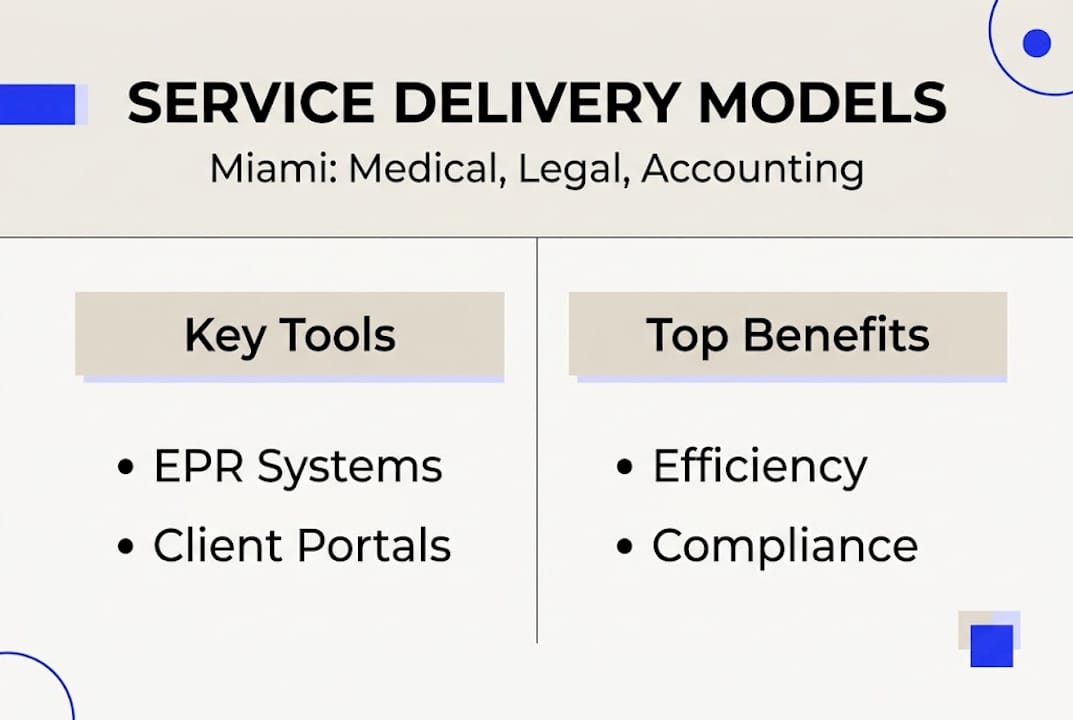
Medical practices are implementing Electronic Patient Records (EPR) systems integrated with telehealth platforms. Patients book, check in, consult, and receive follow-up care entirely through digital channels. HIPAA-compliant video platforms and secure messaging apps handle sensitive communications. AI tools flag billing codes, reducing claim denials.

Law firms in Miami are deploying HIPAA and legal ethics-compliant client portals where clients upload documents, sign agreements digitally, and track case progress in real time. Automated compliance reporting tools reduce the manual burden of regulatory filings.
Accounting firms are using Professional Services Automation (PSA) platforms, which centralize project management, time tracking, invoicing, and client communication. AI tools handle preliminary tax analysis and flag discrepancies before a CPA reviews the file.
Miami adds a layer of complexity that other markets often ignore: a bilingual, bicultural client base. Your digital interfaces need to serve English-speaking and Spanish-speaking clients equally well. A portal that only functions in English is already losing you clients in Miami.
Key compliance priorities for Miami professionals:
- HIPAA compliance for all health-related digital data
- Secure encrypted client portals with audit trails
- Automated regulatory reporting for legal and financial clients
- Florida-specific data privacy requirements
- Bilingual interface options for client-facing platforms
Stat: Miami professional services firms are seeing a 40% YoY rise in AI adoption, outpacing national averages in several practice areas.
Pro Tip: Your most important digital investment is a secure client onboarding workflow. Get that right first. It sets the tone for the entire client relationship and dramatically reduces administrative back-and-forth. Review the step-by-step digital transformation approach to prioritize the right investments in sequence.
Benefits and challenges: Why Miami firms succeed or struggle
The upside of digital service delivery is real and measurable. Firms that implement it fully report stronger client retention, higher per-client revenue, and the ability to scale without proportional hiring. Professional services transformation prioritizes client engagement via portals and self-service over full digitization, meaning the focus is always on value to the client, not just internal efficiency.
Core benefits Miami firms are seeing:
- Enhanced client engagement: Portals and automated communication keep clients informed without adding staff hours
- Revenue scalability: Serve more clients without hiring at the same rate
- Improved experience: Faster response times and 24/7 self-service options increase client satisfaction
- Compliance automation: Automated audit trails and reporting reduce error risk
- Data-driven decisions: Analytics from digital platforms reveal which services drive the most value
But challenges are equally real. Legacy systems, the kind that have been in place for 10 or 15 years, resist integration. Change management is consistently underestimated. Staff resistance is common when digital workflows replace familiar manual processes. And Miami’s regulatory environment adds layers of compliance that generic platforms often cannot handle out of the box.
“The firms that struggle are not the ones that lack technology. They are the ones that invest in technology without first redesigning their processes around what clients actually need.”
The overview of digital service delivery makes clear that successful adoption depends on sustained leadership commitment, not just a one-time technology purchase. Miami firms should prioritize these action steps:
- Audit current workflows before selecting platforms
- Involve staff in design to reduce resistance
- Choose compliance-ready platforms that support HIPAA and Florida regulations
- Build in feedback mechanisms from day one
- Partner with specialists in business transformation for Miami accountants and other professional service sectors
Why most digital service rollouts fall short—and how Miami can get it right
Here is what most firms get wrong: they treat digital service delivery as a technology project. They buy a platform, implement it, and wait for results. When results do not come, they blame the software. The real issue is almost always cultural and structural, not technical.
We have seen Miami firms invest tens of thousands of dollars in sophisticated platforms that their staff barely use and their clients never find. The technology was fine. The rollout ignored user experience, skipped the discovery phase, and never accounted for the fact that half the client base preferred to communicate in Spanish.
True success in Miami means building digital services around the diverse, fast-moving, compliance-heavy reality of this market. That requires continuous feedback loops, not just an annual system review. It means designing for the client who speaks English at work and Spanish at home. It means choosing platforms that can adapt as Florida regulations evolve.
The firms that grow revenue through digital service delivery are not the ones with the most tools. They are the ones who treat digital as a service design discipline, not an IT checkbox. Start with the Miami digital transformation essentials and build outward from real client needs.
Accelerate your Miami practice with expert-led digital service transformation
Understanding digital service delivery is one thing. Executing it in a compliance-heavy, multicultural, fast-growing market like Miami is another challenge entirely.
We work exclusively with doctors, lawyers, and accountants in Miami to design and implement digital service strategies that generate real revenue growth, often into additional 7 to 8 figures monthly. Our team can assess your current workflows, identify the highest-impact opportunities, and connect you with the right platforms and process automation for scalable CPA growth and other professional service applications. Explore digital solutions for Miami professionals or learn more about our full Miami digital transformation services to take the next step.
Frequently asked questions
How is digital service delivery different from just using online forms or email?
Digital service delivery integrates end-to-end systems, automation, and user-centered digital experiences, not just surface-level tech like forms or email. It means your entire service process is designed and optimized around digital channels, not just individual touchpoints.
What is the first step in adopting digital service delivery for my Miami firm?
Begin with user-centered discovery: map client needs, identify friction points, and prioritize processes before selecting any platform. The discovery phase is the foundation of every successful digital service design, and skipping it is the most common and costly mistake.
Do I need custom solutions or can I use off-the-shelf platforms for digital service delivery?
Most Miami professionals can start with industry-standard digital platforms, but customization for compliance, security, and client language needs is almost always required. Professional services use client portals, telehealth tools, and compliance-ready platforms that balance standardization with flexibility.
What are the biggest compliance risks with digital service delivery?
Data security, privacy regulations like HIPAA for healthcare, and maintaining clear audit trails are the critical compliance risks for any digital service model. Compliance-heavy sectors must ensure their platforms are purpose-built for regulatory environments, not retrofitted after the fact.