Every Miami accountant working with healthcare organizations now faces a wave of rapid change as clinics move from paper-based chaos to seamless, tech-driven systems. This shift is more than just a technology upgrade—it is a fundamental overhaul affecting everything from billing speed to compliance headaches. With the digital health market expected to reach $219.6 billion in the United States by 2030, understanding these trends can help you advise healthcare clients, deliver value beyond bookkeeping, and secure higher-revenue opportunities.
Table of Contents
- What Digital Transformation in Healthcare Means
- Major Types and Technologies in Use Today
- How Accountants Leverage Healthcare Digitization
- Compliance, Security, and Legal Obligations
- Potential Risks, Costs, and Common Pitfalls
Key Takeaways
| Point | Details |
|---|---|
| Digital transformation is essential for healthcare organizations | It involves adopting new technologies to optimize care delivery and operational efficiency, impacting revenue and cost structures. |
| Accountants play a crucial role | Understanding digital transformations enables accountants to provide strategic insights, ultimately helping clients maximize the financial benefits of their technology investments. |
| Compliance is paramount | Navigating HIPAA and other regulations is crucial for client success, as non-compliance can lead to severe financial penalties and reputational damage. |
| Investments require careful planning | Organizations must account for hidden costs and ensure they have the necessary infrastructure and training to support technology implementations effectively. |
What Digital Transformation in Healthcare Means
Digital transformation in healthcare isn’t just about buying new software or computers. It’s about fundamentally changing how healthcare organizations deliver care, manage data, and operate their entire business.
For accountants working with healthcare clients in Miami, understanding this shift is critical. Your clients are investing heavily in technology, and these investments directly impact their revenue, cost structure, and profitability.
The Core of Healthcare Digital Transformation
At its heart, digital transformation in healthcare means replacing old, manual processes with modern technology systems that work faster and smarter. Healthcare organizations are moving from paper records to electronic health records (EHRs), from phone calls to telehealth appointments, and from guesswork to data-driven decisions.
This shift addresses real problems your clients face:
- Overwhelming administrative costs eating into profit margins
- Patient data scattered across incompatible systems
- Inefficient billing and claims processing causing cash flow delays
- Difficulty scaling services without proportional hiring
- Compliance headaches and security vulnerabilities
When hospitals, clinics, and medical practices undergo digital transformation, they’re essentially rebuilding their operational foundation.

What’s Actually Changing
Digital transformation in healthcare involves several key technology shifts happening simultaneously. Your clients might be implementing artificial intelligence for diagnostics, deploying telehealth platforms for remote patient care, or integrating Internet of Things (IoT) devices for patient monitoring.
The transformation accelerated dramatically during COVID-19. Healthcare organizations realized they needed flexibility, remote capabilities, and better data integration. These aren’t temporary fixes—they’re becoming permanent competitive advantages.
What matters most for your accounting practice is understanding that these investments create new revenue streams and cost structures. When a clinic launches telehealth, they’re reaching patients beyond their geographic footprint. When a hospital automates billing, they collect payments faster.
Why It Matters for Your Revenue
Here’s where this becomes relevant to your bottom line: healthcare clients need accountants who understand digital transformation. They need advisors who can interpret how technology investments affect cash flow, tax implications, and financial planning.
A client investing in EHR systems might have questions about depreciation schedules, implementation write-offs, and ROI tracking. They need guidance on whether certain cloud software qualifies for specific tax credits. These are high-value conversations that command premium fees.
Healthcare organizations investing in digital transformation generate more complex financial data, creating more opportunities for accountants to add strategic value.
Your competitive advantage emerges when you can explain how technology adoption strategies directly impact their financial statements and planning. That expertise attracts better-paying clients and justifies higher service fees.
Pro tip: Start conversations with healthcare clients by asking specifically about their technology investments and planned digital initiatives. This positions you as a strategic advisor rather than a transactional bookkeeper, immediately increasing your perceived value and ability to charge premium rates.
Major Types and Technologies in Use Today
Your healthcare clients aren’t investing in just one technology. They’re deploying multiple integrated systems that work together to transform how they operate. Understanding these specific tools matters because each one affects their finances differently.
The digital health market is exploding. It’s projected to reach $219.6 billion in the United States by 2030, which means your clients are caught in a wave of rapid technological adoption and competitive pressure.
The Core Technologies Your Clients Are Using
Healthcare organizations are implementing several categories of technology simultaneously. These aren’t optional upgrades—they’re becoming mandatory to stay competitive and meet patient expectations.
The main technology categories include:
- Electronic Health Records (EHRs) and health information systems
- Telehealth and telemedicine platforms for remote patient care
- Artificial intelligence tools for diagnostics and predictive analysis
- Wearable devices and sensors for continuous patient monitoring
- Mobile health applications connecting patients to their care teams
- Health informatics systems for data management and analytics
Each technology creates different accounting challenges. An EHR implementation might span multiple years with staged payments, while a telehealth platform typically involves ongoing subscription costs.
Here’s how key digital health technologies compare in their financial impact on healthcare organizations:
| Technology | Revenue Impact | Cost Structure Change | Compliance Complexity |
|---|---|---|---|
| Electronic Health Records | Enables faster billing, improved collections | High upfront, recurring upgrades | High—requires HIPAA safeguards |
| Telehealth Platforms | Expands patient base, adds new billing streams | Ongoing subscriptions, less physical overhead | Medium—must ensure secure patient data |
| AI Diagnostics | Creates new premium services, improves accuracy | Significant initial investment, training costs | High—requires explanation for audit/tracing |
| Wearables & Sensors | Enables continuous care, increases patient engagement | Device procurement, integration, data storage | Medium—manages sensitive patient metrics |
What’s Actually Happening in Your Client’s Offices
When a clinic adopts AI-powered diagnostic tools, they’re not just buying software. They’re restructuring workflows, training staff, and changing how revenue flows through their practice.
Telehealth is a perfect example. It expands a provider’s patient base beyond geographic limitations. A Miami dermatologist can now serve patients across Florida without opening new offices. That’s new revenue without proportional overhead increases.
Wearable devices and sensors create continuous data streams. Patients monitoring their health at home generate real-time information that improves care quality and reduces emergency visits. This changes appointment patterns and billing structures.
Technologies like wearables and AI diagnostics fundamentally alter when and how patients interact with healthcare providers, creating entirely new revenue models your clients must understand financially.
Mobile health apps keep patients engaged between appointments. They’re shifting healthcare from episodic visits to continuous engagement. Your clients need accountants who can model how this affects patient lifetime value and recurring revenue streams.
Why Your Expertise Commands Premium Fees
Most accountants treat technology investments as simple line items. You need to go deeper. When a hospital implements personalized medicine platforms and AI diagnostics, they’re fundamentally changing their operational model.
They need guidance on:
- Capital versus operating expense classifications for cloud-based systems
- Tax credits available for healthcare technology investments
- Depreciation schedules that match actual system lifecycles
- ROI tracking and performance metrics tied to revenue impact
- Cash flow timing on multi-year implementations
Your value lies in connecting technology decisions to financial outcomes. When you can explain how a telehealth expansion affects patient volume, revenue per visit, and overhead allocation, you become indispensable.
Pro tip: Ask your healthcare clients to walk you through their specific technology roadmap for the next 18 months, then map each investment to its financial impact. This positions you as a strategic partner who understands their business, not just their bookkeeping.
How Accountants Leverage Healthcare Digitization
Digital transformation in healthcare creates a massive opportunity for accountants willing to step beyond traditional bookkeeping. Your role is shifting from recording transactions to becoming a strategic partner who helps healthcare clients understand the financial impact of their technology investments.
This shift isn’t optional. Healthcare organizations are making billion-dollar bets on digital systems, and they need advisors who understand both the accounting and the business implications.
Your New Role: Strategic Technology Advisor
Traditional accounting focused on historical data. You reported what already happened. Digital transformation requires accountants to shift toward forward-looking analysis and strategic guidance.
Your healthcare clients now need you to help them with:
- Evaluating technology ROI before and after implementation
- Modeling how digital initiatives affect cash flow timing
- Analyzing whether cloud systems should be capitalized or expensed
- Tracking performance metrics tied to technology investments
- Identifying tax advantages and depreciation strategies for tech assets
When a hospital decides whether to invest $2 million in an EHR system, they need an accountant who can model the financial outcomes. That expertise commands premium fees.
Using Data Analytics to Drive Decision-Making
Digital transformation generates massive amounts of data. Accountants equipped with analytics skills to process big data can extract insights that inform business strategy.
You can now provide your clients with real-time financial visibility. Instead of waiting for month-end closes, you can offer weekly or daily performance dashboards showing revenue impact from new digital initiatives.
This creates a competitive advantage. Your healthcare clients can make faster, more informed decisions because you’re providing them timely, accurate financial analysis.
Accountants who master data analytics transform from scorekeepers into strategic advisors, justifying significantly higher service fees and creating stickier client relationships.
Cloud Platforms Enable Better Collaboration
Digital transformation means your clients are adopting cloud-based accounting systems. These same platforms enable you to collaborate more effectively with your clients and their other advisors.
Instead of email exchanges and periodic meetings, you can access real-time financial data from cloud platforms. This allows you to identify issues faster and provide recommendations before they become problems.
Cloud collaboration also means you can handle more clients without proportional increases in staff. That’s how you scale your practice and increase revenue without hiring overhead.
Staying Ahead of Cyber Risks
As accountants integrate more technology into healthcare practices, you need to understand cybersecurity risks and mitigation strategies. Healthcare data breaches are expensive and create significant liability.
Your role includes helping clients understand:
- Security requirements for patient data protection
- Compliance obligations tied to digital systems
- Insurance implications of cybersecurity gaps
- Cost-benefit analysis of security investments
Clients who see you as someone who helps them manage technology risk become long-term partners willing to pay premium fees.
Pro tip: Build a checklist of key questions about your healthcare client’s technology roadmap, security measures, and digital investments. Use this to position quarterly strategy calls where you review technology impact on their financials—this transforms you from a transactional accountant into an indispensable strategic advisor.
Compliance, Security, and Legal Obligations
Here’s where things get serious. Healthcare digital transformation isn’t just a business decision—it’s a heavily regulated environment where mistakes cost money, create liability, and damage reputations. Your accountant expertise becomes critical because compliance failures directly impact your clients’ bottom line.
Your healthcare clients are handling protected health information (PHI). That data is a liability waiting to happen if not managed correctly.
Understanding HIPAA and Digital Healthcare
Healthcare organizations must comply with HIPAA, the Health Insurance Portability and Accountability Act. When your clients digitize their operations, HIPAA requirements become your accounting problem too.
HIPAA compliance involves specific security obligations:
- Maintaining detailed documentation of all security measures
- Creating and maintaining technology asset inventories
- Mapping network infrastructure and identifying vulnerabilities
- Regular security risk assessments and remediation
- Employee training on data protection protocols
- Breach notification procedures and incident response plans
The updated HIPAA Security Rule strengthens cybersecurity protections for electronic health records. These aren’t suggestions—they’re legal requirements with financial penalties for non-compliance.
The Cost of Compliance Failures
When healthcare organizations fail HIPAA compliance, the consequences are severe. Penalties range from thousands to millions of dollars per violation. A data breach affecting thousands of patients creates exponential liability.
Your clients need accountants who understand these cost implications. When evaluating technology investments, they must factor in compliance costs, not just software licenses.
A hospital that skips proper security implementation to save money often ends up spending ten times more on breach remediation, legal fees, and reputation damage.
Non-compliance with healthcare data security regulations doesn’t just create regulatory penalties—it destroys client trust, triggers lawsuits, and can end healthcare practices entirely.
Interoperability and Data Security Standards
The Office of the National Coordinator for Health IT establishes standards for how healthcare systems exchange information securely. Secure health information exchange requires interoperability while protecting patient privacy.
Your clients are likely exchanging data with insurance companies, specialists, hospitals, and pharmacies. Each exchange point creates compliance obligations and security risks.
You need to help them understand that interoperability isn’t free. Building secure data exchange infrastructure requires investment in proper systems and ongoing monitoring.
Your Role in Compliance Documentation
Compliance requires meticulous documentation. Your accounting systems need to track security investments, maintenance costs, and compliance activities.
You should help clients document:
- Technology purchases and implementation costs
- Security assessments and vulnerability remediation
- Employee training and certification records
- Data breach insurance policies and coverage limits
- Compliance audit results and remediation activities
Good documentation protects your clients if regulators investigate. It also helps them understand their true compliance costs and ROI on security investments.
Building Your Compliance Expertise
Most accountants don’t understand healthcare compliance deeply. That’s your competitive advantage. When you become fluent in HIPAA, healthcare data security, and regulatory requirements, you become irreplaceable to healthcare clients.
They’ll pay premium fees for accountants who help them navigate compliance risks. They’ll also refer you to other healthcare organizations because you speak their language.
Pro tip: Ask your healthcare clients about their most recent HIPAA compliance audit. Use their audit results to identify areas where they might be underfunding security or documentation—then propose consulting engagement to address those gaps. This turns compliance requirements into revenue opportunities for your practice.
Potential Risks, Costs, and Common Pitfalls
Digital transformation in healthcare sounds great until reality hits. Your clients are about to invest millions in technology, and many will fail miserably. Understanding these risks helps you position yourself as the advisor who prevents expensive disasters.
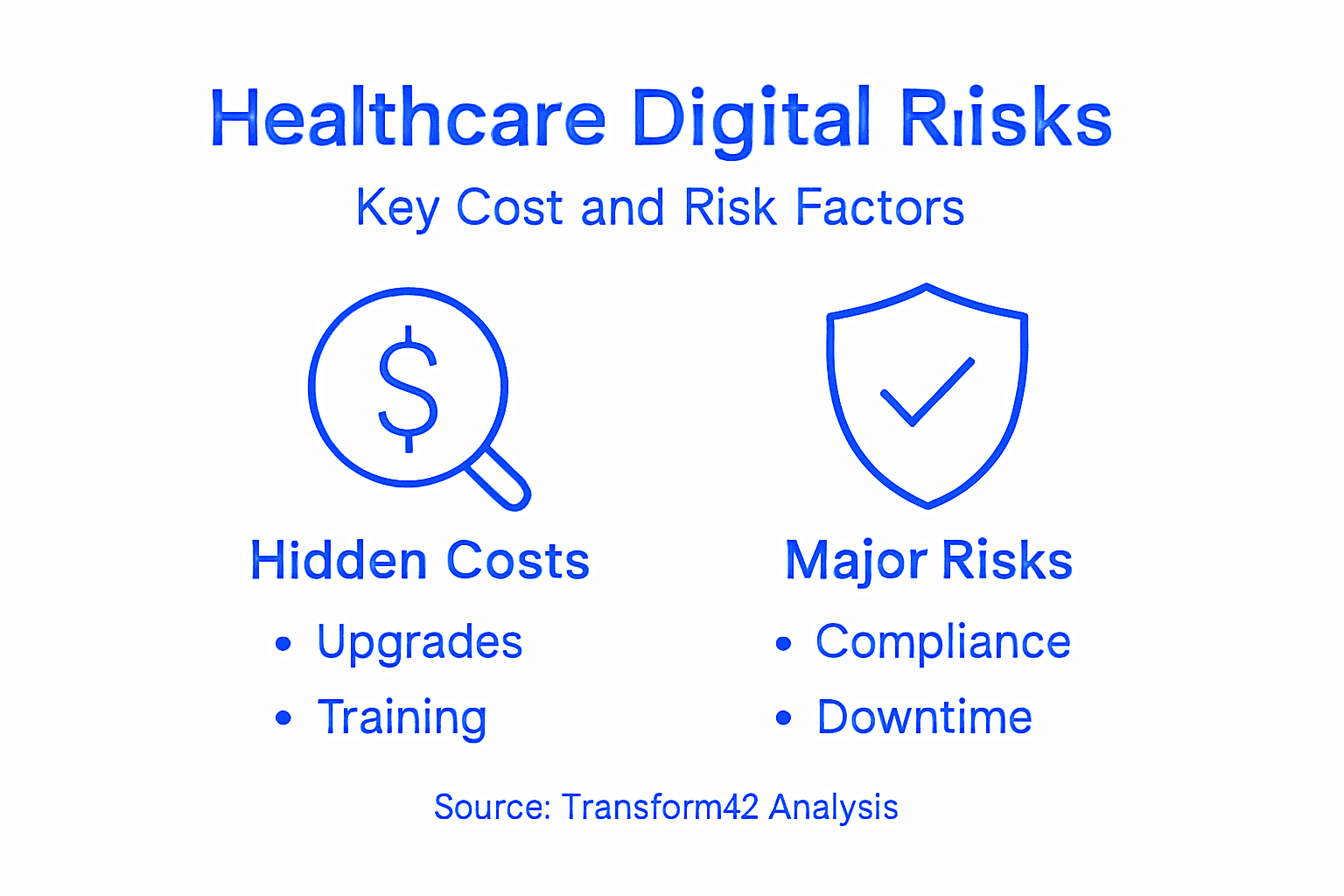
Healthcare organizations consistently underestimate the true cost of digital transformation. They focus on software licenses and miss the hidden expenses that drain budgets and kill projects.
Resource Constraints and Hidden Costs
Most healthcare organizations lack the internal resources to manage digital transformation effectively. They’re already stretched thin running daily operations, so they add transformation on top without adequate staffing.
Common hidden costs include:
- Staff training and change management programs
- System integration and data migration services
- Cybersecurity assessments and remediation
- Ongoing maintenance and system updates
- Consultant fees and technical expertise
- Downtime and productivity losses during implementation
- Legacy system decommissioning and data archiving
Your clients often budget for software but ignore implementation costs. A $500,000 EHR system can easily cost $2 million by the time it’s fully deployed and staff are trained.
The following table highlights common hidden costs and pitfalls during healthcare digital transformation projects:
| Hidden Cost or Pitfall | Potential Financial Impact | Mitigation Strategy |
|---|---|---|
| Inadequate Staff Training | Delays ROI, increases errors | Budget for comprehensive training |
| Poor System Integration | Data silos, inefficiencies | Invest in expert integration services |
| Rushed Implementation | System failures, costly rework | Allow realistic timelines, full testing |
| Compliance Gaps | Fines, reputational damage | Regular audits, documentation updates |
Skills Shortages and IT Infrastructure Gaps
Digital transformation requires skilled staff your clients may not have. Healthcare IT specialists are expensive and hard to find in the Miami area.
Many healthcare organizations have outdated IT infrastructure. They’re running systems from ten years ago and trying to bolt new technology onto a foundation that can’t support it.
This creates a vicious cycle. They need to upgrade infrastructure before implementing new systems, but infrastructure upgrades weren’t budgeted. Projects get delayed, costs escalate, and ROI timelines slip.
Regulatory and Adoption Challenges
Your clients face regulatory uncertainties and slow adoption rates that create ongoing friction. Physicians resist new systems. Patients distrust digital health platforms. Staff avoid learning new workflows.
When adoption lags, ROI projections fail. A telehealth system that was supposed to reach 30 percent of patients might only reach 10 percent. A billing automation system only saves money if staff actually use it.
Regulatory changes also create uncertainty. Laws change. Compliance requirements evolve. A system compliant today might be non-compliant in two years, requiring expensive upgrades.
Failed digital transformation projects don’t just waste money—they damage staff morale, destroy physician trust, and create skepticism about future technology investments.
The Cost of Rushed Implementation
Pressure to show quick ROI causes many healthcare organizations to rush implementation. They skip proper testing, underinvest in training, and push live without adequate support.
Rushed implementations typically result in:
- System failures and data integrity issues
- Staff frustration and workarounds that undermine the system
- Patient safety concerns and quality problems
- Abandoned features and underutilized capabilities
- Need for expensive rework and re-implementation
Your role is helping clients understand that cheap implementation costs often lead to expensive failure costs.
Pro tip: When clients present digital transformation budgets, challenge the assumptions. Ask what percentage is allocated to training, what contingency exists for integration issues, and how they’ll measure adoption success. This reveals whether they’ve really thought through the true cost, and positions you as someone preventing expensive mistakes.
Transform Healthcare Accounting Challenges into Revenue Growth Opportunities
The digital transformation wave reshaping healthcare creates critical challenges for Miami accountants. From managing complex technology investments like Electronic Health Records and AI diagnostics to navigating evolving HIPAA compliance and cybersecurity risks your expertise must extend beyond traditional bookkeeping. Your clients need strategic advice on technology ROI, cost structures, and compliance costs to maximize profitability and avoid costly pitfalls.
You can gain a strategic advantage with the right partner. We help accountants servicing healthcare clients build the expertise and technology capabilities needed to land bigger clients, scale efficiently without hiring more staff, and confidently manage digital health investments that boost revenue. Our comprehensive approach integrates compliance, financial planning, and technology strategy so you become the trusted advisor your healthcare clients rely on.
Elevate your accounting practice by mastering healthcare digital transformation financials with Transform42. Start by exploring how you can build capabilities and compliance your clients expect. Visit All Your Technology In One PARTNER today and turn complex healthcare challenges into your biggest growth opportunity.
Frequently Asked Questions
What is digital transformation in healthcare?
Digital transformation in healthcare involves the integration of technology to fundamentally change how healthcare organizations deliver care, manage data, and operate their business. It includes the transition from manual processes to modern technology systems that improve efficiency and decision-making.
How can digital transformation boost revenue for healthcare accountants?
Digital transformation creates new revenue streams by enabling healthcare organizations to offer innovative services like telehealth and AI diagnostics. Accountants who understand these changes can provide strategic insights into how technology investments impact cash flow and profitability, thereby increasing their advisory fees.
What technologies are primarily involved in healthcare digital transformation?
Key technologies include Electronic Health Records (EHRs), telehealth platforms, artificial intelligence tools for diagnostics, wearable devices for continuous monitoring, and health informatics systems for data management. Each of these technologies impacts financial structures in different ways.
How can accountants leverage technology investments in healthcare?
Accountants can leverage technology investments by analyzing their financial impact, helping clients with ROI evaluations, and tracking performance metrics associated with these investments. Advising clients on capital versus operating expenses for tech implementations is crucial for maximizing profitability.
Recommended
- Digital Transformation For CPAs: Miami’s Revenue Advantage
- Business Transformation For CPAs: Real Revenue Growth In Miami
- Digital Transformation Consulting: Impact For Miami CPAs
- 7 Key Benefits Of Digital Transformation For Miami CPAs
- SeeRM | Effektivisera ditt företag med SeeRM, ett modernt och kraftfullt kundhanteringssystem
- ACP IT Solutions AG | Fallstudie