Miami CPA firms rushing into digital tools without a clear strategy face failure rates exceeding 70%, wasting resources and losing competitive ground. You need a structured roadmap that aligns technology investments with revenue growth and operational efficiency goals specific to your practice. This guide walks you through a proven phased approach to assess readiness, pilot solutions, implement systematically, and optimize continuously. By following this framework, you’ll avoid common pitfalls and position your firm to land bigger clients while reclaiming your time.
Table of Contents
- Key takeaways
- Assessing your firm’s digital readiness and defining clear goals
- Piloting and selecting technologies: From cloud to AI
- Implementing and scaling digital transformation in phases
- Monitoring outcomes and optimizing for growth and efficiency
- Explore strategic IT consulting tailored for Miami CPAs
- Frequently asked questions
Key Takeaways
| Point | Details |
|---|---|
| Phased roadmap approach | Use assess, pilot, implement, and optimize to align technology investments with revenue growth and efficiency goals. |
| SMART goals tied to outcomes | Define clear metrics with owners and timelines that link digital initiatives to revenue and efficiency improvements. |
| Phased adoption lowers risk | Start with small pilots to prove value, then scale to reduce failure risk and build staff skills. |
| AI and cloud ROI | Invest in cloud and AI tools to achieve measurable time savings, fewer errors, and better client service. |
| Continuous KPI monitoring | Track key performance indicators continuously to drive ongoing improvement and adjustments. |
Assessing your firm’s digital readiness and defining clear goals
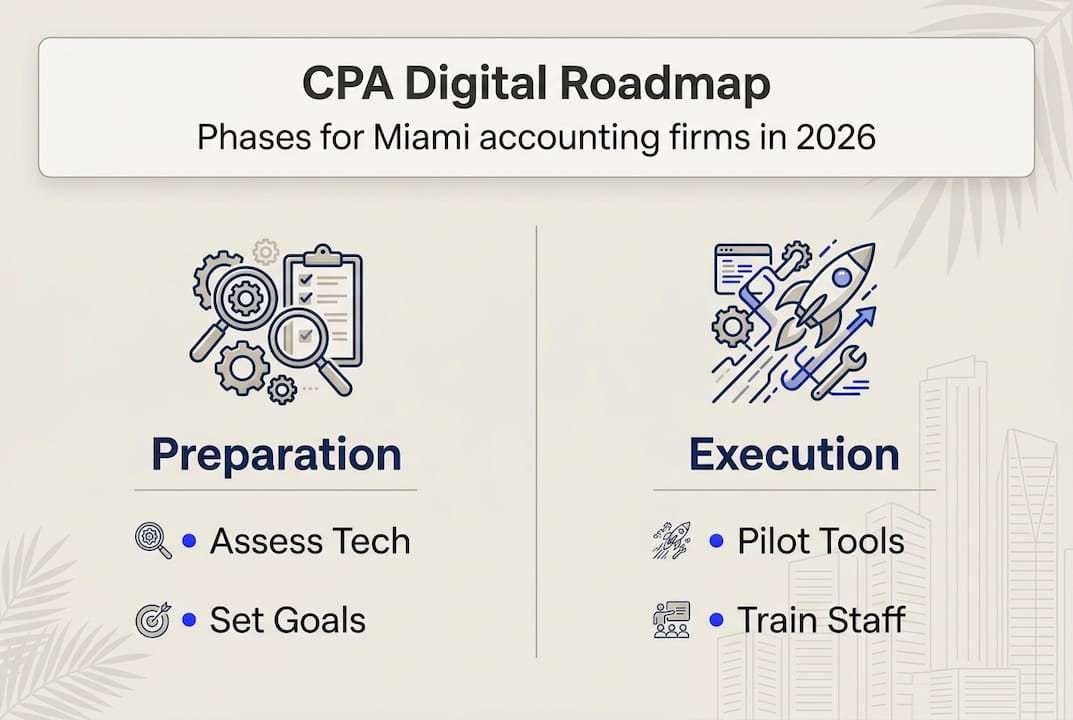
You can’t transform what you don’t understand. Start by conducting a thorough audit of your current technology infrastructure, identifying which systems are outdated, redundant, or creating bottlenecks. Map every client-facing and internal workflow to pinpoint where manual processes drain time and where errors occur most frequently.
Next, assess your team’s digital skills honestly. Survey staff to understand their comfort level with existing tools and their capacity to learn new platforms. This human element determines whether your transformation succeeds or stalls. 62-90% of small firms fail digital transformation because they buy technology before assessing whether their people and processes can support it.
Identify your most painful operational challenges through data, not assumptions. Review where client complaints cluster, which services have the lowest margins, and where staff spend excessive hours on repetitive tasks. These pain points become your transformation priorities.
Set SMART goals that tie directly to business outcomes. Vague aspirations like “go digital” guarantee failure. Instead, define targets such as increasing your client base by 25% within 18 months, reducing audit preparation time by 30%, or launching two new advisory services by year two. Each goal needs a clear metric, timeline, and owner.
For Miami practices, factor in local compliance requirements and security standards from the start. Your digital strategy roadmap Miami CPAs must address data protection regulations and industry-specific mandates that affect technology choices.
Pro Tip: Engage your team early in the assessment phase through workshops and one-on-one conversations. Staff who help identify problems and shape solutions become transformation champions rather than resisters, dramatically improving your adoption rates.
Piloting and selecting technologies: From cloud to AI
Start small and prove value before committing significant resources. Launch pilot projects with cloud accounting platforms like QuickBooks Online or Xero, testing them with a subset of clients over 90 days. Measure specific outcomes such as time saved on reconciliations, reduction in data entry errors, and client satisfaction scores.
Add a CRM system next to centralize client communications, track engagement history, and automate follow-ups. Pilot this with your top 20% of clients who generate 80% of revenue. Document how it improves response times and cross-selling opportunities.
Plan your next wave of automation targeting accounts payable and receivable processes. These repetitive tasks offer quick wins with measurable time savings and error reduction. A phased 18-month roadmap with 6-month sprints focusing on cloud, CRM, automation, and AI delivers better outcomes than trying to implement everything simultaneously.
Use an AI prioritization matrix to evaluate which intelligent tools to adopt first. Plot potential solutions on axes of business impact versus implementation complexity. Start with high-impact, low-complexity options like AI-powered document extraction or automated categorization before tackling complex predictive analytics.
| Technology | Implementation Complexity | Business Impact | Typical Cost | Pilot Duration |
|---|---|---|---|---|
| Cloud Accounting | Low | High | $30-70/user/month | 3 months |
| CRM Platform | Medium | High | $50-150/user/month | 3 months |
| AP/AR Automation | Medium | Medium | $200-500/month | 6 months |
| AI Document Processing | Medium | High | $300-800/month | 6 months |
| Predictive Analytics | High | Medium | $500-2000/month | 9 months |
Evaluate each pilot against predetermined success criteria before scaling. If a tool doesn’t deliver measurable improvements in efficiency, client satisfaction, or revenue within the pilot window, either adjust how you’re using it or move to an alternative.
Pro Tip: Resist shiny object syndrome by creating a one-page business case for each technology pilot. Force yourself to articulate the specific problem it solves, the metric that will prove success, and the maximum investment you’ll make before expecting returns. This discipline keeps you focused on digital transformation workflow accountants need rather than vendor hype.
Implementing and scaling digital transformation in phases
Phase 1 spans months 1 through 6 and establishes your digital foundation. Deploy your chosen cloud accounting platform across all client accounts, migrating data systematically with validation checkpoints. Implement your CRM and train every client-facing team member on proper usage protocols. Set up integrations between these core systems to eliminate duplicate data entry.

Phase 2 runs months 7 through 12, focusing on process automation. Roll out accounts payable and receivable automation to reduce manual processing time by 40-50%. Implement automated client portals for document exchange, eliminating email attachments and version control nightmares. Add workflow automation for common tasks like engagement letters, billing, and compliance reminders.
Phase 3 covers months 13 through 18, introducing AI and advanced analytics. Deploy AI-powered document processing to extract data from invoices, receipts, and financial statements automatically. Launch predictive analytics tools that help clients forecast cash flow and identify tax optimization opportunities. These capabilities position you to offer higher-value advisory services that command premium fees.
Throughout all phases, invest heavily in continuous staff training. Schedule weekly 30-minute sessions where team members share tips, troubleshoot challenges, and celebrate wins. Create role-specific training paths so each person masters the tools relevant to their responsibilities. Continuous phased implementation with monitoring reduces failure rates and improves adoption in CPA firms.
Manage resistance through transparent communication about why changes are happening and how they benefit both the firm and individual team members. Share progress metrics monthly so everyone sees the transformation working. Recognize and reward early adopters who help others learn.
Common implementation pitfalls to avoid:
- Skipping data cleanup before migration, leading to garbage-in-garbage-out problems
- Underestimating training time needed for staff to become proficient
- Failing to designate system champions who provide peer support
- Implementing too many changes simultaneously, overwhelming your team
- Neglecting to document new processes and best practices
- Ignoring feedback from staff actually using the tools daily
For Miami practices, ensure every phase includes compliance verification. Confirm that new systems meet local regulatory requirements and that data security measures align with industry standards. Build in quarterly security audits and staff training on digital transformation change management CPAs need to maintain client trust.
Monitoring outcomes and optimizing for growth and efficiency
Establish a dashboard tracking your most critical KPIs from day one. Monitor revenue growth by service line, new client acquisition rates, average engagement value, and client retention percentages. Track operational metrics like hours spent per tax return, audit preparation time, and accounts receivable days outstanding.
Measure the direct impact of your technology investments. Calculate time saved through automation, error rates before and after implementation, and staff productivity improvements. Document client satisfaction scores and referral rates as indicators of service quality improvements.
Key performance indicators for digital transformation:
- Monthly recurring revenue from new advisory services
- Client acquisition cost and lifetime value ratios
- Average hours per engagement by service type
- Staff utilization rates and billable hour percentages
- System adoption rates and active user counts
- Cost savings from process automation
- Client portal usage and document exchange efficiency
Review progress every 6 months in structured sprint retrospectives. Compare actual results against your SMART goals, identifying what’s working and what needs adjustment. Be willing to pivot quickly when data shows a tool or approach isn’t delivering expected value.
| Metric | Baseline | 6 Month Target | 12 Month Target | 18 Month Target |
|---|---|---|---|---|
| Client Base | 150 | 165 | 180 | 190 |
| Monthly Revenue | $85K | $95K | $110K | $125K |
| Avg Hours/Tax Return | 4.2 | 3.8 | 3.2 | 2.8 |
| Client Satisfaction | 7.8/10 | 8.2/10 | 8.6/10 | 9.0/10 |
| Staff Utilization | 62% | 68% | 72% | 75% |
Use data insights to refine your service offerings continuously. If analytics reveal that certain client segments respond strongly to specific advisory services, develop specialized packages for those niches. When automation frees up staff time, redirect those hours toward higher-value client interactions rather than simply reducing headcount.
Firms implementing comprehensive digital transformations report 28% revenue growth and 42% cost savings from digital services with continuous optimization. These results come from treating transformation as an ongoing practice rather than a one-time project.
Pro Tip: Benchmark your performance against Miami peer firms and national industry data quarterly. Join CPA technology forums and local professional groups where practitioners share metrics and best practices. This external perspective helps you identify 10 essential digital transformation tips and spot emerging opportunities before competitors.
Explore strategic IT consulting tailored for Miami CPAs
Executing a comprehensive digital transformation while running a busy practice stretches even the most capable teams. Strategic IT consulting accelerates your journey by providing specialized expertise in technology selection, implementation planning, and change management specific to accounting firms.
Experts who understand Miami’s regulatory environment help you navigate compliance requirements while maximizing the business value of your technology investments. They bring experience from dozens of similar transformations, helping you avoid expensive mistakes and compress your timeline.
Partnering with specialists ensures you select tools that integrate seamlessly, train staff effectively, and achieve measurable ROI. You gain access to digital transformation services designed specifically for professional services firms, technology consulting that aligns with your growth goals, and comprehensive IT services for accounting firms that handle the technical complexity while you focus on serving clients.
Frequently asked questions
What is the typical timeline for a digital transformation roadmap in small CPA firms?
Most successful transformations span 12 to 18 months, structured as three distinct 6-month sprint phases covering assessment and piloting, core implementation, and advanced capabilities rollout. This timeline allows adequate testing, comprehensive staff training, and gradual adoption that minimizes disruption to client service.
How do Miami CPA firms address compliance and security during digital transformation?
Miami practices must ensure all digital solutions comply with local regulatory standards and industry-specific mandates from the outset. Prioritize platforms with robust data encryption, regular security audits, and compliance certifications relevant to financial services. Engage specialized consultants familiar with digital security Miami CPAs face to validate your technology choices meet regional requirements.
What are common pitfalls to avoid when starting a digital transformation?
The biggest mistake is purchasing technology before assessing whether your firm has the readiness, skills, and processes to support it. 62% of failures stem from premature tech purchases. Ensure leadership commitment, manage staff resistance through transparent communication and training, and implement changes in manageable phases. Effective digital transformation change management prevents these failures.
How much should a small CPA firm budget for digital transformation?
Budget 3 to 5% of annual revenue for technology investments during active transformation phases, covering software subscriptions, implementation services, training, and consulting support. A firm generating $1 million annually should plan for $30,000 to $50,000 in year one, with ongoing costs of 2 to 3% annually for maintenance and optimization.
What ROI can Miami CPA firms expect from digital transformation?
Firms completing comprehensive transformations typically see 25 to 30% revenue growth within 18 months through expanded service offerings and increased client capacity. Operational efficiency improvements reduce costs by 30 to 40% in targeted processes like tax preparation and audit work. Most practices achieve positive ROI within 12 to 15 months when following a structured roadmap.
Recommended
- 7-Step Digital Transformation Checklist For Miami CPAs – Stratgetic IT Consultants For Accountants
- 7 Digital Transformation Best Practices For Miami CPAs – Stratgetic IT Consultants For Accountants
- Digital Transformation For CPAs: Miami’s Revenue Advantage
- Digital Transformation Consulting: Impact For Miami CPAs