Many Miami accountants view emerging technologies as expensive, complex burdens that disrupt established workflows. This misconception costs firms real opportunities. Research shows that technology adoption automates business processes, leading to 28% more clients and measurable revenue growth. This guide explores how AI, automation, cloud computing, and data analytics transform practice efficiency, strengthen client engagement, and drive significant revenue increases for independent accountants and financial consultants across Miami.
Table of Contents
- Key takeaways
- Understanding emerging technologies in accounting
- Impact on practice efficiency and workflow automation
- Enhancing client engagement through technology
- Mitigating risks and challenges of emerging technologies
- Applying emerging technologies to drive revenue growth
- How Transform42 empowers Miami accountants with technology
- Frequently asked questions
Key Takeaways
| Point | Details |
|---|---|
| Revenue growth via automation | Automating routine tasks and processes increases client acquisition and expands revenue for Miami firms. |
| Enhanced client engagement through technology | Real time dashboards and data insights improve communication and advisory value. |
| AI risk management | Training and clear AI usage protocols help mitigate risks and maximize benefits. |
| Strategic tech adoption | A deliberate, scalable approach aligns tools with goals and boosts profitability over time. |
Understanding emerging technologies in accounting
Emerging technologies in accounting encompass AI, machine learning, automation, cloud computing, and data analytics. These tools target time-consuming, error-prone tasks to improve accuracy and speed across your practice. Understanding the role of AI in consulting helps you identify which technologies fit your firm’s size and client needs.
Nearly 45% of firms plan AI training for staff to mitigate risks and maximize benefits. This shift reflects growing recognition that structured technology adoption creates competitive advantages. Different technologies suit different practice contexts, from solo practitioners to mid-sized firms serving diverse Miami clients.
Key technologies transforming accounting include:
- AI and machine learning for predictive analytics and pattern recognition in financial data
- Robotic process automation for data entry, reconciliations, and report generation
- Cloud computing platforms enabling remote collaboration and real-time client access
- Advanced data analytics tools for strategic insights and forecasting
- Blockchain applications for secure transaction verification and audit trails
Implementing digital innovation best practices ensures you adopt technologies that align with your practice goals. Start by assessing which repetitive tasks consume the most billable hours. Then evaluate solutions that address those specific pain points while enhancing client value.
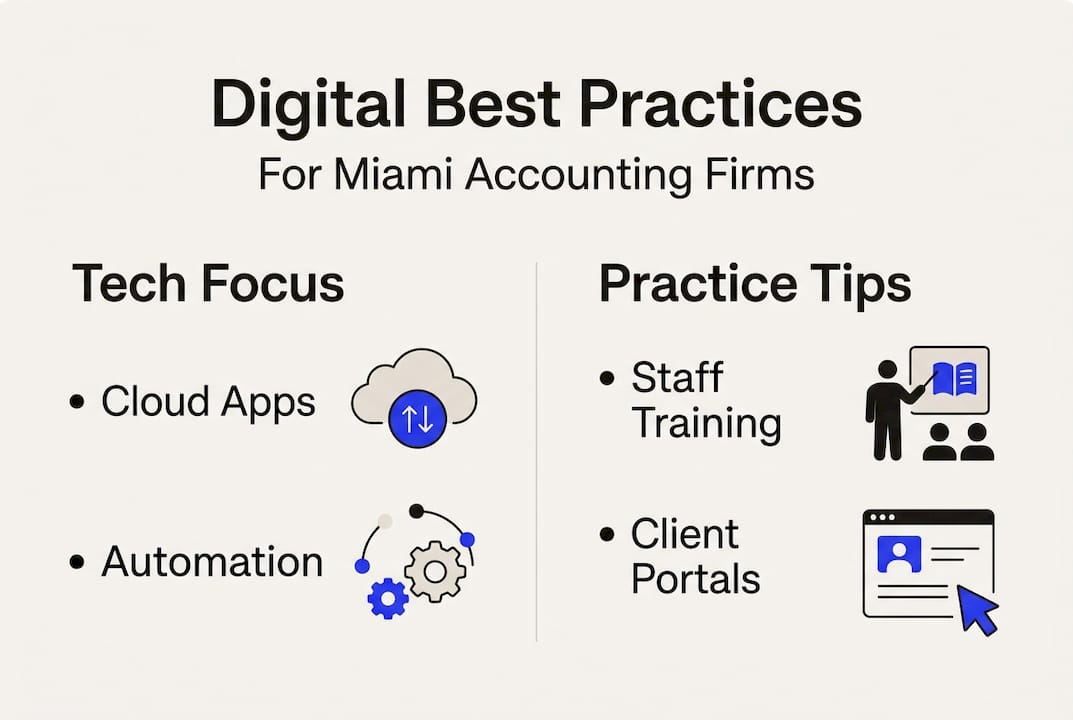
The technology landscape evolves rapidly, but core principles remain constant. Focus on tools that reduce manual effort, improve accuracy, and enable you to deliver higher-value advisory services. This strategic approach positions your Miami practice for sustainable growth.
Impact on practice efficiency and workflow automation
Automation transforms accounting operations by eliminating repetitive data entry, reconciliations, and routine compliance tasks. Technology adoption that automates business processes delivers 28% more clients and measurable revenue growth. This efficiency gain lets you redirect staff time toward advisory services that command premium fees.

Workflow digitization accelerates report generation and audit preparations. Tasks that once required days now complete in hours. Cloud-based platforms enable seamless collaboration across your team and with clients, eliminating version control issues and communication delays.
Consider this efficiency comparison:
| Process | Manual Approach | Automated Approach | Time Savings |
|---|---|---|---|
| Monthly reconciliations | 8-10 hours | 2-3 hours | 70% |
| Tax document preparation | 12-15 hours | 4-5 hours | 65% |
| Financial report generation | 6-8 hours | 1-2 hours | 75% |
| Client data entry | 10-12 hours | 2-3 hours | 80% |
Mixed technology adoption levels exist across Miami firms, with forward-thinking practices investing in scalable solutions that grow with their client base. Technology consulting for Miami CPAs helps identify which automation tools deliver the fastest return on investment for your specific practice.
Pro Tip: Implement incremental automation with clear objectives to avoid disrupting established client relationships. Start with back-office processes before automating client-facing workflows.
Efficiency gains compound over time. As your team masters automated workflows, you can handle larger client volumes without proportional staff increases. This scalability directly impacts profitability and positions your practice for sustainable expansion in Miami’s competitive market.
Enhancing client engagement through technology
Technology enables real-time financial dashboards tailored to each client’s priorities and decision-making needs. Emerging technology facilitates improved client experience with data-driven insights and communication tools that strengthen relationships. Clients gain instant access to their financial data, eliminating delays and building trust through transparency.
Communication tools streamline updates, document sharing, and feedback loops. Secure portals replace email attachments and physical document exchanges. Clients appreciate the convenience of accessing tax documents, financial statements, and advisory reports from any device at any time.
Data analytics help predict client needs and personalize advice. By analyzing historical patterns and industry benchmarks, you can proactively identify opportunities and risks before clients ask. This forward-thinking approach positions you as a strategic partner rather than a compliance vendor.
Key engagement enhancements include:
- Interactive dashboards showing real-time cash flow, profitability, and key performance indicators
- Automated alerts for unusual transactions, upcoming deadlines, or regulatory changes
- Video conferencing integration for convenient consultations without travel time
- Mobile apps enabling clients to photograph receipts and submit expenses instantly
- Customized reporting that highlights metrics each client cares about most
Applying customer engagement strategies from other professional services industries reveals untapped opportunities. Many accounting firms underutilize technology’s potential to differentiate their client experience and justify premium pricing.
Pro Tip: Regularly train staff in client-facing technology to maximize engagement benefits. Technology only enhances relationships when your team uses it confidently and explains its value clearly.
Stronger engagement leads to loyalty, higher referrals, and sustained revenue growth. Clients who feel informed and supported become advocates for your practice. They refer colleagues, expand services, and resist competitive offers. Agile marketing strategies help you communicate these technology advantages to prospects and existing clients effectively.
Mitigating risks and challenges of emerging technologies
Risks include data privacy vulnerabilities, AI bias in decision support, and technology dependence that disrupts operations during outages. Risk mitigation involves defined escalation paths, deterministic AI where possible, and continuous upskilling, with 45% of firms planning AI training programs.
Balancing innovation with caution preserves client trust and regulatory compliance. Rushing technology adoption without proper protocols creates liability exposure. Taking time to establish clear usage guidelines and staff training prevents costly mistakes.
| Risk Type | Potential Impact | Mitigation Strategy |
|---|---|---|
| Data security breaches | Client information exposure, regulatory penalties | Multi-factor authentication, encryption, regular security audits |
| AI bias in recommendations | Inaccurate advice, client financial harm | Human oversight, diverse training data, regular algorithm testing |
| Technology dependence | Service disruption during outages | Backup systems, offline procedures, vendor redundancy |
| Staff resistance | Underutilization, productivity loss | Gradual implementation, comprehensive training, clear benefits communication |
Ongoing upskilling is vital for your team to use technology effectively and recognize its limitations. AI and ML integration challenges in other industries offer lessons for accounting practices. Invest in regular training sessions that keep staff current with evolving capabilities and emerging risks.
Clear escalation paths for technology issues reduce operational impact. Designate team members responsible for troubleshooting common problems and establish vendor support protocols for complex issues. This preparation minimizes client-facing disruptions.
Key risk management practices include:
- Conducting thorough vendor due diligence before adopting new platforms
- Implementing role-based access controls to limit data exposure
- Maintaining detailed documentation of AI-assisted decisions for audit trails
- Testing technology changes in controlled environments before full deployment
- Establishing incident response plans for security breaches or system failures
Understanding AI’s role in risk management across financial services provides valuable context. You can also safeguard against AI threats by staying informed about emerging vulnerabilities and best practices.
Applying emerging technologies to drive revenue growth
Strategic technology implementation scales operations, improves client acquisition, and increases profitability for Miami accounting practices. Implementing emerging tech is linked to significant revenue growth and client base expansion, with firms reporting 7-8 figure monthly revenue increases.
Follow this sequential adoption process:
- Assess your practice’s technology needs by analyzing which tasks consume the most non-billable time and where client complaints or delays occur most frequently.
- Prioritize automation of high-value repetitive tasks like data entry, reconciliations, and routine report generation that free staff for advisory work.
- Research and demo solutions specifically designed for accounting practices, comparing features, pricing, integration capabilities, and vendor support quality.
- Pilot selected technologies with a small client segment to identify implementation challenges and refine workflows before full deployment.
- Invest in comprehensive staff training that covers both technical operation and strategic application of new tools.
- Implement client-facing digital tools like portals, dashboards, and communication platforms that differentiate your services and justify premium pricing.
- Leverage data analytics for strategic decision making, growth forecasting, and identifying cross-sell opportunities within your existing client base.
- Continuously monitor technology performance through efficiency metrics, client satisfaction scores, and revenue impact tracking.
- Scale successful implementations across your entire practice while maintaining flexibility to adjust based on client feedback and evolving needs.
- Stay current with emerging capabilities by attending industry conferences, participating in vendor training, and networking with technology-forward peers.
Exploring business transformation for CPAs reveals how Miami firms successfully navigate this journey. Review technology archives for detailed implementation guides and case studies. Understanding broader digital transformation principles helps you avoid common pitfalls.
Revenue growth accelerates when technology enables you to serve more clients without proportional cost increases. You can also command higher fees by delivering faster turnaround times, deeper insights, and more personalized service than competitors relying on manual processes.
How Transform42 empowers Miami accountants with technology
Navigating the technology landscape alone consumes valuable time and risks costly missteps. Transform42 specializes in helping Miami accounting firms adopt emerging technologies that boost efficiency and drive measurable revenue growth. We provide strategic guidance on digital transformation and business process automation tailored to your practice’s unique needs and client base.
Our technology consulting services assess your current operations, identify high-impact automation opportunities, and implement solutions that deliver rapid returns. We handle the complexity so you can focus on serving clients. Partnering with Transform42 accelerates technology adoption and helps Miami accountants achieve the 7-8 figure monthly revenue increases our clients consistently report. Explore business transformation for CPAs to see how we can support your growth.
Frequently asked questions
What emerging technologies are most impactful for Miami accountants?
AI, automation, cloud computing, and data analytics lead in efficiency and client engagement improvements. AI handles pattern recognition and predictive insights, while automation eliminates repetitive tasks. Cloud platforms enable real-time collaboration, and analytics tools support strategic decision making. Each offers distinct benefits depending on your firm size and client needs.
How can Miami accountants manage risks when adopting new technologies?
Define clear AI usage protocols and escalation paths for technology issues. Continuously train staff in emerging tech to reduce bias and errors. Nearly 45% of firms plan AI training to mitigate risks. Implement role-based access controls, conduct vendor due diligence, and maintain detailed documentation of AI-assisted decisions.
What steps should I take to implement emerging technologies successfully?
Assess your firm’s needs by identifying time-consuming manual tasks and client pain points. Prioritize automation of repetitive processes like data entry and reconciliations first. Adopt client-centric digital tools such as portals and dashboards to differentiate your services. Maintain ongoing staff training to ensure confident use and maximum value realization.
How quickly can I expect to see revenue growth from technology adoption?
Most Miami firms report measurable efficiency gains within 3-6 months of implementing automation tools. Revenue growth typically accelerates in months 6-12 as you scale client capacity and introduce premium advisory services. Firms following structured implementation processes achieve 28% client base expansion and 7-8 figure monthly revenue increases within 18-24 months.
What is the typical investment required for meaningful technology adoption?
Initial investments range from $5,000-$50,000 depending on practice size and technology scope. Cloud-based solutions with subscription pricing lower upfront costs. Factor in staff training time and temporary productivity dips during transition periods. Most firms achieve positive ROI within 12-18 months through efficiency gains and expanded client capacity that offset initial expenses.
Recommended
- 7 Digital Innovation Examples Miami Accountants Can Apply
- 7 Top Technology Trends 2025 Every Miami CPA Should Know
- 7 Technology Trends 2025 Every Miami CPA Should Know
- 7 Top Tech Trends 2025 Every Miami CPA Must Know
- Accountancy Firm Modernises with Cisco Meraki | Re-Solution
- Avalara Alternative Approaches to Tax and E-Invoicing Compliance