
TL;DR:
- IoT in government reduces costs and environmental impact through real-time data and automation.
- Successful deployments require security, interoperability, staff training, and strategic planning.
- Federal guidelines like NIST IR 8349 are essential for secure and scalable IoT adoption.
A single wireless sensor network installed in a USDA data center cut cooling load by 48% and saved $30,000 annually while eliminating 542 metric tons of CO2 per year. That is not a pilot program fantasy. That is a documented federal result. Yet many agency leaders still treat IoT (Internet of Things) as a consumer novelty rather than a strategic infrastructure tool. This article will walk you through what IoT actually delivers in government settings, which applications are producing the strongest results, how the technology works under the hood, and what security frameworks you need before you deploy a single sensor.
Table of Contents
- Why IoT matters for government: Beyond smart gadgets
- Key IoT applications driving government efficiency
- How IoT works: Core technologies and frameworks
- Risks, challenges, and security frameworks for IoT in the public sector
- A strategic perspective: What most government IoT roadmaps miss
- How to get started: Connect with experts for strategic success
- Frequently asked questions
Key Takeaways
| Point | Details |
|---|---|
| Massive ROI potential | Government IoT deployments can deliver up to 10-20x return on investment and significant operational savings. |
| Broad impact areas | IoT drives efficiency across energy, infrastructure, transportation, public safety, and more. |
| Critical security needs | Adopting NIST security frameworks is vital to mitigate risks and protect sensitive public sector systems. |
| Start with pilot projects | Launching focused pilots in one agency or department enables rapid learning and scalability. |
Why IoT matters for government: Beyond smart gadgets
Let’s be direct. IoT is not about smart thermostats or voice assistants. In a government context, it is a network of physical sensors, connected devices, and data platforms that collect real-time information and trigger automated responses. Think bridge stress monitors, smart street lighting, connected water meters, and energy management systems across federal buildings.
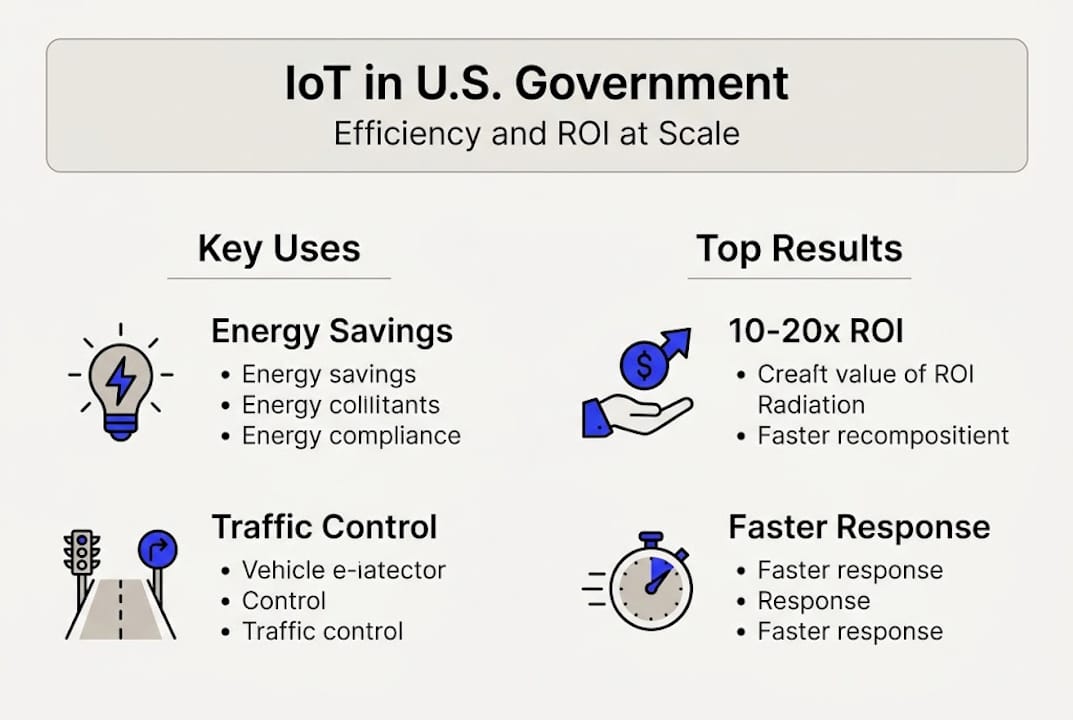
The strategic case is strong. A NIST study on IoT infrastructure identifies 11 strategic areas for federal research investment, estimating a 10 to 20 times return on investment for public sector IoT funding. That figure should stop any budget conversation in its tracks.
“IoT represents a foundational shift in how government agencies collect, analyze, and act on data. The agencies that treat it as infrastructure rather than experimentation will lead the next generation of public service delivery.”
The hesitation in the public sector often comes from outdated perceptions. Leaders assume IoT means expensive, complex overhauls. In reality, phased deployments can generate measurable ROI within the first year. Smart government tech examples show this pattern repeatedly across federal and municipal programs.
Real-time data collection through IoT enhances operational efficiency across five core government impact areas:
- Infrastructure monitoring: Structural sensors on bridges, roads, and utilities flag problems before failures occur
- Energy management: Smart building systems reduce consumption and peak demand costs
- Waste management: Fill-level sensors optimize collection routes, cutting fuel and labor costs
- Transportation: Connected traffic systems reduce congestion and improve emergency response times
- Public safety: Environmental and surveillance sensors support faster, data-driven emergency decisions
Agencies exploring IoT in business contexts will recognize these same efficiency patterns. The difference in government is scale and public accountability, which makes the ROI argument even more compelling.
Key IoT applications driving government efficiency
Real-world results are the best argument for IoT adoption. Here is a snapshot of recent U.S. government IoT deployments and their documented outcomes.
| Deployment | Agency/Location | Key Result |
|---|---|---|
| Wireless sensor network | USDA data center | 48% cooling reduction, $30K/year saved |
| VOLTRON IoT platform | DC commercial buildings | 10-30% energy savings identified |
| Smart traffic systems | Multiple U.S. cities | 15-25% congestion reduction |
| Connected water meters | Municipal utilities | 20-30% leak detection improvement |
The PNNL VOLTRON platform deployed across Washington DC buildings identified 10 to 30% energy savings opportunities and achieved 10 to 15% cost reductions through peak load management. That is not a projection. That is measured performance data from live deployments.
Here are the top IoT use cases producing the strongest government efficiency gains right now:
- Smart buildings and facilities: Sensors monitor occupancy, HVAC performance, lighting, and equipment health. Automated adjustments happen in real time without human intervention.
- Traffic and transportation management: Connected signals, vehicle counters, and incident detection systems reduce response times and improve flow across city networks.
- Energy grid optimization: Smart meters and grid sensors allow agencies to shift loads, reduce peak demand charges, and integrate renewable sources more effectively.
- Waste and resource tracking: Fill sensors on bins and tanks optimize collection schedules, reducing unnecessary trips and associated costs.
Pro Tip: Do not try to deploy IoT agency-wide from day one. Start with a single department or building, measure results for 90 days, then build your business case for expansion. The USDA data center success came from a focused, well-instrumented pilot. You can explore IoT case studies to find models that match your agency’s starting point.
The government tech efficiency gains from these applications compound over time. Energy savings fund the next phase. Operational data from phase one shapes smarter decisions in phase two.

How IoT works: Core technologies and frameworks
You do not need to be an engineer to make smart IoT decisions. But you do need to understand the basic building blocks so you can ask the right questions of vendors and your IT team.
Every IoT system has four core layers:
- Sensors and devices: These collect data. Temperature, motion, pressure, location, energy consumption. They are the eyes and ears of the system.
- Connectivity: Data moves via wired networks, cellular, Wi-Fi, or low-power protocols like LoRaWAN or Zigbee. The right choice depends on range, power availability, and data volume.
- Data platforms: Cloud or on-premise systems that aggregate, store, and organize incoming data streams.
- Analytics and dashboards: AI and machine learning (ML) engines process the data and surface actionable insights through visual dashboards.
IoT methodologies for government include real-time sensors for traffic, energy, and waste monitoring; data integration platforms for KPI tracking; edge processing for low-latency decisions; and AI-based anomaly detection for predictive maintenance.
| Workflow element | Traditional government | IoT-enabled government |
|---|---|---|
| Infrastructure inspection | Scheduled, manual | Continuous, automated alerts |
| Energy management | Monthly billing review | Real-time consumption dashboards |
| Incident response | Report-driven | Sensor-triggered automatic dispatch |
| Asset tracking | Spreadsheet logs | GPS and RFID real-time location |
Integration strategies that work in the public sector include:
- Edge computing: Process data locally at the sensor level to reduce latency and bandwidth costs
- Cloud data lakes: Centralize data from multiple agencies for cross-department analytics
- AI-based anomaly detection: Flag unusual patterns automatically, reducing the need for manual monitoring
Pro Tip: When low latency is critical, such as in traffic management or emergency response, favor lightweight messaging protocols like MQTT-SN or CoAP over standard HTTP. They reduce data overhead and response time significantly. AI and smart services integration is where IoT moves from reactive to genuinely predictive, and that is where the biggest efficiency gains live. For defense-adjacent applications, AI and IoT integration requires additional security layers worth reviewing early.
Risks, challenges, and security frameworks for IoT in the public sector
IoT is powerful. It is also a significant security surface if deployed carelessly. Government leaders must understand the risks before committing to a rollout.
The five main IoT risks in the public sector are:
- Cybersecurity vulnerabilities: 61% of IoT devices run outdated firmware, and 20% of exploits specifically target IoT endpoints
- Device invisibility: Up to 30% of connected devices on government networks are unidentified, creating blind spots
- Legacy system integration: Most agencies run decades-old infrastructure that was never designed to communicate with modern IoT platforms
- Scalability: Piloting 50 sensors is manageable. Scaling to 50,000 across multiple agencies requires architectural planning from day one
- Privacy: Sensors collecting location, behavioral, or biometric data must comply with federal privacy statutes
“The average government agency cannot see nearly a third of the devices connected to its own network. That is not a technology problem. That is a governance problem that technology can solve.”
The NIST IR 8349 guidelines provide a clear federal baseline: use Manufacturer Usage Descriptions (MUD) to define expected device network behavior, apply Zero Trust architecture, enforce secure onboarding procedures, and follow vulnerability disclosure requirements under the IoT Cybersecurity Improvement Act.
Practical risk mitigation steps include:
- Maintain a live inventory of every connected device with automated discovery tools
- Apply Zero Trust principles so no device is trusted by default, even inside the network perimeter
- Enforce firmware update schedules and patch management policies
- Require vendors to provide Software Bills of Materials (SBOMs) for all IoT components
For agencies navigating cybersecurity challenges in government, the NIST framework is not optional guidance. It is the compliance floor. And for teams dealing with legacy system challenges, integration planning must happen before procurement, not after. The NIST IoT study reinforces that agencies investing in proper security frameworks see far better long-term returns.
A strategic perspective: What most government IoT roadmaps miss
Most government IoT roadmaps fail for the same reason. They start with a vendor demo and end with a siloed pilot that never scales. The technology works. The strategy does not.
Conventional wisdom says run a pilot, prove value, then expand. That sounds reasonable. But if the pilot is built on a proprietary platform with no interoperability plan, you have not proven value. You have created a dependency.
Real transformation comes from whole-of-government thinking. That means shared data standards, cross-agency dashboards, and security baselines aligned to NIST from day one. Not as an afterthought. The agencies producing the strongest IoT outcomes are not the ones with the flashiest technology. They are the ones with the clearest governance frameworks and the most invested staff.
Staff training is consistently underbudgeted and overlooked. Sensors generate data. People act on it. If your team cannot interpret the dashboards or respond to automated alerts correctly, the technology delivers nothing. Governance and AI best practices point to this gap repeatedly. Invest in people as much as platforms, and your IoT program will outperform every vendor promise.
How to get started: Connect with experts for strategic success
IoT implementation in government is not a plug-and-play exercise. Vendor selection, security compliance, legacy integration, and scalability planning all require specialized expertise that most agency IT teams are not staffed to handle alone.

We work with organizations navigating exactly this complexity, helping them build technology strategies that deliver measurable results without the guesswork. From initial IoT assessment to full deployment support, our technology strategy services are built for leaders who need outcomes, not just options. Explore our digital transformation consulting to see how we structure IoT roadmaps, or connect with our IT support experts to evaluate your current infrastructure readiness. The right partner makes the difference between a pilot that stalls and a program that scales.
Frequently asked questions
How does IoT improve government operational efficiency?
IoT enables real-time data collection and automation across energy management, transportation, and emergency response, replacing slow, manual processes with continuous, sensor-driven workflows that reduce costs and response times.
What are the main cybersecurity challenges when using IoT in government?
The biggest issues involve 61% of devices running outdated firmware, up to 30% of connected devices being invisible to network teams, and legacy systems that were never designed to integrate with modern IoT platforms.
How can government agencies ensure IoT deployments are secure?
Agencies should follow NIST IR 8349 guidelines including secure device onboarding, Zero Trust architecture, MUD-based network behavior controls, and vulnerability disclosure practices required under the IoT Cybersecurity Improvement Act.
What is one example of successful IoT implementation in a U.S. government context?
The USDA data center deployment used a wireless IoT sensor network to cut cooling load by 48% and total power consumption by 17%, saving $30,000 per year and eliminating 542 metric tons of CO2 annually.