Running a solo CPA practice in Miami means more than balancing ledgers and meeting tax deadlines. Juggling technology decisions, client privacy, and a maze of regulations can leave you scrambling if something fails. Understanding the difference between IT governance, risk management, and compliance is what separates firms that scale confidently from those overwhelmed by complexity. This guide demystifies each concept so you can protect your business, meet all requirements, and build a foundation for sustainable growth.
Table of Contents
- Defining IT Governance, Risk, and Compliance
- Key GRC Frameworks and Standards Explained
- Legal and Regulatory Requirements for Miami CPAs
- How GRC Strengthens Practice Scalability
- Common GRC Mistakes Solo CPAs Must Avoid
Key Takeaways
| Point | Details |
|---|---|
| Understand the Distinctions | IT Governance, Risk Management, and Compliance are interconnected yet distinct areas that require coordinated efforts for effective firm management. |
| Establish a Unified Framework | Implementing an integrated GRC framework helps streamline operations and aligns security, compliance, and risk management effectively. |
| Continuously Update and Review | Regularly assess and update documentation and practices to keep pace with evolving regulations and operational complexities. |
| Prioritize Accountability | Clearly document roles and responsibilities to enhance operational maturity and scalability as the practice grows. |
Defining IT Governance, Risk, and Compliance
Three terms get thrown around in accounting circles like they mean the same thing. They don’t. And if you’re running a CPA practice, understanding the difference between IT governance, risk management, and compliance is the difference between scaling confidently and scrambling when something breaks.
Let’s start with what these actually mean. IT governance is how you direct and control your technology operations. It’s the system that sets decision rights, defines who owns what, and ensures accountability when things go wrong. Think of it as the management structure for your firm’s tech. It establishes which technology decisions get made at your level versus your staff’s level, who can approve new systems, and how you measure whether your tech is actually supporting your business goals. Governance aligns your security strategies with your business objectives and compliance regulations, distinct from simply implementing controls.
Risk management is different. It’s about identifying the bad things that could happen and deciding what to do about them. Your client files could be breached. Your tax software could fail during peak season. A disgruntled employee could sabotage records. The NIST Risk Management Framework provides a structured approach for managing these security and privacy risks systematically. You assess what could go wrong, measure how likely it is, understand the damage it would cause, and then determine whether you avoid it, reduce it, accept it, or transfer it through insurance. Most CPAs need to reduce risk, not eliminate it entirely, because total elimination costs more than tolerating manageable losses.
Compliance is the easiest to define. It’s following the rules. Federal regulations like HIPAA if you work with health data, state CPA board requirements, IRS rules for tax return preparation, and client expectations all create compliance obligations. When a Miami-based firm handles client data, you’re subject to Florida’s data breach notification laws. When you manage financial information, you need to follow AICPA standards. Compliance failures create liability, damage reputation, and can end your practice.
Here’s what matters most: these three work together. Governance structures how you manage risk. Risk management determines what compliance controls you actually need. Compliance requirements shape your governance decisions. A firm without governance drifts into compliance violations because no one owns the decision to implement controls. A firm focused only on compliance wastes money on unnecessary controls that don’t actually reduce your biggest risks. You need all three working in balance.
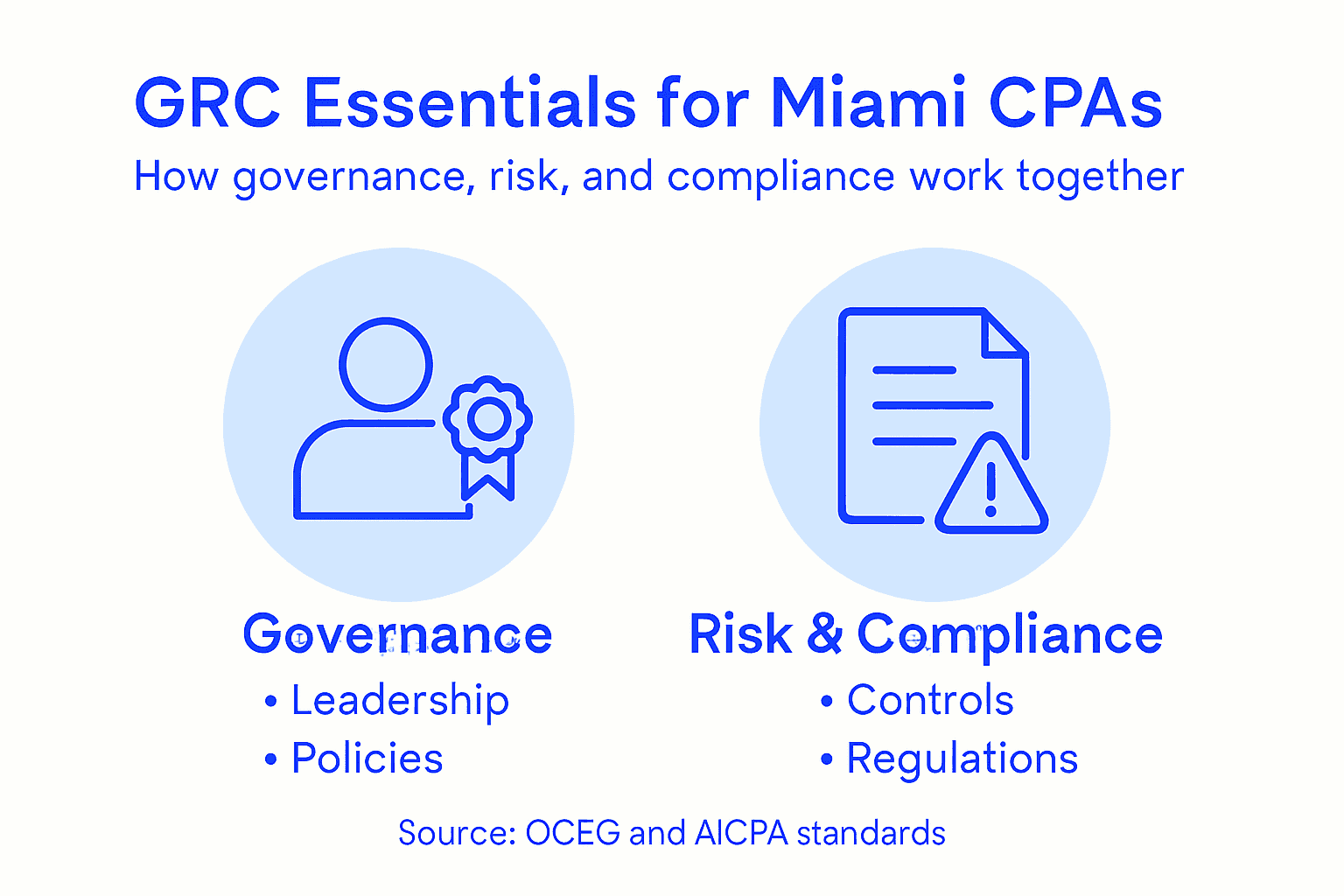
For most Miami CPA practices, this means establishing clear ownership of technology decisions, identifying your actual risk exposures based on the data you handle and systems you use, and implementing controls that address both your top risks and your specific compliance obligations.
Here’s how IT governance, risk management, and compliance differ in a CPA practice:
| Aspect | IT Governance | Risk Management | Compliance |
|---|---|---|---|
| Primary Focus | Decision rights, accountability | Identifying threats, mitigation | Adhering to rules and regulations |
| Typical Activities | Setting tech policy, oversight | Risk assessments, risk response | Policy updates, regulatory tracking |
| Business Impact | Aligned tech strategy, clarity | Minimized disruptions, resilience | Protected reputation, legal safety |
Pro tip: Start by listing every system that touches client data, every person with access to it, and every regulation that applies to your firm. This creates your baseline for understanding what governance structure you need and which risks demand immediate attention.
Key GRC Frameworks and Standards Explained
You’ve heard the term GRC thrown around. Now you need to understand which frameworks actually apply to your Miami CPA practice and why they matter. The frameworks exist for a reason: after corporate scandals like Enron, regulators and professional organizations realized that governance, risk, and compliance needed to work together, not separately. That lesson applies directly to your firm.
The most widely recognized framework comes from OCEG’s GRC Capability Model, which provides a unified vocabulary and standardized practices for implementing GRC effectively. Rather than forcing you into one rigid approach, OCEG offers adaptable components you can use based on your firm’s size and complexity. Their framework covers policy management, data privacy, integrated risk management, and compliance ethics. For a solo CPA practice, you don’t need every component immediately, but understanding what exists helps you scale the right way. As you grow from handling ten clients to one hundred, you need processes that actually work at scale instead of systems that collapse under their own weight.
Beyond OCEG, you’ll encounter industry-specific standards that matter for your clients. The AICPA has standards for audit and attest services. State CPA boards have rules about data security and client communication. The IRS has specific requirements for tax return preparation. If you work with health information or financial data, HIPAA and Gramm-Leach-Bliley Act requirements apply. If you handle EU client data, GDPR compliance is mandatory. The key insight: these aren’t separate compliance burdens. A solid GRC framework consolidates all of them into one operational structure rather than forcing you to maintain parallel compliance systems.
Here’s what separates firms that scale from ones that get stuck. Small practices often chase compliance piece by piece, implementing systems in response to each new requirement. Larger practices build a unified GRC infrastructure first, then plug requirements into it. The integrated approach reduces redundancy, cuts costs, and actually improves your security posture because everything connects logically rather than existing as isolated fixes. When your governance structure is clear, your risk management becomes focused on actual exposures, and your compliance controls address both regulation and risk simultaneously.
For your practice specifically, start by identifying which standards apply to you. Document them. Then assess whether your current systems address them. The gap between what you need and what you have is your roadmap. Most Miami CPAs discover they’re doing the work required by multiple standards but haven’t organized it into a coherent framework. That disorganization creates both compliance risk and operational inefficiency.
Pro tip: Map your current tools and processes against the OCEG GRC framework to see where you have gaps, then prioritize filling critical gaps before scaling your client base further.
Review this summary of GRC frameworks relevant for Miami CPA practices:
| Framework/Standard | Main Purpose | Applicability for CPAs | Key Components |
|---|---|---|---|
| OCEG GRC Model | Integrated GRC practices | All firm sizes | Policy mgmt, risk, compliance |
| AICPA Standards | Audit/attest standards | Financial statement engagement | Ethics, reporting, quality control |
| IRS Regulations | Tax prep requirements | Tax return preparation | Documentation, filings, deadlines |
| HIPAA | Health data protection | Healthcare client data | Security, privacy safeguards |
| Florida Statutes | CPA licensing, ethics | Licensure, state-based compliance | Hours, ethics, CPE, documentation |
Legal and Regulatory Requirements for Miami CPAs
Running a CPA practice in Miami means operating under multiple layers of regulation. You answer to the Florida Board of Accountancy, the IRS, state tax authorities, and your clients’ own compliance obligations. Miss one requirement and you expose your firm to disciplinary action, loss of licensure, or liability claims. Understanding what you’re required to do versus what’s optional separates firms that grow sustainably from ones that face unexpected enforcement actions.
Start with the Florida Board of Accountancy. Florida Statutes Chapter 473 governs CPA licensure, exam administration, and disciplinary procedures. You need specific education and experience requirements to maintain your license. You must pass the CPA exam. You must complete continuing professional education annually, including Florida-specific ethics courses. The board meets regularly and has clear reporting procedures. These aren’t suggestions. Violations result in fines, license suspension, or revocation. Most Miami CPAs handle the education requirements without issue, but where firms get into trouble is failing to document compliance. You need records showing you completed required hours, took the right courses, and maintained your license in good standing. When the board audits randomly, documentation matters. A lot.
Beyond licensure, you face specific compliance obligations tied to the work you do. If you prepare tax returns, the IRS has rules about engagement letters, client documentation, and your professional obligations. If you handle financial statements, AICPA standards apply. If your clients include healthcare providers, HIPAA requirements flow through to your data handling. If you work with employee benefit plans, ERISA rules apply. Many Miami CPAs underestimate how these different regulations compound. You might comply perfectly with IRS requirements while accidentally violating HIPAA because you didn’t secure a health provider’s data properly. The regulations don’t announce themselves. You have to identify which ones apply to your specific client base, then build your operations around them.
Here’s what most solo practitioners miss: IT risk management connects directly to regulatory compliance. When regulators audit a firm, they increasingly examine your technology controls. Do you encrypt client data in transit and at rest? Do you have access controls limiting who touches sensitive information? Do you maintain audit logs? These aren’t optional tech questions anymore. They’re regulatory requirements embedded in multiple frameworks. A firm compliant with tax regulations but vulnerable to data breach is a firm that will face enforcement action when that breach happens.
The practical reality: your regulatory obligations grow as your practice grows. A solo CPA with five clients faces different requirements than one with fifty. The scale triggers new compliance burdens. Firms that plan for this scale proactively rather than reacting to problems end up with sustainable operations. Firms that wait until they hire staff or hit a revenue threshold scramble to implement controls retroactively, which costs significantly more and creates gaps.
Pro tip: Create a compliance calendar documenting every regulatory deadline specific to your firm: CPA license renewal dates, continuing education deadlines, client data security assessments, and required audit procedures. Set reminders 60 days before each deadline so you never face a surprise enforcement issue.
How GRC Strengthens Practice Scalability
Here’s the uncomfortable truth about scaling a CPA practice: most firms can’t do it without breaking something. You hire a staff member and suddenly your data security gets messier. You add fifty clients and your compliance procedures fall apart. You implement new software and nobody understands who has access to what. The chaos isn’t inevitable. It’s the result of growing without GRC infrastructure in place.
When you build GRC into your practice from the start, scaling becomes predictable instead of chaotic. A comprehensive GRC framework integrates governance, risk management, and compliance capabilities so they grow with your firm rather than against it. Instead of maintaining separate systems for compliance, another for security, and a third for client data management, you operate from one unified structure. When you hire your first staff member, you already know who has access to what because your governance defines it. When you add clients, your risk assessment process automatically identifies new exposures based on their industry or data type. When regulations change, your compliance framework has the flexibility to adapt without collapsing your operations.

The practical impact shows up in your bottom line. Firms without GRC spend enormous amounts of time on reactive firefighting. A client calls asking about their data security. You scramble to document what you do. An employee leaves and nobody remembers which systems they accessed. You spend weeks trying to secure accounts retroactively. A new regulation drops and you’re uncertain whether it applies to you. These aren’t one-time problems. They happen repeatedly, consuming time and energy that should go toward client work and business development. A resilient GRC model reduces this friction by establishing clear decision-making processes, defined risk thresholds, and documented compliance obligations from day one. As your firm grows from five clients to five hundred, your operations don’t become more chaotic. They become more refined.
The scalability advantage compounds over time. Firms with established GRC can hire qualified staff faster because they have clear documentation of what the role entails and what controls exist. They can take on larger clients because they’ve already built the compliance infrastructure those clients demand. They can expand into new service lines without creating compliance gaps because their framework provides a template for assessing what controls each new service requires. They can raise prices more confidently because they operate efficiently and predictably rather than burning time on preventable problems.
What separates firms that hit seven-figure revenue from those stuck at five figures often isn’t client quality or tax expertise. It’s operational maturity. A firm with mature GRC can serve ten times as many clients with the same number of staff members because they work efficiently. They don’t repeat the same compliance work manually for every client. They don’t recreate security controls each time they hire someone. They don’t guess about risk because their framework guides decision-making. That operational maturity directly translates to scalability.
Pro tip: Map out which governance decisions you make repeatedly as you grow: hiring practices, system access approval, new client onboarding, and compliance deadlines. Create documented processes for each one now, before you need them, so that when you scale rapidly, you’re executing proven processes instead of inventing them under pressure.
Common GRC Mistakes Solo CPAs Must Avoid
You’re running a solo practice. You wear every hat. You handle client relationships, manage finances, do the tax work, and somehow keep the technology functioning. When GRC gets mentioned, it sounds like something for big firms with entire departments. So you skip it. That’s the first mistake. The second mistake is treating it like a checklist instead of an integrated system that actually supports your business. The third mistake is letting things drift until a client demands security documentation or the IRS asks questions you can’t answer.
The most dangerous GRC mistake solo CPAs make is operating with siloed efforts. You handle compliance separately from risk management. You manage security independently from governance. You document access controls for one system but ignore them for another. Siloed GRC approaches create inefficiencies and duplicated work that waste your limited time. You end up maintaining three separate systems when one integrated framework would serve you better. A client asks if their data is encrypted. You check one system. Another client asks about staff access. You check a different system. A third asks about your backup procedures. You create a document from scratch because you don’t have a unified inventory of what you actually do. That’s not governance. That’s chaos with documentation.
Another critical mistake is treating GRC as a one-time project instead of continuous monitoring. You implement access controls once, then never review them. An employee leaves and nobody deactivates their accounts for three months. You add a new client with stricter data requirements but don’t update your security procedures. You hear about a new regulation but assume it doesn’t apply to you. Effective GRC requires regular review, assessment, and updates. Your risk profile changes as your practice grows. Your compliance obligations shift as you take on different client types. Your technology evolves as you adopt new tools. A GRC system that doesn’t evolve with your practice becomes a relic that provides false comfort without actual protection.
Solo practitioners also frequently fail to document roles and accountability clearly. You know you’re responsible for compliance. But when you hire your first staff member, they don’t know what they can and can’t do. When a client asks who manages their data security, you struggle to give a clear answer. Lack of clear accountability and insufficient training creates gaps that expose your practice to real risk. Document who owns what. Make it explicit. Train people on it. Update it when things change. That seems simple. It’s the difference between a practice that scales and one that collapses when complexity increases.
The cost of these mistakes compounds. A small documentation gap becomes a major problem during an audit. A minor access control oversight leads to a breach. A missed regulation change creates liability. These aren’t theoretical risks. They’re what happens to practices that don’t treat GRC seriously. And you can’t afford that outcome if you’re scaling toward seven figures. Every incident disrupts revenue. Every regulatory problem threatens your license.
Pro tip: Start with three simple documents: a written list of what data you handle and where it lives, a written list of who has access to what system and why, and a written calendar of compliance deadlines specific to your practice. Review and update these monthly. This foundation prevents 80 percent of common GRC disasters.
Take Control of Your IT Governance, Risk, and Compliance Today
Scaling a CPA practice in Miami means managing complex IT governance, risk management, and compliance demands all at once. The challenge is clear: without an integrated framework, your technology decisions, security risks, and regulatory obligations become overwhelming. You need a partner who understands these exact pain points and translates them into strategic technology solutions that protect your firm and support sustainable growth.
Unlock the power of a unified approach to governance, risk, and compliance with our expert services tailored for accountants. From setting clear decision rights to implementing effective risk controls and ensuring full compliance, we help you align your IT with your business goals. Explore our GRC Archives – Strategic IT Consultants For Accountants to see how we bring structure and clarity to your firm’s operations.
Stop scrambling with disconnected tools and ad hoc fixes that drain your time and energy. Partner with us at Transform42 to build the capabilities your clients expect while reclaiming your life. Learn how our technology expertise makes scaling predictable and efficient by visiting our Technology Archives – Strategic IT Consultants For Accountants. Take the first step to transform your practice today.
Frequently Asked Questions
What is the difference between IT governance, risk management, and compliance?
IT governance focuses on directing and controlling technology operations, ensuring accountability and alignment with business objectives. Risk management involves identifying potential threats, assessing their likelihood and impact, and determining how to address them. Compliance refers to adhering to rules and regulations set by governing bodies and organizations that affect business operations.
Why is a GRC framework important for CPA practices?
A GRC framework integrates governance, risk management, and compliance into a cohesive system, helping CPA practices operate efficiently. It ensures that practices can scale effectively by providing clear processes for decision-making, risk assessment, and compliance obligations, thus reducing redundancy and improving security.
How can Miami CPAs ensure they meet regulatory requirements?
Miami CPAs can ensure regulatory compliance by documenting all applicable standards and assessing their current systems against those requirements. Regularly updating operational processes and maintaining thorough documentation of compliance efforts will help avoid regulatory violations and the associated penalties.
What are common mistakes solo CPAs make regarding GRC?
Common mistakes include siloed efforts in managing governance, risk, and compliance separately, treating GRC as a one-time project rather than a continuous process, and failing to clearly document roles and responsibilities. These mistakes can lead to inefficiencies and increased risk for the practice.