TL;DR:
- IT modernization replaces outdated systems to enhance speed, safety, and profitability.
- It unlocks revenue through automation, cloud scalability, compliance, AI analytics, and cybersecurity.
- Delaying modernization risks security breaches, compliance failures, and uncompetitive growth.
Most Miami business leaders treat IT as an expense line, something to minimize and revisit only when something breaks. That mindset is costing your firm millions. For doctors, lawyers, and accountants competing in one of the most dynamic markets in the country, technology is not overhead. It is the engine behind your next revenue milestone. This article breaks down what IT modernization actually means, the specific revenue drivers it unlocks, the real risks of delaying action, and a practical roadmap you can start using today. If you are serious about scaling to 7 or 8 figures, keep reading.
Table of Contents
- What is IT modernization and why does it matter?
- Major revenue drivers unlocked by IT modernization
- Risks and costs of ignoring IT modernization
- Practical steps to modernize IT for transformative results
- What most Miami business leaders get wrong about IT modernization
- Accelerate your Miami firm’s growth with expert IT modernization
- Frequently asked questions
Key Takeaways
| Point | Details |
|---|---|
| Direct revenue growth | Modern IT systems fuel 7-8 figure gains for Miami service firms. |
| Reduces operations risk | Up-to-date IT lowers the chance of costly downtime and compliance issues. |
| Foundation for innovation | Modernization enables future-ready services, agility, and competitive advantage. |
| Essential, not optional | Delaying IT upgrades means lost revenue and rising risks for business leaders. |
What is IT modernization and why does it matter?
IT modernization is not about buying new laptops or upgrading your Wi-Fi. It is the deliberate process of replacing or improving outdated systems, software, and workflows so your firm can operate faster, safer, and at a higher margin. Think of it as rebuilding the foundation of your business while the lights stay on.
Many leaders confuse modernization with a simple hardware refresh. That confusion is expensive. True modernization covers everything from cloud migration and automation to AI integration, cybersecurity architecture, and compliance infrastructure. It touches how your team works, how your clients experience your services, and how quickly you can scale.
“IT modernization directly improves efficiency and revenue potential” for firms that approach it strategically rather than reactively.
When you invest in IT service management the right way, the outcomes are concrete: faster client onboarding, fewer manual errors, stronger data security, and the ability to take on more clients without proportional hiring. A productivity improvements study found that firms modernizing their core systems saw measurable gains in output and staff efficiency within the first year.
The concept of digital transformation is often thrown around without real context. For a Miami medical practice, it might mean integrating electronic health records with billing automation. For a law firm, it could mean deploying secure client portals and AI-assisted document review. For an accounting firm, it is likely cloud-based ERP systems and real-time financial dashboards.
Pro Tip: Run a quick internal audit. If your team spends more than two hours per week on manual data entry, or if your systems cannot talk to each other, your legacy infrastructure is actively limiting your revenue ceiling.
Here are three visible signs your IT is holding back revenue:
- Slow turnaround times on client deliverables because staff must manually transfer data between systems
- Frequent compliance scares triggered by outdated software that cannot meet current regulatory standards
- Inability to scale without hiring additional administrative staff for every new client added
Recognizing these signs early is the difference between proactive growth and reactive damage control.
Major revenue drivers unlocked by IT modernization
Once you understand what modernization is, the next question is simple: what does it actually do for your bottom line? The answer is more direct than most people expect.
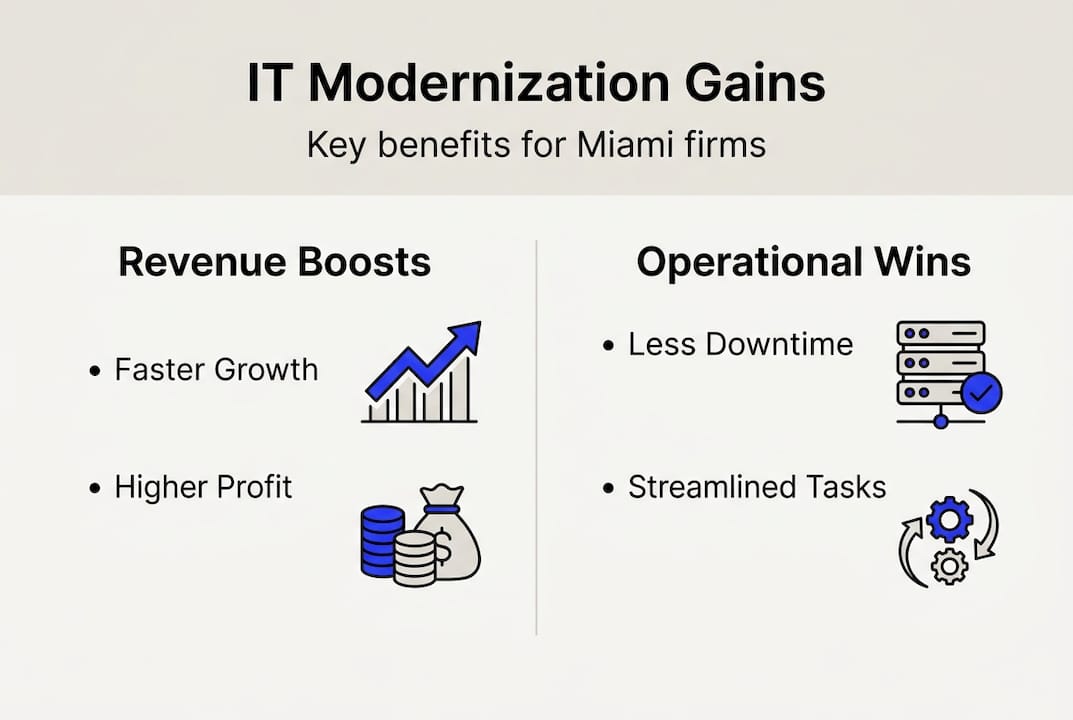
46% of Miami professionals credit digital strategy with significant revenue boosts, according to recent trend data. That is not a coincidence. It reflects a structural shift in how professional service firms compete and grow.

Here is a breakdown of the top revenue drivers and their business impact:
| Revenue driver | Business impact |
|---|---|
| Process automation | Reduces labor costs, speeds delivery, frees staff for high-value work |
| Cloud scalability | Allows rapid client growth without proportional overhead increases |
| Compliance infrastructure | Prevents costly fines and protects client trust |
| AI-powered analytics | Enables data-driven pricing, service expansion, and client retention |
| Cybersecurity posture | Reduces breach risk and protects revenue continuity |
Each of these drivers compounds over time. Here is how they translate to real revenue for Miami’s legal, medical, and accounting sectors:
- Automation eliminates repetitive billing, scheduling, and reporting tasks. Your team redirects those hours to revenue-generating work, directly increasing capacity without adding headcount.
- Scalability means you can say yes to larger clients and more complex engagements. Firms using cloud infrastructure can onboard new clients in days instead of weeks.
- Compliance tools protect against regulatory penalties that can run into six figures for a single violation in healthcare or financial services.
- AI analytics help you identify which services carry the highest margins and which clients are most likely to expand their relationship with your firm.
The missed multiplier effect is real. When these drivers work together, the compounding impact on digital transformation impact is not linear. Miami firms that modernize comprehensively often report revenue growth that exceeds initial projections because each upgrade amplifies the next. For CPA digital innovation specifically, firms that have adopted integrated platforms report landing larger corporate clients who require exactly the kind of infrastructure those platforms provide.
Risks and costs of ignoring IT modernization
Knowing the upside is motivating. But understanding what you stand to lose by waiting is often what drives real action.
Legacy systems do not just slow you down. They create active liability. Legacy systems create vulnerabilities and regulatory risks that grow more serious with every year you delay. A security risks study confirms that outdated infrastructure is among the top factors in data breaches affecting professional service firms.
“The cost of a data breach is not just the fine. It is the client you lose, the reputation you spend years rebuilding, and the legal exposure that follows.”
Here is a direct comparison of what modern versus outdated IT looks like across key business dimensions:
| Business dimension | Modern IT | Outdated IT |
|---|---|---|
| Security | Proactive threat detection, encrypted data | Reactive patching, high breach risk |
| Compliance | Automated updates, audit-ready records | Manual tracking, frequent gaps |
| Cost structure | Predictable subscription costs | Unpredictable repair and downtime costs |
| Agility | Rapid scaling and integration | Slow adaptation, siloed systems |
The hidden costs of legacy IT are often invisible until they become crises. Three of the most damaging:
- Unplanned downtime that halts billing, client communication, and service delivery, often costing more per hour than a full month of modernization investment
- Staff inefficiency from working around broken or incompatible systems, which quietly erodes morale and increases turnover
- Regulatory penalties tied to regulations in accounting compliance that outdated systems simply cannot meet, particularly in healthcare and financial services
For Miami firms in high-stakes sectors, the risk is compounded by client expectations. Corporate clients, hospital networks, and high-net-worth individuals expect the firms they hire to have airtight data practices. One visible breach or compliance failure can end relationships that took years to build.
Practical steps to modernize IT for transformative results
Understanding the risks and rewards is only useful if you know how to act. Here is a clear roadmap built for Miami’s professional service leaders.
Effective IT modernization is achieved through a systematic roadmap approach, not a single big-bang project. Breaking it into phases reduces risk and allows your team to adapt.
- Assess your current state. Conduct an honest audit of every system, workflow, and tool your firm uses. Identify what is slowing you down, what creates compliance exposure, and what your team works around daily.
- Build a strategy aligned with revenue goals. Modernization without a business objective is just spending. Map every technology decision to a specific outcome: faster client onboarding, higher billing capacity, lower error rates.
- Capture quick wins first. Identify two or three changes that can deliver visible results within 90 days. This builds internal confidence and demonstrates ROI before larger investments are made.
- Secure leadership and staff buy-in. Technology fails when people do not use it. Involve your team early, communicate the benefits clearly, and invest in training before rollout.
- Implement with a trusted partner. Whether you use consulting for Miami CPAs or a broader technology partner, choose someone who understands your industry’s regulatory environment and growth goals.
Pro Tip: Avoid the trap of managing modernization entirely in-house unless you have a dedicated IT leadership team. The complexity of integrating cloud technology for Miami CPAs with compliance requirements and existing workflows is a full-time specialty. A qualified partner pays for itself.
Key success factors for Miami firms executing modernization:
- Change management planning that addresses staff resistance before it becomes a roadblock
- Phased rollout that minimizes disruption to client-facing operations
- Ongoing training so your team can actually use the new tools at full capacity
- Regular performance reviews to measure outcomes against your original revenue targets
What most Miami business leaders get wrong about IT modernization
Here is the uncomfortable truth we have seen play out repeatedly: most firms that struggle with modernization are not failing because of bad technology choices. They are failing because they treat IT modernization as a technology project instead of a business transformation.
Leaders get excited about new platforms and automation tools, but they underinvest in the cultural and operational changes that make those tools effective. The result is expensive software that nobody uses correctly and a team that reverts to old habits within six months.
The other trap is chasing quick ROI. Modernization done right is a compounding investment. The firms we see reach 8-figure growth milestones are the ones that commit to a multi-year strategy, not the ones looking for a 90-day payback. Digital innovation for CPAs and other professional sectors works the same way: the firms that win are the ones that build the infrastructure first and then scale aggressively on top of it.
Our honest opinion: IT is no longer a support function. It is the backbone of every high-growth professional services firm in Miami. The sooner you treat it that way, the faster your revenue reflects it.
Accelerate your Miami firm’s growth with expert IT modernization
You now have a clear picture of what IT modernization is, what it delivers, and what it costs you to delay. The next step is putting that knowledge into action with the right partner by your side.
We work exclusively with doctors, lawyers, and accountants in Miami who are serious about adding 7 to 8 figures to their monthly revenue. Our technology consulting for Miami firms is built around your industry’s specific compliance requirements, client expectations, and growth targets. From your first digital transformation consulting session to full implementation, we handle the complexity so you can focus on your clients. Ready to see what expert IT modernization looks like for your firm? Let’s talk.
Frequently asked questions
What are the first signs my business needs IT modernization?
Outdated IT leads to inefficiency and risks that show up as slow operations, frequent system downtime, and growing compliance concerns. If your team regularly works around your systems instead of with them, it is time to modernize.
Can IT modernization really drive 7-figure revenue growth?
Yes. 46% of Miami professionals report major revenue growth directly tied to IT upgrades, particularly in professional services where speed, compliance, and scalability directly affect client capacity and billing rates.
Is IT modernization worth it for small and midsize Miami firms?
All firm sizes benefit from modernization because the competitive, regulatory, and client expectation pressures apply regardless of headcount. Smaller firms often see faster percentage gains because the baseline inefficiencies are more concentrated.
How long does an IT modernization project typically take?
Systematic modernization produces measurable results within 6 to 12 months for most firms, depending on the scope of changes and how well the rollout is planned and managed.
Recommended
- Digital Transformation For CPAs: Miami’s Revenue Advantage
- 7 Key Benefits Of Digital Transformation For Miami CPAs
- Digital Strategy Trends 2025: 46% Of Miami Pros Boost Revenue
- 7 Key Benefits Of Digital Upskilling For Miami Accounting Firms – Stratgetic IT Consultants For Accountants
- Legacy Software Modernization Services | PODTECH