
TL;DR:
- Managed cloud services enhance compliance, security, and scalability for Miami accountants handling sensitive data.
- They enable flexible scaling during peak seasons and improve cost predictability through fixed monthly fees.
- Choosing an accounting-specific provider with proven experience ensures better compliance management and workflow integration.
Most Miami accounting firms now use managed cloud services for over half their operations, yet many professionals still aren’t sure how these solutions directly improve their compliance posture or ability to scale. That gap between adoption and understanding costs you clients, time, and competitive ground. 70% of businesses use managed services for at least half their operations, yet the question of how to extract real value remains unanswered for many independent accountants and financial consultants. This guide cuts through the noise. You’ll walk away knowing exactly what managed cloud services do, how they solve Miami-specific challenges, and what steps to take to implement them in your practice.
Table of Contents
- What are managed cloud services—and why do Miami accountants need them?
- Key benefits: Compliance, security, and scalability unlocked
- Navigating real-world challenges: Integrations, legacy systems, and cost control
- Best practices: Selecting and implementing managed cloud services
- What most cloud guides miss: The invisible financial levers for Miami advisors
- Transform your Miami practice with the right cloud partner
- Frequently asked questions
Key Takeaways
| Point | Details |
|---|---|
| Compliance fast-tracked | Managed cloud providers make regulatory compliance and audit-readiness attainable for Miami firms. |
| Seamless scale possible | Adding users or increasing workloads is frictionless with managed cloud during peak accounting seasons. |
| Expert-driven cloud choice | Choosing accounting-specific managed providers ensures optimal security, compliance, and support. |
| Integration and cost vigilance | Careful integration planning and financial oversight prevent hidden costs or performance issues. |
What are managed cloud services—and why do Miami accountants need them?
A managed cloud service is when a third-party provider handles your IT infrastructure, security, software updates, and data storage on your behalf, through the cloud. You don’t manage servers. You don’t patch software at midnight. You focus on your clients while a specialized partner keeps your systems running, secure, and compliant.
For Miami accountants and financial consultants, this distinction matters more than it might in other industries. Your clients hand you sensitive financial data. Regulators expect you to protect it. And the pace of change in both tax law and cybersecurity means your technology needs to evolve constantly. Trying to do all of that in-house, without a dedicated IT team, is a losing battle.
Managed services for Miami firms address several specific pressures you face:
- Regulatory complexity: Florida and federal compliance rules shift frequently, and your systems must keep pace.
- Seasonal demand spikes: Tax season creates sudden surges in workload, data processing, and user access needs.
- Client data sensitivity: Financial records require encryption, access controls, and audit trails that generic IT setups rarely provide.
- Talent gaps: Hiring a full-time IT security specialist in Miami is expensive. A managed provider gives you that expertise at a fraction of the cost.
- Remote and hybrid work: Many consultants now serve clients across South Florida and beyond, requiring secure, always-on access to systems from anywhere.
Research confirms the impact. Cloud adoption improves financial management through system integration, with a statistically significant effect (beta=0.359, p<0.001). That’s not a marginal gain. It’s a structural improvement in how your practice operates.
Pro Tip: When evaluating providers, look specifically for managed cloud partners with accounting or professional services experience in the Miami market. A generic IT vendor won’t understand FTC Safeguards Rule requirements or the nuances of client data handling in a CPA context.
Key benefits: Compliance, security, and scalability unlocked
With a strong foundation in what managed cloud means, let’s dig into the proven advantages for Miami finance professionals.
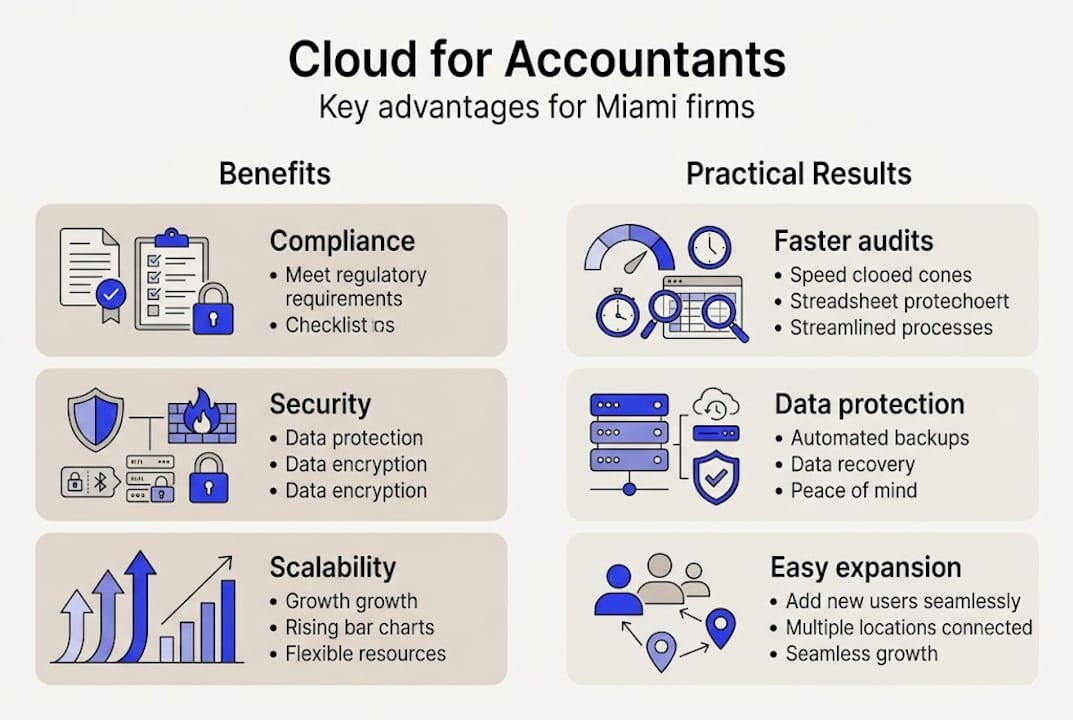
The compliance benefit alone is enough to justify the switch for many firms. A 50-person CPA firm achieved serverless operations and FTC compliance in just six months using managed cloud services. That’s a firm your size moving from exposure to full compliance in half a year. AAFCPAs scaled from 160 to 400 users with improved cyber insurance coverage, all through managed cloud infrastructure.
Security is another area where managed cloud consistently outperforms in-house setups. Providers maintain 24/7 monitoring, automatic threat detection, and regular vulnerability assessments. For Miami CPA cloud examples, the results speak clearly: fewer breaches, faster incident response, and better standing with cyber insurers.

Here’s a direct comparison of what in-house IT versus managed cloud typically looks like for an independent accounting firm:
| Factor | In-house IT | Managed cloud |
|---|---|---|
| Monthly cost | High and unpredictable | Fixed and foreseeable |
| Uptime guarantee | Varies by setup | 99.9% SLA standard |
| Compliance management | Manual and reactive | Automated and proactive |
| Scalability | Slow and capital-intensive | On-demand and fast |
| Security monitoring | Business hours only | 24/7 continuous |
| Disaster recovery | Often incomplete | Built-in and tested |
“Managed cloud is the foundation of predictable security in a regulated field. When your infrastructure is handled by specialists who understand compliance requirements, you stop reacting to threats and start preventing them.” — Cloud security advisor, financial services sector
For IT cloud services for accountants, the scalability advantage is especially valuable. You can add users during tax season and reduce capacity afterward, paying only for what you use. That kind of flexibility is simply not possible with on-premise hardware.
Navigating real-world challenges: Integrations, legacy systems, and cost control
Cloud isn’t a silver bullet. Let’s tackle the most common pain points and how Miami firms overcome them.
The biggest practical hurdle most accountants face is integrating cloud services with existing software. QuickBooks, practice management tools, and document storage systems don’t always play nicely with new cloud environments. The solution is virtual application delivery, where legacy software runs in a cloud-hosted environment without requiring a full replacement. This protects your current workflows while giving you cloud-level security and access.
Multi-cloud complexity requires FinOps (Financial Operations, a discipline focused on cloud cost governance) for real cost control. Without proper tagging and spending governance, cloud bills can grow unpredictably. Many firms are surprised by this. The insanity of cloud granularity is real: dozens of micro-charges across storage, compute, and data transfer can obscure your true spend.
Here’s a breakdown of common cost and integration challenges:
| Challenge | What it looks like | How to address it |
|---|---|---|
| Legacy system conflicts | Old software won’t sync with cloud | Virtual app delivery or phased migration |
| Hidden cloud costs | Unexpected billing spikes | FinOps tagging and monthly spend reviews |
| Data residency concerns | Client data stored outside Florida | Confirm provider’s data center locations |
| Compliance gaps during migration | Temporary exposure during transition | Staged rollout with compliance checkpoints |
When vetting a managed cloud provider for cloud migration for Miami CPAs, follow these steps:
- Ask for a full breakdown of all recurring and variable charges before signing.
- Confirm the provider has experience migrating accounting-specific software.
- Request references from firms of similar size in regulated industries.
- Review their data residency policy and confirm it meets Florida and federal standards.
- Clarify who owns the data if you end the contract.
For firms comparing on-premise versus cloud for compliance, a co-managed model is often the smartest middle ground. You keep control over critical workflows while offloading infrastructure management to a specialist.
Pro Tip: Co-managed IT lets you retain oversight of sensitive client processes while your provider handles security patching, backups, and monitoring. It’s the best of both worlds for compliance-conscious accounting firms.
Best practices: Selecting and implementing managed cloud services
Having explored the main challenges, it’s time to get practical. Here’s how to assess and implement the right managed cloud solution for your Miami practice.
Not all managed service providers (MSPs) are built for accounting firms. Generic MSPs often lack the compliance knowledge, accounting software expertise, and regulatory awareness your practice requires. Accounting-specific MSPs outperform generic providers in compliance management, and cost savings only materialize when proper governance is in place from day one.
When evaluating providers, look for these qualities:
- Accounting software fluency: Your MSP should know QuickBooks, Sage, Thomson Reuters, and other tools your firm uses.
- Compliance track record: Ask specifically about FTC Safeguards Rule, IRS Publication 4557, and GLBA compliance experience.
- Miami market knowledge: Local providers understand Florida-specific regulations and can respond faster when issues arise.
- Transparent pricing: Fixed monthly fees with clear documentation of what triggers variable charges.
- Disaster recovery testing: Providers should test backup and recovery procedures regularly, not just set them up.
- Security certifications: SOC 2 Type II certification is a strong signal of operational security maturity.
When comparing options, use a structured evaluation. Our guide on comparing managed IT services walks through the key criteria side by side.
During onboarding, the most common pitfall is rushing the data migration. Moving client records to the cloud without a staged rollout creates compliance gaps and data integrity risks. Insist on a phased migration plan with compliance checkpoints at each stage. Also, confirm the provider’s approach to on-premise versus cloud security so you understand exactly where your data lives and who can access it.
Finally, keep your internal team involved throughout implementation. Cloud success isn’t just a technology project. It’s a workflow change, and your staff needs training, documentation, and clear escalation paths from the start.
What most cloud guides miss: The invisible financial levers for Miami advisors
Most cloud guides focus on uptime and security. Those matter, but they’re table stakes. The real opportunity for Miami accountants is subtler and more financially significant.
Managed cloud changes your cost structure in ways that directly improve cash flow. Fixed monthly fees replace unpredictable capital expenditures. That predictability makes your practice easier to budget, easier to value, and easier to scale. It also opens new service offerings. When your infrastructure is solid, you can confidently take on more complex clients, offer advisory services, and bill for higher-value work.
Scaling isn’t just about adding users. It’s about absorbing compliance peaks and tax season surges without hiring proportionally. That’s where the real margin improvement lives. Non-linear cost scaling is a genuine risk if you don’t govern your cloud spend, but with the right FinOps discipline, you can smooth those peaks into predictable, manageable costs.
The contrarian truth is this: don’t chase generic cloud savings. Align your cloud environment with your specific accounting workflows, and the ROI becomes defensible and durable. True transformation happens when cloud changes how you deliver and bill, not just where your data lives. Explore expert MSP perspectives to see how Miami firms are making this shift in practice.
Transform your Miami practice with the right cloud partner
You now have a clear picture of what managed cloud services can do for your compliance, security, and scalability. The next step is finding a partner who understands accounting firms in Miami specifically.
At Transform42, we help independent accountants and financial consultants build the technology foundation their clients expect. From technology solutions for accountants to cloud scalability for Miami firms, we align every solution to your compliance requirements and growth goals. Our essential IT services are designed to help you land bigger clients, scale without proportional hiring, and reclaim your time. Let’s talk about what the right cloud setup looks like for your practice.
Frequently asked questions
What are the specific compliance benefits of managed cloud services for Miami accountants?
Managed cloud providers automate FTC Safeguards Rule and data privacy compliance, dramatically reducing your exposure. A 50-person CPA firm reached FTC compliance in just six months after switching to managed cloud infrastructure.
How do managed cloud services help independent accountants scale during busy seasons?
Managed cloud lets you add user capacity and computing power on demand, without hardware purchases or long lead times. AAFCPAs scaled from 160 to 400 users seamlessly using this approach, with no disruption to client service.
Are there hidden costs or challenges in switching to managed cloud?
Legacy system integration and non-linear cost scaling are real challenges, but they’re manageable with proper governance. Multi-cloud complexity requires FinOps discipline and clear contract terms to keep costs predictable.
Should Miami accountants use generic or accounting-specific managed cloud services?
Accounting-specific providers consistently deliver better compliance outcomes and workflow alignment than generic MSPs. Accounting-specific MSPs outperform generic providers when compliance management and cost governance are priorities for your firm.