
TL;DR:
- Most Miami professionals mistakenly view a service desk as basic IT support, costing them clients and efficiency. A modern service desk encompasses incident management, user communication, workflow coordination, and full ownership of resolutions, not just ticket logging. To succeed, practices must treat the service desk as a strategic client experience infrastructure, supported by skilled people, clear processes, and appropriate technology.
Most Miami CPAs, lawyers, and doctors think a service desk is just a fancier name for IT support. That assumption is costing them clients and operational efficiency. A modern service desk is the organization’s front-line support capability and single point of contact for reporting needs, with full ownership for diagnosis, troubleshooting, routing, and resolution. It is not a passive ticket collector. For independent professionals managing demanding client relationships, understanding what a service desk truly is and how to use it strategically can be the difference between a thriving practice and one that constantly feels reactive.
Table of Contents
- What is a service desk? The modern definition
- Service desk vs. help desk: Why the difference matters
- How a service desk works: People, process, and technology
- Measuring service desk performance: What success looks like
- Applying service desk principles to your Miami practice
- Why most Miami professionals underutilize service desks (and how to change that)
- Improve your client experience with expert service desk guidance
- Frequently asked questions
Key Takeaways
| Point | Details |
|---|---|
| Beyond IT support | A service desk manages all types of support requests, not just technical break/fix issues. |
| End-to-end workflow | A service desk owns the entire request lifecycle, handling intake through to resolution. |
| Measured by outcomes | Key metrics like FCR, MTTR, and satisfaction show real effectiveness and drive improvements. |
| People, process, and tech | Success depends on skilled teams, well-defined processes, and smart use of automation tools. |
| Operational impact | Adopting service desk best practices directly increases efficiency, trust, and client satisfaction for Miami professionals. |
What is a service desk? The modern definition
Let’s clear up the confusion right away. A service desk is far more than a phone number your clients call when something breaks. According to ITIL standards, a service desk is the central point of contact between users and the IT service provider, managing incidents, service requests, and user communications while coordinating with technical teams. That word “coordinating” is key. The service desk does not just log requests and move on.
Critically, service desks own diagnosis, troubleshooting, and resolution rather than simply passing tickets through. That distinction matters enormously for your practice.
Here is what a modern service desk actually handles:
- Incident management: When something breaks or stops working, the service desk owns the path to resolution from start to finish.
- Service requests: Routine requests like software access, document delivery, or onboarding workflows are tracked and fulfilled systematically.
- User communication: Clients and staff receive timely, consistent updates at every stage, not just when something is fixed.
- Workflow coordination: The service desk connects people, processes, and systems to keep everything moving without bottlenecks.
- Policy alignment: Every action ties back to your firm’s defined procedures, protecting compliance and consistency.
“A service desk is not a cost center. It is the operational backbone that ensures every client interaction, request, and issue is handled with accountability and speed.”
When you explore service desk operations through this lens, you start to see why independent Miami professionals who invest in a mature service desk model consistently outperform those who rely on ad hoc email chains and informal support processes.
Service desk vs. help desk: Why the difference matters
Understanding the full definition is easier when you see how a service desk compares to a traditional help desk. The nuance is real and it directly impacts your client relationships.
A help desk is reactive by design. Someone has a problem, they call for a fix, the issue gets resolved, and that is the end of the interaction. There is no tracking of patterns, no formal ownership of the resolution process, and no strategic connection to broader business outcomes. It is break/fix support, plain and simple.
A service desk is different in scope and intent. As Salesforce notes, a service desk is broader than basic break/fix, typically owning end-to-end intake-to-resolution workflows. That end-to-end ownership is what separates mature service operations from reactive chaos.
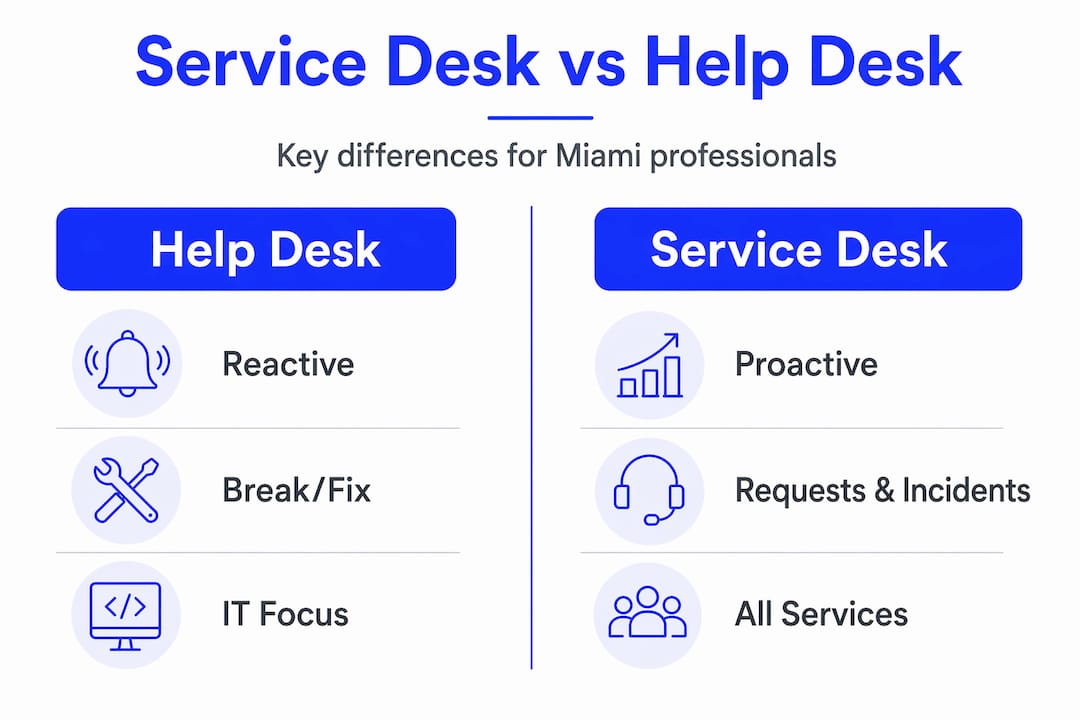
Here is a clear comparison:
| Feature | Help desk | Service desk |
|---|---|---|
| Focus | Break/fix technical issues | Incidents, service requests, and user communication |
| Scope | Narrow and reactive | Broad and proactive |
| Ownership | Issue closed when fixed | Full lifecycle from intake to resolution |
| Communication | Limited updates | Structured, ongoing user communication |
| System integration | Minimal | Integrated with business systems and policies |
| Goal | Restore function | Improve experience and efficiency continuously |
For a Miami CPA firm handling tax season with dozens of client document requests flying in simultaneously, a help desk model creates chaos. A service desk model creates order. The same applies to a law firm managing case intake or a medical practice handling patient follow-up requests.
Pro Tip: If your team currently handles client requests through a shared inbox or informal text chains, you already have a service desk in practice. You just do not have the structure, tracking, or technology to make it work efficiently. That gap is entirely fixable with centralized service operations.
The professionals who understand this distinction do not just patch problems. They build systems that prevent problems from compounding in the first place.
How a service desk works: People, process, and technology
With the differences clarified, let’s see how a well-running service desk actually functions and how all components work together for better support.
A service desk runs on three pillars: skilled people, clear processes, and the right technology. Weakness in any one of these three areas creates friction that your clients ultimately feel.
According to InvGate, a service desk commonly includes both the people process and the supporting technology and workflow used to intake, track, communicate, and route requests to the right resolver group. Let’s break each pillar down.
Skilled people: Your service desk team or partner needs clear role definitions. Who receives incoming requests? Who is responsible for diagnosis? Who escalates complex issues? Without defined roles, even the best technology fails. In a Miami medical practice, this might mean a dedicated patient services coordinator working in tandem with your IT support partner.

Clear processes: Every type of request needs a defined path. How long should a routine document request take? What triggers an escalation? When does the client get a status update? Documented workflows eliminate guesswork and protect your firm from inconsistency.
Right technology: Service desk software enables tracking, routing, and automated updates that no human team can sustain manually at scale. AI automation for support desks is increasingly changing how requests are triaged and resolved, reducing resolution times significantly.
Here is how a well-designed service desk handles a request from start to resolution:
- Intake: A client or staff member submits a request via email, portal, or phone. The system logs it automatically with a timestamp and category.
- Triage: The system or a team member assesses urgency and assigns the request to the appropriate resolver based on defined routing rules.
- Diagnosis: The assigned party investigates the root cause, not just the symptom.
- Resolution: The issue is resolved or the request is fulfilled, and the client receives a clear confirmation.
- Documentation: The resolution is logged for future reference and trend analysis.
- Review: Patterns across multiple requests are reviewed regularly to improve processes.
Pro Tip: Pair your service desk with automation workflow strategies to handle routine request categories automatically. This frees your team to focus on complex, high-value client needs instead of repetitive administrative tasks. Firms that implement workflow automation in professional services consistently report significant reductions in response time and staff overhead.
Measuring service desk performance: What success looks like
Once you have built or improved your service desk, the next step is measuring its value. Here is what truly separates average support operations from great ones.
Metrics give you the ability to make decisions based on reality rather than gut feeling. Three metrics matter most for Miami professionals evaluating their service desk performance.
First Contact Resolution (FCR): This measures the percentage of requests resolved without requiring a follow-up contact or escalation. A high FCR means your service desk is knowledgeable, empowered, and efficient. A low FCR signals gaps in either training or process design. For client-facing practices, FCR directly correlates with how confident and supported your clients feel.
Mean Time to Resolve (MTTR): This tracks the average time from when a request is submitted to when it is fully resolved. According to Yorizon’s service desk benchmark report, common performance benchmarks track metrics such as FCR and MTTR based on large volumes of user interactions. Knowing where you stand against industry benchmarks tells you whether your operation is competitive or falling behind.
User satisfaction scores: These are collected through brief post-resolution surveys. A single question like “Was your issue resolved to your satisfaction?” tells you more about client trust than any internal metric.
Here is a practical performance tracking framework:
- Track FCR weekly and set a target above 70% for routine request categories
- Monitor MTTR by request type to identify where bottlenecks concentrate
- Send satisfaction surveys within 24 hours of resolution for accurate recall
- Review IT service desk benchmark data quarterly to compare your performance against peers
- Use trend analysis to surface recurring issues before they become client complaints
Continuous improvement practices focus on benchmarking efficiency and customer experience signals, then improving via incident and request trends and governance. The Miami professionals who take metrics seriously are the ones who catch problems before clients feel them.
Pro Tip: Review your service desk management strategies with a quarterly rhythm. Monthly reviews feel frequent but often lack enough data for meaningful trend identification. Quarterly reviews give you a clear view of patterns and enough time to make process adjustments that actually stick. Also invest time in learning to define and improve incidents systematically.
Applying service desk principles to your Miami practice
Measuring success is only the beginning. Here is how to put service desk principles into practice within your own Miami-based operation.
The common mistake many Miami professionals make is thinking service desk principles only apply to large IT departments. They do not. A two-person CPA firm, a solo attorney, and a small medical group all have support workflows. The question is whether those workflows are structured or chaotic.
As Cireson outlines in IT service desk best practices, continuous improvement via reporting, trend identification, and adapting governance is key for aligning service desk outcomes with user trust and organizational success. That guidance translates directly to your practice.
“The fastest way to grow a professional practice is to build the operational infrastructure that makes scaling feel effortless for both your team and your clients.”
Here are the concrete steps to audit and improve your client service workflow:
- Map your current request flows. Write down how your team currently handles client inquiries, document requests, appointment follow-ups, and technical issues. Be honest about where things fall through the cracks.
- Identify your highest-volume request categories. Not all requests are equal. Find the top three request types your team handles daily and focus your initial process design there.
- Set baseline metrics. Even informally, track how long it currently takes to resolve common requests. That baseline is your starting point for improvement.
- Define ownership and escalation rules. Every request category needs a named owner and a clear escalation path for exceptions.
- Choose the right technology. You do not need enterprise software to get started. The right tool matches your volume and complexity, not a vendor’s upsell pitch.
- Review and adapt monthly. Service desk governance is not a one-time project. It is an ongoing practice that evolves with your client base.
The impact of automation on service delivery in professional services is substantial. Practices that apply even basic automation to intake and routing report faster client response times and meaningful reductions in administrative overhead. For IT service management for professionals in Miami, this kind of operational maturity is quickly becoming a competitive differentiator.
Why most Miami professionals underutilize service desks (and how to change that)
Here is the honest take that most technology articles skip over. Many Miami CPAs, lawyers, and doctors know something about service desks. They have heard the term, maybe even paid for a platform. But they are not getting real value from it. Why?
The biggest reason is a mental model problem. Independent professionals in Miami often treat service desks as IT infrastructure rather than client experience infrastructure. They delegate the whole topic to a vendor and never think about it again. The result is a tool that technically exists but has no real ownership, no governance, and no connection to how clients actually feel about working with the firm.
The second reason is that the responsibility for service desk improvement is unclear. In a small practice, nobody owns the process end to end. The attorney handles client calls. The paralegal handles document requests. The office manager handles IT issues. Nobody is looking at the full picture of how requests flow from intake to resolution across all of these categories together.
The fix is not complicated. It requires assigning a single point of accountability for your service desk operation, whether that is an internal role or an external partner. It requires regular review of what is working and what is not. And it requires connecting the data from your service desk to actual business outcomes like client retention, referral rates, and staff satisfaction.
We have seen this play out with Miami professionals who invest in local service desk strategies built specifically for their practice type. The ones who treat their service desk as a strategic asset, rather than a back-office IT function, consistently report higher client satisfaction and a much smoother path to scaling their practice. That is the shift worth making.
Improve your client experience with expert service desk guidance
If any of this has made you rethink how your firm handles client support, you are already ahead of most of your peers in Miami. The gap between knowing what a service desk should do and actually having one that performs well is exactly where we help.
At Transform 42, we work with Miami doctors, lawyers, and accountants to build the operational capabilities their clients expect. From structured service desk models to full process optimization, we provide the technology and strategic guidance that helps you land bigger clients and scale without proportional hiring. Explore service desk support for Miami professionals, review our approach to business process optimization, or see how our essential IT services for accounting firms can transform the way your practice operates.
Frequently asked questions
How does a service desk differ from a traditional IT help desk?
A service desk manages both incidents and service requests end-to-end, serving as a single point of contact, while a help desk usually handles only break/fix technical issues. As Salesforce explains, a service desk owns end-to-end intake-to-resolution workflows rather than simply reacting to technical problems.
What metrics matter most for measuring service desk success?
First Contact Resolution (FCR), Mean Time to Resolve (MTTR), and user satisfaction scores are the three most important benchmarks. Yorizon’s benchmark report tracks these metrics across large volumes of interactions to provide meaningful industry comparisons.
How can a service desk benefit my independent Miami practice?
A streamlined service desk centralizes all client and operational requests, standardizes your resolution processes, and builds measurable trust with clients. Gartner confirms that service desks own diagnosis, troubleshooting, and resolution rather than passing issues off, which directly improves accountability in your practice.
Can service desk technologies leverage automation or AI?
Yes. Modern service desks use workflow automation and AI tools to intake, route, and resolve requests far more efficiently than manual processes allow. According to InvGate, supporting technology and workflow are core components of an effective service desk operation.
What are the first steps to improving an existing service desk?
Start by benchmarking your current response and resolution times, collect direct user feedback, and identify your top process bottlenecks. Cireson’s best practices emphasize that continuous improvement through reporting and trend identification is what aligns service desk outcomes with lasting client trust.
Recommended
- Service Desk For Miami Accountants: Boost Client Support
- IT Service Desk | Fast Support To Protect Firm Momentum
- What Is Digital Service Delivery? A Guide For Miami Professionals
- IT Service Desk Manager: Driving Miami CPA Growth
Stay Ahead of IT Risks in Your Industry
Weekly insights on cybersecurity, compliance, and IT strategy for accounting firms, law firms, and medical practices.