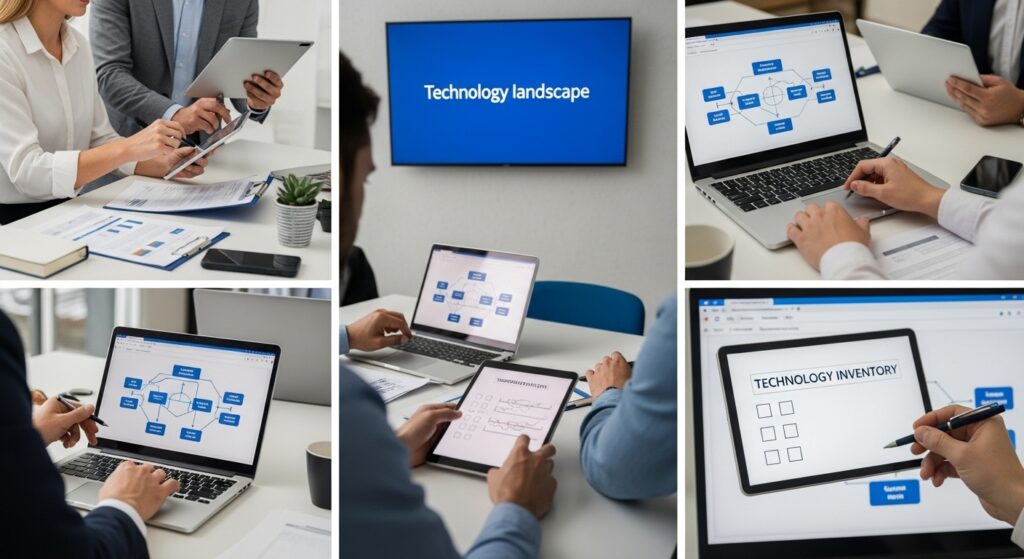
Every independent CPA in Miami knows that hitting ambitious revenue targets often comes down to the strength of your practice’s technology backbone. Without a clear view of your current systems and assets, critical growth opportunities can slip through your fingers. By focusing on a thorough assessment of your technology infrastructure, you position your accounting firm to identify gaps, avoid hidden costs, and lay the groundwork to reach those 7 to 8 figure monthly revenue goals.
Table of Contents
- Step 1: Assess Current Technology Infrastructure
- Step 2: Set Actionable It Budgeting Goals
- Step 3: Allocate And Prioritize Technology Investments
- Step 4: Verify Budget Effectiveness And Refine Strategies
Quick Summary
| Key Point | Explanation |
|---|---|
| 1. Assess Current Technology | Create a comprehensive inventory of all hardware, software, and processes to understand your current infrastructure’s strengths and weaknesses. |
| 2. Set Clear IT Budget Goals | Define specific, measurable IT goals aligned with business objectives to ensure that spending leads to tangible outcomes. |
| 3. Prioritize Technology Investments | Categorize investments into must-haves, strategic, and nice-to-have to effectively allocate your budget and resources. |
| 4. Measure Project Effectiveness | Continuously track the metrics of each project monthly to ensure they deliver expected results and adjust strategies as needed. |
| 5. Build in Contingencies | Allocate 10-15% of your budget for unexpected costs to ensure smooth project execution and avoid funding interruptions. |
Step 1: Assess current technology infrastructure
You can’t improve what you don’t measure. Before you spend a single dollar on new technology, you need to understand exactly what you currently have running your practice. This means looking at every system, every application, every device, and every process that supports your accounting work.
Start by creating a simple inventory of your technology assets. Walk through your office and your team’s day-to-day work, then document what’s actually being used.
Your inventory should include:
- Hardware devices like computers, servers, printers, and backup systems
- Software applications and licenses your team relies on daily
- Network infrastructure including routers, switches, and internet connectivity
- Cloud-based platforms for data storage, accounting software, and client communication
- Security tools like firewalls, antivirus software, and password managers
- Mobile devices and remote access capabilities
Next, assess the actual performance of each system. Ask your team direct questions about what’s slowing them down. Are they waiting for software to load? Does the internet connection drop during critical work? Are outdated systems creating manual workarounds?
Your current technology infrastructure either enables your growth or limits it. You can’t fix what you don’t understand.
Evaluate the age and condition of your equipment. Technology that’s more than five years old typically costs more to maintain than replace. Hardware failures become more frequent, software updates stop being supported, and security vulnerabilities multiply. When assessing infrastructure capacity for your practice, identify which systems are approaching end-of-life and which are performing reliably.
Document any gaps between what you need and what you have. Are you manually handling tasks that could be automated? Do you lack backup systems? Is your security falling short of what clients expect? These gaps become your roadmap.
Finally, talk to your clients about their expectations. Modern clients expect secure file sharing, real-time updates, and mobile access to their tax information. If your current infrastructure can’t deliver these things, you’re losing competitive advantage.
Pro tip: Document everything in a single spreadsheet with purchase dates, license expiration dates, and annual costs. This inventory becomes invaluable when planning your IT budget and shows you exactly where your money is going right now.
Here is a summary of technology asset factors to evaluate during your infrastructure assessment:
| Technology Area | Key Evaluation Focus | Business Impact |
|---|---|---|
| Hardware devices | Age, reliability, performance | Avoid service interruptions, reduce costs |
| Software applications | Support, licensing, updates | Enable automation, reduce errors |
| Security tools | Threat coverage, compliance | Protect client data, reduce risk |
| Network infrastructure | Speed, uptime, capacity | Maintain productivity, support remote work |
| Cloud platforms | Accessibility, scalability | Enhance collaboration, meet client expectations |
Step 2: Set actionable IT budgeting goals
Now that you understand what you have, it’s time to decide what you actually want to achieve. Vague goals like “improve technology” won’t move the needle on your revenue. You need specific, measurable targets that directly connect to your bottom line.
Start by identifying your primary business objectives for the next 12 months. Are you trying to land bigger clients? Scale your team without hiring more people? Reduce the time your accountants spend on manual work? Each goal shapes your IT budget differently.
Your goals should include:
- Revenue targets you want to hit and how technology enables them
- Efficiency gains like reducing client onboarding time from two weeks to three days
- Risk reduction through better security or compliance automation
- Client satisfaction improvements through faster turnaround or better communication
- Team capacity gains by eliminating repetitive tasks
Once you have your business goals, translate them into specific IT targets. Setting clear, measurable goals7/en/pdf) tied to budget allocations helps you spend money strategically instead of reactively. For example, if your goal is to land five new clients worth $500,000 in revenue, your IT goal might be implementing client portals and automating tax document requests.
Your IT budget should serve your business goals, not exist for its own sake. Every dollar you spend should have a measurable outcome attached to it.
Be realistic about what you can accomplish with your current resources. A practice with $200,000 in annual IT budget has different opportunities than one with $50,000. Defining clear priorities and setting a realistic fiscal resource envelope ensures your goals match your actual spending capacity.
Create a timeline for each goal. Some objectives require immediate investment, while others phase in over the year. A security upgrade might happen in quarter one, while staff training happens in quarter two.
Finally, assign accountability. Who is responsible for each goal? Without ownership, goals become wishful thinking instead of actionable plans.
Pro tip: Write your goals down in a simple document with the business outcome, the IT solution needed, the timeline, the budget, and who owns it. Review this quarterly and measure actual progress against what you planned.
This table offers a quick reference for aligning IT budgeting goals with strategic outcomes:
| Business Goal | Example IT Initiative | Measurable Outcome |
|---|---|---|
| Increase revenue | Implement client portal | $500K new client revenue |
| Boost efficiency | Automate document workflows | Reduce onboarding from 2 weeks to 3 days |
| Reduce risk | Advanced security software | Fewer security incidents |
| Enhance client satisfaction | Real-time client updates | Higher client feedback scores |
Step 3: Allocate and prioritize technology investments
You have your goals. Now comes the hard part: deciding which technology investments get funded and which ones wait. Not everything can happen at once, and spreading your budget too thin across too many projects guarantees that nothing gets done well.

Start by categorizing your technology needs into three buckets. First, there are must-have investments that keep your practice running. If your servers are failing, that’s urgent. If your accounting software is no longer supported by the vendor, that’s urgent. These things cannot wait.
Second, there are strategic investments that directly support your revenue goals. If your goal is to land bigger clients, a client portal and real-time reporting dashboard might be strategic. These projects move the needle on your business objectives.
Third, there are nice-to-have investments that would be convenient but aren’t critical. These go on a waiting list.
Your allocation framework should look like this:
- 40 to 50 percent of budget for critical infrastructure and security
- 30 to 40 percent for strategic growth initiatives
- 10 to 20 percent for efficiency improvements and staff tools
Within each category, rank projects by impact and urgency. Strategically allocating IT investments to support long-term agility means balancing what you need now with what positions you for future growth.
The best technology investment is the one that gets completed and actually used. Half-finished projects waste money and frustrate your team.
Consider dependencies carefully. Some projects must happen before others. You can’t implement a new accounting system and a client portal simultaneously if they need to integrate. Sequence your investments logically.
Also think about your team’s capacity to absorb change. If you roll out five major technology projects in the same quarter, your staff becomes overwhelmed. Spread significant implementations across quarters so your team can adapt and master each tool.
Finally, build in 10 to 15 percent contingency. Something always costs more than expected or takes longer than planned. Having financial buffer prevents good projects from derailing.
Pro tip: Create a simple spreadsheet with each project, its category, its ranking, its budget, its start date, and its expected completion date. This becomes your investment roadmap and keeps everyone aligned on what is happening when.
Step 4: Verify budget effectiveness and refine strategies
Your budget is deployed, your projects are running, and money is being spent. But is it actually working? Most CPAs never look back to measure whether their technology investments delivered what they promised. That’s a critical mistake that costs you thousands in wasted spending.
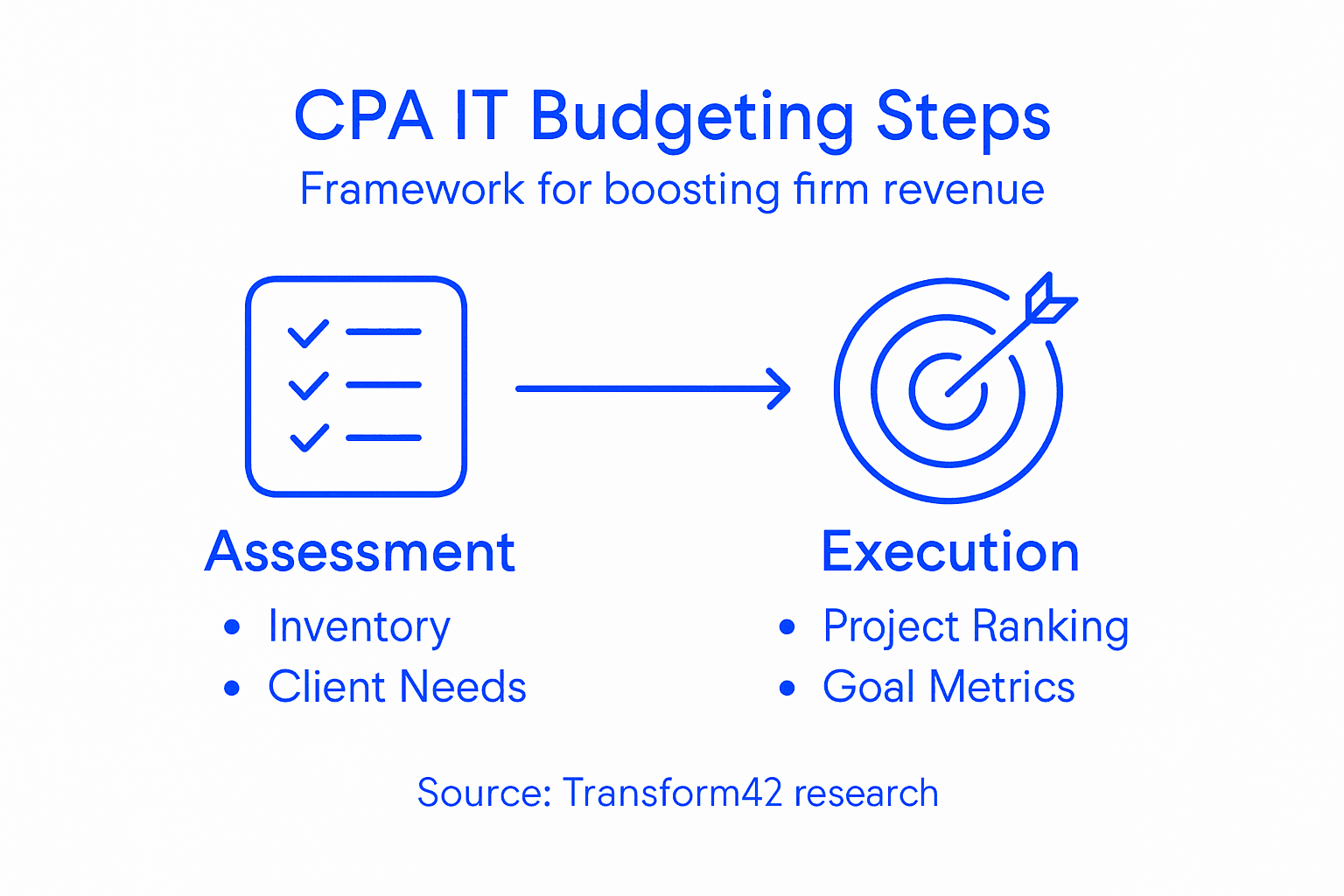
Measurement starts with clear metrics for each project. Before you started a project, you should have defined success. Did you want to reduce client onboarding time by 30 percent? Track it. Did you want to cut manual data entry by half? Measure it. Did you want to land three new enterprise clients? Count them.
Collect data monthly, not annually. Monthly tracking lets you catch problems early. If a project is underperforming by month two, you can adjust course. Waiting until year-end means you’ve already wasted eleven months of budget.
Your measurement dashboard should track:
- Time savings achieved compared to your goals
- Client satisfaction scores and feedback
- Revenue impact from new capabilities
- Staff adoption rates and training effectiveness
- Security incidents and compliance status
- Cost per transaction or per client served
Verifying IT budget impact against strategic objectives7/en/pdf) ensures your spending actually drives results. When you see data showing that a project is working, celebrate it. When data shows a project is failing, kill it before you waste more money.
Numbers don’t lie. If you’re not measuring results, you’re just hoping your technology investments work.
Use your monthly results to refine your strategy quarterly. If client portal adoption is low, you might need more training or a simpler interface. If a new automation tool isn’t delivering time savings, investigate why your team isn’t using it.
Evidence-informed decision-making means adjusting your approach based on what the data tells you, not what you hoped would happen.
Also budget for ongoing optimization. Technology doesn’t perform optimally on day one. You need resources for training, troubleshooting, and fine-tuning. Plan for 10 to 15 percent of your annual IT budget to be dedicated to making existing systems work better.
Pro tip: Create a simple one-page dashboard showing your five most important metrics each month. Share it with your leadership team. This keeps everyone focused on results instead of just activity, and it makes problems impossible to ignore.
Unlock Your CPA Firm’s Growth with a Trusted Technology Partner
Struggling to turn strategic IT budgeting into real revenue growth? This article highlights common challenges like unclear budgeting goals, poor technology infrastructure, and difficulty prioritizing investments that stall CPA firms from landing bigger clients and scaling efficiently. If you want to transform these pain points into competitive advantages you need a partner who understands how to build your firm’s technology capabilities and compliance requirements.
At Transform42 we help Accountants like you build all your technology in one partner. Our tailored solutions help you automate manual workflows, secure client data, and deliver the real-time access modern clients expect. Take control of your IT budget with actionable goals and expert planning to scale without proportional hiring and reclaim your time. Ready to move beyond wishful thinking and make every technology investment count? Visit Transform42 IT Solutions and discover how to align your technology with strategic growth now.
Frequently Asked Questions
How can I assess my current technology infrastructure to boost CPA revenue?
To assess your current technology infrastructure, create an inventory of all hardware devices, software applications, and security tools your practice uses. Examine their performance, age, and condition to identify any gaps that may be limiting your efficiency or client satisfaction.
What actionable IT budgeting goals should I set to increase CPA revenue?
Set specific, measurable goals that align with your primary business objectives, such as reducing client onboarding time or enhancing client satisfaction. For instance, aim to reduce onboarding from two weeks to three days within 12 months, which can lead to increased revenue.
How should I prioritize technology investments within my IT budget?
Categorize your technology needs into three buckets: must-have investments, strategic investments, and nice-to-have investments. Allocate 40 to 50 percent of your budget for critical infrastructure and security, and make a plan to implement these projects in a logical sequence to maximize your practice’s operational efficiency.
What metrics should I track to verify the effectiveness of my IT budget?
Track metrics such as time savings, client satisfaction scores, and staff adoption rates to measure the effectiveness of your IT investments. Collect data monthly to catch any issues early and adjust your strategies as necessary, ensuring your investments drive the intended results.
How can I refine my IT budgeting strategy over time?
Refine your IT budgeting strategy by reviewing your results quarterly based on the metrics you track. For example, if client portal adoption is low, consider implementing additional training or redesigning the interface to better meet team and client needs.
What percentage of my IT budget should I allocate for ongoing optimization?
Plan to dedicate 10 to 15 percent of your annual IT budget for ongoing optimization efforts. This includes resources for training, troubleshooting, and fine-tuning existing systems to ensure they continue to perform optimally over time.