TL;DR:
- Strategic IT planning aligns technology decisions with long-term business goals to boost revenue.
- Without it, firms face high costs, security risks, and slow growth compared to strategic competitors.
- Regular audits, goal setting, and phased implementation help practices improve efficiency and scalability.
Miami’s independent doctors, lawyers, and accountants are leaving serious revenue on the table. Not because they lack skills or clients, but because their technology decisions happen in reactive bursts rather than through a deliberate plan. Cost overruns of 40-60% are common when firms skip structured IT planning, and the gap between high-growth practices and stagnant ones often comes down to one thing: strategy. This guide breaks down what strategic IT planning actually means, how it drives real revenue gains for Miami professionals, and the exact steps you can take to build a roadmap that works for your practice.
Table of Contents
- What strategic IT planning means for professionals
- How strategic IT planning drives revenue growth
- Key elements of an effective IT strategy
- How to apply strategic IT planning to your Miami practice
- Why most Miami professionals underinvest in IT strategy (and how to break the cycle)
- Ready to grow your Miami practice with strategic IT planning
- frequently asked questions
Key Takeaways
| Point | Details |
|---|---|
| Proactive planning pays | Strategic IT planning cuts costs and boosts revenue for Miami professionals. |
| ROI from technology | Over half of firms leveraging AI and IT strategy see measurable business growth. |
| Essential components | A complete IT plan covers security, innovation, budget control, and regular updates. |
| Action steps matter | Step-by-step implementation helps transform your practice faster and more safely. |
What strategic IT planning means for professionals
With the revenue opportunity in mind, you first need to understand what makes IT planning “strategic” rather than just operational. Strategic IT planning is not about buying new software or calling a technician when something breaks. It means making technology decisions based on your long-term practice goals, not just the crisis in front of you today.
For a Miami-based cardiologist, attorney, or CPA, this distinction matters enormously. Your revenue depends on client trust, operational efficiency, and the ability to scale services without hiring a full team for every new task. Technology is the lever that makes all three possible, but only when it is chosen and deployed intentionally.
Strategic IT planning impact typically involves three core phases:
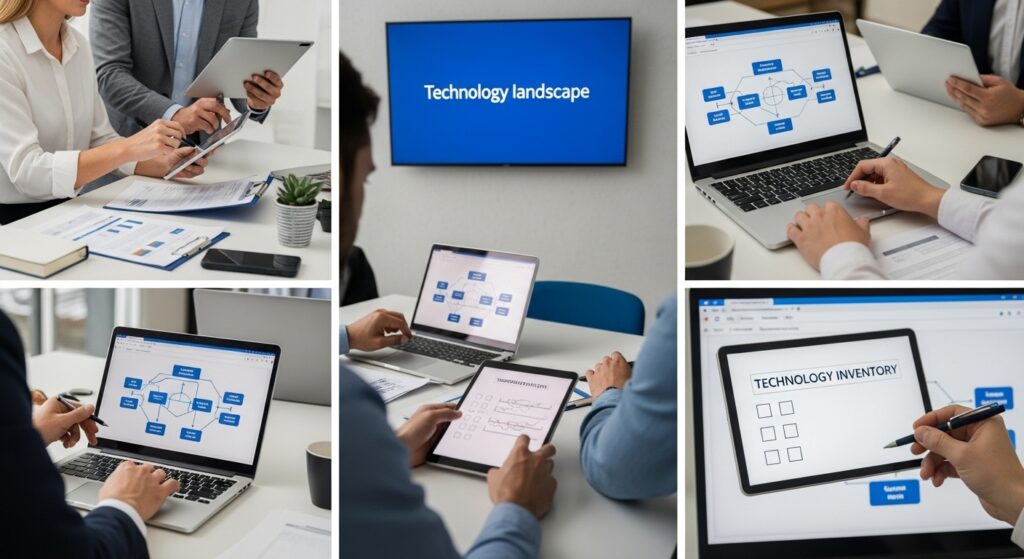
- Assessment: A thorough audit of your current systems, tools, and workflows to identify gaps, redundancies, and security risks.
- Goal alignment: Setting technology priorities that directly connect to your revenue targets, compliance requirements, and client experience goals.
- Technology roadmap: A written plan that sequences investments, timelines, and expected outcomes over 12 to 36 months.
The assessment phase alone tends to surface surprising findings. Many independent practices in Miami are paying for three overlapping tools that do the same job, while missing one affordable integration that would save hours each week.
“Planning proactively reduces costly overruns and boosts efficiency in professional practices, while reactive decision-making locks firms into a cycle of patching problems rather than building momentum.”
For IT services for law firms, strategic planning looks different than it does for a medical practice, but the framework is the same. Define where you want to go, identify the technology that gets you there, and build a prioritized sequence of actions.
The biggest misconception is that strategic IT planning is only for large enterprises. In reality, independent Miami professionals benefit even more because every dollar invested needs to produce a measurable return, and a clear plan ensures that happens.
How strategic IT planning drives revenue growth
Knowing what strategic IT planning means, let’s examine the real-world dividends for Miami’s doctors, lawyers, and accountants.
The connection between disciplined IT planning and revenue is direct. 53% of professional firms see a strong ROI from AI and technology investments when those investments are guided by a clear IT strategy. Without that strategy, the same tools often become expensive distractions.

Here is a snapshot of how strategic IT planning translates into financial outcomes:
| Practice type | Common IT investment | Revenue impact with strategy | Without strategy outcome |
|---|---|---|---|
| Law firm | Document automation | 30% faster case processing | Manual rework, billing gaps |
| Medical practice | Patient portal integration | Higher retention, fewer no-shows | Data silos, staff overtime |
| CPA firm | AI-assisted tax prep tools | More clients per staff member | Error-prone workflows |
For Miami professionals digital strategy to pay off, the approach needs to follow a logical sequence:
- Run a tech spending audit. List every software subscription, tool, and IT service you currently pay for. Calculate the actual cost per user and measure it against measurable output.
- Map workflows against bottlenecks. For each core service you deliver, trace the steps and find where time and money are lost. These are your highest-priority automation targets.
- Model your growth forecast. Project where you want your practice revenue to be in 24 months, then work backward to identify the technology capabilities you need to get there.
- Budget with ROI in mind. For digital consultancy for CPAs, every tool should be evaluated by what it returns, not just what it costs upfront.
Pro tip: Track the time your staff spends on repetitive administrative tasks for two weeks before your next planning cycle. That data becomes the foundation of your highest-ROI automation investments.
Practices that follow this approach do not just cut costs. They create capacity. More capacity means more clients, better service delivery, and the kind of reputation that attracts bigger cases, more complex accounts, and higher-value patients.
Key elements of an effective IT strategy
Understanding the “why” of IT planning makes it crucial to address the “how,” specifically what your strategy must cover to be effective.
A strong IT strategy for an independent Miami practice is not a single document. It is a living framework built on four core pillars:
- Risk management and cybersecurity: Small firms lag significantly in AI governance and cyber preparation compared to larger peers. For a solo attorney or a small medical group, one data breach can end client relationships permanently. Strong cybersecurity best practices need to be baked into your strategy from day one, not added later.
- AI and data adoption: Strategic use of AI in IT strategy means identifying which repetitive tasks in your practice can be automated, and which analytical functions can be enhanced by machine learning tools.
- Budget controls: Every IT investment should have a defined budget ceiling, an expected payback period, and a review date.
- Staff training and workflow integration: The best tools fail when people do not know how to use them. Training is not optional; it is part of the technology cost.
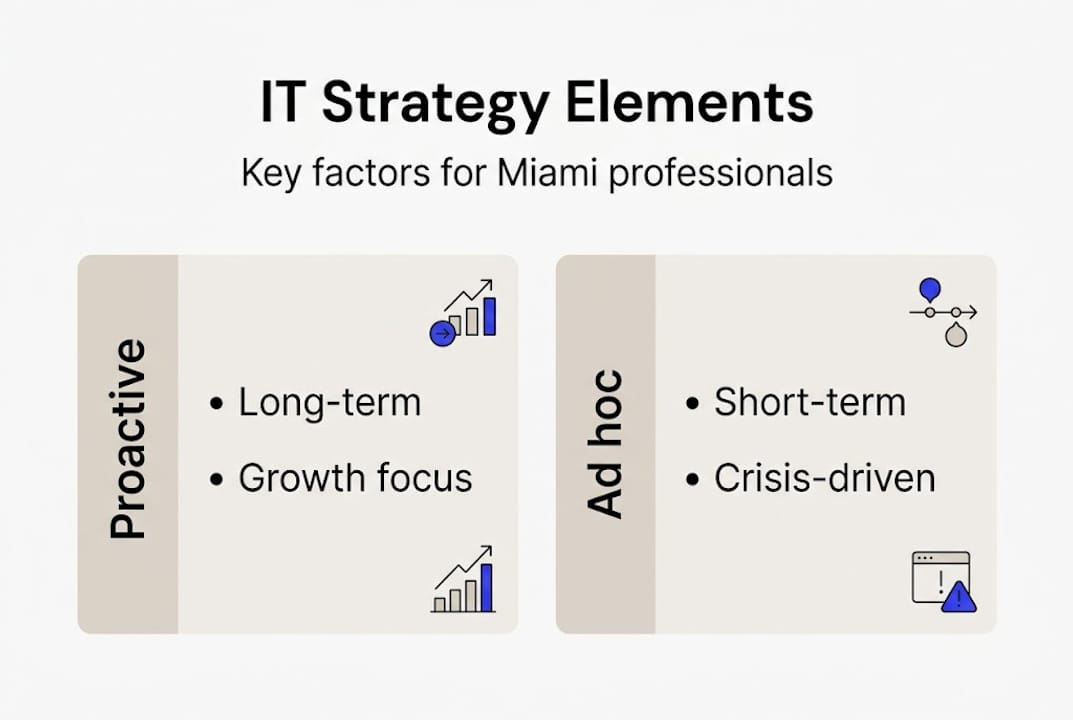
Here is a quick comparison of what separates proactive from reactive IT strategies:
| Factor | Strategic (proactive) | Ad hoc (reactive) |
|---|---|---|
| Decision basis | Long-term goals | Current emergencies |
| Cost control | Budget-driven, trackable | Variable, often inflated |
| Security posture | Built-in, regularly reviewed | Added after incidents |
| Tech debt | Low, actively managed | High, grows over time |
| Growth readiness | Built to scale | Often blocks scaling |
Pro tip: Schedule a quarterly IT strategy review, even if it is only 90 minutes. Review what changed in your practice, what technology gaps emerged, and whether your roadmap still aligns with your growth goals. This prevents tech debt from quietly stacking up.
How to apply strategic IT planning to your Miami practice
Now, let’s make the theory tangible and see how you can start or upgrade your strategic IT journey today.
The following roadmap is designed specifically for independent professionals in Miami who are ready to shift from reactive tech decisions to a structured approach:
- Document your current state. List every tool, system, and vendor you use today. Note costs, contracts, and what each tool is supposed to do versus what it actually does in practice.
- Define your 24-month revenue goal. Be specific. “I want to grow from $800K to $1.5M in annual revenue” is a goal. “I want to grow” is not. Your IT plan needs a target to be meaningful.
- Build your technology gap list. Compare what you have today against what you would need to hit that revenue goal. What capabilities are missing? What needs replacing? Use strategic IT budgeting frameworks to prioritize items by impact versus cost.
- Create a phased implementation timeline. Do not try to change everything at once. Phase one should address your biggest operational bottleneck. Phase two focuses on growth enablers. Phase three scales what is working.
- Train your team. For every tool you introduce, assign a staff lead, provide structured training, and set a 60-day adoption checkpoint.
- Track metrics and adjust. For essential IT services for accounting and medical or legal practices alike, track KPIs (key performance indicators) like time saved per workflow, cost per client served, and error rates before and after each technology change.
The most common missteps are skipping the audit step, underestimating training time, and failing to assign ownership for each IT initiative. Without proactive planning, firms risk 40-60% cost overruns and fall behind on critical technology adoption. With a plan, those same resources generate measurable growth.
Why most Miami professionals underinvest in IT strategy (and how to break the cycle)
Here is the uncomfortable truth. Most independent professionals in Miami are not avoiding IT strategy because they lack information. They are avoiding it because technology has historically felt like a cost, not a driver of growth. That belief is the real obstacle.
We have seen Miami practices transform their revenue once they stopped viewing IT as overhead and started treating it as a strategic asset. The shift is not about spending more. It is about spending intentionally. A $500 per month investment in the right automation tool can free up 10 billable hours per week. That is a return most financial instruments cannot match.
The myth that IT strategy is too complex or too expensive for a solo or small practice is simply wrong. A focused two-hour planning session with the right partner can produce a 12-month technology roadmap that pays for itself in the first quarter. High-performing Miami doctors, lawyers, and accountants are not necessarily the most tech-savvy. They are the ones who made a decision to treat technology as a growth engine and built a plan around that commitment.
Ready to grow your Miami practice with strategic IT planning
If you are ready to move from planning to action, professional support can make the process smoother and more effective.
We work with independent Miami doctors, lawyers, and accountants to build tech strategies for revenue growth that are practical, budget-conscious, and designed to scale. Whether you are starting your first IT roadmap or optimizing an existing one, we bring the structure, tools, and experience to make your technology investments pay off. If you want to know what top IT support looks like for a practice your size, we are ready to show you. Let’s build your roadmap together.
frequently asked questions
How does strategic IT planning differ from basic tech support?
Strategic IT planning aligns technology decisions with your long-term business goals, while basic tech support only addresses immediate problems. Without a plan, reactive decisions typically lead to higher costs and missed revenue opportunities.
Can strategic IT planning really improve my revenue?
Yes. Over half of professional firms see measurable ROI and practice growth when technology investments are guided by a proactive strategy. The key is connecting every tool to a revenue or efficiency outcome.
What risks do Miami professionals face without an IT strategy?
Practices without a structured IT plan are exposed to 40-60% cost overruns and are significantly behind on cybersecurity readiness and AI adoption compared to strategic peers.
What is the first step to start strategic IT planning?
Begin with a full audit of your current technology setup and a clear statement of your primary business goal. That combination gives you the baseline and the target your roadmap needs.
How often should IT strategy be reviewed?
Review your IT strategy at least once a year, or immediately following any major practice change such as adding a partner, expanding services, or moving to a new location.
Recommended
- Why Strategic IT Planning Boosts Revenue For Miami Pros
- Digital Strategy For Miami Pros: Grow Clients 40-70% In 2026
- Top Managed IT Examples For Miami Professionals: Boost Efficiency
- IT Service Desk Manager: Driving Miami CPA Growth
- What is an IT roadmap: strategic guide for Brisbane SMBs – IT Start