
TL;DR:
- Effective change management reduces failure risks and ensures technology adoption in Miami SMBs.
- Preparation, leadership buy-in, and tailored communication are key for successful organizational changes.
- External experts can streamline implementation and improve long-term results for small and medium-sized businesses.
Switching software platforms, restructuring workflows, or rolling out AI-powered tools sounds straightforward until your team resists, timelines slip, and revenue takes a hit. Miami’s small and medium-sized businesses face a particularly sharp version of this challenge. The city’s competitive professional services market moves fast, and when technology integration stalls, the cost compounds quickly. This guide walks you through a proven change management procedure, from initial planning and stakeholder alignment to execution, troubleshooting, and long-term measurement, so your next organizational shift actually delivers the results you need.
Table of Contents
- Why change management matters for Miami SMBs
- Preparing for change: Requirements and planning
- Executing a change management procedure: Step-by-step
- Troubleshooting and common pitfalls in change management
- Measuring success and making change stick
- Why most change management advice misses the real pain points for Miami SMBs
- Put effective change management into practice with expert support
- Frequently asked questions
Key Takeaways
| Point | Details |
|---|---|
| Preparation is essential | Investing time in planning and stakeholder buy-in makes later change much smoother. |
| Follow a clear process | A step-by-step procedure significantly increases technology project success rates. |
| Engagement reduces failure | Frequent communication and staff involvement prevent most change management setbacks. |
| Measure for lasting impact | Use technology to monitor results and reinforce the value of new practices. |
Why change management matters for Miami SMBs
Most business owners underestimate how disruptive change really is. They focus on the technology itself, the new ERP system, the automation platform, the AI integration tool, and assume that once it is installed, people will figure it out. That is rarely how it works.
Poorly managed change can increase failure rates by up to 70%. That number is not a scare tactic. It reflects what happens when organizations skip structured procedures and hope adoption happens on its own. For a Miami medical practice, law firm, or accounting office, a failed technology rollout does not just cost the price of the software. It costs staff time, client trust, and sometimes key personnel who quit out of frustration.
Here is what makes Miami’s business environment especially demanding:
- Cultural diversity in the workforce. Miami’s workforce spans dozens of cultural backgrounds, each with different communication norms and comfort levels with technology. A one-size approach to training consistently fails here.
- Competitive pressure from regional and national players. Larger firms are investing heavily in automation. Miami SMBs that lag in technology adoption lose clients to competitors who can serve them faster and at lower cost.
- Client expectations are rising. Patients, clients, and customers now expect seamless digital experiences. A clunky internal process always shows up on the outside.
- Staff retention challenges. Miami’s labor market in professional services remains tight. Poorly executed change increases turnover at exactly the wrong time.
The role of change management is not just to check boxes. It is to protect your investment in technology and keep your team moving in the same direction. Effective change management leads to faster adoption, lower costs, and measurable revenue improvement.
“Organizations that invest in structured change management are significantly more likely to meet project objectives, stay on schedule, and stay within budget.”
Effective change management tips consistently point to the same truth: process beats improvisation. When you build a repeatable procedure, every future change becomes less painful and less expensive.
Preparing for change: Requirements and planning
Before anyone flips a switch or attends a training session, your groundwork determines everything. Preparation is the phase most Miami SMBs rush, and it is the single biggest predictor of whether the change succeeds.
According to the change management guide for Miami firms, clear vision communication is the number one success factor in any change initiative. That means before you talk about timelines or tools, you need to be crystal clear on why the change is happening and what success looks like.
Use this checklist to assess your readiness:
| Requirement | Questions to answer | Status |
|---|---|---|
| Stakeholder identification | Who is affected? Who has influence? | Complete / Pending |
| Clear objectives | What does success look like in 90 days? | Complete / Pending |
| Resource allocation | Budget, staff time, training materials ready? | Complete / Pending |
| Leadership buy-in | Are department heads aligned and visible? | Complete / Pending |
| Readiness assessment | Have you surveyed team comfort with the change? | Complete / Pending |
| Communication plan | Do people know what is happening and when? | Complete / Pending |
Leadership buy-in is non-negotiable. When staff see that senior partners, department heads, or practice managers are genuinely committed and not just approving from a distance, adoption accelerates. Conversely, if leadership signals ambivalence, resistance spreads fast.

Stakeholder analysis should go beyond identifying who is affected. Map out their likely concerns and their level of influence over others. In a medical practice, for example, the office manager and lead physician often carry more informal influence than the org chart suggests. Winning them early changes the entire trajectory.
Key preparation steps include:
- Conduct a readiness survey. Ask your team directly how they feel about the upcoming change. You will surface concerns early, before they become problems.
- Set measurable objectives. Vague goals like “improve efficiency” do not drive accountability. Specific targets like “reduce billing cycle time by 30% within 60 days” do.
- Identify your change champions. Every team has one or two people others trust. Recruit them into the process early and give them a role.
- Define resource limits. Know what budget, staff hours, and external support you have before committing to a timeline.
Pro Tip: Use a simple stakeholder mapping tool like a two-by-two grid plotting influence against openness to change. Those with high influence and low openness need your attention first. Bring them in early, ask for their input, and give them a way to shape the process. It converts resistance into ownership.
The professional services approach we use with Miami firms consistently confirms that preparation time pays back in faster execution and fewer costly missteps.
Executing a change management procedure: Step-by-step
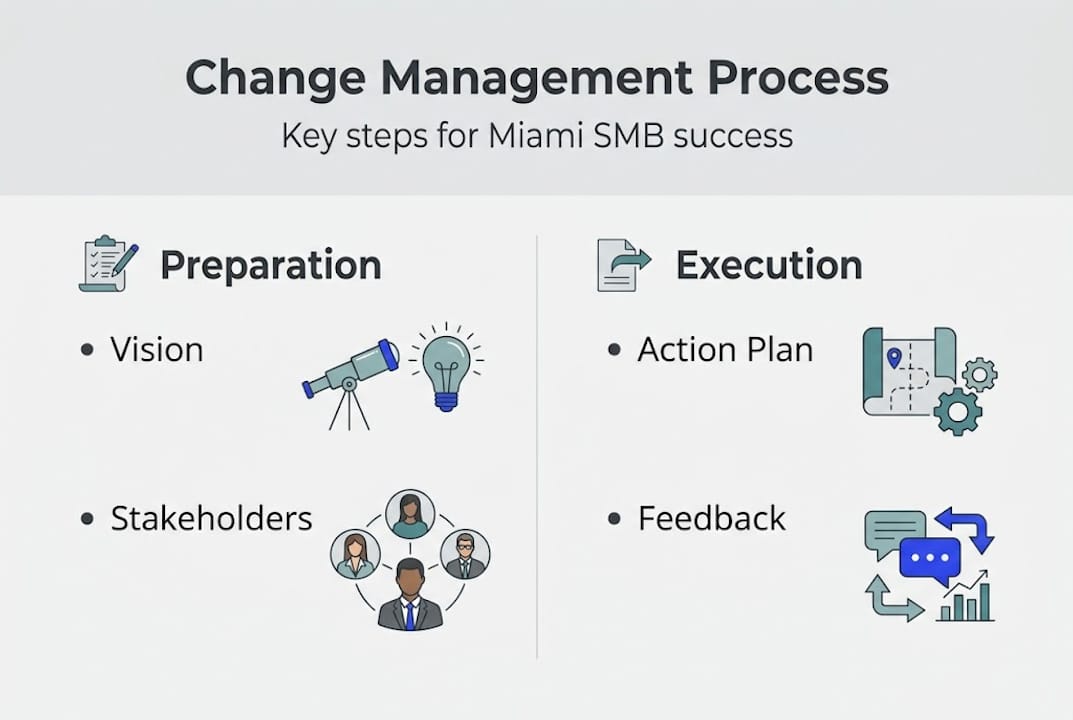
Once your preparation is solid, execution becomes far more predictable. Here is a proven, step-by-step procedure that works for Miami SMBs integrating technology or restructuring operations.
Following a structured procedure boosts adoption rates by over 60%. That is the difference between a rollout that stalls at 40% usage and one that achieves full team adoption.
- Communicate the why before the what. Launch with a clear message about the reason for the change, the benefits to the team, and the timeline. People accept change more readily when they understand the purpose.
- Assign clear ownership. Designate a change lead for each department or team. This person is the go-to resource for questions and the first signal of any resistance.
- Deliver role-specific training. Generic training wastes time. Tailor sessions to how each role will actually use the new system or process. A billing specialist needs different training than a client-facing coordinator.
- Run a pilot phase. Before full deployment, test the change with a small group. Capture real feedback and fix friction points before scaling.
- Deploy in phases. Roll out to the full organization in logical stages. This controls risk and lets you apply lessons from each phase.
- Monitor adoption actively. Track usage data, completion rates, and team sentiment weekly during the first 90 days. Do not wait for problems to surface on their own.
- Communicate progress regularly. Share wins. Acknowledge challenges. Keeping the team informed maintains momentum and reduces anxiety.
- Refine and iterate. Build in a formal review at 30, 60, and 90 days to adjust based on real data.
Here is how structured and ad hoc approaches compare across the metrics that matter most:
| Metric | Structured approach | Ad hoc approach |
|---|---|---|
| Time to full adoption | 60 to 90 days | 6 to 18 months |
| Staff morale impact | Positive, guided | Negative, confused |
| Budget overruns | Less common | Frequent |
| Outcome reliability | High, measurable | Unpredictable |
| Repeat failures | Rare | Common |
The change management process steps that work for CPAs and professional services firms in Miami share one consistent feature: they treat people as the primary variable, not technology. The tools matter, but how your team experiences the transition determines whether those tools ever deliver value.
Understanding digital change management specifically helps you plan for the added complexity that comes with technology-driven transitions, where learning curves and integration issues can derail even well-planned rollouts.
Troubleshooting and common pitfalls in change management
Even with solid preparation and a clear procedure, things go sideways. Knowing what to watch for, and how to respond fast, is what separates successful change leaders from those who spend months in recovery mode.
Up to 70% of change efforts fail due to lack of engagement and support. The causes are predictable, which means they are also preventable.
Common pitfalls to watch for:
- Skipping the communication plan. When people hear about changes through rumor rather than leadership, anxiety and distrust spike immediately.
- Underestimating training needs. One-hour orientation sessions rarely produce competent users. Ongoing, role-specific training is essential.
- Losing leadership visibility after launch. Leaders who disappear post-announcement send a signal that the change is not truly a priority.
- Ignoring early resistance signals. What looks like minor grumbling in week one often becomes open refusal by week four if left unaddressed.
- Declaring victory too early. Many organizations stop monitoring after the first 30 days. Sustained adoption requires sustained attention.
- Neglecting cultural agility. In Miami’s diverse workforce, change communication that works for one group may land differently with another. Adaptability in messaging is not optional.
Pro Tip: When you detect employee pushback, act within 48 hours. Schedule a small-group conversation, not a mass email. Ask what specific concerns they have. Acknowledge what you do not yet know. Resistance almost always shrinks when people feel heard. Silence from leadership amplifies it. Use practical change management tips to build a fast-response protocol before you need it.
To regain momentum after a stall, restart with a visible, specific win. Identify one part of the change that is working and publicize it internally. Momentum is contagious. When people see progress, they want to be part of it.
Measuring success and making change stick
Implementation is not the finish line. The real measure of a successful change management procedure is whether the change holds six months later. Most organizations focus entirely on launch and then wonder why old habits creep back in.
Adoption is highest when outcomes are measured and communicated regularly. That means you need a clear set of metrics from day one, not as an afterthought.
Key metrics to track:
- Revenue impact. Is the change contributing to faster billing, shorter sales cycles, or higher client retention? Tie process changes to revenue wherever possible.
- Process speed. Measure the time to complete key tasks before and after the change. A 25% reduction in client onboarding time, for example, is a concrete, trackable win.
- Employee satisfaction scores. Use brief pulse surveys every 30 days during the adoption period. Track how comfort levels shift over time.
- System usage rates. For technology integrations, measure actual login and usage frequency. Low usage is an early warning sign, not a post-mortem finding.
- Error and rework rates. If the new process is working, error rates should decline within 60 days. Rising errors signal a training or design problem.
Best practices for post-implementation review:
- Hold a structured debrief at 90 days with all department leads present.
- Document what worked and what did not. Build this into your institutional knowledge so future changes benefit from the lessons.
- Recognize team members who drove adoption. Public acknowledgment reinforces the behaviors you want to see repeated.
- Update your standard operating procedures to reflect the new state. Written documentation prevents backsliding.
Technology tools play a major role in sustaining change. Project management platforms, automation dashboards, and real-time reporting systems keep accountability visible. When everyone can see the data, the change becomes part of daily operations rather than an initiative that fades.
Why most change management advice misses the real pain points for Miami SMBs
Here is what frustrates us about the standard change management playbooks: they were written for large enterprises with dedicated HR teams, six-figure training budgets, and change management offices. Miami SMBs are working with lean teams, real budget constraints, and staff who wear multiple hats every day.
Generic procedures skip two things that matter enormously here. First, they ignore Miami’s workforce diversity. Communication strategies built for a homogeneous team often fall flat in an environment where cultural backgrounds, languages, and professional norms vary widely across the same office. Change communication needs to be adapted at the team level, not broadcast from the top.
Second, standard advice consistently underweights the frontline employee experience. Your front desk coordinator or billing specialist often sees friction points weeks before leadership does. Smart Miami change management insights come from actually listening to those people and building feedback loops into the procedure from day one.
The firms that consistently succeed treat change management as a people strategy first and a project plan second. Copy the structure, but localize everything else.
Put effective change management into practice with expert support
Managing change while running a busy practice is genuinely hard. Most Miami doctors, attorneys, and accountants do not have a dedicated operations team to lead these initiatives. That is exactly where the right technology partner changes the equation.
We help professional services firms in Miami integrate technology solutions that work from day one, not after months of painful trial and error. Our digital transformation services are built around your workflow, your team, and your growth targets. Whether you are rolling out your first ERP or scaling automation across your practice, we bring the structure, the tools, and the hands-on support to make it stick. Visit our Miami IT consulting page to see how we work and take your next step.
Frequently asked questions
What are the most important steps in a change management procedure?
Key steps in change management involve communication, engagement, and measurement. Start with clear goal-setting, then move through stakeholder alignment, training, phased execution, and regular outcome tracking.
How long does a typical change management procedure take for an SMB?
For most Miami SMBs, change management projects run 3 to 6 months from planning to full adoption, though complex technology integrations can extend that timeline depending on scope and team readiness.
Why do change efforts fail in small businesses?
Most failures stem from poor communication, missing leadership support, and underestimating how strongly employees resist unfamiliar processes. Up to 70% of change efforts fail due to lack of engagement and support, which is preventable with the right structure.
Can technology integration make change management easier?
Yes. The right technology tools streamline communication, create visible accountability through dashboards, and make it easier to track adoption rates and flag problems early before they stall the entire initiative.
Do I need outside consulting for my SMB’s change management?
Not always, but expert consultants reduce costly mistakes and compress the time to successful adoption, particularly for complex technology rollouts where the stakes are high and internal expertise is limited.