
TL;DR:
- Effective tech strategies align tools with clear business goals to drive revenue growth.
- Miami professionals see rapid ROI through deliberate, measured technology adoption and pilot testing.
- Ongoing measurement and security are essential to maximize benefits and avoid pitfalls.
Miami’s most successful doctors, lawyers, and accountants aren’t growing because they work harder. They’re growing because they work smarter, with technology aligned to clear revenue goals. Miami SMBs see up to 62% revenue growth with effective tech adoption, yet most small practices still treat technology as an afterthought. The assumption that tech strategy is reserved for large corporations is simply wrong. With the right approach, even a solo practitioner or a boutique firm can see 63% faster workflows, 3.9x ROI, and payback in under six months. This guide breaks down exactly how to get there.
Table of Contents
- What is a tech strategy and why it matters
- Core components of a revenue-driving tech strategy
- Tech strategy in action: Real gains for Miami doctors, lawyers, and accountants
- Measuring success and avoiding pitfalls
- Why strategy, not tools, separates growth leaders from the pack
- Next steps: Transform your practice with expert tech guidance
- Frequently asked questions
Key Takeaways
| Point | Details |
|---|---|
| Strategic alignment | Intentional tech strategy, not ad-hoc adoption, drives real revenue growth. |
| Incremental pilots work | Small, measurable tech pilots minimize risk and maximize ROI for Miami professionals. |
| Measure what matters | Track KPIs like payback period and cost savings to prove and sustain the value of tech investments. |
| Leverage local resources | Free Miami programs and tailored consulting amplify the benefits of a smart tech strategy. |
What is a tech strategy and why it matters
A tech strategy is not a list of software subscriptions. It is a deliberate plan that aligns your technology investments with your specific business goals, whether that means increasing billable hours, reducing overhead, or expanding your client base. Tech strategy aligns technology with business goals for measurable, trackable results.
Most small practices in Miami operate with ad-hoc tech adoption. A new tool gets added when someone recommends it, another subscription gets purchased to solve a one-time problem, and before long you have a cluttered stack of disconnected software that costs money without delivering clear returns. That is tech sprawl, and it quietly drains revenue.
Strategic deployment is different. Every tool serves a defined purpose, connects to a measurable outcome, and fits within a planned budget. The contrast is significant:
| Approach | Outcome | Risk level |
|---|---|---|
| Ad-hoc adoption | Unclear ROI, fragmented workflows | High |
| Strategic deployment | Measurable gains, aligned processes | Low |
| Incremental pilots | Controlled growth, fast learning | Very low |
Building a tech strategy follows a clear sequence:
- Assess your current digital maturity honestly
- Set goals tied to revenue, efficiency, or client satisfaction
- Select tools that directly serve those goals
- Implement with a defined rollout plan
- Monitor KPIs and adjust based on real data
“The firms that grow fastest are not the ones with the most tools. They are the ones who know exactly why each tool is there.”
Pro Tip: Start with a digital maturity assessment before spending a dollar on new technology. It reveals where your biggest gaps and opportunities actually are. Pairing this with strategic IT budgeting keeps your investment focused and purposeful.
Core components of a revenue-driving tech strategy
With a foundational understanding of what tech strategy means, let’s look at the essential building blocks that make it drive real-world revenue.
The starting point is always a digital maturity assessment. This is a structured review of how your practice currently uses technology across client communication, billing, document management, and internal workflows. It tells you where you stand and where the fastest gains are hiding.
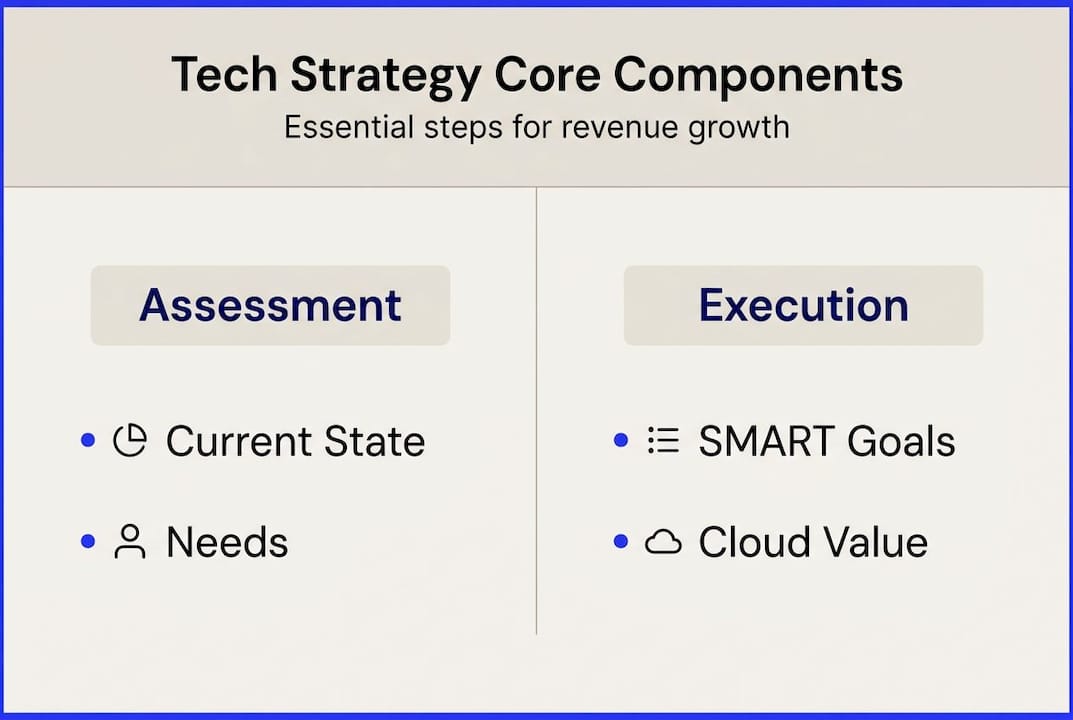
From there, you set SMART goals: Specific, Measurable, Achievable, Relevant, and Time-bound. For a law firm, that might mean reducing document turnaround time by 40% in 90 days. For an accounting practice, it could mean increasing cross-sold services to 30% of existing clients within two quarters. Key methodologies including digital maturity assessments, SMART goals, automation, AI, and incremental adoption consistently drive the strongest results.
Here is how major tech investments typically perform:
| Technology | Average ROI | Typical payback period |
|---|---|---|
| Workflow automation | 200-400% | 3-6 months |
| Cloud migration | 150-300% | 6-12 months |
| AI tools | 390% | Under 6 months |
| Client portals | 120-250% | 6-9 months |
The adoption sequence matters as much as the tools themselves:
- Pilot the tool with a small subset of clients or cases
- Measure the specific outcome you targeted
- Adjust based on what the data shows
- Scale only after the pilot proves the ROI
Cloud migration deserves special attention for Miami professionals. It enables mobility, supports remote consultations, and protects your practice from local disruptions like hurricane-related outages. Understanding the full IT budgeting process helps you prioritize which modernization steps deliver the fastest returns.

Pro Tip: Prioritize automation first. E-signatures, automated billing reminders, and intake forms have the fastest payback and the lowest implementation risk of any tech investment a small practice can make.
Tech strategy in action: Real gains for Miami doctors, lawyers, and accountants
Understanding the components is key, but seeing real-world wins brings tech strategy to life.
Law firms are seeing some of the sharpest gains. AI for document review increases efficiency by 63%, and practice management software consistently boosts revenue per client. When attorneys spend less time on repetitive document tasks, they have more capacity for billable work and client development.
Medical practices are benefiting from voice AI that transcribes clinical notes in real time, cutting documentation time dramatically. Telehealth platforms expand patient volume without adding physical space. Automated appointment reminders alone reduce no-shows by as much as 30%, which translates directly to recovered revenue.
Accounting firms are using secure client portals and advanced analytics to increase retention and identify cross-selling opportunities. When clients experience a seamless, professional digital interaction, they stay longer and refer more.
Miami-specific resources make this even more accessible. eMerge Americas SMB Growth Lab and CPA digital roadmaps are Miami-specific tech resources that local professionals can tap into right now. The city’s 5G infrastructure and growing tech ecosystem give Miami practitioners a real competitive edge.
Stat callout: 87.9% of tech projects deliver over 100% ROI. That is not a best-case scenario. That is the norm for firms that approach technology strategically.
- AI and automation tools reduce administrative overhead by 20-40%
- Client portals cut back-and-forth communication time significantly
- Cloud-based billing systems accelerate collections and reduce errors
- Telehealth and virtual consultations open new revenue streams
Pro Tip: Connect with local digital upskilling programs in Miami. eMerge Americas and similar initiatives offer workshops, grants, and peer networks that can accelerate your tech adoption at low cost. Explore workflow automation examples and automation strategies built specifically for Miami professionals.
Measuring success and avoiding pitfalls
The power of tech strategy is real, but only if you measure outcomes and avoid common traps.
The right KPIs for Miami professionals focus on revenue impact. Track increased billings per month, cost savings from reduced manual labor, client retention rates, and payback period for each tech investment. If a tool cannot be tied to at least one of these metrics, it probably does not belong in your stack.
AI adopters see 3.9x ROI, and 70% of projects break even in under six months. The math strongly favors action over hesitation.
The biggest risks come from reactive adoption. Buying tools in response to vendor pressure or peer recommendations, without a clear goal, creates tech sprawl and security issues that quietly undermine your ROI. Security blind spots are especially dangerous for doctors, lawyers, and accountants who handle sensitive client and patient data.
Here are the top five pitfalls and how to avoid them:
- Tech sprawl: Audit your stack quarterly and eliminate tools that do not serve a defined goal
- Poor alignment: Every tool must connect to a revenue or efficiency target before purchase
- Skipping pilots: Never roll out a new system firm-wide without a controlled test first
- Ignoring cybersecurity: Protecting client data is non-negotiable; build cybersecurity practices into every tech decision
- No measurement plan: Define your success metrics before implementation, not after
The best-performing practices treat tech strategy as an ongoing discipline, not a one-time project. Pilot, measure, adjust, and scale. Repeat that cycle and your revenue trajectory changes permanently.
Why strategy, not tools, separates growth leaders from the pack
Measuring success is critical, but it is worth stepping back to understand why some firms stay stuck while others surge ahead.
The technology market floods professionals with options every quarter. New AI tools, new platforms, new integrations. The temptation to chase the latest feature is real. But the firms that actually grow are not the ones with the most sophisticated software. They are the ones with the clearest strategy.
We have seen practices spend tens of thousands on enterprise-grade tools that sit underused because no one defined what problem they were solving. That is not a technology failure. That is a strategy failure. The tool was never the issue.
Incremental, measured pilots are not just safer. They are smarter. A 90-day pilot with clear KPIs teaches you more about your practice than any vendor demo ever will. It forces you to define success before you spend, and it protects your budget from expensive mistakes.
Miami’s growth leaders share one trait: they are obsessed with outcomes, not features. They ask “what revenue problem does this solve?” before they ask “what does this tool do?” That mindset shift, more than any specific technology, is what separates the firms scaling to seven and eight figures from the ones spinning their wheels. Partnering with specialists in IT consulting for revenue growth accelerates that shift significantly.
Next steps: Transform your practice with expert tech guidance
If you are ready to move from confusion to clarity, the good news is you do not have to figure this out alone.
We work exclusively with doctors, lawyers, and accountants in Miami to build tech strategies that drive real revenue growth. From automation and AI integration to cloud migration and compliance, we align every technology decision with your specific growth goals. Whether you need IT services for doctors, IT services for law firms, or business process services for Miami CPAs, we have the expertise and the local knowledge to help you act with confidence. Your next seven-figure revenue milestone starts with a strategy, not a software purchase.
Frequently asked questions
What is the first step in building a tech strategy for a small firm?
Begin by assessing your current digital maturity and identifying your key revenue goals. That assessment reveals your highest-impact opportunities before you spend anything.
How much should small businesses or practices invest in technology?
Experts recommend allocating 3 to 7% of annual revenue toward technology for the strongest results. The exact figure depends on your growth stage and current digital maturity.
Can tech upgrades really deliver ROI for small Miami firms?
Yes. 87.9% of tech projects deliver over 100% ROI, and 70% of AI investments see full payback within six months.
What are the top risks of tech strategy missteps for Miami professionals?
Reactive tool adoption leads to tech sprawl and security vulnerabilities that erode your returns and expose sensitive client data to unnecessary risk.