More than 50 percent of American accounting firms now experiment with Agile practices to accelerate their growth. Miami CPAs and firm owners face constant pressure to deliver faster results and deeper financial insights for local clients. Adopting Agile can turn unpredictable workloads into simple, repeatable actions that drive consistent results and higher revenue. This guide explains how small firms can use Agile to maximize efficiency and set the stage for 7-8 figure success.
Table of Contents
- Defining Agile for Accountants and CPAs
- Types of Agile Practices in Accounting
- How Agile Improves Firm Efficiency and Results
- Implementing Agile: Roles, Tools, and Workflows
- Compliance, Risks, and Common Pitfalls
Key Takeaways
| Point | Details |
|---|---|
| Agile Transforms Accounting | Agile methodology encourages accountants to shift from rigid processes to flexible workflows, enabling quicker adaptations to client needs. |
| Key Practices Include Scrum and Kanban | Scrum uses sprints for project-based work, while Kanban visualizes workflow for ongoing processes, enhancing efficiency and transparency. |
| Improved Risk Management | Agile allows accounting teams to conduct continuous risk assessments, enabling faster responses to financial issues and more strategic planning. |
| Defined Roles Enhance Efficiency | Clearly defined roles like Product Owner and Scrum Master in Agile teams foster collaboration and streamline project execution. |
Defining Agile for Accountants and CPAs
Agile isn’t just for tech teams anymore. For Miami accountants and CPAs, Agile methodology represents a transformative approach to delivering financial services and client work with unprecedented speed and precision. This revolutionary framework shifts traditional accounting practices from rigid, linear processes to dynamic, responsive workflows that adapt quickly to changing business environments.
At its core, Agile is about breaking down complex projects into smaller, manageable chunks and delivering value incrementally. For accounting professionals, this means moving beyond annual financial reports and static spreadsheets toward continuous value delivery that provides real-time insights and strategic recommendations. The Institute of Management Accountants highlights that Agile enables finance teams to accelerate transformation from mere data stewardship to active value creation.
Key principles of Agile for accountants include iterative work cycles, frequent client communication, and rapid adaptation. Instead of spending months preparing comprehensive financial analyses, Agile-driven CPAs can deliver targeted insights in weeks or even days. This approach allows accounting professionals to respond more quickly to client needs, leverage emerging technologies, and provide more strategic financial guidance. Agile auditing techniques are particularly powerful in helping firms stay competitive in a rapidly evolving business landscape.
Pro Tip: Start implementing Agile by breaking one major project into smaller two-week sprints and tracking your efficiency and client satisfaction throughout the process.
Types of Agile Practices in Accounting
Accounting firms in Miami are increasingly adopting diverse Agile methodologies to transform traditional financial workflows. These practices go beyond simple project management, fundamentally reshaping how financial professionals approach client services, reporting, and strategic planning. From Scrum to Kanban, accountants now have multiple frameworks to choose from that can dramatically improve efficiency and client responsiveness.

One prominent Agile approach is Scrum, which breaks financial projects into short, focused cycles called sprints. Accounting project management techniques emphasize iterative development, allowing CPAs to deliver incremental value rather than waiting months for comprehensive reports. These sprints typically last two to four weeks and involve daily stand-up meetings, sprint planning, and retrospective sessions that keep teams aligned and adaptable.
Another critical Agile practice is the Kanban method, which visualizes workflow using digital boards that track tasks from initiation to completion. According to the Institute of Management Accountants, finance transformation through agile practices enables teams to improve transparency, reduce bottlenecks, and quickly respond to changing client needs. Kanban boards help accounting teams limit work in progress, identify potential roadblocks, and continuously optimize their operational processes.
Pro Tip: Select one accounting process and map it using a digital Kanban board to immediately visualize your workflow and identify potential efficiency improvements.
Here’s a quick comparison of key Agile frameworks used in accounting:
| Framework | Core Principle | Typical Use Case | Business Impact |
|---|---|---|---|
| Scrum | Sprints and iterations | Project-based client work | Faster delivery of insights |
| Kanban | Visual task tracking | Ongoing accounting processes | Improved workflow transparency |
| Hybrid Agile | Combines methods | Regulatory or complex audits | Balanced flexibility and control |
How Agile Improves Firm Efficiency and Results
Miami accounting firms are discovering that Agile methodology is more than just a trendy buzzword – it’s a transformative approach to dramatically improving operational efficiency and client outcomes. By breaking away from traditional linear workflows, Agile empowers accounting professionals to deliver faster, more responsive, and more strategic financial services that directly address client needs in real time.
One of the most significant efficiency gains comes from continuous risk assessment and adaptation. Instead of waiting months to complete comprehensive audits, Agile accounting teams can quickly identify and respond to emerging financial risks, providing clients with more timely and actionable insights. This approach reduces wasted effort, minimizes potential financial complications, and allows firms to allocate resources more strategically.
Moreover, Agile methodologies enhance collaboration and decision-making across finance teams. Flexible planning and tailored solutions enable accounting professionals to break down complex financial projects into manageable sprints, improving transparency and reducing communication bottlenecks. By implementing regular check-ins and iterative review processes, firms can continuously refine their approaches, leading to higher-quality deliverables and more satisfied clients.
Pro Tip: Implement a weekly 30-minute team retrospective to identify inefficiencies and brainstorm immediate improvements in your accounting workflows.
Implementing Agile: Roles, Tools, and Workflows
Successful Agile implementation for Miami accounting firms requires understanding the key roles, specialized tools, and strategic workflows that transform traditional financial processes. By embracing a structured yet flexible approach, accounting teams can create more responsive and efficient organizational systems that deliver exceptional value to clients.
The foundation of Agile implementation lies in defining critical team roles. Project management in accounting teams typically involves three primary positions: the Product Owner, who sets strategic priorities and represents client interests; the Scrum Master, who facilitates team processes and removes obstacles; and cross-functional team members who collaborate on delivering incremental financial solutions. These roles work together to break down complex accounting projects into manageable sprints, ensuring continuous progress and adaptability.
Below is a summary of essential Agile roles and their responsibilities for accounting teams:
| Role | Main Responsibility | Impact on Accounting Outcomes |
|---|---|---|
| Product Owner | Sets priorities, connects with clients | Aligns services to client needs |
| Scrum Master | Facilitates process, removes obstacles | Ensures efficient workflows |
| Team Member | Delivers financial solutions, collaborates | Maintains steady project progress |
Agile workflows leverage specific tools to enhance transparency and productivity. Burn-down charts track project progress, sprint backlogs prioritize tasks, and iterative review processes enable real-time adjustments. By implementing digital collaboration platforms and visualization tools, accounting firms can create more dynamic work environments that respond quickly to changing client needs and market conditions. These technological supports enable teams to maintain high-quality standards while increasing operational speed and flexibility.
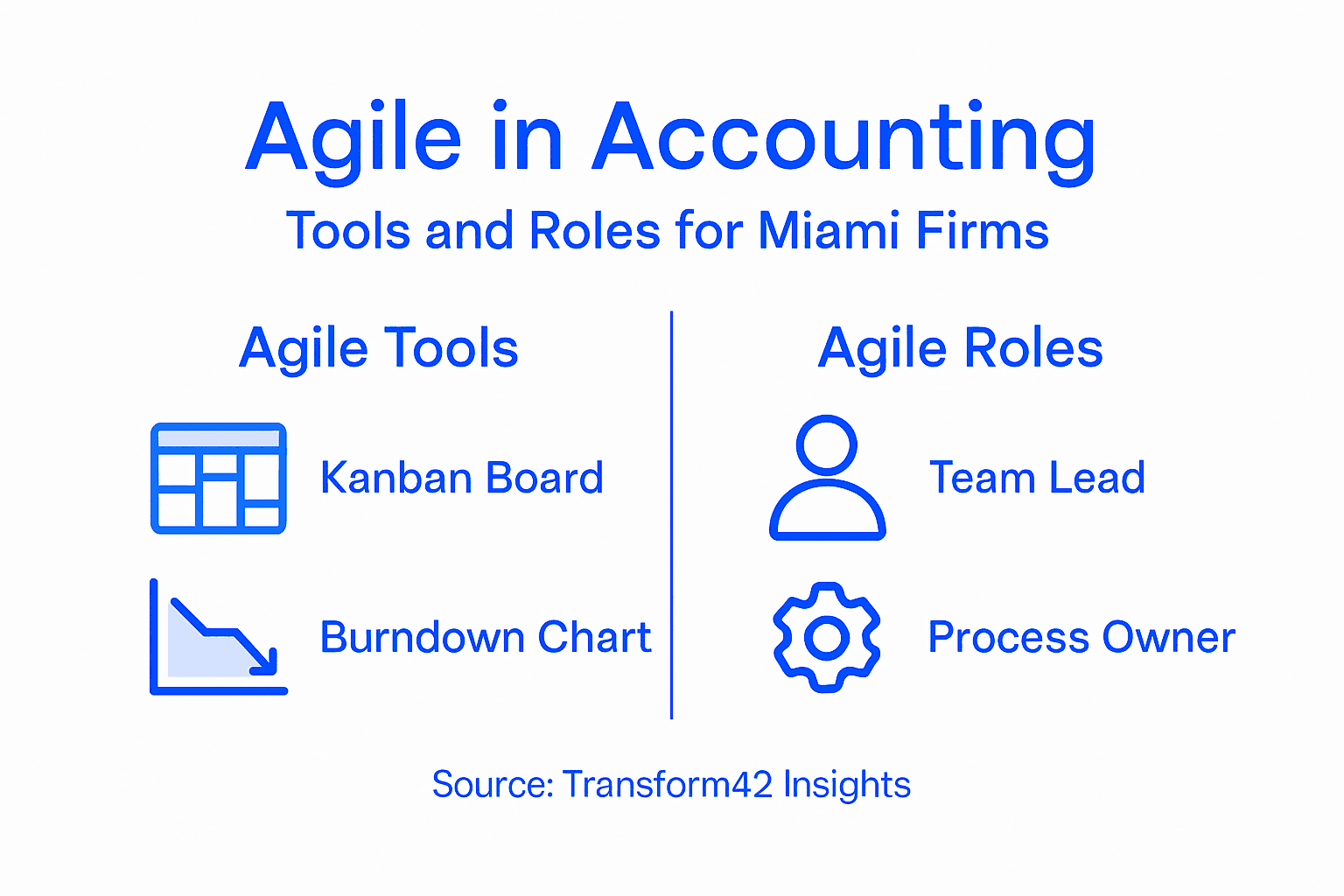
Pro Tip: Start your Agile transformation by mapping one complex accounting process and identifying specific pain points where iterative workflows could immediately improve efficiency.
Compliance, Risks, and Common Pitfalls
Agile methodologies bring transformative potential to accounting practices, but they also introduce unique compliance challenges that Miami firms must navigate carefully. Implementing Agile requires a nuanced understanding of regulatory requirements and proactive risk management strategies to ensure both operational flexibility and legal adherence.
Risk management in Agile projects demands a sophisticated approach that integrates enterprise risk practices with innovative delivery techniques. Accounting teams must develop adaptive frameworks that allow for frequent releases and short sprint cycles while maintaining rigorous compliance standards. Common pitfalls include insufficient management commitment, lack of clear strategic goals, and inadequate risk identification processes that can expose firms to significant operational and legal vulnerabilities.
Accounting professionals must also recognize that Agile compliance is not a one-size-fits-all solution. Disciplined Agile approaches require tailored lifecycle processes that blend traditional governance practices with flexible, goal-driven methodologies. This means developing hybrid strategies that incorporate regulatory requirements like PCI or industry-specific standards while maintaining the iterative, responsive nature of Agile workflows. Success depends on creating a culture of continuous risk assessment and transparent communication across all organizational levels.
Pro Tip: Conduct a monthly compliance audit of your Agile processes, documenting how each sprint aligns with regulatory requirements and identifying potential risk mitigation strategies.
Unlock Agile Success for Miami Accountants with Strategic Technology Partnership
The article highlights the challenges Miami accountants face when adopting Agile methodologies such as managing iterative workflows, accelerating project delivery, and maintaining compliance. If you want to land bigger clients while scaling operations without proportional hiring, embracing Agile is key. However, to truly harness its benefits and enhance your firm’s efficiency, you need a trusted technology partner who understands both the finance landscape and Agile principles.
At Transform42, we specialize in empowering Miami accountants with tailored digital solutions that build the capabilities and compliance your clients demand. Explore our insights on Digital-transformation Archives to see how technology drives Agile success. Leadership plays a crucial role in this journey, so check out our Leadership Archives for strategies to lead Agile adoption effectively. Partner with us at Transform42 to start scaling your firm with confidence and reclaim your time now.
Frequently Asked Questions
What is Agile methodology in accounting?
Agile methodology in accounting is a transformative approach that focuses on delivering financial services in smaller, manageable chunks, allowing for quick adaptations and continuous value delivery, rather than relying on rigid, linear processes.
How can Agile improve efficiency for accountants?
Agile improves efficiency by breaking down projects into short sprints, enabling continuous client communication, and allowing rapid responses to emerging financial risks, which leads to timely, strategic insights.
What are the key principles of Agile for accounting professionals?
Key principles of Agile for accounting include iterative work cycles, frequent client interactions, rapid adaptation to change, and delivering incremental value rather than comprehensive reports all at once.
How can accounting firms implement Agile practices effectively?
Accounting firms can implement Agile practices by defining key roles (such as Product Owner and Scrum Master), utilizing specialized tools like Kanban boards and digital collaboration platforms, and mapping workflows to identify areas for improvement.