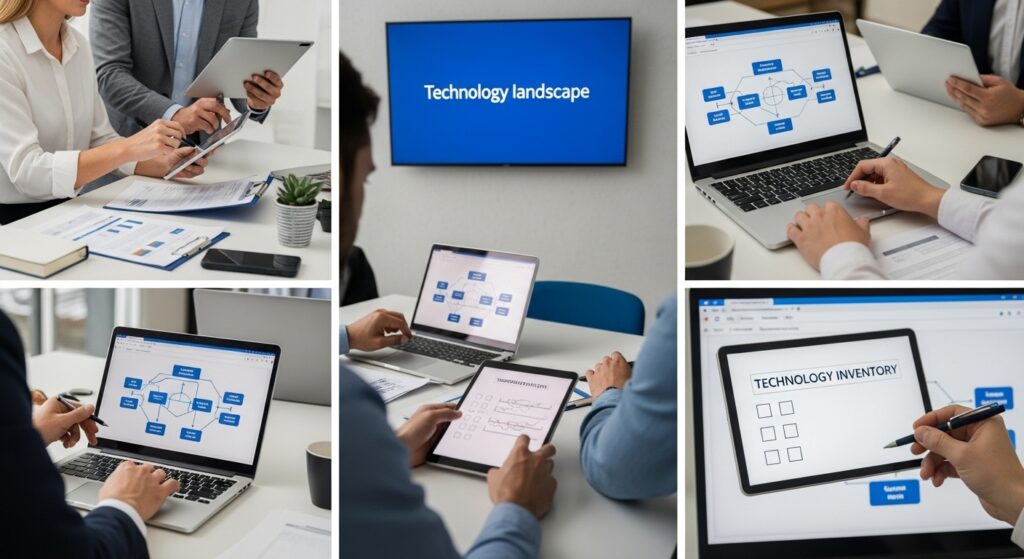
Independent CPAs, tax professionals, doctors, and lawyers in Miami face mounting pressure to scale revenue without proportional hiring. Technology consulting offers a strategic advantage, yet many believe it’s only for large enterprises. In reality, law firms achieved up to 300% productivity increases through targeted tech consulting. This guide explains what technology consulting is, why it matters for your practice, and how to apply it effectively to unlock seven to eight figure revenue growth while maintaining compliance and professional craftsmanship.
Table of Contents
- Key takeaways
- Understanding technology consulting: core services and benefits
- Nuances and challenges: choosing the right technology approach for your practice
- Applying technology consulting to grow your Miami practice
- How Transform42 can help Miami professionals leverage technology consulting
- Frequently asked questions about technology consulting
Key Takeaways
| Point | Details |
|---|---|
| Core consulting services | Strategy, workflow automation, cybersecurity, and AI tools align technology investments with revenue growth objectives. |
| Law firm productivity gains | Law firms have seen up to 300 percent productivity increases and significant cost reductions through targeted tech consulting. |
| Customization versus off the shelf | Choosing between tailored software and ready-made solutions remains a strategic decision that affects cost and fit. |
| Human plus AI collaboration | Effective technology consulting blends AI automation with professional judgment to improve quality while expanding capacity. |
Understanding technology consulting: core services and benefits
Technology consulting helps independent professionals align their technology investments with business growth objectives. Unlike basic IT support that fixes computers, consulting transforms how your practice operates. For Miami CPAs, doctors, and lawyers, this means identifying revenue cycle bottlenecks, automating repetitive tasks, and implementing AI tools that amplify your expertise rather than replace it.
Core methodologies include technology strategy consulting, workflow automation, cybersecurity, revenue cycle optimization, and AI tools. Strategy consulting examines your current technology stack and maps it to your three-year revenue goals. Workflow automation eliminates manual data entry, document processing, and client communication delays. Cybersecurity protects sensitive client information while meeting HIPAA and legal compliance standards. Revenue cycle optimization identifies where money leaks from your practice through billing errors, missed follow-ups, or inefficient collections.
Law firms achieved up to 300% productivity increase and 65% cost reduction with tech consulting. These aren’t hypothetical gains. Legal practices using AI-powered contract review, automated discovery, and intelligent document management saw dramatic improvements in billable hours and client capacity. One firm reduced contract review time from eight hours to ninety minutes while improving accuracy.
Accountants benefit similarly through automated tax preparation workflows, real-time financial dashboards for clients, and AI-powered anomaly detection in bookkeeping. Medical practices gain from intelligent scheduling systems that reduce no-shows by 40%, automated insurance verification, and AI billing assistants that catch coding errors before submission.
“The future belongs to those who combine AI in consulting with professional judgment. Technology handles repetitive analysis while you focus on strategic advisory work that commands premium fees.”
Human oversight remains critical alongside AI tools. Technology consulting isn’t about replacing your expertise but amplifying it. The best implementations create feedback loops where AI suggests options, you apply professional judgment, and the system learns from your decisions. This partnership approach lets you serve more clients at higher quality levels without burning out your team.
Nuances and challenges: choosing the right technology approach for your practice
Not all professional work automates equally. Tax compliance work with clear rules and repetitive calculations suits automation perfectly. However, tax advisory work resists full automation due to craftsmanship needs involving client relationships, strategic planning, and nuanced interpretation. Understanding this distinction prevents disappointing technology investments.
Compliance requirements vary dramatically by profession. Doctors must implement HIPAA-compliant solutions for any system touching patient data. Lawyers face bar association rules about client confidentiality and data security. CPAs handle sensitive financial information requiring encryption and access controls. Choosing technology without understanding these regulations creates liability risks that outweigh any efficiency gains.
The custom versus off-the-shelf software debate impacts your total cost of ownership significantly:
| Factor | Custom Software | Off-the-Shelf Software |
|---|---|---|
| Initial cost | Higher upfront investment | Lower initial expense |
| Fit to workflow | Perfect alignment with unique processes | Requires workflow adaptation |
| Implementation time | 3-6 months typical | Days to weeks |
| Ongoing costs | Maintenance and updates needed | Subscription fees, limited customization |
| Competitive advantage | Unique capabilities competitors can’t replicate | Same tools available to everyone |
Off-the-shelf solutions work well for standard functions like email, accounting, and basic practice management. Custom development makes sense for proprietary workflows that differentiate your practice. Many successful implementations use a hybrid approach: standard tools for commodity functions, custom solutions for competitive advantages.

Miami’s tech ecosystem supports specialized consulting aligning with local market realities. The city’s growing technology sector includes consultants who understand both the technical and regulatory landscapes for professional services. This local expertise helps you avoid costly mistakes that national consultants unfamiliar with Florida regulations might miss.
Poor planning causes 70% of technology projects to fail or underdeliver. Common pitfalls include:
- Selecting software before defining requirements
- Underestimating training and change management needs
- Ignoring data migration complexity from legacy systems
- Failing to establish success metrics before implementation
Pro Tip: Conduct a thorough needs assessment examining your current workflows, pain points, and growth objectives before evaluating any software. Document specifically what success looks like in measurable terms. This clarity helps you choose solutions that deliver ROI rather than just impressive features. Consider business automation workflows that address your highest-value bottlenecks first.
Integration challenges multiply when systems don’t communicate. Your practice management software, billing system, client portal, and accounting tools must share data seamlessly. Otherwise, you recreate manual data entry problems that automation should eliminate. Evaluating integration capabilities upfront saves significant frustration later. Review managed IT services comparison to understand support options for complex technology ecosystems.
Applying technology consulting to grow your Miami practice
Starting your technology consulting journey requires systematic assessment and strategic implementation. Follow this proven approach:
-
Audit current workflows: Document how work moves through your practice from client intake to final deliverable. Identify bottlenecks where work queues up, errors occur frequently, or staff spend time on low-value tasks.
-
Quantify opportunity costs: Calculate the revenue impact of inefficiencies. If partner time worth $500 per hour goes to administrative tasks, that’s $500 per hour in lost revenue. Multiply by hours per week and weeks per year to see the true cost.
-
Prioritize based on impact and feasibility: Rank potential improvements by expected ROI and implementation difficulty. Quick wins with high impact should come first to build momentum and fund larger initiatives.
-
Select technology partners carefully: Evaluate consultants on industry expertise, local presence, implementation methodology, and client references from similar practices. Generic IT consultants rarely understand professional service nuances.
-
Implement incrementally: Roll out changes in phases rather than attempting complete transformation simultaneously. This approach manages risk, allows learning, and maintains practice operations during transitions.
-
Measure and optimize continuously: Establish KPIs before implementation and track them weekly. Use data to refine processes and demonstrate ROI to stakeholders.
Healthcare practices should prioritize HIPAA-compliant AI and custom solutions for billing and patient engagement. Medical billing complexity makes it ideal for AI assistance that catches coding errors, verifies insurance eligibility, and optimizes reimbursement. Patient engagement tools using automated appointment reminders, secure messaging, and telehealth platforms improve outcomes while reducing no-shows.
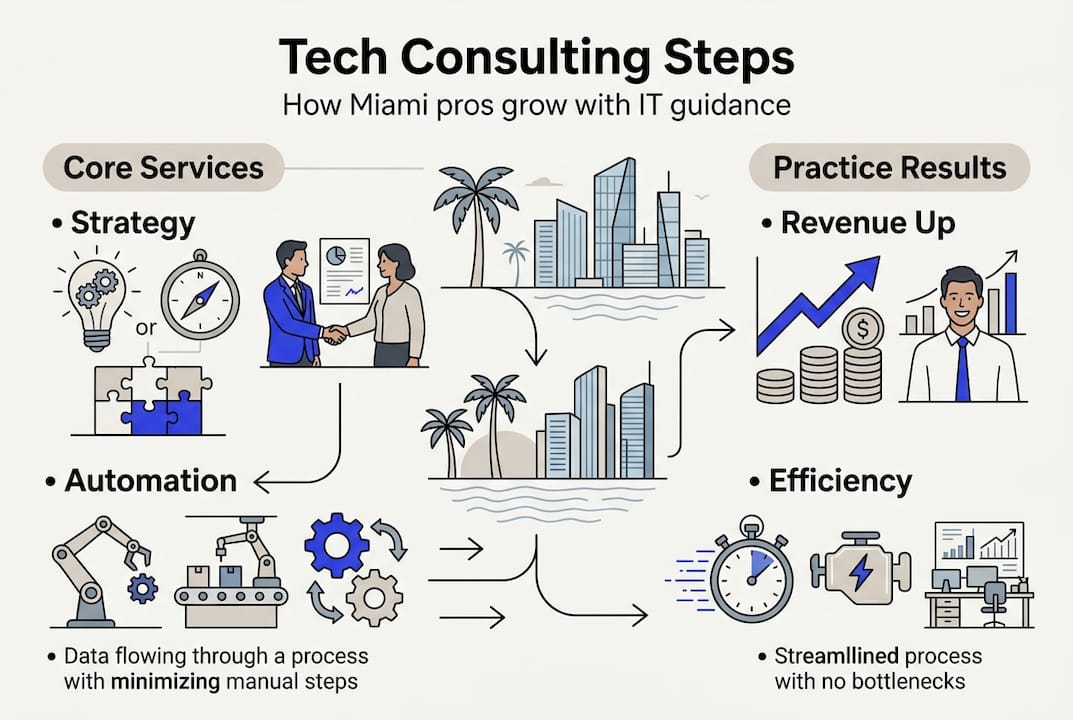
Firms leveraging advanced technology see up to 739% higher revenue growth in Miami’s expanding tech ecosystem. This dramatic difference comes from technology enabling practices to serve more clients without proportional staffing increases. A CPA firm that automates tax preparation can handle triple the client load during tax season with the same team size.
| Profession | Common Tech Project | Typical Impact |
|---|---|---|
| CPAs | Automated tax workflows and analytics | 40-60% time savings, 25% client capacity increase |
| Doctors | AI-powered billing and scheduling | 30-50% revenue cycle improvement, 40% no-show reduction |
| Lawyers | Document automation and AI research | 200-300% productivity in contract work, 50% research time savings |
Leveraging Miami’s legal and technology ecosystems creates strategic advantages. Local technology attorneys understand Florida regulations affecting professional practices. Tech consultants familiar with Miami’s market help you differentiate from competitors using the same national solutions everyone else deploys.
CPA firms focus on automation and analytics, healthcare practices on AI billing, and lawyers on AI-powered workflows for intellectual property productivity. Each profession has unique high-value applications where technology delivers maximum impact. CPAs gain most from automating repetitive compliance work, freeing time for advisory services commanding premium fees. Healthcare practices see dramatic returns from revenue cycle optimization given the complexity of medical billing. Law firms benefit enormously from AI-powered contract review and legal research automation.
Pro Tip: Adopt technology incrementally to balance change management with ROI realization. Attempting complete digital transformation simultaneously overwhelms staff, disrupts client service, and makes isolating what works difficult. Instead, implement one major change per quarter. This pace allows proper training, process refinement, and ROI measurement before adding complexity. Consider business transformation for CPAs approaches that phase implementations strategically.
Change management determines technology success more than the technology itself. Staff resistance kills even the best solutions. Involve team members in selection decisions, provide comprehensive training, and celebrate early wins publicly. When people see technology making their work easier rather than threatening their jobs, adoption accelerates dramatically.
Consider scaling your firm with workflow automation that addresses your specific growth constraints. Generic solutions rarely fit professional service workflows perfectly. The investment in customization or careful configuration pays dividends through higher adoption rates and better outcomes.
How Transform42 can help Miami professionals leverage technology consulting
Transform42 specializes in helping independent CPAs, doctors, and lawyers in Miami grow monthly revenue to an additional seven to eight figures through strategic technology advantages. We understand that your practice needs more than generic IT support. You need a partner who combines deep technology expertise with knowledge of professional service business models, compliance requirements, and Miami’s competitive landscape.
Our technology consulting services include strategic IT planning aligned with your revenue goals, workflow automation that eliminates bottlenecks, and AI-powered solutions that amplify your expertise. We implement HIPAA-compliant systems for medical practices, secure client portals for legal work, and advanced analytics for accounting firms. Every solution balances regulatory compliance with competitive advantage.
Through digital transformation services, we help you build the capabilities and compliance your clients expect. This means landing bigger clients, scaling without proportional hiring, and reclaiming your life from operational chaos. Our approach focuses on measurable outcomes: increased revenue per professional, improved client satisfaction scores, and reduced operational costs. We deliver business transformation for CPAs and other professionals that creates sustainable competitive advantages rather than temporary efficiency gains.
Frequently asked questions about technology consulting
What is the difference between technology consulting and IT support?
IT support fixes technical problems when systems break or users need help. Technology consulting strategically aligns your technology investments with business growth objectives. Support is reactive and tactical; consulting is proactive and strategic. You need both, but they serve different purposes in your practice.
Does automation replace the need for professional judgment in my practice?
No. Effective automation handles repetitive, rules-based tasks so you can focus on high-value advisory work requiring professional judgment. The most successful implementations create partnerships where AI suggests options and you apply expertise to make final decisions. This amplifies your capacity without compromising quality or professional standards.
How long does it take to see results from technology consulting?
Quick wins like automated client communication or document templates deliver results within weeks. Comprehensive workflow automation typically shows measurable ROI within three to six months. Strategic transformations enabling new service offerings or market expansion may take 12 to 18 months for full impact. Phased implementations provide incremental value throughout the journey rather than requiring you to wait for complete transformation.
What factors should I consider when choosing a technology consultant in Miami?
Prioritize industry expertise in professional services, understanding of your profession’s regulatory requirements, local market knowledge, implementation methodology emphasizing change management, and client references from similar practices. Avoid consultants who push specific vendor solutions without understanding your unique needs. The best partners act as advisors helping you make informed decisions rather than salespeople promoting particular products.
How do compliance requirements affect technology choices for healthcare and legal practices?
Compliance requirements significantly narrow your technology options and increase implementation complexity. Healthcare practices must ensure all systems handling patient data meet HIPAA security and privacy standards. Legal practices face bar association rules about client confidentiality and data security. These requirements affect cloud storage choices, communication tools, mobile access policies, and vendor selection. Non-compliance creates liability risks that outweigh any efficiency gains, making compliance expertise essential when evaluating technology solutions.