
TL;DR:
- Digital transformation is essential for SMBs to increase revenue and save time through digital tools.
- Most businesses fail to realize that developing skills and infrastructure is vital for successful implementation.
Most small and medium business owners assume digital transformation is something big corporations do. That assumption is costing them money every single day. The question of why digital transformation for SMBs matters is not theoretical. It shows up in your monthly revenue, your team’s capacity, and whether your competitors are pulling ahead while you’re still managing operations manually. SMBs increasingly rely on digital tools as critical infrastructure, not optional extras. If your business isn’t moving in that direction, it’s falling behind.
Table of Contents
- Key Takeaways
- The real benefits of digital transformation for SMBs
- What actually blocks SMBs from getting value
- How digital tools reclaim your time and capacity
- Practical digital transformation strategies for small businesses
- Future-proofing your digital approach
- My honest take on why most SMBs get this wrong
- Ready to stop leaving revenue on the table?
- FAQ
Key Takeaways
| Point | Details |
|---|---|
| Revenue grows with digital tools | 66% of SMBs report revenue increases linked to AI and digital adoption. |
| Time savings are massive | Digital automation saves SMBs between 156 and 364 hours per year, freeing capacity for real growth work. |
| Tools alone are not enough | Digital maturity, workforce skills, and reliable infrastructure are required to see full value from any investment. |
| Consolidation reduces chaos | Moving to all-in-one platforms removes app fatigue and creates cleaner, faster operations. |
| Start with back-office automation | Automating repetitive tasks delivers the fastest ROI and funds larger technology improvements over time. |
The real benefits of digital transformation for SMBs
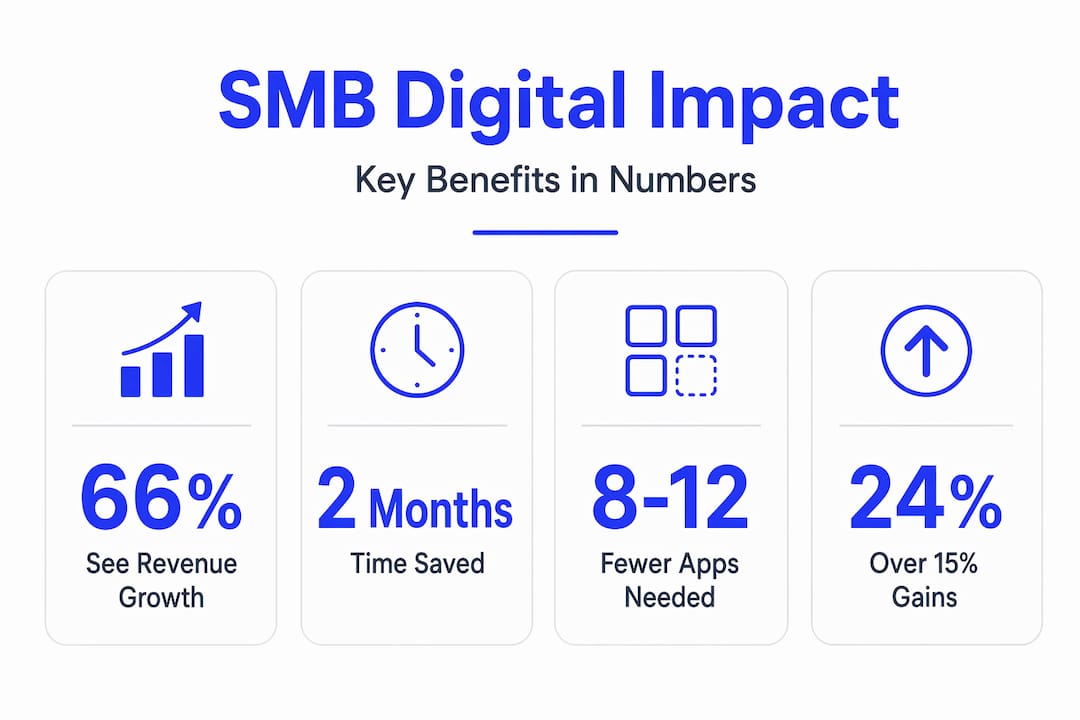
Here’s a number that should stop you cold. 66% of SMBs report revenue increases directly tied to AI and digital tool adoption, with 22% reporting gains exceeding 10%. That is not a marginal improvement. That is a structural shift in what a business can earn.
The benefits of digital tech for SMBs show up in two clear ways: time and money. On the time side, digital tools save up to 156 hours per year for 47% of SMBs surveyed, and up to 364 hours annually for 34% of businesses. Think about what 364 hours means to a small team. That’s roughly nine full work weeks returned to your business every year.
On the revenue side, digital platforms let SMBs compete in markets that used to belong exclusively to large firms. Online booking, automated billing, digital marketing, and client portals used to require enterprise budgets. Today, they’re accessible tools that level the playing field in ways that were simply impossible a decade ago.
The impact of digital change on SMBs compounds quickly. A doctor’s office that automates appointment reminders stops losing no-show revenue. An accounting firm that moves to a client portal cuts down hours of email back-and-forth every week. A law practice that uses contract automation software shortens its document turnaround from days to hours.
- Automated invoicing and payments reduce late payments and save hours of follow-up per week
- Digital scheduling platforms eliminate double-booking and reduce front-desk labor costs
- Cloud-based document management allows your team to work from anywhere without losing productivity
- AI-assisted client communication handles routine queries so your staff can focus on billable work
Pro Tip: Start your digital transformation with back-office automation. Invoicing, scheduling, and payment processing are high-frequency tasks with clear time costs. Automating these first delivers fast, measurable ROI and gives you the budget and confidence to tackle bigger technology investments.
What actually blocks SMBs from getting value
Here’s the part most technology vendors won’t tell you. Buying software doesn’t mean your business transforms. The OECD research on SMB AI adoption is clear: SMBs face persistent gaps compared to large firms in digital maturity, and the gap isn’t just about budget. It’s about skills, connectivity, and readiness.
The challenges of digital transformation for SMBs fall into three categories that most owners ignore until money has already been wasted.
- Skills gaps: Your team needs to actually use the tools effectively. A platform sits idle when nobody knows how to get the most out of it.
- Financial readiness: Underfunded implementations get abandoned halfway through, leaving you worse off than before you started.
- Connectivity and infrastructure: Reliable internet, compatible devices, and secure networks are the invisible foundation without which nothing else works.
The most common and expensive mistake is treating digital transformation as a one-time purchase. You buy a system, implement it once, and assume it’s done. It isn’t. Digital capabilities and worker skills must be continuously developed for transformation to deliver real productivity gains. The businesses that fail at this spend real money and see almost nothing in return.
The technology is rarely the problem. The gap between buying a tool and getting value from it is almost always a people and process problem. Fix those first.
This is exactly why working with a partner who understands your specific business context is so different from simply purchasing a software subscription. The implementation path for digital transformation requires more than a product. It requires a plan.
How digital tools reclaim your time and capacity
Time reclamation is the number-one reason SMB owners say they invest in automation. Not brand prestige. Not staying trendy. Time. And when you look at the numbers, it’s obvious why.
An owner saving 364 hours per year gets back nearly two full months of working time. What would you do with two extra months? Most owners answer that question the same way: focus on clients, pursue bigger opportunities, or simply stop working evenings and weekends.

The other piece that doesn’t get enough attention is app fatigue. Many SMBs end up with eight to twelve separate tools that don’t talk to each other, each requiring its own login, its own updates, and its own learning curve. The trend toward consolidated platforms handling scheduling, invoicing, payments, and marketing in one place is not just about convenience. It’s about mental load. Running your business through a fragmented tech stack costs you focus every single day.
Pro Tip: Before adding any new tool, audit what you already have. Most SMBs are paying for overlapping subscriptions and underusing all of them. Consolidating to fewer, better-integrated platforms almost always reduces cost and improves results simultaneously.
There’s also a cash flow dimension here. When billing is automated and payment reminders go out without manual effort, money comes in faster and more consistently. That’s not a feature. That’s a business stability upgrade. AI-driven efficiency gains are most visible precisely in these daily financial workflows.
Practical digital transformation strategies for small businesses
Knowing you need to transform is one thing. Knowing where to start is another. Digital transformation strategies for small businesses work best when they follow a logical sequence rather than a scattered shopping spree of new tools.
- Audit your highest-frequency tasks. Identify what your team does repeatedly every week. Those are your first automation targets.
- Choose integrated platforms over point solutions. Pick tools that share data with each other. Disconnected apps create new problems.
- Train your team before you launch. Budget time for training. An untrained team will revert to old habits within weeks.
- Bring in outside expertise. An experienced technology partner can cut your implementation timeline significantly and prevent costly mistakes.
- Measure results after 90 days. Set clear benchmarks before you start so you can confirm what’s working and adjust what isn’t.
| Component | What it does | Business benefit |
|---|---|---|
| Automated billing | Sends invoices and payment reminders automatically | Faster cash flow, fewer late payments |
| Client portal | Centralizes document sharing and communication | Saves staff hours, improves client experience |
| AI scheduling | Books appointments without human intervention | Eliminates no-shows, reduces front-desk workload |
| Cloud document storage | Makes files accessible from any device | No more lost files, supports remote work |
| Analytics dashboard | Tracks revenue, client activity, and trends | Better decisions based on real data |
Pro Tip: Why SMBs need digital tools isn’t about keeping up appearances. It’s about staying solvent and competitive. The firms landing bigger clients today are the ones that look and operate more professionally because their back-end technology makes it possible.
For SMBs in professional services, specifically accounting, legal, and medical practices, the role of technology in SMB success is even more pronounced. Clients now expect digital intake forms, secure document portals, and fast response times. Practices that cannot deliver this lose clients to competitors who can.
Future-proofing your digital approach
Only 9% of SMBs fear a negative impact from AI, which means the vast majority of business owners are ready to engage with these tools. The fear barrier is lower than most people think. The execution barrier is where most businesses get stuck.
Here’s what future-proofing your digital strategy actually looks like in practice:
- Treat digital readiness as an ongoing investment, not a project with an end date. Technology evolves, and your systems need to evolve with it.
- Connect with ecosystem support. Government and private initiatives now fund SMB digital skills training and AI adoption programs. Use them.
- Adopt AI incrementally. Leveraging digital solutions for growth works best when you add AI to workflows that are already clean and organized. Don’t automate chaos.
- Build a trusted technology partner relationship. The businesses that scale well digitally almost always have an expert in their corner who knows their industry and their systems.
The digital strategy trends shaping professional services firms right now point to one consistent pattern: slow, deliberate AI integration outperforms fast, scattered adoption every single time.
My honest take on why most SMBs get this wrong
I’ve watched hundreds of business owners make the same mistake. They buy the technology. They skip the readiness work. And six months later, they tell me the tools didn’t deliver.
The tools were never the problem. The problem is that most SMBs jump straight to AI and automation without first fixing their basic workflows. You cannot automate a broken process and expect a good result. You get a faster broken process.
What I’ve seen actually work is starting with the smallest, most repetitive task in your back office. Automate that one thing completely. Measure the time you get back. Then reinvest that time and that confidence into the next piece. Automating high-frequency workflows first is not a compromise strategy. It’s the fastest path to meaningful, compounding returns.
The other thing I’d push back on is the idea that tool consolidation is just a nice-to-have. It isn’t. Owner burnout is real, and a fragmented tech stack contributes to it in ways that are hard to see until you’ve fixed the problem. When your invoicing, scheduling, and client communication run on one platform, your brain stops carrying the weight of remembering which system holds which information.
The real competitive advantage for SMBs doesn’t come from having the newest AI model. It comes from being digitally mature enough that your entire operation runs smoothly with less effort from you.
— Joe
Ready to stop leaving revenue on the table?
If reading this article made you realize your business is running harder than it needs to, that’s not an accident. The gap between where most SMBs operate today and what’s possible with the right technology is significant, and it’s costing real money every month.
At Transform42inc, we work with doctors, lawyers, and accountants in Miami to build the technology foundation their practices need to grow without adding proportional headcount. We don’t just sell software. We become your technology integration partner, designing a digital infrastructure that fits your specific workflows and compliance requirements. If you’re ready to see what an additional six or seven figures in monthly revenue looks like for your practice, let’s talk about your digital transformation plan today.
FAQ
What is digital transformation for SMBs?
Digital transformation for SMBs means replacing manual, time-consuming processes with technology that automates, connects, and improves how your business operates. It covers everything from billing and scheduling to client communication and data management.
How does digital transformation boost efficiency for small businesses?
Digital tools save SMBs up to 364 hours per year by automating repetitive tasks, reducing the time your team spends on work that technology can handle automatically.
Does digital transformation actually increase revenue?
Yes. 66% of SMBs report revenue growth linked to AI and digital tool adoption, with nearly a quarter reporting gains above 10%.
What is the biggest challenge of digital transformation for SMBs?
The biggest challenge is not the technology itself. It’s the lack of digital skills and readiness within the team, which prevents businesses from getting real value out of the tools they purchase.
Where should an SMB start with digital transformation?
Start by automating your highest-frequency back-office tasks, such as invoicing, payment reminders, and appointment scheduling. These deliver the fastest, most measurable ROI and build the momentum to tackle larger changes.
Recommended
- Digital-transformation Archives – Stratgetic IT Consultants For Accountants
- Step By Step Digital Transformation For Small Businesses – Stratgetic IT Consultants For Accountants