TL;DR:
- Most Miami CPAs spend up to 70% of hours on manual, routine tasks that automation can reduce.
- Digitalization involves building connected, automated workflows, not just digitizing paper.
- Implementing phased pilots of automation can deliver immediate ROI and long-term efficiency gains.
Most Miami CPAs spend up to 70% of their billable hours on manual, routine tasks—data entry, reconciliations, document chasing—even though proven digital solutions can automate the majority of these processes. That’s not a small inefficiency. It’s a structural problem that limits your growth, your margins, and your ability to serve clients at a higher level. Digitalization isn’t a future-state concept. It’s happening now, and the firms that act early are already pulling ahead. This guide breaks down what digitalization actually means for your practice, how it reshapes everyday work, and exactly how to start building a more efficient, more profitable firm.
Table of Contents
- What does it mean to digitalize business processes?
- How digitalizing business processes transforms accounting work
- Proven strategies for digitalizing business processes in Miami accounting firms
- Risks, challenges, and common pitfalls in digitalizing processes
- Our perspective: What Miami CPAs often miss about digital transformation
- Ready to digitalize your business processes?
- Frequently asked questions
Key Takeaways
| Point | Details |
|---|---|
| Automate routine work | Digitalizing processes can automate up to 80% of routine accounting tasks, freeing time for more valuable client services. |
| Boost efficiency and revenue | Miami CPAs often experience up to 40% efficiency gains and 15-28% revenue growth by embracing digital transformation. |
| Mitigate risks early | A phased approach with staff training and workflow redesign avoids common pitfalls and ensures sustainable results. |
| Start with pilot projects | A 90-day pilot on key processes delivers quick wins and builds momentum for broader digital adoption. |
What does it mean to digitalize business processes?
To understand why digitalization matters, let’s clarify what it actually means for your practice. Many accountants use “digitization” and “digitalization” interchangeably, but they are not the same thing. Digitization is converting paper to digital format—scanning receipts, saving PDFs, storing files in the cloud. Useful, yes. Transformative, no.
Digitalization goes further. It means building connected, automated workflows that reduce manual intervention across your entire practice. Instead of scanning a document and then manually entering the data, a digitalized workflow captures the document, extracts the data automatically, routes it for review, and updates your records without anyone touching a keyboard. That’s the difference.
For Miami accountants specifically, digitalization shows up in practical ways:
- Automated data import from bank feeds directly into your accounting software
- AI-powered reconciliation that flags discrepancies instead of requiring line-by-line review
- Client document portals that eliminate email chains and lost attachments
- Automated reporting that generates financial statements on a set schedule
- E-signature workflows that replace wet signatures and courier delays
The starting points most firms use are cloud-based accounting platforms, robotic process automation (RPA), and AI integrations. RPA handles repetitive, rule-based tasks. AI handles pattern recognition, categorization, and anomaly detection. Together, they form the backbone of a digitalized practice.
Here’s a quick comparison of where most Miami firms start:
| Starting point | What it automates | Typical timeline |
|---|---|---|
| Cloud accounting software | Data entry, bank feeds, basic reporting | 2-4 weeks |
| Client portal | Document collection, e-signatures | 1-2 weeks |
| RPA tools | Reconciliation, data extraction | 4-8 weeks |
| AI integrations | Categorization, anomaly detection | 6-12 weeks |
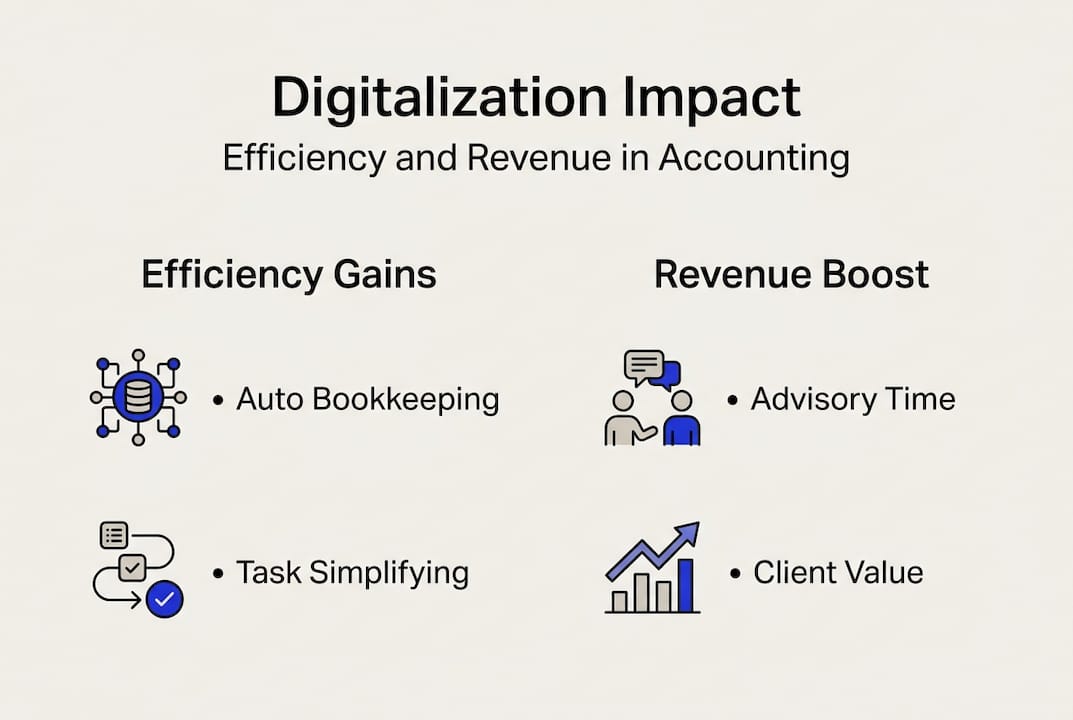
The reason this matters so much is scale. Digitalization automates 40-80% of routine accounting tasks. That’s not a marginal gain—it’s a fundamental shift in how your firm operates. If you want to unlock growth efficiency without adding headcount, this is where it starts.
For a deeper look at how connected workflows are structured, the digital transformation workflow framework gives you a practical map. And if you want to see where automation in accounting is heading industry-wide, the research is clear: this is the direction the profession is moving.
How digitalizing business processes transforms accounting work
Once you know what digitalization involves, the next step is seeing its impact on your everyday accounting work. The shift is more significant than most CPAs expect before they experience it.
The most immediate change is in bookkeeping and data management. Auto-categorization tools eliminate hours of manual transaction coding. Fast close processes—where month-end reporting that used to take two weeks now takes two days—become standard. Client self-service portals mean your staff stops playing document retrieval coordinator and starts doing actual accounting work.

But the bigger transformation is strategic. When routine work is automated, your time shifts toward advisory services. That’s where the real revenue growth lives. Digital transformation delivers 20-40% efficiency gains, cost reductions up to 50%, and 15-28% revenue growth via advisory services. Those numbers aren’t theoretical—they reflect what firms are achieving by making this shift.
Here’s how the outcomes compare:
| Workflow | Manual process | Digitalized process |
|---|---|---|
| Bank reconciliation | 3-5 hours per client/month | 20-30 minutes with AI review |
| Month-end close | 10-14 days | 2-4 days |
| Document collection | Email back-and-forth, 3-7 days | Portal upload, same day |
| Financial reporting | Manual compilation, error-prone | Automated, scheduled, consistent |
“The firms seeing the biggest gains aren’t just using new tools—they’re restructuring what their team actually does with their time.”
For Miami CPAs, this matters locally too. The Miami market is competitive. Clients have more options than ever. The firms that boost efficiency for accountants are the ones winning larger, more complex clients because they can demonstrate capacity and responsiveness.
The digital transformation benefits extend beyond cost savings. Think about the client experience: faster turnaround, real-time access to their financials, proactive advisory conversations instead of reactive tax prep. That’s a different kind of firm. And AI and automation research confirms this shift is accelerating across the profession.
Pro Tip: Start with data automation—specifically bank feeds and auto-categorization—before tackling more complex workflows. It delivers the fastest visible impact and builds team confidence in the process.
Proven strategies for digitalizing business processes in Miami accounting firms
Understanding the transformation is key, but how can Miami CPAs start their journey? Let’s turn to actionable strategies.
The firms that succeed with digitalization don’t try to change everything at once. They use a phased approach that builds momentum and proves ROI before scaling. Here’s a framework that works:
-
Conduct a client digital readiness assessment. Before buying any tools, map your current workflows. Identify which processes consume the most time and have the highest error rates. These are your highest-value automation targets.
-
Set SMART goals for each digitalization project. Specific, Measurable, Achievable, Relevant, and Time-bound. “Reduce reconciliation time by 60% within 90 days” is a SMART goal. “Get more efficient” is not.
-
Run a 90-day pilot on one target workflow. Pick reconciliation, document management, or reporting. Implement one tool. Measure the before and after. This builds the business case for broader rollout.
-
Integrate RPA and AI in phase two. Once your team is comfortable with cloud-based tools and basic automation, layer in RPA for repetitive tasks and AI for pattern recognition. Phased implementation using 90-day pilots combined with intelligent process automation (IPA) is the methodology that consistently delivers results.
-
Expand to connected processes for compounding returns. Each connected workflow multiplies the value of the previous one. Client onboarding feeds into document management, which feeds into reconciliation, which feeds into reporting. The more connected your processes, the greater the efficiency gain.
Stat: A well-executed 90-day pilot can generate 3-5x return on investment when focused on your most manual, high-volume process.
Pro Tip: Use the digital transformation tips framework to prioritize which workflows to tackle first based on time savings potential and client impact.
For Miami firms specifically, the Miami revenue advantage comes from combining operational efficiency with a stronger advisory offer. The AICPA audit roadmap also provides useful benchmarks for firms looking to modernize audit workflows alongside their core accounting processes.
Risks, challenges, and common pitfalls in digitalizing processes
To ensure lasting gains, it’s crucial to recognize and plan for the risks and pitfalls many overlook.
Digitalization is not a guaranteed win. Many firms invest in tools and see little return because they underestimate what it takes to make the transition stick. Here are the most common challenges:
- Budget constraints that lead to under-investment in training and change management
- Shallow implementation where tools are adopted but workflows aren’t redesigned around them
- Skills gaps where staff lack the technical confidence to use new systems effectively
- AI governance issues where no one is responsible for reviewing AI-generated outputs
- Shadow AI where staff use unauthorized AI tools that introduce compliance and data security risks
The risk of over-reliance on AI is real. Skills gaps hinder 25% of projects and overreliance on AI tools creates risks including hallucinations and biases in outputs. An AI tool that auto-categorizes transactions can make confident errors. If no one is reviewing the outputs, those errors compound.
“The biggest mistake firms make is treating digitalization as a technology project instead of a people and process project. The tools are the easy part.”
The AI risks in accounting are well-documented and growing as adoption increases. Human oversight isn’t optional—it’s the control layer that makes automation trustworthy.
The solution is balance. Automate aggressively, but build in review checkpoints. Train your team on both the tools and the judgment required to catch errors. And use the digital scalability guide to build a governance structure that grows with your firm.
Change management is the piece most firms skip. Staff resistance, unclear ownership of new processes, and lack of leadership buy-in are the real reasons digitalization projects stall. Budget for training. Communicate the why. Celebrate early wins.
Our perspective: What Miami CPAs often miss about digital transformation
After covering strategies and risks, let’s share a perspective Miami accountants rarely hear.
Most CPAs approach digitalization as a technology upgrade. Buy better software. Automate a few tasks. Done. But that thinking produces a predictable result: you move the mess online instead of fixing it.
True transformation requires rethinking your workflows end-to-end. Start with client onboarding. How does a new client enter your system? What happens to their documents, their data, their first deliverable? Map that entire journey and identify every manual handoff. Those handoffs are where time is lost and errors are born.
The Miami CPAs we see growing fastest aren’t just more efficient—they’ve repositioned themselves as strategic advisors. They use the time freed by automation to have proactive conversations with clients about cash flow, tax strategy, and business growth. That’s a fundamentally different value proposition, and clients pay more for it.
The impact of digital transformation isn’t measured in hours saved. It’s measured in the quality of relationships you can build when you’re not buried in manual work.
Pro Tip: Before selecting any new tool, write down the workflow it will support from start to finish. If you can’t describe the redesigned process clearly, you’re not ready to implement the tool yet.
Ready to digitalize your business processes?
Armed with these insights, you can capture the full value of digitalization. Here’s how to take your next steps.
We work with independent accountants and CPAs in Miami to build the technology for accountants infrastructure that makes this kind of growth possible. From cloud migration to AI integration to full digital transformation strategy, we bring everything together in one partner relationship.
You don’t have to figure this out alone or piece together a dozen vendors. Our process automation for CPAs solutions are built specifically for Miami accounting firms that want to scale without proportional hiring and reclaim their time for higher-value work. The competitive window is open now. Let’s build your advantage together.
Frequently asked questions
How does digitalization specifically help Miami CPAs increase revenue?
By automating routine tasks, Miami CPAs free up more time for advisory services, which can drive 15-28% revenue growth through higher-value client engagements.
What are the first steps to start digitalizing my practice?
Assess your current workflows, set SMART digital goals, and pilot cloud-based automation in your most manual process. Phased 90-day pilots consistently deliver fast, measurable ROI.
Are there risks with AI or automation for accountants?
Yes. AI can produce errors and biases without proper governance, and skills gaps hinder 25% of digitalization projects, making human oversight and staff training non-negotiable.
How quickly can Miami CPAs see benefits after digitalizing?
Many Miami firms see ROI within 90 days by automating key processes like reconciliation and reporting, with 90-day pilots generating 3-5x returns on targeted workflows.
Does digitalization require major new investments for small Miami firms?
Not necessarily. Many improvements start with targeted pilots and cloud tools that fit smaller budgets, delivering 20-40% efficiency gains without requiring enterprise-level spending.
Recommended
- How Digital Operations Boost Efficiency For Accountants
- Why Digital Transformation Matters: Boost Revenue & Efficiency
- Revolutionizing Business Processes For The Digital Age – Stratgetic IT Consultants For Accountants
- 7 Digital Transformation Benefits For Your Business Success – Stratgetic IT Consultants For Accountants
- Digital accounting for Finnish SMEs: boost efficiency in 2026