
Most American CPA firms leave significant growth on the table by not building a scalable data analysis framework from the start. Miami practitioners face fierce competition and evolving expectations from high-value clients seeking insights that drive decisions. Refining your approach to data collection, validation, and reporting can unlock meaningful improvements—firms with strong data capabilities are twice as likely to hit major revenue milestones. This guide breaks down how to systematize analysis for efficient, accurate results as your firm expands.
Table of Contents
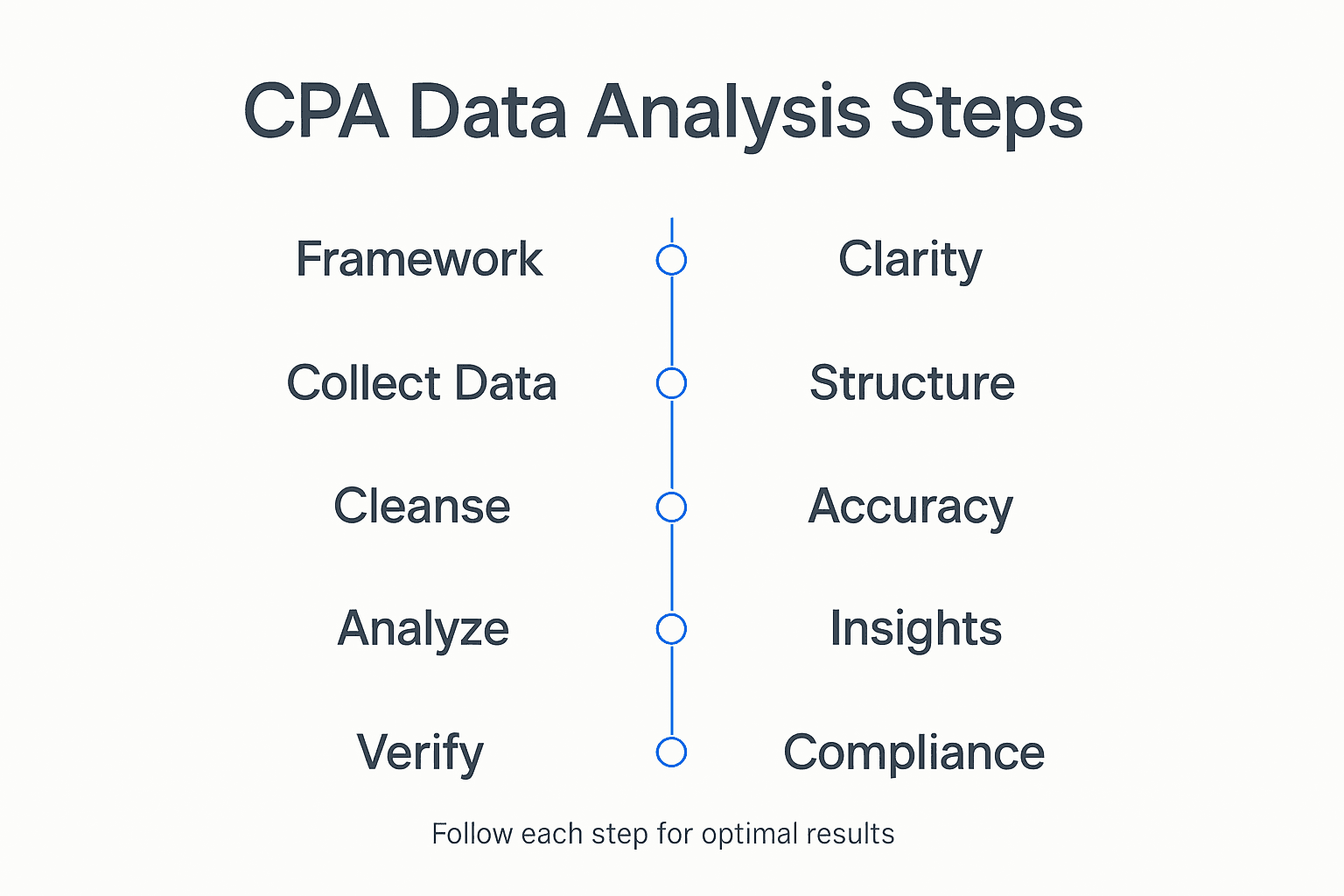
- Step 1: Set Up Your Data Analysis Framework
- Step 2: Collect and Organize Financial Data
- Step 3: Cleanse and Validate Your Dataset
- Step 4: Apply Analytical Methods for Actionable Insights
- Step 5: Verify Results to Ensure Compliance
Quick Summary
| Key Point | Explanation |
|---|---|
| 1. Establish a robust framework | Develop a structured data analysis framework with clear processes for data collection and analysis. |
| 2. Standardize data collection | Implement standardized methods to efficiently gather financial records, minimizing manual errors. |
| 3. Cleanse data for accuracy | Systematically identify and correct inconsistencies in financial datasets to ensure reliability. |
| 4. Apply strategic analytics | Use advanced analytical methods to extract actionable insights from cleaned financial data. |
| 5. Rigorously verify results | Implement thorough verification processes to ensure accuracy and compliance with regulations. |
Step 1: Set up your data analysis framework
Building a robust data analysis framework for your CPA practice transforms how you approach client financial insights. Your goal is creating a systematic approach that helps you quickly analyze complex financial data while meeting regulatory standards.
Starting with a comprehensive multidimensional framework for integrating data analytics, you want to develop an adaptable structure that evaluates financial risks and meets industry requirements. Focus on establishing clear processes for data collection, standardization, and analysis. This means creating consistent workflows that allow you to import financial records, clean and organize data, and generate meaningful reports without getting bogged down in manual processing.
Your framework should include specific components like risk assessment matrices, automated data validation protocols, and reporting templates. When designing these elements, consider how they connect with regulatory standards and can scale as your practice grows. Modern audit analytics frameworks now integrate advanced programming techniques to streamline complex analytical tasks.
Professional Recommendation: Build flexibility into your framework from the start and plan for regular reviews to ensure your processes remain current with changing financial regulations and technological capabilities.
The following table summarizes the main components of a strong data analysis framework for CPA practices:
| Component | Purpose | Business Value |
|---|---|---|
| Risk assessment matrix | Evaluates client financial risks | Identifies red flags early |
| Automated validation | Checks data accuracy efficiently | Reduces manual errors |
| Reporting templates | Standardizes client financial outputs | Ensures clear, consistent reports |
| Scalable structure | Adapts to firm growth | Supports expanding client base |
Step 2: Collect and organize financial data
In this critical stage of your data analysis framework, you will transform raw financial information into a structured format that enables powerful insights. Your objective is to efficiently gather client financial documents while creating a systematic approach to data management.

Implementing effective data preparation techniques for financial information involves understanding the extraction, transformation, and loading (ETL) processes. Start by establishing standardized methods for collecting financial records from diverse sources like bank statements, tax returns, payroll documents, and investment portfolios. Utilize automated tools that can import digital files, scan physical documents, and convert various formats into a consistent digital repository. This approach minimizes manual data entry and reduces the potential for human error.
When organizing your collected financial data, focus on creating a logical structure that allows for quick retrieval and analysis. Comprehensive financial data management strategies recommend categorizing information by client, date, document type, and financial year. Implement a cloud-based or secure local system that provides robust tagging and search capabilities, enabling you to quickly locate specific documents or financial records when needed.
Professional Recommendation: Develop a consistent file naming convention and folder structure that allows immediate identification of documents without opening them.
Step 3: Cleanse and validate your dataset
Once you have collected financial data, the next crucial phase is ensuring its accuracy and reliability through comprehensive cleansing and validation processes. Your goal is to transform raw financial information into a pristine dataset that supports accurate analysis and reporting.
Effective data collection and cleansing techniques for financial applications involve systematic approaches to identifying and correcting potential errors. Begin by scanning your dataset for inconsistencies such as duplicate entries, mismatched formats, incomplete records, and outliers that could skew your financial analysis. Pay special attention to numerical data like transaction amounts, dates, and account numbers where even small errors can significantly impact your conclusions.
Comprehensive financial dataset validation strategies recommend establishing a structured validation workflow. This includes standardizing data formats across different sources, handling missing values through consistent rules, removing redundant information, and cross-referencing records against multiple financial documents. Implement automated validation tools that can quickly flag potential discrepancies and help you maintain the highest standards of data integrity for your CPA firm.
Professional Recommendation: Create a detailed log of all data cleaning actions to maintain transparency and allow for potential future audits of your data processing methods.
Step 4: Apply analytical methods for actionable insights
Transforming your cleaned financial data into meaningful business intelligence requires strategic analytical methods that uncover hidden patterns and drive informed decision making. Your objective is to move beyond raw numbers and extract powerful insights that can guide your CPA firm’s strategic planning.
Digital transformation strategies leverage competitive intelligence to elevate financial analysis. Start by applying advanced statistical techniques like regression analysis, trend forecasting, and comparative benchmarking to your financial datasets. Focus on identifying key performance indicators that reveal client financial health, potential growth opportunities, and areas requiring strategic intervention. Use visualization tools to translate complex numerical data into clear, compelling graphics that communicate insights effectively to clients and stakeholders.
Business process management techniques can help you systematically interpret your analytical findings. Develop a structured approach to categorizing insights by their potential impact create actionable recommendations. Segment your analysis into categories such as risk assessment, growth potential, operational efficiency, and financial optimization. This methodical approach ensures that every insight generates practical value for your clients and supports their long term financial goals.
Professional Recommendation: Create a standardized reporting template that consistently translates your analytical findings into clear, actionable strategic recommendations for your clients.
Step 5: Verify results to ensure compliance
The final critical stage of your data analysis process involves rigorous verification to guarantee the accuracy, reliability, and regulatory compliance of your financial insights. Your goal is to create an ironclad validation process that protects your CPA firm from potential errors and legal risks.
When assessing digital transformation strategy, competitive intelligence becomes vital in developing robust verification protocols. Begin by implementing a comprehensive cross validation approach that involves comparing your analytical results against multiple independent sources. This means checking your findings against original financial documents, reconciling discrepancies, and documenting each verification step. Utilize automated compliance checking tools that can flag potential inconsistencies and help you maintain the highest standards of professional accuracy.
Business process management techniques provide an adaptive strategy for systematic result verification. Develop a structured verification checklist that covers key compliance dimensions including mathematical accuracy, regulatory alignment, professional standards adherence, and potential interpretative risks. Engage multiple team members in the review process to introduce additional layers of scrutiny and reduce the likelihood of overlooked errors. Your verification process should be transparent, repeatable, and capable of withstanding potential external audits.
Professional Recommendation: Create a detailed verification log that records every validation step, including who performed the check, when it was completed, and what specific aspects were examined.
Here’s a quick comparison of data preparation vs. data verification in the CPA process:
| Stage | Key Goal | Example Tools | Business Risk if Missed |
|---|---|---|---|
| Data preparation | Structured, organized datasets | ETL, OCR, cloud drives | Missing or lost records |
| Data verification | Ensure accuracy and compliance | Validation software | Regulatory or legal issues |
Scale Your CPA Firm With Confidence Using Advanced Data Analysis Frameworks
The challenge of building a compliant, scalable data analysis framework while managing vast amounts of financial data is real for every CPA professional. This article highlights the crucial pain points many face including risk assessment, data validation, and actionable insight extraction. You need solutions that reduce manual errors, ensure regulatory compliance, and let you focus on growing your client base without hiring at the same pace. Imagine having the power to transform raw data into strategic advantages that land bigger clients and boost your firm’s efficiency.
We help Accountants in Miami build these exact capabilities and more. Our technology-driven approach is designed to streamline your data collection, cleansing, and analysis processes all while maintaining the highest standards of compliance and accuracy. Explore how we help CPAs scale smarter by adopting flexible, automated frameworks that grow with your practice. Ready to reclaim your life and maximize revenue without sacrificing quality or control
Take the first step to elevate your CPA firm’s financial insights and client satisfaction. Discover proven strategies for building scalable data frameworks and mastering compliance through technology. Visit us now at Transform42 Inc and start transforming your practice today.
Frequently Asked Questions
How can I set up a data analysis framework for my CPA firm?
To set up a data analysis framework, start by defining clear processes for data collection, standardization, and analysis. Create risk assessment matrices, automated data validation protocols, and reporting templates to ensure compliance and efficiency.
What steps are involved in collecting and organizing financial data?
Collect financial data by establishing standardized methods for sourcing documents like bank statements and tax returns. Organize this data logically, categorizing it by client, date, and financial year, to facilitate quick retrieval and analysis.
How do I cleanse and validate my financial dataset?
To cleanse and validate your dataset, identify and correct errors such as duplicate entries and inconsistencies. Implement a structured validation process that includes standardizing formats and using automated tools to flag discrepancies, ensuring high data integrity.
What analytical methods should I apply for actionable insights?
Apply advanced statistical techniques such as regression analysis and trend forecasting to uncover insights from your financial data. Segment your analysis into categories like risk assessment and financial optimization to create actionable recommendations for your clients.
How can I verify results to ensure compliance?
Verify your results by comparing analytical outcomes with independent sources and maintaining a structured verification checklist. This process should include multiple team members to review findings, thereby minimizing the risk of oversight and ensuring regulatory compliance.
Recommended
- Agile Methodology Explained: Complete Guide for CPAs – Stratgetic IT Consultants for Accountants
- How to Build It Strategy for Miami CPA Firms
- Agile Methodology Explained: Complete Guide for CPAs
- Complete Guide to Cyber Security for Miami CPAs – Stratgetic IT Consultants for Accountants
- Importancia del análisis de datos para empresas y su comprensión | Itcons.app