
Over half of American accounting firms now face urgent pressure to reinvent how they operate in a rapidly changing marketplace. Staying competitive no longer means doing just enough—leaders must rethink their core strategies and embrace sweeping organizational change. Whether you run a Miami practice or oversee a growing national team, understanding business transformation consulting can reveal practical solutions that help your firm thrive, outpace rivals, and adapt to evolving client needs.
Table of Contents
- Defining Business Transformation Consulting Services
- Types of Transformation: Digital, Operational, Strategic
- How Consulting Drives Revenue Growth for Accountants
- Technology Integration and Compliance for Miami Firms
- Common Pitfalls and Mitigating Risks in Transformation
Key Takeaways
| Point | Details |
|---|---|
| Business Transformation Consulting | Firms must engage consultants to address technology integration, workflow optimization, and client experience enhancements for sustainable growth. |
| Types of Transformation | Digital, operational, and strategic transformations are crucial for accounting firms to adapt to evolving market demands and enhance service delivery. |
| Revenue Growth Strategies | Effective consulting can unlock new revenue streams by revising service portfolios and implementing innovative pricing strategies. |
| Risk Mitigation in Transformation | Firms must proactively manage change to overcome employee resistance and implementation challenges for successful transformation initiatives. |
Defining Business Transformation Consulting Services
Business transformation consulting services represent strategic partnerships designed to help accounting professionals radically reimagine their operational capabilities and growth potential. These specialized services go far beyond traditional advisory approaches, focusing on comprehensive organizational change that fundamentally reshapes how accounting firms generate value, serve clients, and compete in an increasingly complex marketplace.
At its core, business transformation consulting involves a holistic approach to analyzing and restructuring core business processes, technological infrastructure, and strategic positioning. Understanding the role of consulting firms reveals that these services are not merely about incremental improvements, but about catalyzing profound shifts in business models, operational efficiency, and competitive advantage. Accounting firms seeking transformation typically engage consultants to address critical challenges such as technological integration, workflow optimization, client experience enhancement, and strategic market repositioning.
The key components of business transformation consulting for accountants often include several critical dimensions:
- Technology Integration: Implementing cutting-edge digital tools and platforms that streamline accounting processes
- Strategic Repositioning: Redesigning service offerings to meet evolving market demands
- Operational Efficiency: Restructuring internal workflows to maximize productivity and reduce administrative overhead
- Client Experience Design: Creating more responsive, personalized service delivery models
- Talent Development: Upskilling teams to leverage new technologies and service methodologies
Why strategic consulting matters becomes crystal clear when accounting firms recognize that transformation is no longer optional but essential for survival in a rapidly changing professional landscape. Successful business transformation consulting does not simply prescribe generic solutions but crafts bespoke strategies tailored to each firm’s unique strengths, challenges, and market positioning.
Types of Transformation: Digital, Operational, Strategic
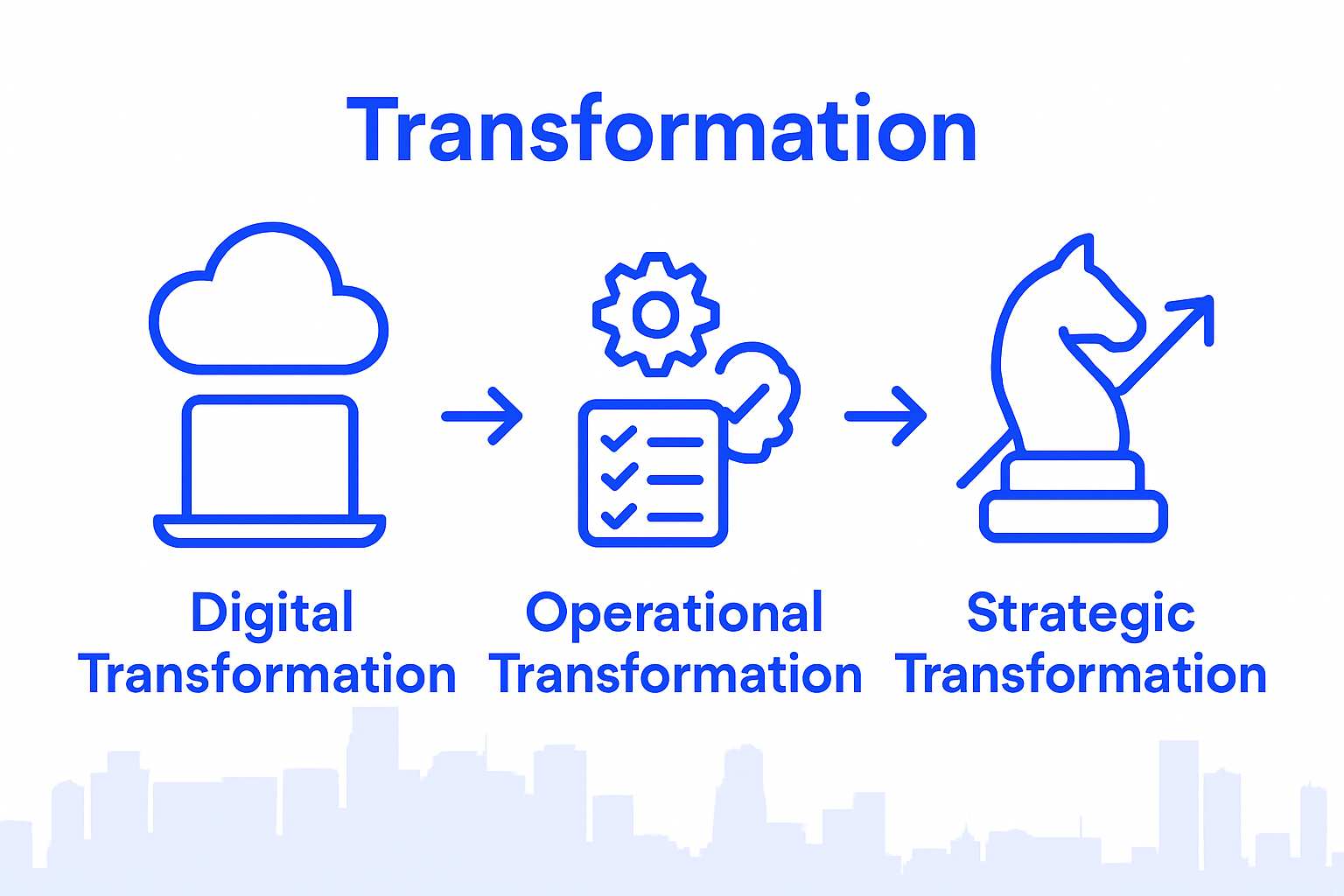
Business transformation encompasses multiple interconnected approaches that enable accounting firms to evolve and thrive in a dynamic professional landscape. These transformational strategies are not standalone initiatives but intricate, complementary pathways designed to comprehensively reinvent organizational capabilities and competitive positioning.

Digital Transformation represents the most technologically driven approach, fundamentally redesigning how accounting firms leverage digital tools and platforms. Navigating the digital future reveals that successful digital transformation goes beyond mere technological implementation, focusing on creating integrated ecosystems that enhance operational efficiency, client engagement, and data-driven decision making. Syracuse University’s research highlights core pillars including business process transformation, customer experience redesign, and organizational cultural shifts.
The three primary transformation types include:
-
Digital Transformation: Integrating advanced technologies to reimagine service delivery
- Implementing cloud-based accounting systems
- Adopting artificial intelligence for predictive analytics
- Developing seamless digital client interaction platforms
-
Operational Transformation: Redesigning internal workflows and organizational structures
- Streamlining administrative processes
- Developing cross-functional collaboration models
- Implementing agile project management approaches
-
Strategic Transformation: Repositioning the firm’s market approach and value proposition
- Developing new service offerings
- Identifying emerging market opportunities
- Realigning business models to meet changing client expectations
Accounting firms must recognize that digital transformation extends beyond technological tools and requires a holistic approach to organizational change. Successful transformation demands not just technological investment, but a comprehensive strategy that addresses cultural adaptation, workforce capabilities, and strategic vision.
How Consulting Drives Revenue Growth for Accountants
Business consulting represents a powerful strategic lever for accountants seeking to dramatically expand their revenue potential and market positioning. By providing expert external perspectives and sophisticated strategic frameworks, consultants help accounting professionals transform traditional service models into high-value, scalable revenue generation platforms that extend far beyond conventional accounting practices.
Understanding the role of consulting services reveals multiple mechanisms through which consulting drives substantial revenue growth. These mechanisms include identifying untapped market opportunities, optimizing service delivery models, and developing innovative pricing strategies that align with emerging client expectations. Accountants who strategically engage consultants can unlock new revenue streams by redesigning their service portfolios, leveraging technology, and creating more compelling value propositions for increasingly sophisticated clients.
The primary revenue acceleration strategies consultants introduce include:
-
Service Portfolio Expansion
- Developing high-margin advisory services
- Creating specialized consulting offerings
- Identifying niche market opportunities
-
Operational Efficiency Improvements
- Reducing non-billable administrative time
- Implementing automated billing systems
- Streamlining client onboarding processes
-
Technology-Driven Revenue Enhancement
- Integrating predictive analytics tools
- Developing data-driven service models
- Creating scalable digital service platforms
The most successful accounting firms recognize that management consulting approaches are not expense lines but strategic investments. By systematically addressing organizational constraints and market opportunities, consultants help accountants transform their practices from transactional service providers into strategic business partners capable of delivering exponential value to their clients.
Technology Integration and Compliance for Miami Firms
Technology integration and compliance represent critical strategic imperatives for accounting firms in Miami’s dynamic business ecosystem. Navigating the complex intersection of technological innovation and regulatory requirements demands a sophisticated approach that balances cutting-edge digital capabilities with rigorous professional standards.
Implementing digital transformation strategies requires Miami accounting firms to develop comprehensive technological frameworks that enhance operational efficiency while maintaining strict adherence to industry compliance standards. The most successful firms recognize that technology is not just a tool but a strategic platform for delivering exceptional client value and maintaining competitive differentiation.
Key technological integration strategies for Miami accounting firms include:
-
Secure Cloud Infrastructure
- Implementing robust cloud-based accounting platforms
- Ensuring end-to-end data encryption
- Developing multi-factor authentication protocols
-
Compliance Technology Solutions
- Automated regulatory tracking systems
- Real-time compliance monitoring tools
- Advanced reporting and audit trail capabilities
-
Client Engagement Technologies
- Secure client portal development
- Digital document management systems
- Integrated communication platforms
Miami accounting firms must strategically manage IT services to transform technological challenges into competitive advantages. By embracing integrated technological solutions that prioritize both innovation and compliance, firms can create more resilient, efficient, and client-focused business models that drive sustainable growth in an increasingly complex professional landscape.
Common Pitfalls and Mitigating Risks in Transformation
Business transformation represents a complex journey fraught with potential obstacles that can derail even the most well-intentioned strategic initiatives. Accounting firms must approach transformation with a nuanced understanding of the inherent risks and proactive strategies to navigate potential challenges effectively.
Digital transformation challenges often emerge from fundamental organizational resistance and limited strategic preparation. Successful firms recognize that transformation is not merely a technological upgrade but a comprehensive reimagining of business capabilities, requiring meticulous planning, cultural alignment, and strategic risk management.
Critical pitfalls that accounting firms must anticipate include:
-
Change Management Risks
- Employee resistance to new technologies
- Cultural inertia blocking innovation
- Communication breakdowns during transition
-
Technological Implementation Challenges
- Incompatible legacy system integrations
- Cybersecurity vulnerability during transitions
- Inadequate staff technological training
-
Strategic Execution Risks
- Misaligned transformation objectives
- Insufficient resource allocation
- Lack of clear performance metrics
Miami accounting firms can strategically navigate digital transformation risks by developing comprehensive risk mitigation frameworks. These frameworks must balance technological innovation with organizational readiness, ensuring that transformation efforts are sustainable, aligned with strategic goals, and capable of delivering measurable business value.
Unlock Your Accounting Firm’s Full Potential with Expert Transformation Guidance
Accounting professionals face intense pressure to adapt rapidly by integrating new technologies, optimizing operations, and redefining their strategic positioning. This article highlights key challenges like overcoming organizational resistance, improving client experience, and leveraging digital transformation to stay competitive. If you want to build the capabilities and compliance your clients expect while scaling your firm without the burden of proportional hiring, targeted transformation is essential.
Explore practical solutions in our Digital-transformation Archives to learn how technology can be the catalyst for sustainable growth. At Transform42, we specialize in helping Miami accountants land bigger clients and grow their monthly revenue by 7-8 figures using strategic technology advantages. Our comprehensive approach covers operational workflows as detailed in the Processes Archives, ensuring every aspect of your firm’s transformation is seamless.
Take charge of your future today with tailored business transformation consulting that turns challenges into opportunities. Visit Transform42 Inc. to start scaling your firm with confidence and reclaim your life through smart, strategic growth.
Frequently Asked Questions
What are business transformation consulting services for accountants?
Business transformation consulting services help accountants fundamentally change their operational capabilities and value generation through comprehensive analysis, strategic repositioning, and technology integration.
How can technology integration enhance accounting practices?
Technology integration improves accounting practices by implementing advanced tools such as cloud-based systems and AI analytics, streamlining processes, enhancing client interaction, and ensuring compliance with regulations.
What are the main types of transformation in accounting firms?
The main types of transformation are digital transformation, which focuses on technology adoption; operational transformation, which redefines internal workflows; and strategic transformation, which reshapes the firm’s market approach and value proposition.
What are common pitfalls in business transformation for accountants?
Common pitfalls include resistance to change among employees, technological implementation challenges like system compatibility, and misalignment of transformation objectives with overall business strategy.
Recommended
- Understanding The Role Of Consulting Services In Accounting – Stratgetic IT Consultants For Accountants
- Understanding Digital Transformation Explained for CPAs – Stratgetic IT Consultants for Accountants
- 5 Steps to Take When Choosing a Consulting Firm – Stratgetic IT Consultants for Accountants
- Understanding the Role of Consulting Services in Accounting