
More than 80 percent of American accounting professionals now handle sensitive client data online, making security a top concern. For firms managing financial records and regulatory tasks, safeguarding information is not optional—it is essential. By exploring how on premise cloud solutions work, CPAs can discover the practical advantages of keeping operations secure, efficient, and fully under their own control in an increasingly digital world.
Table of Contents
- Defining On Premise Cloud Solutions
- Private Cloud Vs. Public Cloud Models
- Features And Architecture Of On Premise Cloud
- Compliance And Security For Miami Accountants
- Cost, Maintenance, And Common Pitfalls
Key Takeaways
| Point | Details |
|---|---|
| On Premise Cloud Security | On premise cloud solutions provide exclusive infrastructure for enhanced security and control, essential for accounting professionals managing sensitive data. |
| Public vs. Private Cloud | Unlike public clouds, private clouds offer dedicated resources and compliance capabilities, making them suitable for accounting firms needing stringent data protection. |
| Architectural Advantages | The architecture of on premise clouds allows for tailored security protocols and operational flexibility, beneficial for the specific needs of CPAs. |
| Cost Efficiency Considerations | Although initial investments for on premise clouds can be high, they often result in long-term savings for firms with consistent workload needs. |
Defining On Premise Cloud Solutions
For CPAs and accounting professionals, understanding on premise cloud solutions means recognizing a powerful computing model that provides ultimate security and control. Unlike traditional public cloud environments, an on premise cloud offers exclusive infrastructure dedicated entirely to your organization’s specific needs.
The core advantage of an on premise cloud is its dedicated nature. Private cloud architecture enables web-scale networking capabilities with improved scalability and dramatically lower total cost of ownership. Accounting firms can essentially create a customized computing environment that meets precise compliance and data protection requirements without sharing resources with other organizations.
Key characteristics of on premise cloud solutions include:
- Complete infrastructure control
- Enhanced data security protocols
- Exclusive resource allocation
- Customizable network configurations
- Direct management of computing resources
When implemented strategically, on premise cloud solutions allow accounting professionals to maintain rigorous data protection standards while enjoying enterprise-grade computing flexibility. By keeping critical financial data within a dedicated environment, CPAs can minimize external vulnerabilities and ensure client information remains completely confidential.
Private Cloud vs. Public Cloud Models
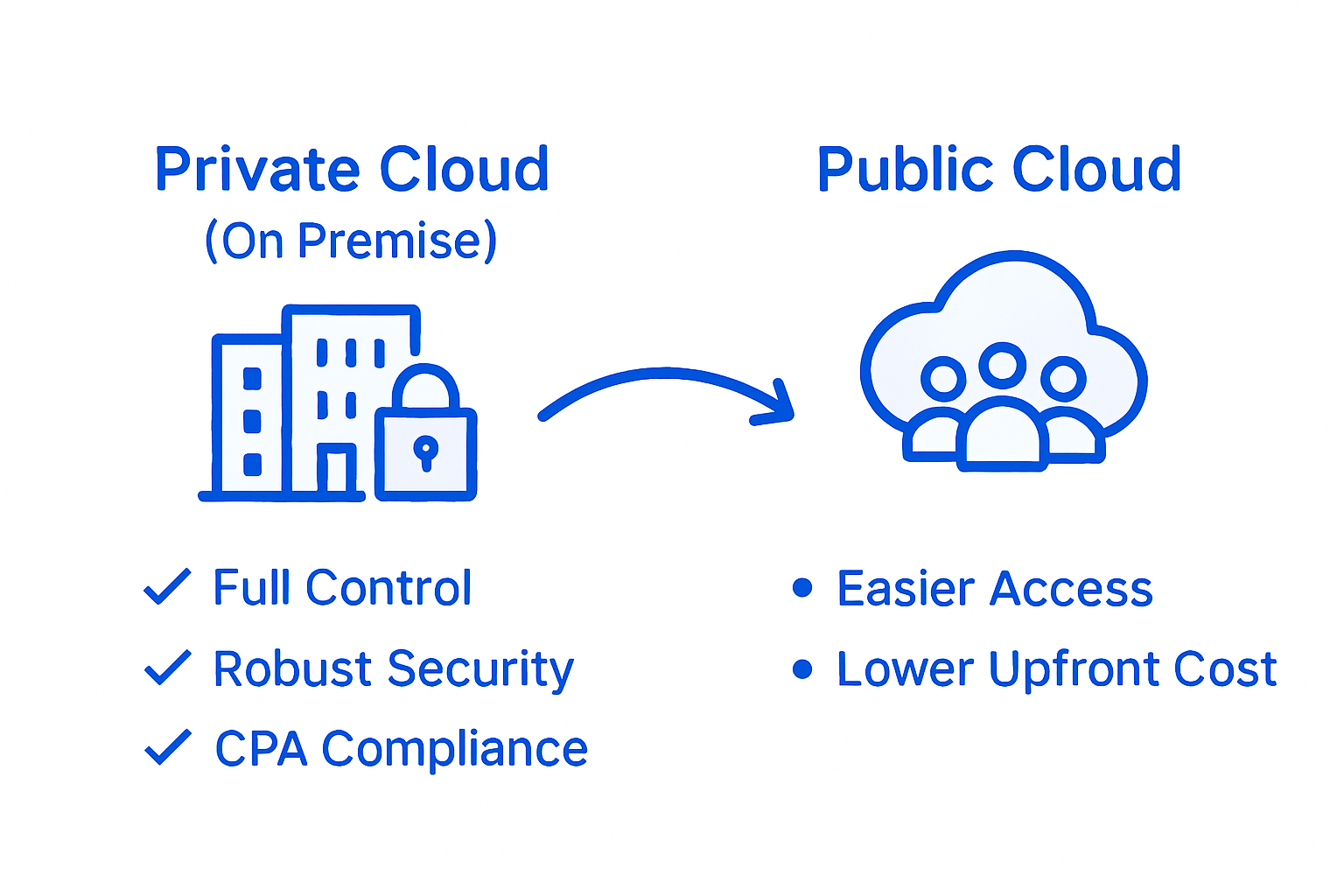
For accounting professionals navigating modern technology infrastructure, understanding the fundamental differences between public and private cloud models is crucial for making strategic IT decisions. Public cloud environments are shared resources accessible over the internet, managed by third-party providers, while private cloud solutions offer dedicated infrastructure exclusively controlled by a single organization.
The primary distinctions between these cloud models center on resource allocation, security, and management control. In a public cloud setup, multiple organizations share computing resources, which can reduce individual infrastructure costs but potentially compromise data isolation. Private clouds, conversely, provide complete infrastructure control, enabling accounting firms to customize network configurations, implement stringent security protocols, and maintain direct oversight of critical financial data.
Key comparative features include:
- Public Cloud
- Lower upfront infrastructure costs
- Shared computational resources
- Managed by third-party providers
- Scalable but less customizable
- Private Cloud
- Higher initial investment
- Exclusive resource allocation
- Complete organizational control
- Tailored security and compliance options
For CPAs handling sensitive financial information, the private cloud model often represents the most secure and compliant approach. By maintaining dedicated infrastructure, accounting professionals can ensure maximum data protection, meet rigorous regulatory requirements, and create a computing environment precisely aligned with their specific operational needs.
Features and Architecture of On Premise Cloud
On premise cloud architecture represents a sophisticated computing model designed specifically for organizations requiring maximum control and security. Private cloud infrastructure offers web-scale networking capabilities that dramatically improve scalability and operational agility, making it an ideal solution for accounting professionals who demand precise technological control.

The architectural framework of an on premise cloud is fundamentally different from traditional computing models. By establishing a dedicated private cloud environment, organizations can create a computing ecosystem that provides exclusive access to computational resources, ensuring complete infrastructure isolation and customized performance optimization.
Critical architectural components include:
- Dedicated hardware infrastructure
- Virtualization layers for resource allocation
- Advanced network segmentation
- Robust security middleware
- Customizable access management protocols
- Scalable computational resources
- Integrated backup and disaster recovery systems
Specifically for accounting firms, the on premise cloud architecture allows unprecedented levels of data protection and compliance. By maintaining direct control over infrastructure, CPAs can implement granular security protocols, ensure rapid incident response, and create a computing environment that meets the most stringent regulatory requirements while providing flexible, high-performance technological capabilities.
Compliance and Security for Miami Accountants
Miami accounting professionals face unique challenges in maintaining rigorous data protection and meeting complex regulatory requirements. Private cloud environments are specifically designed for organizations requiring highly secure IT infrastructure, making them an ideal solution for CPAs handling sensitive financial information and client data.
The security framework for accounting firms demands multi-layered protection strategies. Enhanced security controls in private cloud systems provide accounting professionals with customizable environments that meet strict industry compliance standards, including regulations specific to financial services and tax preparation.
Key compliance and security considerations include:
- Advanced encryption protocols
- Granular access management
- Real-time threat monitoring
- Comprehensive audit trail capabilities
- Regulatory compliance tracking
- Secure data segregation
- Rapid incident response mechanisms
For Miami accountants navigating complex regulatory landscapes, a robust cybersecurity approach for accounting firms means implementing proactive defense strategies. By leveraging dedicated cloud infrastructure, CPAs can create secure digital environments that protect client confidentiality, ensure data integrity, and maintain the highest standards of professional accountability while mitigating potential cybersecurity risks.
Cost, Maintenance, and Common Pitfalls
Accounting professionals must carefully evaluate the financial implications of on premise cloud infrastructure. Private cloud architecture can significantly lower total cost of ownership, with organizations reporting up to 60 percent reduction in expenses by implementing web-scale computing principles.
The financial considerations of on premise cloud solutions extend beyond initial investment. Private cloud environments require higher upfront costs but offer substantial long-term savings for businesses with predictable workloads, particularly for accounting firms with consistent computational requirements and stringent security needs.
Common challenges and potential pitfalls include:
- Substantial initial capital expenditure
- Complex infrastructure management
- Ongoing hardware maintenance costs
- Technical skill requirements
- Potential over-provisioning of resources
- Long-term technology upgrade commitments
- Risk of technological obsolescence
For Miami accounting firms, navigating these challenges requires strategic planning and expert guidance. Successful implementation means balancing initial investments with long-term efficiency, understanding precise computational needs, and developing a forward-looking technology strategy that aligns with the firm’s operational objectives and growth projections.
Secure Your Accounting Firm with On Premise Cloud Solutions Tailored for CPAs
Handling sensitive financial data demands uncompromising security and absolute control. This article highlights the critical need for dedicated infrastructure, customizable security protocols, and regulatory compliance that Miami accounting professionals face daily. If you strive to minimize vulnerabilities, prevent costly penalties, and protect client confidentiality, adopting a strategic on premise cloud approach is vital.
At Transform42, we don’t just manage IT—we align our service with your firm’s vision and operational goals. Benefit from 99.99% uptime, guaranteed 15-minute response times, and ironclad compliance that empower your team to focus on what matters most. Experience peace of mind with a partner who covers the cost if we fall short.
Ready to take control of your firm’s technology with a scalable, secure private cloud environment optimized for Miami accountants? Visit Transform42 today and discover how our cloud security solutions can eliminate downtime and regulatory risks for your practice.
Frequently Asked Questions
What are the key benefits of on premise cloud solutions for CPAs?
On premise cloud solutions provide CPAs with complete control over their infrastructure, enhanced data security, exclusive resource allocation, and the ability to customize network configurations to meet specific compliance and data protection requirements.
How does an on premise cloud differ from a public cloud?
An on premise cloud is a dedicated infrastructure solely for a single organization, offering greater control and security compared to a public cloud, which shares resources among multiple users and can compromise data isolation.
What are some of the critical architectural components of on premise cloud solutions?
Key architectural components include dedicated hardware infrastructure, virtualization layers for resource allocation, advanced network segmentation, robust security middleware, and customizable access management protocols.
What are the common challenges associated with implementing on premise cloud solutions?
Common challenges include substantial initial capital expenditure, complex infrastructure management, ongoing hardware maintenance costs, and the potential for over-provisioning resources, which requires careful strategic planning.
Recommended
- Complete Guide to Cyber Security for Miami CPAs – Stratgetic IT Consultants for Accountants
- Complete Guide to Cyber Security for Miami CPAs
- Complete Guide to the Role of Managed Services – Stratgetic IT Consultants for Accountants
- Understanding Types of Government Technology for CPAs – Stratgetic IT Consultants for Accountants