
TL;DR:
- Automation in government frees staff from repetitive tasks to focus on resident engagement and complex work.
- Miami’s agencies use AI and RPA to improve permit processing, fleet management, benefits, and HR workflows.
- Effective automation requires strong governance, oversight, resident feedback, and gradual scaling to avoid backlogs and loss of trust.
One public health agency automated 47 processes and saved 200 work years without eliminating a single department. That kind of result is no longer reserved for private enterprise. Miami-area agencies are already deploying automation across permitting, HR, and benefits administration, and the results are redefining what residents expect from government services. If you lead or manage a public sector organization in Miami, this guide will cut through the noise, clarify what these technologies actually do, show you what local agencies have achieved, and give you a practical blueprint to move forward with confidence.
Table of Contents
- What automation means in the public sector
- Miami’s automation journey: Real-world examples
- Benefits, risks, and the need for safeguards
- Getting started: Framework for automation success
- Why ‘perfect automation’ could backfire and what truly works
- Next steps: Partner with local automation experts
- Frequently asked questions
Key Takeaways
| Point | Details |
|---|---|
| Automation delivers major savings | Public sector automation can save years of staff time and millions of dollars if applied effectively. |
| Local success is real | Miami agencies have implemented automation projects that shorten service cycle times and enhance public experiences. |
| Balance efficiency with trust | Strong governance and human oversight are essential to prevent risks like bias and to maintain democratic values. |
| Start with high-impact processes | Target repetitive, rules-based workflows first to ensure quick wins and measurable improvements. |
| Automation is an ongoing journey | Successful transformation depends on adaptability, transparency, and thoughtfully managed innovation, not one-time fixes. |
What automation means in the public sector
Let’s be direct: automation in government is not about robots replacing civil servants. It is about freeing your team from the tasks that drain time without adding judgment or value.
Intelligent automation combines RPA (Robotic Process Automation), task mining, chatbots, and computer vision to handle repetitive, high-volume, rules-based processes. Think of RPA as a digital worker that follows a precise script, moving data, filling forms, and triggering notifications without human intervention. AI adds a layer of adaptive decision-making on top of that. AI applications in government include RPA for time savings and cost reduction, plus more advanced tools like natural language processing for resident inquiries.
Here is what these technologies look like in practice:
- RPA: Automates data entry, invoice processing, and records management
- AI chatbots: Handle resident FAQs, permit status inquiries, and appointment scheduling around the clock
- Process mining: Analyzes existing workflows to identify bottlenecks and automation candidates
- Computer vision: Reviews submitted documents and images for compliance checks
- Machine learning: Flags anomalies in benefit claims or budget reporting
Research estimates that 35 to 45 percent of federal government tasks are technically automatable using current technology. That is a significant opportunity for any agency willing to look closely at its own workflows.
Pro Tip: Start with your highest-volume, most rules-based tasks. Permitting intake, payroll exception handling, and HR onboarding paperwork are classic starting points because the rules are clear and the volume justifies the investment.
The concern that automation eliminates jobs misses the point. What it actually does is shift where people spend their time. Staff move away from repetitive data entry and toward resident engagement, policy interpretation, and complex case management. That is a better use of public talent, and most employees welcome it. For a broader view of how this technology is reshaping government, explore digital innovation for government and what AI’s future in public services looks like over the next decade.
Miami’s automation journey: Real-world examples
Miami is not waiting for permission. The city is already moving, and the results offer a clear picture of what is possible for agencies at various stages of their automation journey.

The most notable recent example is the City of Miami’s adoption of Oracle Permitting and Licensing (OPAL), which uses AI to automate review processes and significantly reduce permit cycle times. Before OPAL, permit applications required manual routing, redundant data entry, and slow interdepartmental handoffs. After implementation, review cycles shortened, staff workload dropped, and residents gained real-time visibility into their application status.
| Project | Technology used | Key outcome |
|---|---|---|
| OPAL permitting (Miami) | Oracle AI, workflow automation | Reduced permit cycle times, less manual review |
| Fleet management automation | IoT sensors, predictive analytics | Lower maintenance costs, fewer vehicle downtime incidents |
| Benefits administration RPA | RPA bots, process mining | Faster claim processing, reduced backlogs |
| HR onboarding automation | RPA, digital forms | Shorter onboarding cycles, fewer data errors |
“Agencies that invest in automation as a service delivery strategy, not just a cost-cutting tool, consistently report higher resident satisfaction scores alongside measurable efficiency gains.”
Other U.S. examples reinforce Miami’s direction. Georgia’s Department of Labor deployed RPA to process unemployment claims faster during peak demand periods. Connecticut ran a successful RPA pilot for its SNAP benefits program, reducing processing time by over 80 percent for routine eligibility checks. These results transfer directly to Miami’s context, where a diverse, multilingual population places high demand on timely, accurate service.
The challenges Miami agencies faced were real. Legacy systems required custom integration work. Staff needed change management support to trust the new tools. Interdepartmental data silos slowed early pilots. The agencies that succeeded treated these obstacles as design problems rather than reasons to delay. They built cross-functional teams, invested in training, and maintained open feedback loops with frontline workers. You can read more about this kind of public sector transformation and technology trends in government to benchmark your own planning.
Benefits, risks, and the need for safeguards
Automation delivers real value. But it also introduces risks that Miami decision-makers cannot afford to ignore.
| Benefits | Risks |
|---|---|
| Significant cost savings | Algorithmic bias in decision-making |
| Faster service delivery | Lack of transparency for residents |
| Higher accuracy, fewer errors | Increased service demand overwhelming systems |
| 24/7 availability for residents | Digital divide excluding vulnerable populations |
| Staff freed for complex tasks | Accountability gaps in automated decisions |
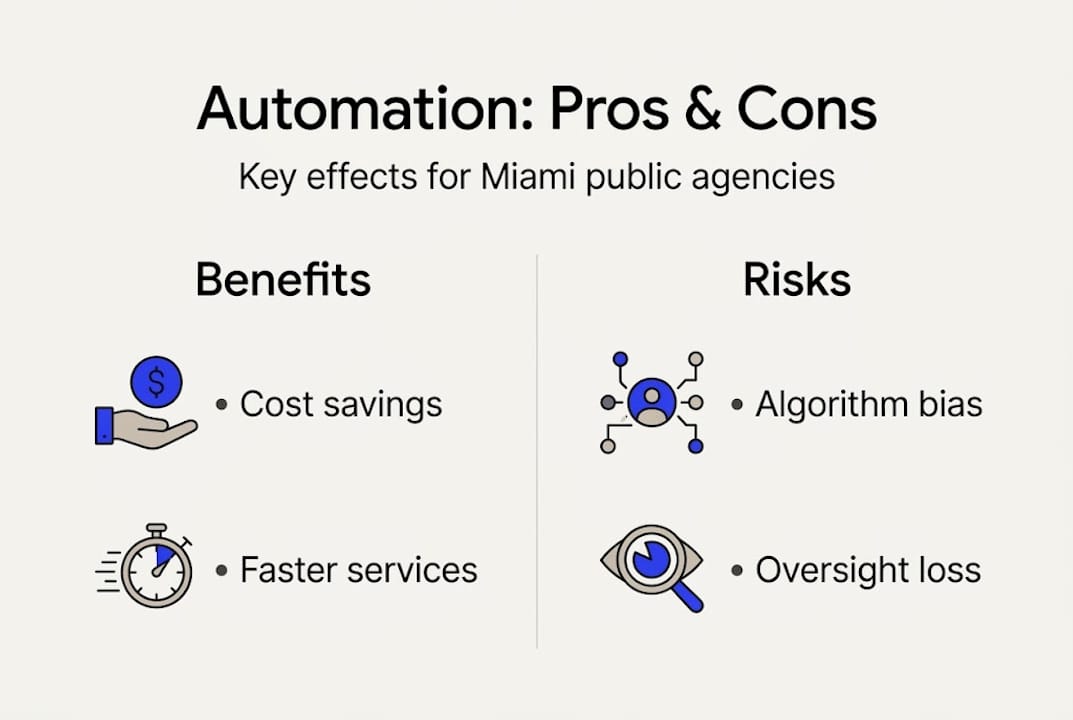
The financial case is strong. Federal AI automation potential is estimated at $40 to $70 billion in annual savings, and Miami agencies operate within that same economic logic. Faster permitting accelerates development. Automated benefits processing reduces operational costs. Fewer manual errors mean fewer costly corrections.
But the risks are equally concrete. Algorithmic bias has eroded public trust in government automation cases in Brazil and the Netherlands, where automated systems made consequential decisions without adequate human review. That is not a distant problem. It is a blueprint for what happens when speed outpaces oversight.
Here are the essential safeguards every Miami agency should put in place:
- Responsible governance framework: Establish clear ownership and accountability for every automated process before launch
- Human oversight for exceptions: Any automated decision affecting a resident’s rights or benefits must have a human review pathway
- Audit trails: Every automated action should be logged, timestamped, and reviewable
- Bias testing: Run regular audits to check whether automated decisions produce disparate outcomes across demographic groups
- Digital inclusion strategy: Ensure residents without digital access can still receive services through alternative channels
Over-efficiency without these checks does not just create operational risk. It can undermine democratic accountability. When residents cannot understand why a decision was made or who is responsible, trust erodes fast. Explore how automation and compliance work together to keep your agency both efficient and accountable.
Getting started: Framework for automation success
Knowing automation is valuable and actually implementing it successfully are two different things. Here is a practical framework built for Miami public sector realities.
Key steps to launch automation effectively:
- Process mining first: Map your current workflows before buying any tool. You need to know where time is actually lost before you can fix it
- Secure executive sponsorship: Automation initiatives without visible leadership support stall. Get a champion at the director or commissioner level
- Build a cross-functional team: Include IT, operations, legal, and frontline staff from day one. Siloed implementation produces siloed results
- Pilot on contained, high-volume tasks: Choose a workflow that is repetitive, well-documented, and measurable
- Define success metrics before you start: Time saved, error rate reduction, and cost per transaction are your baseline measures
- Measure, learn, then scale: Do not attempt agency-wide rollout from a single pilot. Earn confidence through results
Pro Tip: Permitting intake and HR onboarding are ideal pilots. Both involve high transaction volumes, clear rules, and measurable cycle times, giving you fast, defensible evidence of ROI to share with stakeholders.
Prioritize structured governance from the start: executive sponsorship, a steering committee, human-in-the-loop checkpoints for exceptions, and full audit trails. This is not optional bureaucracy. It is what protects your agency when something unexpected happens.
As your program matures, evolve from basic RPA toward agentic AI and hyperautomation. These advanced tools handle unstructured data and make adaptive decisions, opening up more complex use cases like dynamic resource allocation and predictive maintenance. But that evolution works only when your foundational governance is solid. Start your journey with the right digital transformation strategies and consider working with digital transformation consulting in Miami to accelerate results.
Why ‘perfect automation’ could backfire and what truly works
Here is something most automation vendors will not tell you: making a government process perfectly efficient can actually make the underlying problem worse.
Research on AI increasing service demand describes a real phenomenon. When you remove friction from accessing a service, more people use it. That is good for equity. But without adequate capacity planning, newly automated services can create backlogs that dwarf the original problem. Faster intake with the same processing capacity is just a bottleneck that moved.
There is also a deeper governance issue. Democratic systems are built on friction. Deliberation, appeals, human judgment, and public accountability are not inefficiencies to be automated away. They are features. Agencies that rush to eliminate human touchpoints often discover they have also eliminated the mechanisms residents use to push back, appeal decisions, and hold government accountable.
We have seen this pattern repeatedly. A department automates a process, proudly reports 60 percent faster cycle times, then faces a wave of resident complaints because edge cases are falling through the system with no clear escalation path. The lesson is not to slow down automation. It is to build for adaptability, not just speed.
For Miami agencies, success means treating automation as an ongoing discipline, not a one-time project. Invest in resident feedback loops. Review your automated decisions quarterly. Engage community stakeholders before scaling. Use your roadmap for digital transformation as a living document, not a finished blueprint.
Next steps: Partner with local automation experts
The gap between knowing automation works and making it work inside your agency is where most initiatives stall. That gap is exactly where we focus.
Our team works with Miami organizations to audit existing processes, identify high-impact automation candidates, and build governance structures that hold up under scrutiny. We understand local regulatory realities, interdepartmental workflows, and the resident engagement expectations that shape every decision you make. Whether you are launching your first pilot or scaling an existing program, our public sector technology solutions and digital transformation initiatives give you a practical path forward. Book a discovery session today and turn your automation ambitions into measurable results.
Frequently asked questions
What are the first steps for a Miami agency considering automation?
Start with process mining to identify repetitive tasks, secure executive sponsorship, and launch a pilot with clear success metrics. Structured governance and piloting high-volume tasks are the proven starting points.
What public sector processes are most suitable for automation?
HR onboarding, benefits administration, permitting, and other high-volume, rules-based tasks offer the most value. One agency automated 47 processes including employee onboarding and benefits systems with strong results.
What are the major risks of public sector automation?
Risks include algorithmic bias, transparency gaps, and possible loss of public trust if not properly managed. Algorithmic bias and accountability gaps have already eroded trust in multiple government contexts worldwide.
How can agencies prevent automation from creating new problems?
Implement strong governance, run regular audits, maintain human oversight for exceptions, and actively seek resident feedback. Human-in-loop checkpoints and audit trails are non-negotiable safeguards for any automated government process.
Will automation replace public sector jobs?
Automation mostly shifts routine work away from people so staff can focus on more meaningful, complex cases. Automation offloads repetitive tasks, shifting emphasis to higher-value work rather than eliminating positions outright.