TL;DR:
- Effective smart government solutions require measurable impact, seamless integration, and proper governance.
- Miami-Dade’s AI strategy and Coral Gables’ open data platform demonstrate phased, results-driven implementations.
- Global examples like Singapore’s digital twin and chatbots show significant cost savings and improved citizen service.
Miami government leaders face a real problem: there are more smart government solutions on the market than ever before, yet most produce demos instead of results. Picking the wrong tool wastes budget, frustrates staff, and erodes public trust. The good news is that proven, results-driven examples already exist, right here in South Florida and around the world. This article gives you a practical selection framework, highlights what Miami-Dade, Coral Gables, and Singapore have achieved in measurable terms, and shows you exactly how to compare options before committing your agency’s resources.
Table of Contents
- Key criteria for choosing smart government solutions
- Miami-Dade County’s AI strategy: Local best practices
- Global success stories: Singapore’s digital twin and AI chatbots
- Coral Gables Smart City Hub: Open data and engagement for South Florida
- Comparing top smart government solution models
- Miami’s smart future: Beyond technology for lasting impact
- Next steps: Accelerate your smart government transformation
- Frequently asked questions
Key Takeaways
| Point | Details |
|---|---|
| Clear criteria matter | Evaluating solutions by impact, integration, and governance ensures Miami agencies invest in what works. |
| Local and global examples | Draw lessons from Miami-Dade, Singapore, and Coral Gables to choose scalable, proven smart projects. |
| Collaboration fuels results | Prioritizing interagency teamwork and workforce upskilling is essential for lasting smart city success. |
| Phased rollouts minimize risk | Starting small and focusing on data governance allows for safer, effective technology adoption. |
Key criteria for choosing smart government solutions
Not every technology that works in Silicon Valley will work in a Miami government office. Your agency has specific data structures, citizen demographics, and regulatory requirements that generic off-the-shelf software rarely accounts for. Knowing which criteria to apply upfront saves months of painful backtracking.
Start with these non-negotiables when evaluating any solution:
- Measurable impact targets: Define success before you buy. Shorter permit processing times, higher digital engagement rates, and documented cost savings should be written into vendor agreements.
- Integration capacity: Can the solution connect with your existing databases, GIS platforms, and legacy systems? A tool that creates another data silo is a step backward.
- Privacy and security compliance: Any platform handling citizen data must meet federal and Florida state data protection requirements.
- Customization to local needs: Miami’s bilingual population, hurricane preparedness cycles, and urban density require solutions tailored to those realities.
- Phased rollout design: Start small, measure outcomes, then scale. This protects your budget and builds internal confidence.
- Workforce upskilling plan: Technology without trained users underperforms every time.
As phased rollouts address governance, edge cases and data silos make government smart solution deployments complex, particularly around security and privacy risks. Digital transformation strategies that account for these realities from day one outperform reactive approaches. Look also at how centralized planning in smart cities like Singapore and Dubai reinforces governance structures that Miami can adapt.
Pro Tip: Before issuing any RFP, map every department that will touch the new system. Hidden integration points discovered late in deployment are the number one cause of project overruns in government technology projects.
Innovation for government works best when it is built around the people it serves, not just the technology being deployed.
Miami-Dade County’s AI strategy: Local best practices
Miami-Dade County is not waiting for other cities to figure this out first. The county’s 2025 AI strategy shows what thoughtful, phased implementation actually looks like in a large, diverse public sector environment.
Key initiatives currently in motion include:
- AI-powered 311 services: Automated case routing and response generation reduces resolution times and frees staff for complex issues.
- Smart energy management: AI systems monitor and optimize energy consumption across public buildings, cutting operational costs.
- Environmental monitoring: Real-time data collection supports faster response to flooding, air quality events, and urban heat risks.
- Governance frameworks: The county has built oversight protocols specifically to prevent AI hallucinations from reaching citizen-facing outputs.
- Staff upskilling programs: Employees are trained to work alongside AI tools rather than be displaced by them.
Miami-Dade’s phased AI implementation covers 311 services, energy efficiency, and environmental management, with a deliberate focus on governance and upskilling to avoid common pitfalls. These smart government tech examples demonstrate that real outcomes come from disciplined execution, not just ambitious planning.
Pro Tip: If your agency is just starting out, the 311 AI model is one of the most replicable. It has a clear input, a measurable output, and a defined citizen interaction point. That makes it easier to pilot, evaluate, and scale.
Understanding how AI shapes public services is essential for any Miami agency that wants to stay ahead of rising citizen expectations without burning through its operating budget.
Global success stories: Singapore’s digital twin and AI chatbots
Miami is not alone in this journey. Singapore has built some of the most data-rich, results-proven smart government programs in the world, and the numbers are hard to ignore.
Virtual Singapore is a city-scale digital twin that lets planners simulate construction projects, model solar energy potential, and analyze emergency evacuation routes before a single dollar is spent on physical work. The digital twin reduced mapping costs by 83%, cut project delivery timelines by 67%, and saved $29 million through smarter urban planning decisions. Miami’s complex coastal infrastructure and dense urban core make this kind of simulation tool immediately relevant.
Singapore’s AI chatbots tell an equally compelling story. Platforms like CPF, HealthBuddy, and Ask Jamie handle multilingual citizen queries around the clock. The AI chatbots reduced call center workload by 50% and cut response times by 80%. For a multilingual city like Miami, that efficiency gain translates directly into better service for Spanish-speaking residents.
| Smart solution | Key outcome | Estimated savings |
|---|---|---|
| Virtual Singapore digital twin | 67% faster project delivery | $29 million |
| Singapore AI chatbots | 80% faster citizen response | 50% call center reduction |
“The most effective smart city investments combine citizen-centric design with transparent governance. Technology alone is not the differentiator. Execution is.”
Miami agencies exploring public sector digital transformation can draw directly from Singapore’s blueprint, adapting scale and language capabilities to South Florida’s context.
Coral Gables Smart City Hub: Open data and engagement for South Florida
You do not have to look to Southeast Asia for inspiration. Coral Gables, right here in Miami-Dade County, has built a smart city platform that delivers measurable gains for residents and staff alike.
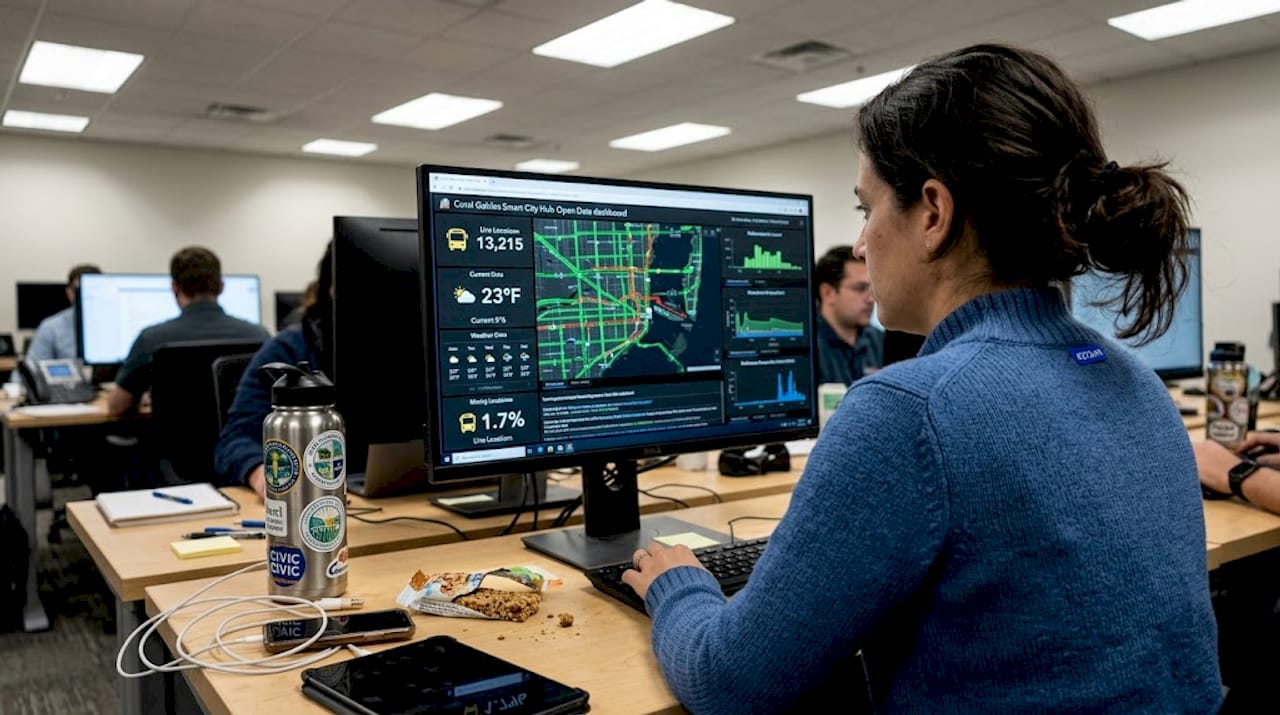
The Coral Gables Smart City Hub aggregates data from IoT sensors, GIS mapping, and public APIs into a single, accessible platform. The results are concrete: the Smart City Hub reduced service access time by 10% and increased citizen engagement by 20%. Those numbers may sound modest, but at scale they represent thousands of residents served faster and more interactions captured for future improvement.
| Feature | Traditional city portal | Coral Gables Smart City Hub |
|---|---|---|
| Data sources | Single department | IoT, GIS, multiple APIs |
| Citizen engagement | Passive information display | Interactive, real-time updates |
| Service access time | Baseline | 10% reduction |
| Engagement level | Baseline | 20% increase |
Here is what Miami agencies can do right now based on the Coral Gables model:
- Audit existing open data assets across departments before building anything new.
- Identify the top five citizen service requests and prioritize digital access for those first.
- Connect IoT for government ROI analysis to your budget justification process.
- Use engagement metrics, not just cost metrics, to evaluate platform success.
Boosting efficiency with smart governance starts with knowing what data you already have and making it work harder before investing in new infrastructure.
Comparing top smart government solution models
With three strong case studies reviewed, a side-by-side comparison makes it easier for Miami agencies to align the right model with their specific priorities.
| Program | Primary focus | Efficiency gain | Cost impact | Citizen engagement |
|---|---|---|---|---|
| Miami-Dade AI strategy | AI-powered services, energy | High | Reduced operational cost | Improved 311 response |
| Singapore Virtual Twin | Urban planning simulation | 67% faster delivery | $29M savings | Indirect, planner-focused |
| Singapore AI chatbots | Citizen query handling | 80% faster response | 50% call center reduction | Direct, high volume |
| Coral Gables Smart Hub | Open data, IoT aggregation | Moderate, consistent | Low upfront, scalable | 20% engagement increase |
Use this comparison with a numbered action plan:
- Identify your primary pain point. Is it operational cost, service speed, or citizen satisfaction? Your answer determines which model to benchmark first.
- Assess your data readiness. Digital twins and AI require clean, accessible data. Audit your current state before selecting a vendor.
- Start with a pilot, not a full deployment. Every successful program above began with a contained, measurable phase.
- Build in governance from day one. Security, privacy, and staff training are not afterthoughts. Budget for them.
- Track the right metrics. Time-to-resolution, engagement rates, and cost-per-service interaction are more useful than vanity metrics like app downloads.
Staying current with top government technology trends ensures your agency is evaluating the right options as the landscape continues to evolve.
Miami’s smart future: Beyond technology for lasting impact
Here is an uncomfortable truth most smart city roundups skip: the agencies that struggle most with digital transformation are rarely the ones that chose the wrong software. They are the ones that underinvested in the human side of change.
Technology is the easy part. Convincing three departments with different database formats and competing budget priorities to share data in real time? That is the hard part. Miami’s real advantage is not its access to vendors. It is the opportunity to build genuine interagency collaboration before problems become crises.
Most pilots that fail do so because they were designed to impress a procurement committee, not to survive contact with day-to-day operations. Flashy demos win approvals. Boring governance wins outcomes. The cities that sustain smart government results, year after year, are the ones that treat workforce upskilling and data alignment as core budget items, not optional line items.
We believe Miami’s agencies should be as ambitious about their collaboration frameworks as they are about their technology selections. Public sector progress that lasts is built on multi-year vision, strong interagency trust, and a commitment to measuring what actually matters to residents. That is what separates genuine innovation from a successful press release.
Next steps: Accelerate your smart government transformation
If your agency is ready to move from evaluation to execution, the right partner makes all the difference. We work with Miami organizations to build smart government technology solutions that are practical, compliant, and designed to scale with your needs.
Whether your priority is AI integration, IoT infrastructure, open data platforms, or change management support, we bring the technical depth and local context to help you get it right the first time. Explore how workflow automation for Miami can streamline your agency’s processes today. Reach out to the Transform42 team for a no-obligation consultation and find out how we can tailor a roadmap specifically for your department’s goals.
Frequently asked questions
What is a smart government solution?
A smart government solution uses advanced technologies like AI, IoT, and digital twins to improve service delivery, operational efficiency, and public engagement. Miami-Dade County’s AI, energy, and environmental strategies exemplify what these solutions look like in practice.
How did Singapore’s digital twin project benefit the government?
It reduced mapping costs by over 80%, cut project timelines by nearly two-thirds, and saved millions on city planning efforts. The Virtual Singapore impact data shows these are not projections but verified outcomes.
What’s the biggest hurdle for Miami adopting smart solutions?
The biggest hurdle is integrating siloed data across agencies while ensuring governance and privacy are addressed through phased rollouts. Miami’s phased governance approach tackles these challenges with structured oversight and training.
Are smart government projects affordable for smaller cities?
Yes, solutions like Miami-Dade’s phased AI rollout or Coral Gables’ open-data hub show that scalable pilots can demonstrate value without massive upfront investment. The Coral Gables Smart City Hub improved both engagement and service access at a manageable scale.