TL;DR:
- Digital agility enables small Miami practices to double revenue and handle more clients efficiently.
- Implementing low-cost automation and staff training accelerates growth without large IT investments.
- Hybrid agile frameworks and leadership buy-in are essential for overcoming barriers and ensuring success.
Solo and small independent practices in Miami are sitting on a revenue opportunity that most overlook. Solo and small law firms using efficiency tools and AI are achieving 2x revenue growth compared to industry averages, yet the majority of independent healthcare and legal professionals still treat technology as a cost rather than a growth engine. Digital agility, the ability to rapidly adopt and adapt technology to meet shifting demands, is not a privilege reserved for large hospital networks or big law. It is a practical, scalable strategy that independent Miami practitioners can deploy right now to increase revenue, reduce overhead, and build practices that grow without burning you out.
Table of Contents
- Defining digital agility: What it means for Miami professionals
- The revenue impact: How digital agility scales practices
- Approaches and frameworks: Agile, hybrid, and digital fluency
- Overcoming barriers: Training, infrastructure, and resistance
- Our take: Why Miami professionals should rethink digital agility
- Ready to scale your Miami practice?
- Frequently asked questions
Key Takeaways
| Point | Details |
|---|---|
| Digital agility defined | Rapid, flexible tech adoption enables Miami professionals to quickly scale and adapt to new challenges. |
| Measurable revenue gains | Healthcare and legal practices implementing digital agility see double revenue and reduced workload within 18 months. |
| Hybrid agile is best | Combining structured planning with iterative updates is ideal for compliance-heavy, complex Miami environments. |
| Overcoming barriers | Leadership, phased pilots, and targeted upskilling are essential for successfully adopting digital agility. |
| Practical next steps | Start with workflow automation, audit tools, and low-code pilots to begin scaling your Miami practice. |
Defining digital agility: What it means for Miami professionals
Digital agility is not a buzzword. It is a measurable capability. At its core, digital agility means your practice can adopt new tools, pivot processes, and respond to market or regulatory changes faster than your competition. For Miami’s independent doctors, lawyers, and accountants, this speed and flexibility translate directly into more clients served, fewer administrative bottlenecks, and compliance handled without panic.
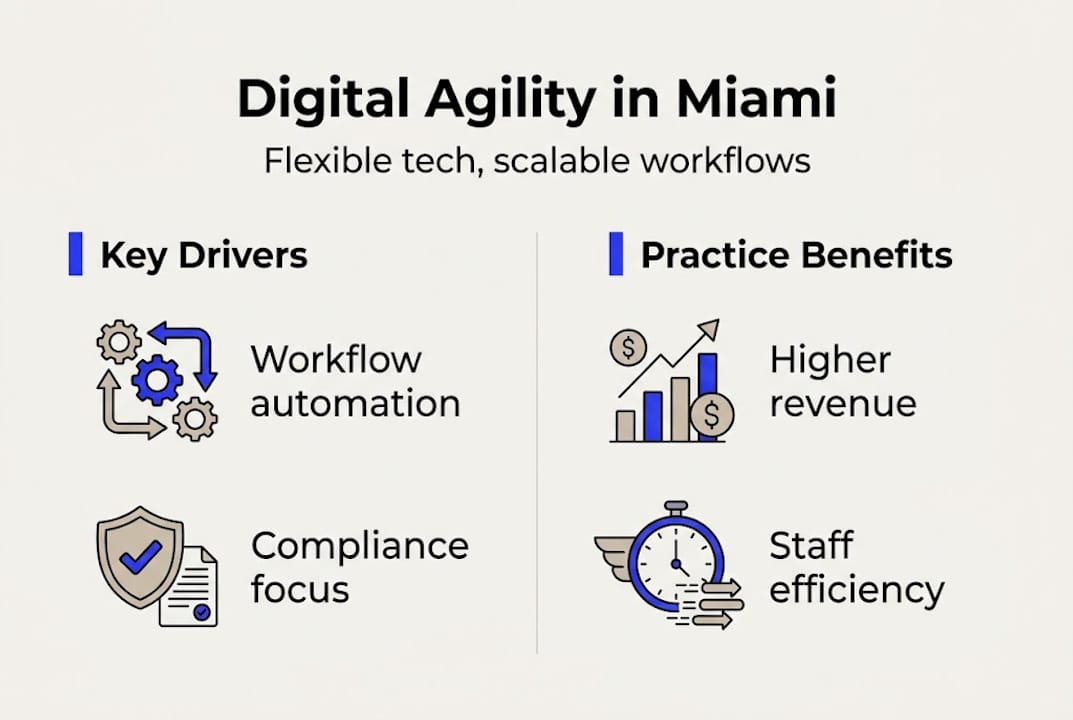
Many professionals in Miami assume digital agility requires a massive IT budget or a dedicated tech team. That assumption is wrong, and it is costing them revenue. The real mechanics of digital agility are accessible to any practice willing to invest time and strategy.
According to CIO’s IT agility guide, the core mechanics include agile software development, automation of repetitive processes, low-code platforms, self-service tools, hybrid agile approaches, and continuous training for digital literacy. Each of these components can be implemented in stages, without overhauling your entire operation overnight.
Here is what each mechanic looks like inside a real Miami practice:
- Agile software development: Instead of waiting for a perfect system, you build and refine digital tools in short cycles, testing what works with real patients or clients.
- Automation: Appointment reminders, billing follow-ups, document generation, and intake forms can all run without your staff touching them.
- Low-code platforms: Tools like Microsoft Power Apps or Zoho Creator let your team build custom workflows without a software engineer on payroll.
- Self-service tools: Patient portals, client document upload systems, and online scheduling give your clients control while freeing your staff.
- Hybrid agile approaches: Combining structured planning with flexible execution, which is especially valuable in compliance-heavy environments like healthcare and law.
- Continuous training: Digital literacy is not a one-time event. It is an ongoing investment that keeps your team capable and confident.
For Miami professionals specifically, the compliance landscape adds urgency. Florida’s healthcare regulations, HIPAA requirements, Florida Bar rules, and evolving telehealth standards mean your digital systems must be both fast and airtight. Exploring digital innovation best practices shaped for regulated industries gives you a foundation that balances speed with protection.
Digital agility also reshapes how you think about growth. Instead of adding staff every time client volume increases, an agile practice uses technology to absorb more volume with the same team. That is vertical scaling, and it is how independent Miami professionals reach eight-figure revenue trajectories without hiring an army.
The revenue impact: How digital agility scales practices
Understanding what digital agility is matters. Understanding what it does to your revenue is what drives action.
The numbers are striking. Digital agility research consistently shows that technology adoption enables 2x revenue growth, allows practices to handle 25 to 37 percent more cases or patients, and helps healthcare professionals cut administrative time by up to 50 percent. Digital health technology (DHT) improves performance with a beta coefficient of 0.452 and reduces workload burden at 0.594, meaning your team does more and feels less stretched.
Healthcare practices adopting digital tools through a structured framework show consistent gains in both service delivery and financial performance. Research using the TOE framework, which stands for Technology, Organization, and Environment, confirms that DHT adoption mediates real performance improvements in healthcare settings. This is not theory. These are documented outcomes from practices structured just like yours.
Here is how those numbers look when applied to a Miami context:
| Practice type | Without digital agility | With digital agility |
|---|---|---|
| Solo law firm (annual revenue) | $280,000 | $560,000+ |
| Independent medical practice (patients/week) | 60 patients | 80 to 90 patients |
| Healthcare admin time (weekly hours) | 20 hours | 10 hours |
| Case/client volume increase | Baseline | 25 to 37% higher |
These are not hypothetical projections. They reflect what happens when Miami practices follow a structured workflow automation scaling guide and commit to replacing manual processes with intelligent systems.
For legal professionals, the gains show up in billable hours recovered. When a Miami attorney automates client intake, contract generation, and follow-up scheduling, they recapture an average of 8 to 12 hours per week. At a billing rate of $300 per hour, that is $2,400 to $3,600 added to weekly revenue without a single new client. Multiply that across a year and the impact becomes impossible to ignore.
For healthcare practices, automation reduces the administrative drag that burns out clinical staff. When billing, prior authorizations, and appointment reminders run automatically, your nurses and coordinators focus on patient care, which improves outcomes and satisfaction scores. Better scores attract more patients and better reimbursement rates. The system feeds itself.
Pro Tip: Track your digital initiative ROI through three lenses: billable hours or patient volume recovered, compliance incident reduction, and staff hours freed from administrative tasks. Review these numbers monthly during your first year of implementation. This gives you clear evidence to justify further technology investment and helps you spot which tools are delivering real value.
Understanding how to boost workflow efficiency at the process level is the first step. Connecting those efficiency gains to Miami-specific digital strategy trends gives you the context to prioritize where to invest first.
Approaches and frameworks: Agile, hybrid, and digital fluency
Once you see the revenue potential, the next question is how to get there without disrupting your practice. The answer depends on which framework fits your environment.

Pure agile works well for technology companies. It prioritizes speed, iteration, and frequent change. For a law firm handling complex litigation or a medical practice managing chronic care protocols, pure agile can introduce instability in areas where consistency is non-negotiable.
Hybrid agile is the better fit for most Miami professionals. Hybrid approaches combine predictive planning with iterative development, making them highly effective for complex and regulatory-driven projects. You plan your compliance requirements in advance and then iterate on the technology that supports them. This gives you the best of both worlds.
Here is a side-by-side comparison:
| Framework | Best for | Risk level | Compliance fit |
|---|---|---|---|
| Pure agile | Software teams, startups | Higher for regulated work | Low |
| Hybrid agile | Healthcare, legal, compliance-heavy | Moderate, manageable | High |
| Traditional waterfall | One-time, fixed projects | Low flexibility | Moderate |
Beyond the framework choice, digital fluency is the underlying capability that determines how far your practice can go. Digital fluency describes the maturity level of your team’s relationship with technology, ranging from reactive to anticipatory.
Organizations operating at the reactive level face a 70 to 80 percent failure rate in digital initiatives, while those reaching anticipatory leadership see dramatically higher success rates and sustained competitive advantage.
This means the practices that treat technology as a fire to fight rather than a strategy to lead are statistically positioned to fail most of their digital projects. Moving from reactive to anticipatory requires intentional digital leadership transformation, not just buying new software.
Key characteristics of each digital fluency level:
- Reactive: Technology adopted under crisis pressure, no clear strategy, high resistance from staff, frequent project failures.
- Adaptive: Technology adopted with some planning, moderate staff buy-in, inconsistent outcomes, dependent on individual champions.
- Anticipatory: Technology embedded in strategy, leadership drives adoption, continuous improvement culture, consistent revenue gains.
For Miami practitioners serious about scaling, the target is anticipatory. Getting there requires committed digital transformation strategies and a willingness to treat your practice like the business it is. The innovation blueprint for digital success lays out a structured path from wherever you are today to where your revenue goals demand you be.
Overcoming barriers: Training, infrastructure, and resistance
Even the clearest framework hits real-world friction. Miami independent practices face specific barriers that, if not addressed deliberately, stall digital agility before it gains momentum.
The three most common barriers are training gaps, outdated infrastructure, and internal resistance to change. Research confirms that these challenges are overcome most reliably through leadership buy-in, phased pilots, and consistent upskilling programs. Each of these requires a different kind of commitment, but none requires a massive budget.
Here is a practical numbered framework for breaking through resistance in a Miami practice:
-
Audit your current tools first. Before adding anything new, document what systems your practice currently uses, which ones your team actually trusts, and where the biggest time losses occur. This baseline prevents redundant spending and identifies your highest-leverage starting points.
-
Secure leadership buy-in before launch. If you are the practice owner, this means committing publicly to the change. If you are part of a group practice, it means bringing data to your partners before the first meeting. Skepticism from leadership kills adoption faster than any technical barrier.
-
Run a micro-pilot with one process. Choose one workflow: patient intake, appointment reminders, or contract generation. Automate only that process and measure results for 60 days. A small, visible win builds credibility for the next step.
-
Train in context, not in isolation. Generic software training rarely sticks. Train your staff on the exact workflows they use daily, using the actual tools they will touch. Contextual training cuts adoption time significantly.
-
Review and expand based on data. At the end of each pilot, review your three key metrics: time saved, errors reduced, and revenue affected. Use that data to decide what to automate next. Scale deliberately, not reactively.
Understanding digital era leadership skills is essential at this stage. Resistance to change is rarely about the technology itself. It is about trust. Staff members who feel unheard or unprepared will undermine even the best systems. A leader who communicates the “why” behind digital adoption and involves the team in process design earns buy-in instead of fighting it. The commitment to empowering your workforce through technology change is what separates practices that scale from those that stall.
Pro Tip: Start your digital agility journey with a micro-pilot limited to one workflow and one tool. After 60 days, conduct a simple adoption audit: how often is the tool used, which team members adopted it, and what time or errors did it save? This data becomes your internal business case for the next phase of implementation.
Miami’s market is competitive and fast-moving. Healthcare professionals face reimbursement pressure, telehealth expansion, and new patient expectations. Legal professionals navigate evolving regulations, client demand for speed, and pricing pressure from online legal services. The practices that build digital agility as a core capability now will be positioned to absorb these pressures and convert them into competitive advantage.
Our take: Why Miami professionals should rethink digital agility
Most conversations about digital agility focus on tools. We think that misses the point entirely. The real opportunity is in operating model design, not software selection. Miami professionals who spend months evaluating the perfect EHR or practice management platform often end up with expensive software their team barely uses. The question is not which tool to buy. It is how to build a practice that adapts faster than its market.
The hybrid agile approach is underused and underappreciated in Miami’s independent practice community. It accounts for the complexity and compliance requirements that make pure agile impractical, while still delivering the speed and iteration that drive growth. Pair that with genuine leadership commitment and contextual staff training, and you have a formula that does not require a six-figure IT budget.
Miami’s unique environment, its regulatory density, its multilingual patient and client base, and its position as a gateway to Latin American markets, actually makes digital agility more valuable here than in most other U.S. markets. The practices that recognize this and explore Miami innovation best practices will find that digital agility pressure is not a threat. It is the clearest path to sustainable seven and eight-figure revenue.
Ready to scale your Miami practice?
The strategies in this article work. But knowing them and executing them are two different things. That is where we come in.
We help doctors, lawyers, and accountants in Miami implement the technology, automation, and compliance infrastructure that drives real revenue growth. Our team specializes in Miami technology consulting built specifically for independent professionals who want to scale without proportional hiring. Whether you need workflow automation, compliance-ready digital systems, or a full digital transformation guidance roadmap, we handle the technology so you can focus on your clients. We also support integrated healthcare consulting for practices ready to modernize patient delivery. Let’s build the capabilities your clients expect. Contact us today to get started.
Frequently asked questions
How can Miami healthcare and legal professionals start with digital agility?
Begin with low-code platforms for workflow automation, pilot one simple process, and prioritize staff upskilling to ensure fast adoption. Investing targeted technology budget in the right tools positions solo and small practices for 2x growth potential within 12 to 18 months.
What barriers do Miami professionals face in adopting digital agility?
The main barriers are training gaps, outdated infrastructure, and internal resistance to change. Leadership buy-in, phased pilots, and upskilling are the most reliable strategies for overcoming each of these obstacles without disrupting active client or patient care.
Is digital agility only about technology, or does it impact leadership?
Digital agility requires both technology and strong leadership to succeed. Agility pressure creates opportunity but demands that leaders prioritize flexibility over excessive control and actively champion a culture where innovation is expected, not feared.
How quickly can digital agility increase revenue in Miami practices?
With targeted implementation, most practices see measurable revenue gains and workload relief within 12 to 18 months. Solo and small law firms using efficiency tools and AI report doubling revenue and significantly increasing case volume within that window.
What frameworks should Miami practices use for compliance-heavy digital agility?
Hybrid agile frameworks are the strongest fit for compliance-heavy environments. Hybrid agile approaches combining structured predictive planning with iterative development are specifically proven effective for complex and regulatory-driven projects like those in healthcare and law.