
TL;DR:
- Managing human change is crucial for successful technology adoption in accounting firms.
- Incremental rollout, stakeholder engagement, and continuous support improve adoption and long-term success.
- Effective change management requires at least 18 months of ongoing behavioral governance and reinforcement.
Technology is not the biggest obstacle standing between your accounting practice and its next level of growth. The real challenge is managing the human side of change. Most Miami accountants and financial advisors invest heavily in selecting the right software, automating workflows, or deploying AI in financial reporting, yet still face slow adoption, staff resistance, and compliance gaps after go-live. Structured change management is what separates firms that thrive after a tech rollout from those that stall. This guide breaks down what change management actually means, why it matters specifically for your practice in Miami, and how to apply it step by step.
Table of Contents
- Understanding change management: The foundation for successful tech adoption
- Key pillars of effective change management in accounting practices
- Behavioral and compliance governance: Sustaining change for the long-term
- Practical application: Implementing technology change in your Miami practice
- Why most Miami firms get change management wrong—and what actually works
- How Miami firms can access expert IT change support
- Frequently asked questions
Key Takeaways
| Point | Details |
|---|---|
| Define change management | It is a strategic process to guide organizational shifts, especially for new technology in accounting. |
| Adopt incremental rollout | Phased pilots and super-user networks help reduce risks and build buy-in during tech upgrades. |
| Behavioral sustainment is essential | Sustaining change requires ongoing governance for at least 18 months to ensure compliance and adoption. |
| Measure outcomes and efficiency | Track time savings and adoption rates to validate the impact of change management in your Miami practice. |
Understanding change management: The foundation for successful tech adoption
Change management is the structured process of preparing people, processes, and systems to move from a current state to a desired future state. In the context of accounting and financial advisory firms, this means more than installing software. It means guiding your team through new workflows, addressing resistance before it becomes a problem, and creating conditions where technology actually gets used as intended.
Too many Miami firms treat change management as an afterthought. They finalize a software contract, schedule a training session, and expect staff to adjust. That approach consistently underperforms. The gap between technology’s theoretical value and its actual impact on your firm almost always comes down to people and process, not the platform itself.
Here are the most common misconceptions that keep accounting firms stuck:
- Myth: Better software automatically drives better results. Adoption depends on behavioral change, not features.
- Myth: A training session is enough to drive adoption. Real competence builds over weeks and months of supported practice.
- Myth: Resistance is a staff problem. Resistance is almost always a communication and leadership problem.
- Myth: Change management is only for large firms. Independent accountants with small teams face the same adoption risks, often with less room for error.
“Champion tech incrementally, frame as risk reduction, build coalitions, use super-user networks, phased pilots, measure time savings and adoption.” This evidence-backed approach shows that incremental rollout is consistently more effective than attempting full-scale transformation at once.
The clearest signal that your firm lacks structured change management is low adoption after go-live. Staff continue using old workarounds, clients notice service inconsistencies, and leadership loses confidence in the technology investment. This is preventable with the right digital change management guide from the start.
Miami’s accounting sector also faces unique pressures. Florida’s evolving regulatory environment, a competitive talent market, and a client base with high expectations for service quality all raise the stakes for any technology rollout. Firms that apply structured change management tips consistently report smoother transitions and faster time to value. Those that skip this step often spend months course-correcting instead of growing.
The foundation is simple: acknowledge that technology adoption is a change process, not just an IT project. Once your firm operates from that mindset, everything else becomes easier to plan and execute.
Key pillars of effective change management in accounting practices
Now that you understand why change management matters, let’s look at its key components and practical steps. A solid framework for Miami accounting firms includes five interconnected pillars: risk framing, coalition building, super-user networks, phased pilots, and outcome measurement.
Incremental vs. big-bang tech adoption is one of the most important decisions your firm will make. Here is a direct comparison to guide your thinking:
| Approach | Risk level | Staff adoption rate | Time to value | Recovery if problems arise |
|---|---|---|---|---|
| Incremental rollout | Low to medium | High | Medium | Manageable |
| Big-bang rollout | High | Low to medium | Fast (in theory) | Difficult and costly |
| Phased pilot program | Low | Very high | Steady and predictable | Easy, built into process |
The data is consistent. Finance transformation strategies that champion incremental adoption, starting with one process like accounts receivable (AR) automation before expanding, reduce rollout risk and build confidence across the team.
Here is a practical numbered process for applying this framework in your practice:
- Identify one high-friction process that technology can improve. AR follow-up, document management, and tax workflow tracking are common starting points.
- Frame the change as risk reduction, not just efficiency. Staff respond better when they understand that the new tool protects clients and the firm from errors and delays.
- Build a coalition of two to four engaged team members who are willing to test the new process and advocate for it internally.
- Run a time-boxed pilot of four to eight weeks with clear success metrics. Track time savings per task and error reduction rates.
- Expand based on evidence, using pilot data to communicate benefits to the rest of the team before broader rollout.
Improving your process workflow efficiency depends on executing these steps in sequence, not rushing to the outcome.
Pro Tip: Build your coalition before you finalize your technology choice. When team members feel involved in the evaluation process, their buy-in at launch is significantly stronger and resistance drops noticeably. The coalition also becomes your early adopter network, which you can draw on during the pilot phase to identify issues before they affect clients.
Super-user networks are another underrated pillar. A super-user is a team member who receives deeper training on a new system and becomes the internal expert others turn to for help. This model reduces the burden on external vendors and creates peer-to-peer support, which staff trust more than top-down instruction. Understanding the core automation key concepts that drive these tools helps super-users guide their colleagues with accuracy and confidence.

Behavioral and compliance governance: Sustaining change for the long-term
With strong fundamentals in place, accountants must focus on the human and compliance sides of any change. Launching technology is one thing. Sustaining its use is a different challenge entirely, and it is where most Miami firms underinvest.
Post-launch sustainment is critical for at least 18 months. AI and technology changes demand behavioral governance that extends well beyond the go-live date. For finance firms, this means aligning new tools with existing compliance controls through pilots and super-users. This is not optional. It is the difference between a tool that gets used and one that quietly gets abandoned.
Here is what behavioral and compliance governance actually looks like in practice:
- Monthly check-ins during the first six months after launch. Review adoption metrics, surface friction points, and celebrate measurable wins.
- Compliance mapping before any new tool is deployed. Every workflow change should be reviewed against your current controls for client data handling, reporting standards, and audit trail integrity.
- Super-user accountability reviews at the 30, 90, and 180-day marks. These reviews identify gaps in training and flag behavior patterns that could create compliance risk.
- Updated standard operating procedures that reflect the new technology. Written procedures reinforce behavioral change and provide a reference point during audits.
- Formal off-boarding from legacy processes. Until the old method is officially retired, teams will default to it under pressure.
The compliance dimension is especially significant for Miami firms. Florida’s financial sector operates under strict federal and state regulatory frameworks. When you deploy AI in financial reporting, for example, your compliance controls must evolve alongside the technology. Ignoring this creates audit exposure and client trust issues.
| Governance activity | Frequency | Primary responsible party |
|---|---|---|
| Adoption rate review | Monthly (first 6 months) | Practice manager or partner |
| Compliance control check | Quarterly | Compliance lead or external advisor |
| Super-user performance check | 30/90/180 days | IT lead or department head |
| SOP updates | After each process change | Operations lead |
| Staff feedback sessions | Bi-monthly | Team leads |
Pro Tip: Treat behavioral change as an ongoing process, not a single event. Firms that conduct quarterly reviews of technology adoption consistently outperform those that treat go-live as the finish line. Schedule these reviews in advance and protect them on the calendar the same way you protect client deadlines. Access to strong digital transformation support during this phase can significantly reduce the burden on your internal team.
Practical application: Implementing technology change in your Miami practice
Ready to put these principles into action? Here is how Miami practices can roll out change successfully, with a grounded example and the key pitfalls to avoid.
Real-world example: AR automation at a Miami accounting firm
Consider a small accounting firm in Miami with eight staff members handling 200 active business clients. Their accounts receivable process relied on manual follow-up emails and phone calls, averaging four hours of staff time per week. Leadership decided to pilot an AR automation tool with one dedicated team member acting as the super-user.
The rollout followed these steps:
- Week one to two: Super-user receives dedicated training and documents the existing AR workflow.
- Week three to four: Pilot runs with 25 client accounts. Staff track time savings and errors manually.
- Week five to six: Review pilot data. Time spent on AR drops from four hours to 45 minutes per week. Error rate drops significantly.
- Week seven to eight: Broader rollout to all 200 clients with super-user providing peer support.
- Month three: Formal compliance review confirms the tool integrates cleanly with existing audit trail requirements.
This is exactly the kind of incremental approach that finance transformation research consistently validates: frame the change as risk reduction, run a phased pilot, measure outcomes, and build from there.
Key pitfalls to avoid:
- Pushing technology without stakeholder buy-in. Decisions made without involving staff lead to passive resistance that is hard to detect and even harder to reverse.
- Skipping the compliance review. Any process change that touches client financial data must be mapped to your existing controls before launch.
- Measuring only the first month. Real adoption data emerges at the three and six-month marks.
- Treating training as a one-time event. Ongoing reinforcement through super-users and check-ins is what cements new habits.
Learning how to automate business processes effectively starts with this structured approach. The automation advantages only materialize when your team is genuinely prepared and supported through the transition.
Statistic callout: Firms that apply structured change management during technology rollouts report efficiency gains of 30% or more within the first six months, compared to firms that deploy technology without a formal change process.
The pattern is clear. Accountability, measurement, and human-centered rollout are not soft skills. They are the operational backbone of every successful technology investment your firm will make.
Why most Miami firms get change management wrong—and what actually works
Here is an uncomfortable truth: most accounting firms race to the technology before they have addressed the people or the process. The pitch from a software vendor is always compelling, the demo looks clean, and the ROI projection is attractive. So the decision gets made. And then reality arrives.
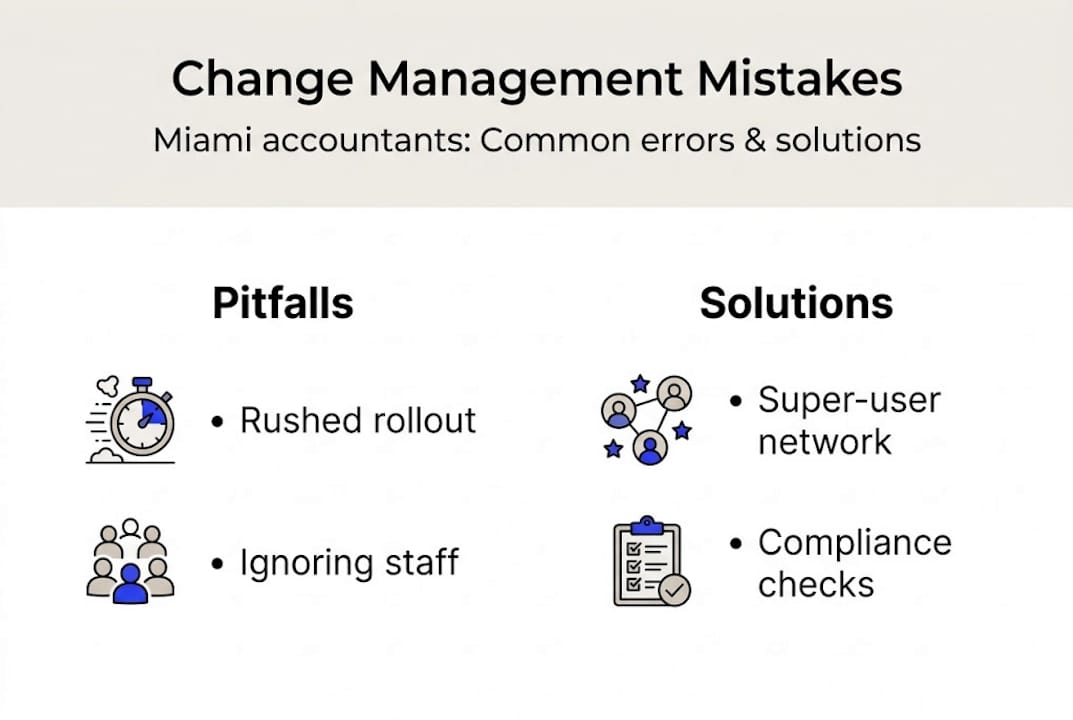
Staff do not change their habits because a new tool exists. They change because the environment, expectations, and support around them change. Post-launch sustainment requires at least 18 months of consistent behavioral governance, and AI-driven tools demand even more attention because they often alter how compliance controls function at the workflow level.
What actually works in Miami’s accounting environment is building super-user networks before launch, treating compliance mapping as a non-negotiable pre-launch requirement, and measuring adoption at regular intervals. Firms that lean on transformation consulting insights during this process consistently move faster and waste less. The goal is not just a smooth go-live. It is a firm that is genuinely transformed 18 months later.
How Miami firms can access expert IT change support
Accountants and financial advisors in Miami do not have to manage technology change alone. Accessing the right expertise early shortens the learning curve, reduces compliance risk, and accelerates the returns on your technology investment.
Our team at Transform42 works specifically with accounting and financial practices in Miami to put all your technology needs under one strategic partner. From deployment planning to post-launch sustainment, we build the capabilities and compliance your clients expect. Whether you need structured support for your IT solutions for accountants or a full roadmap through digital transformation consulting, we help you land bigger clients, scale without proportional hiring, and reclaim your time. The technology is available. Let us help you make it stick.
Frequently asked questions
What is change management in accounting?
Change management refers to the structured approach used to prepare, implement, and sustain organization-wide changes, especially technological upgrades, in accounting and financial practices. It covers everything from stakeholder buy-in to post-launch sustainment, and research confirms that incremental adoption with super-user networks significantly outperforms unplanned rollouts.
Why is change management often overlooked by accountants?
Most accountants focus on software features and compliance requirements, overlooking the critical need for structured behavioral and process changes among staff and clients. The data is clear: post-launch sustainment lasting 18 months or more is required for technology changes to take hold at the behavioral level.
How long does effective change management take for a tech rollout?
Research suggests post-launch sustainment should last at least 18 months for behavioral changes to solidify and compliance to stabilize. This does not mean constant heavy effort, but it does mean regular check-ins, adoption reviews, and super-user engagement throughout that period.
What’s the biggest mistake firms make when implementing tech changes?
The most common mistake is neglecting incremental rollout and stakeholder engagement, which leads to resistance and low adoption rates. Firms that skip the coalition-building phase and jump straight to full deployment often find that measuring time savings never materializes because the tool is not being used as intended.