TL;DR:
- AI improves government efficiency by automating tasks and enhancing decision-making processes.
- Strong governance, transparency, and citizen engagement are essential to building trust in public sector AI.
- Successful AI adoption requires careful planning, pilot projects, and ongoing risk management across agencies.
Government agencies across the United States are under constant pressure to do more with less. Citizens expect fast, accurate, and accessible services, yet many agencies still rely on outdated manual processes that slow everything down. The good news? AI is already closing that gap in meaningful, measurable ways. Massachusetts deployed a Retrieval Augmented Generation assistant called HEKA that cut document search time by 78%, turning a frustrating bottleneck into a smooth workflow. This guide unpacks how AI is being used in public services today, what governance structures keep it accountable, where the risks live, and how your agency can move from pilot to real impact.
Table of Contents
- How AI is transforming government services
- Governance and risk: building trust in public sector AI
- Challenges and risks: bias, trust, and workforce impact
- Keys to effective implementation: from pilots to scaling solutions
- Why responsible AI in government is more than just compliance
- Technology partners for transforming government with AI
- Frequently asked questions
Key Takeaways
| Point | Details |
|---|---|
| AI boosts efficiency | AI-driven automation and analytics streamline processes and improve citizen outcomes. |
| Governance is essential | Strong governance frameworks are critical for risk management and building public trust in AI. |
| Manage risks proactively | Address challenges like bias, privacy, and skills early to ensure sustainable AI adoption. |
| Pilot and scale wisely | Start with focused pilots and scale based on evidence and capacity. |
| Ethics and engagement matter | Transparency and inclusion are just as important as technical excellence in government AI projects. |
How AI is transforming government services
Government AI is not science fiction. It is operating right now in federal agencies, state departments, and municipal offices across the country. The technology trends in US government show a clear direction: agencies that embrace AI-driven workflows are outperforming those still stuck in paper-based processes. The transformation is happening across three primary methodologies.
Process automation eliminates repetitive, rule-based tasks. Benefits claims, license renewals, and permit applications are prime candidates. When a computer handles data entry and verification, staff can focus on complex cases that require human judgment. Predictive analytics lets agencies forecast demand before it peaks. A transportation department can predict where road maintenance will be needed based on traffic data and weather patterns, rather than waiting for complaints to roll in. Retrieval Augmented Generation (RAG) is perhaps the most exciting development. RAG-powered knowledge assistants pull from large document libraries in real time, giving frontline staff and citizens accurate answers in seconds instead of hours.
According to Treasury AI Strategy guidance, AI methodologies in US government services include federated governance models with AI Governance Boards, risk assessments for high-impact uses, phased deployment moving from development through pilot to production, RAG for knowledge assistants, and predictive analytics for demand forecasting. This is not experimental. It is structured, intentional, and already delivering results.
Areas seeing the biggest impact
- Benefits administration: Faster eligibility determinations and reduced backlogs in Social Security, Medicaid, and unemployment insurance
- Licensing and permitting: Automated review of applications cuts processing time from weeks to days
- Call center operations: AI-assisted agents resolve routine questions instantly, escalating complex issues to human staff
- Fraud detection: Pattern recognition flags anomalous claims before payments go out the door
- Infrastructure planning: Predictive tools optimize maintenance schedules and resource allocation
Government AI initiative outcomes
| Initiative | Agency/State | Outcome |
|---|---|---|
| HEKA RAG Assistant | MassDOT | 78% reduction in document search time |
| Predictive maintenance AI | Federal Highway Admin | 20% reduction in emergency repairs |
| AI chatbot for benefits | Multiple state agencies | 40% drop in call volume for routine inquiries |
| Fraud detection ML | IRS | Billions flagged annually before disbursement |
| License processing automation | Several state DMVs | Processing time cut from 14 days to 2 days |
When you look at smart tech for efficiency models from other sectors, a clear pattern emerges: structured pilots with measurable outcomes lead to successful scaling. Government is no different.
Pro Tip: Do not try to automate everything at once. Pick one high-volume, low-complexity process for your first pilot. Prove the ROI with real numbers, then use that success to build internal support for larger deployments.
Governance and risk: building trust in public sector AI
Strong AI results do not come from technology alone. They come from governance. Without clear accountability structures, even the most capable AI tool can generate mistrust, errors, or legal exposure. Data-driven governance starts with asking who owns the decision when an algorithm gets it wrong.

AI governance in government refers to the policies, processes, and oversight mechanisms that guide how AI is developed, deployed, monitored, and audited within public sector organizations. It answers critical questions: Who approved this tool? What data was it trained on? How is performance tracked over time? What happens when it fails?
The Office of Management and Budget’s directive OMB M-25-21 makes clear that AI integration must prioritize governance through risk management frameworks and maturity assessments, balancing innovation with public trust. This is the federal playbook. It is worth knowing well.
OMB’s phased deployment model, step by step
- Assessment: Map current processes, identify AI opportunities, and evaluate organizational readiness
- Risk classification: Categorize each use case by potential impact on citizens, privacy, and fairness
- Development: Build or procure the AI solution with appropriate safeguards and documentation
- Pilot: Deploy in a controlled environment with clear success metrics and human oversight
- Evaluation: Measure outcomes against goals; review for unintended consequences
- Production: Scale the solution with ongoing monitoring, audit schedules, and update protocols
This structured approach prevents agencies from jumping straight from idea to full deployment, which is where most failures originate.
Governance model comparison
| Model | Structure | Best for | Key risk |
|---|---|---|---|
| Centralized | Single AI oversight authority | Large federal agencies | Bottleneck, slow approvals |
| Federated | Agency-level boards with central standards | Multi-agency environments | Inconsistent standards |
| Decentralized | Department-level autonomy | Smaller, specialized agencies | Fragmentation, compliance gaps |
The federated model is gaining the most traction at the federal level. It allows departments to move at their own pace while still adhering to government-wide standards. For AI and public services governance, this balance between flexibility and accountability is the sweet spot most agencies are working toward.
“AI governance is not a gate that slows innovation. It is the foundation that makes innovation trustworthy enough to last.” This is the mindset that separates agencies making sustainable AI progress from those cycling through failed pilots.
Maturity mapping is a critical tool within governance frameworks. It helps agencies honestly assess where they are on the AI adoption curve, so they invest in the right capabilities at the right time, rather than chasing technologies their infrastructure cannot yet support.
Challenges and risks: bias, trust, and workforce impact
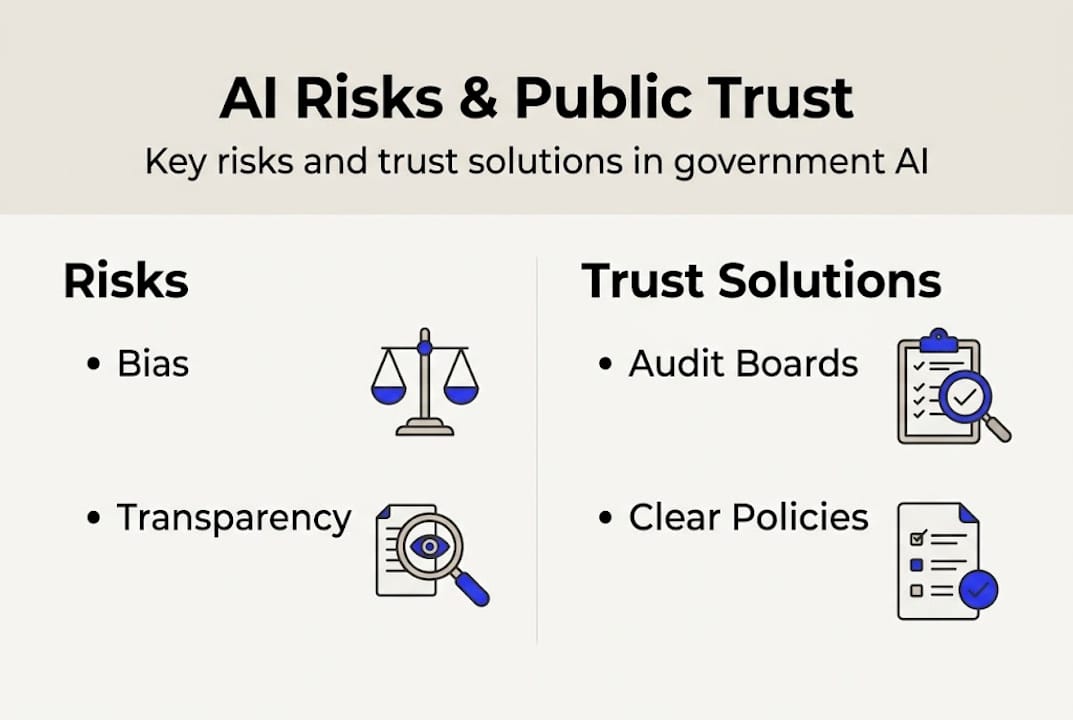
Even well-governed AI can go wrong. In fact, the highest-risk failures often come from tools that seemed fine during testing but produced harmful outcomes at scale. Leaders need to walk into AI adoption with clear eyes about what can go wrong and a concrete plan for each risk.
Algorithmic bias and other edge-case risks include unfair exclusion, as seen in the Dutch fraud detection scandal where an algorithm incorrectly flagged families for benefits fraud, leading to devastating financial harm. Similar risks appear in US Medicaid prior authorization systems, where AI-driven denials have been challenged for lacking adequate human review. Hallucinations in AI outputs, privacy violations from poorly secured training data, and errors in high-stakes decisions like criminal sentencing or benefits eligibility are all documented concerns. Workforce capacity constraints and procurement challenges add operational complexity. Low public trust remains one of the most cited barriers to adoption.
Roughly 78% of agencies cite low public trust as a primary barrier to moving AI tools from pilot to full deployment. That number should motivate every leader planning an AI initiative to treat communication and transparency as core project components, not afterthoughts.
The AI bias in healthcare sector provides instructive parallels for government. When algorithms are trained on historical data that reflects past inequities, they tend to reproduce and sometimes amplify those inequities. Government AI that touches benefits, housing, criminal justice, or education must be scrutinized through this lens.
Top ways to address each major risk
- Algorithmic bias: Conduct demographic impact assessments before deployment; use diverse training datasets; audit outcomes quarterly by population segment
- Privacy violations: Apply data minimization principles; require privacy impact assessments for any AI using personal data; enforce role-based access controls
- Workforce gaps: Invest in AI literacy training for all staff, not just IT; create AI champion roles within departments to bridge technical and operational teams
- Low public trust: Publish plain-language explanations of how AI tools work and what decisions they influence; create accessible feedback channels for citizens
- Procurement risks: Require vendors to disclose training data sources, model performance metrics, and explainability documentation before contract award
- High-stakes decision errors: Mandate human review for all AI-assisted decisions that affect individual rights, benefits, or penalties
Pro Tip: Establish a multi-disciplinary risk review board that includes legal counsel, frontline staff, IT specialists, and community representatives before approving any new AI use case. Diverse perspectives catch blind spots that homogenous tech teams miss. For deeper context on AI risk management frameworks, sector-specific models offer useful templates you can adapt.
Keys to effective implementation: from pilots to scaling solutions
Knowing the risks is half the battle. The other half is building an implementation strategy that moves steadily from concept to impact without derailing under pressure. Most agencies that struggle with AI adoption are not failing because of bad technology. They are failing because of inadequate planning, unclear ownership, and insufficient investment in people alongside tools.
AI adoption research from Brookings confirms that adoption is currently concentrated in large federal agencies, while smaller agencies face significant barriers. The report emphasizes the need for AI literacy programs, procurement reform, and robust transparency mechanisms as foundational requirements, not optional extras.
Step-by-step implementation process
- Assess readiness: Audit your current data infrastructure, staff capabilities, and technology stack. Identify gaps that would prevent a successful AI deployment before you spend a dollar on tools.
- Define the use case: Choose a specific, bounded problem with measurable outcomes. Avoid vague goals like “improve efficiency.” Target something concrete like “reduce permit processing time by 30%.”
- Build your governance structure: Appoint an AI program lead, establish your review board, and document your risk classification criteria before the pilot begins.
- Run a controlled pilot: Deploy the tool in one department or region. Set a clear timeline, typically 90 to 180 days, and define the metrics you will use to evaluate success.
- Evaluate outcomes honestly: Measure against your original goals. Include unintended consequences in your review. Talk to the frontline staff using the tool and the citizens affected by it.
- Scale carefully: Expand only after the pilot demonstrates clear benefit and manageable risk. Scaling a flawed tool multiplies the problem.
Digital innovation for government follows the same pattern as private sector digital transformation: sustainable progress comes from disciplined iteration, not big-bang deployments. Agencies that try to do everything at once tend to create confusion, resistance, and costly rollbacks.
It is also worth noting that AI is reshaping recruitment and workforce planning in ways that affect government agencies directly. As you scale AI tools, plan for shifts in how your staff spend their time and what skills your future hiring should prioritize.
Barriers and solutions by agency size
| Barrier | Large agency solution | Small agency solution |
|---|---|---|
| Procurement complexity | Dedicated AI acquisition team; modular contracting | Leverage GSA schedules; partner with larger agencies |
| Workforce skills gap | Internal AI training academies; rotational programs | Partner with universities; invest in online certification |
| Data quality issues | Enterprise data governance program | Start with clean, bounded datasets for pilot scope |
| Budget constraints | Multi-year AI investment roadmap | Pilot grants; shared services with neighboring agencies |
| Public trust deficits | Proactive community engagement campaigns | Local town halls; transparent reporting on outcomes |
Transparency is not just ethical. It is strategic. Agencies that publish clear, accessible information about their AI tools consistently see higher adoption rates from both staff and citizens. People support what they understand.
Why responsible AI in government is more than just compliance
Here is something that often gets lost in the technical conversation: the most dangerous mistake government leaders make with AI is treating it as a compliance exercise. You check the governance boxes, submit the risk assessment, get the approval, and consider the job done. That mindset produces tools that are technically approved but practically harmful.
Real responsible AI means treating deployment as the beginning of a commitment, not the end of a process. It means involving end users, including the citizens on the receiving end of AI-driven decisions, before you finalize anything. Interview a benefits caseworker. Talk to a resident who navigated your DMV’s online portal. Their insights will surface problems that no internal review board will catch. The future of AI in public service belongs to agencies that build feedback loops into their AI programs from day one.
Equity cannot be retrofitted. If diverse perspectives are not part of the design and testing phase, no amount of post-launch auditing will fully correct for bias. Leaders who invest as much in community engagement and ongoing transparency as they do in technical infrastructure will build AI programs that last and that citizens actually trust.
Technology partners for transforming government with AI
The path from AI strategy to real-world results is clearer when you have experienced partners walking it with you.
At Transform42, we work with organizations at every stage of digital transformation, from readiness assessments to full-scale implementation. Our digital transformation services are built around the same phased, governance-first approach this guide outlines. We help leaders cut through the noise, identify the right tools for their specific context, and build the internal capabilities that make AI investments stick. If your agency is ready to move from conversation to action, explore our technology solutions for government and see how a strategic partner can accelerate your timeline while reducing risk.
Frequently asked questions
What are the main benefits of AI in government services?
AI speeds up processes, reduces costs, and enhances accuracy in areas like claims processing and citizen engagement. For example, RAG assistants reduced document search time by 78% in the MassDOT HEKA deployment, translating directly into faster service for residents.
How does government ensure AI systems are fair and unbiased?
Governments use risk assessments, frequent audits, and multidisciplinary governance boards to reduce bias and monitor algorithmic outcomes. The Treasury AI Strategy specifically outlines AI Governance Boards as a core structural requirement for high-impact AI use cases.
What’s a common pitfall in AI adoption for public sector agencies?
Overlooking transparency and citizen communication often leads to low public trust and resistance to new AI solutions, which stalls even technically sound deployments before they reach full impact.
Are small government agencies able to use AI effectively?
Smaller agencies face more barriers but can succeed by focusing on workforce training, clear procurement, and pilot projects. Brookings research confirms that AI literacy and procurement reform are the two most critical enablers for agencies with limited resources.
What is the first step for an agency planning to implement AI?
Conduct an AI readiness assessment and identify a small, targeted project to pilot. The phased deployment model used by federal agencies starts with this foundational step before any tool is selected or budget committed.
Recommended
- AI In Healthcare: Navigating The Bias Minefield – Stratgetic IT Consultants For Accountants
- Top Technology Trends Shaping U.S. Government In 2025
- Smart Government Solutions: Proven Examples For City Innovation
- Evolving Governance: AI, ML, And The Future Of Public Services – Stratgetic IT Consultants For Accountants