
TL;DR:
- Government change projects often fail due to treating change management as simple project planning rather than an integrated process. Success requires early development of a theory of change, clear documentation, multi-agency impact mapping, and ongoing measurement, especially in complex environments. Adopting frameworks like ADKAR and NIST RMF simultaneously and ensuring their integration into daily operations are essential for lasting public sector transformation.
Government change projects fail far more often than leaders expect, and not because of bad intent. The real culprit is treating change management as project planning with a few communication emails attached. Real public sector transformation demands integrated records handling, risk lifecycle management, individual adoption work, and long-term benefits tracking. Get one of those wrong and you get compliance failures, staff resistance, or services that quietly revert to old habits within six months. This guide cuts through the theory and gives you a practical, framework-based roadmap to drive lasting government change.
Table of Contents
- Why public sector change management demands a different approach
- Core frameworks for successful public sector change
- Applying change frameworks in complex government environments
- Measuring change success and real-world ROI
- What most public sector leaders overlook: Our candid perspective
- Accelerate public sector change with expert support
- Frequently asked questions
Key Takeaways
| Point | Details |
|---|---|
| Integrated change is critical | Combining records, risk, and behavior frameworks prevents costly failures and drives lasting government transformation. |
| Framework selection matters | Choosing people-based (ADKAR) or compliance-focused (NIST RMF) models helps tailor change to project needs. |
| Measure benefits and outcomes | Tracking success goes beyond project completion—embed benefit measurement and plan for business-as-usual early. |
| Prioritize early record handling | Deciding which records transfer and documenting changes ensures accountability and transparency. |
| Iterative delivery accelerates results | Embedding change decisions in iterative cycles improves speed while maintaining compliance and auditability. |
Why public sector change management demands a different approach
The private sector measures success through revenue, margin, and shareholder return. Government does not get that luxury. Every change initiative you lead is accountable to citizens, auditors, oversight bodies, and elected officials simultaneously. That is a fundamentally different operating environment, and it changes everything about how you design and execute transformation.
Public sector transformation carries a transparency requirement that private companies simply do not face. Citizens expect to know what changed, why it changed, and what it cost. Auditors expect a paper trail. Ministers expect measurable outcomes they can defend at a committee hearing. This means your change process cannot just work. It must be visible, documented, and provably linked to intended outcomes.
One of the most significant shifts in how governments now approach this is the adoption of a formal theory of change. A theory of change is an explicit pathway that maps how specific activities lead to specific outcomes, and how you will know if those outcomes were actually achieved. As governments increasingly frame change through this explicit pathway and tie it to measurement and learning, leaders who skip this step create a critical accountability gap.
Here is what a solid government change approach looks like in practice:
- Define your theory of change early. Map inputs, activities, outputs, and long-term outcomes before you write a project plan.
- Identify multi-agency impacts at the start. Government changes rarely stay within one department. Map every affected body on day one.
- Build measurement and evaluation into the design phase. Not as an afterthought. Evidence must be collected from the beginning if you want defensible results.
- Plan the transition to routine operations explicitly. Benefits do not stick without a structured handoff to business-as-usual teams.
“Transparency without measurement is theater. If you cannot show a causal link between your change activities and citizen outcomes, you have a communications strategy, not a change strategy.”
Strong service quality strategies reinforce this point: evidence-based approaches consistently outperform volume-based ones in public service improvement. The lesson is clear. Build your evidence structure before you build your project schedule.
Core frameworks for successful public sector change
Now that we have clarified why government change stands apart, let us break down the core frameworks leaders need. Two models dominate the practical toolkit: ADKAR for people-driven adoption and the NIST Risk Management Framework for compliance-heavy technology transitions. Using only one of them is one of the most common mistakes we see.
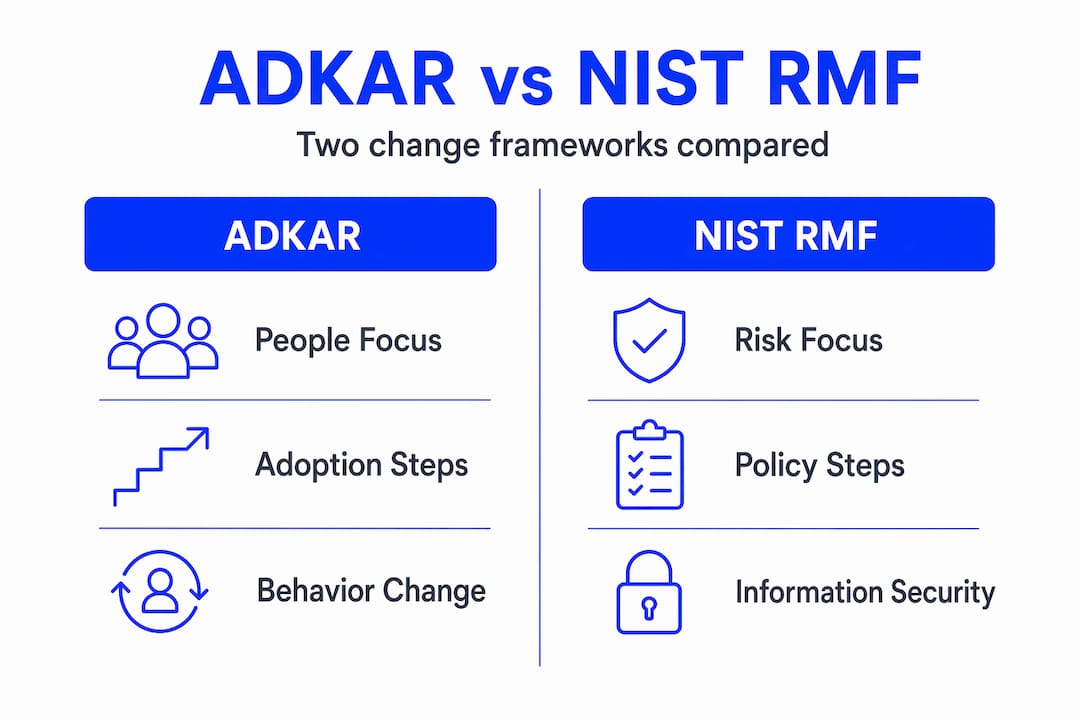
ADKAR vs. NIST RMF: A side-by-side comparison
| Dimension | ADKAR | NIST RMF |
|---|---|---|
| Primary focus | Individual adoption and behavior change | Risk management and compliance |
| Best for | Culture shifts, new workflows, staff transitions | Technology rollouts, data systems, security |
| Phases | Awareness, Desire, Knowledge, Ability, Reinforcement | Prepare, Categorize, Select, Implement, Assess, Authorize, Monitor |
| Measurement | Adoption rates, resistance tracking, reinforcement audits | Risk posture, authorization status, continuous monitoring |
| Government fit | High for organizational redesign | High for IT modernization and cybersecurity |
ADKAR, which stands for Awareness, Desire, Knowledge, Ability, and Reinforcement, focuses squarely on the human side of change. As local government research confirms, this people-centered roadmap drives lasting adoption by addressing each stage of individual transition. The reason ADKAR resonates in government is that public sector workers often have strong institutional loyalty and long tenure. They need to understand why change is happening before they will invest in learning how to operate differently.
The NIST Risk Management Framework takes a different angle. It provides a structured, repeatable seven-step process for managing information security and privacy risk across government systems. When your change initiative involves migrating citizen data, upgrading digital infrastructure, or integrating new compliance systems, NIST RMF is not optional. It is the governance backbone.
Here is a practical integration sequence for government project managers:
- Define the change scope and identify whether it is primarily a people transition, a technology transition, or both.
- Activate ADKAR for all roles that will experience workflow or behavioral change.
- Launch NIST RMF in parallel for any technology component touching government data or security systems.
- Align timelines so that technical authorization and human adoption milestones are synchronized.
- Review both frameworks at every sprint gate to catch gaps before they become compliance failures.
For deeper context on building these structures, the change management guides and role of change management resources cover how to sequence these steps in high-stakes environments.
Pro Tip: Do not wait until a technology system is built to start ADKAR work. Resistance to adoption forms in the silence before training begins. Start building awareness the same week you kick off your NIST RMF preparation phase.
Applying change frameworks in complex government environments
With frameworks in place, the next challenge is adapting them to complex government environments. Theory looks clean on a slide. Reality involves legacy systems, coalition partners, audit requirements, and Agile delivery sprints running simultaneously.

The Lean-Agile Configuration and Change Management model, known as LACCM, offers a compelling example. In complex defense and mission-critical software environments, change management processes integrated into iterative delivery cycles preserve both auditability and compliance while dramatically improving cycle time. One reported benchmark shows adjudication cycle times dropping from multiple weeks to under 24 hours. That is not a marginal improvement. That is a structural transformation in how change decisions get made and recorded.
Cycle time benchmarks: Before and after framework integration
| Environment | Before integration | After LACCM integration | Improvement |
|---|---|---|---|
| Defense software change decisions | 2 to 4 weeks | Less than 24 hours | Over 90% reduction |
| Multi-agency policy updates | 6 to 10 weeks | 2 to 3 weeks | Approximately 65% reduction |
| IT security authorization renewals | 8 to 12 weeks | 3 to 4 weeks | Approximately 60% reduction |
The speed gains are real, but they come with a condition: documentation discipline cannot slip. Faster decisions are only defensible if every decision is recorded. This is where records management becomes a change management issue, not just an administrative one.
UK National Archives guidance is explicit: machinery of government changes require early decisions about which records follow transferred functions, and those decisions must be documented for accountability and transparency. Leaders who treat records management as a post-project clean-up task consistently face audit failures and accountability gaps months or years after the project closes.
Key practices for managing change in complex environments:
- Integrate change decision logs directly into sprint retrospectives. Make documentation a delivery artifact, not an afterthought.
- Assign a dedicated records lead at the start of every major change initiative.
- Map transferred functions to existing records before restructuring begins. Waiting until after transition creates irreversible gaps.
- Use workflow efficiency principles to streamline how documentation is captured without burdening frontline teams.
For a step-by-step structure, the change process steps framework provides a practical sequence that maps well to government delivery contexts.
Pro Tip: Before your project begins, ask this question: “If a senior auditor reviewed every change decision we make in this project, where would they find the evidence?” If you cannot answer that cleanly on day one, build your documentation architecture before you do anything else.
Measuring change success and real-world ROI
Now, having covered framework adaptation, it is critical to measure change success with nuanced benchmarks. Completing a project on time and on budget is a starting point, not a definition of success. Public sector success requires sustained outcomes, measurable citizen benefit, and a clean transition to ongoing operations.
Here is what genuine benefits realization looks like in practice:
- Define benefit indicators before project kickoff. Include efficiency metrics, citizen satisfaction scores, and compliance measures.
- Measure at multiple points. At project completion, six months post-go-live, and twelve months post-go-live.
- Track reverting behaviors. If teams drift back to old workflows after ninety days, your ADKAR reinforcement phase failed.
- Report benefit attainment to governance bodies. Accountability loops close when reporting is formal and regular.
One important caution on benchmarks. Widely cited success-rate numbers for change management, including figures claiming 88% success rates for structured programs, should be treated carefully because some figures come from vendor-reported data rather than peer-reviewed research. This does not mean structured change management does not work. The evidence clearly supports it. But it does mean you should demand transparent, methodologically sound evidence when vendors or consultants cite impressive numbers to justify their approach.
“The most honest ROI case for change management is not the percentage of projects that ‘succeed.’ It is the documented gap between organizations that invest in structured adoption versus those that do not. That gap is consistently significant and consistently ignored until it is too late.”
The Government Efficiency Framework is clear: benefits management must be embedded before, during, and after delivery. Transition planning, the formal handoff from project team to business operations, is the mechanism that prevents change “fade-out,” where gains erode because no one owns the new way of working after the project team disbands.
The digital transformation journey in public sector organizations shows this pattern repeatedly. Investments in digital tools produce short-term gains that plateau or reverse when transition planning is weak. Build the business-as-usual structure before you celebrate delivery.
What most public sector leaders overlook: Our candid perspective
Most change management guides focus on frameworks and steps. That is helpful, but it misses the real failure pattern. In our experience working with complex organizations, the single most underrated failure point is the gap between what gets documented in a project plan and what actually gets integrated into daily operations.
Leaders consistently underestimate three things. First, the human cost of non-integrated records. When records management is treated as an IT problem rather than a change governance problem, accountability failures surface months after the project closes. By then, the project team is gone and the operational team inherits a documentation gap they did not create. Second, the risk of process rigidity. Frameworks are tools, not rules. Organizations that apply ADKAR or NIST RMF mechanically, without adapting to their specific environment, often find that compliance is achieved on paper while adoption fails in practice. Third, and most damaging, the transition to business-as-usual is consistently skipped or rushed. Project teams celebrate go-live and move to the next initiative. The new process then lacks an owner, lacks reinforcement, and quietly degrades.
The honest answer to preventing all three failures is integration. Risk management, human adoption, records governance, and benefits measurement must be running simultaneously, not sequentially. When you treat them as separate workstreams, gaps form at every handoff point. When you treat them as one integrated change system, those gaps close.
The rise of AI in government adds another dimension here. AI tools can accelerate cycle times and improve data analysis, but they also introduce new risks around auditability and accountability. Without an integrated change framework already in place, AI adoption creates new governance gaps rather than closing existing ones.
Ask yourself before starting any major change initiative: Do we have a documented audit trail plan? Do we have a benefits measurement schedule that extends twelve months past go-live? Have we assigned a business-as-usual owner before the project team is assembled? If the answer to any of those is no, that is your starting point.
Accelerate public sector change with expert support
Leading government transformation is demanding. The frameworks work, but applying them correctly, especially across multi-agency environments with compliance requirements and long-term outcome accountability, requires both strategic clarity and practical execution support.
Our technology services are built to give organizations the infrastructure and compliance capabilities that large-scale change demands. Whether you need support structuring records governance, aligning digital systems with NIST RMF requirements, or ensuring your adoption strategy is built for sustained results, we bring the tools and expertise to make it happen. Explore our digital transformation consulting to see how we help leaders move from framework knowledge to measurable operational outcomes, without the typical lag and risk that derails most government change programs.
Frequently asked questions
What are the main steps in the public sector change management process?
Most government projects follow frameworks like ADKAR for people-driven transitions or risk-oriented models such as the NIST seven-step process, covering awareness, planning, implementation, authorization, and ongoing evaluation and monitoring.
How does public sector change management differ from the private sector?
Public sector change places greater emphasis on transparency, audit trails, citizen outcomes, and transition to business-as-usual. As Scottish Government research shows, governments frame change through explicit pathways and measurement systems rather than shareholder value metrics.
What is the ADKAR model and why is it recommended for government change?
ADKAR supports lasting adoption by addressing individual Awareness, Desire, Knowledge, Ability, and Reinforcement. As a people-centered roadmap for local government, it is particularly effective for overcoming the institutional resistance that is common in public sector environments.
How should records and information be handled during government change?
Records management must be integrated early in the project lifecycle. Machinery of government changes require early decisions about which records follow transferred functions, with full documentation maintained for accountability and future audit purposes.
Recommended
- Change Management Guide: 88% Success Rate For Miami Firms
- Streamline Your Change Management Procedure For Miami SMBs
- Change Management Guide For Miami Accountants
- Role Of Change Management: Everything You Need To Know – Stratgetic IT Consultants For Accountants
Stay Ahead of IT Risks in Your Industry
Weekly insights on cybersecurity, compliance, and IT strategy for accounting firms, law firms, and medical practices.