TL;DR:
- Most organizations mistakenly believe their firewalls fully protect internal networks, but trust assumptions leave gaps for attackers. Adopting Zero Trust, verifying every access request based on identity and context, reduces breach costs and enhances security amidst modern remote, cloud, and AI threats. A phased implementation focusing on identity, access, and continuous monitoring builds resilience, compliance, and long-term security growth.
Your firewall is not protecting you the way you think it is. Most organizations still operate on the assumption that anything inside their network can be trusted. That assumption is what attackers count on. The case for why adopt zero trust has never been more urgent or better supported by data. Breach costs are climbing, insider threats are harder to catch than ever, and the old perimeter model was built for an era before cloud, remote work, and AI-powered attacks. This guide breaks down what Zero Trust is, what it costs you to ignore it, and how to start doing it right.
Table of Contents
- Key Takeaways
- Why adopt Zero Trust: the case is no longer optional
- What the zero trust principle actually means
- Common misconceptions that slow adoption down
- How to start your zero trust adoption
- Zero trust, compliance, and long-term resilience
- My honest take on why most organizations wait too long
- How Transform42inc can help you get started
- FAQ
Key Takeaways
| Point | Details |
|---|---|
| Zero Trust rejects default trust | Every access request is verified based on identity and context, not network location. |
| Breaches cost 38% less | Organizations with Zero Trust in place pay significantly less when breaches occur. |
| Insider threats are the hardest problem | 93% of security leaders say insider incidents are harder to detect than external attacks. |
| Adoption is incremental, not instant | Starting with identity governance and MFA is the most practical and effective first step. |
| Compliance and resilience improve together | Zero Trust makes auditing easier and limits how far an attacker can move once inside. |
Why adopt Zero Trust: the case is no longer optional
The traditional security model works like a castle with a moat. Once you get past the walls, you can walk anywhere inside. That worked reasonably well when employees sat in one building and data lived on local servers. That world is gone.
Today, your staff works from home, coffee shops, and client offices. Your data lives across multiple cloud platforms. Your devices include everything from laptops to smart thermostats. Every one of those connection points is a potential entry for an attacker. The old perimeter cannot cover all of it, and trying to patch it with more firewalls is like adding locks to a house with no walls.
The financial reality makes this even harder to ignore. Breach costs are 38% lower for organizations that have adopted Zero Trust compared to those that have not. The global Zero Trust market was valued at $42.28 billion in 2025 and is projected to reach $148.68 billion by 2034. That growth reflects how seriously organizations worldwide are taking this shift.
“Treating Zero Trust as optional is the same as choosing to pay more when you get breached. And you will get breached.”
And the threat is not just coming from outside. 93% of security leaders say insider incidents are harder to detect than external attacks. These are your own employees, contractors, and vendors moving through systems they were given legitimate access to. Without Zero Trust, there is often nothing in place to catch them until the damage is done.
The rise of AI makes the external threat worse too. AI-driven phishing campaigns are 450% more effective than traditional ones. Federal agencies were already mandated to implement phishing-resistant MFA by the end of FY 2024 under OMB M-22-09. That mandate exists because the threat is real and growing. If you are relying on passwords and basic email filters, you are already behind.
What the zero trust principle actually means
Understanding zero trust starts with one sentence: never trust, always verify. That is it. Every request for access, whether from a person, a device, or an application, is treated as potentially hostile until proven otherwise.
This is a completely different way of thinking from the perimeter model. With traditional security, passing the login screen gets you into the building. With Zero Trust, every door inside the building requires its own key, and the building is constantly checking whether you still belong there.
NIST SP 800-207 is the authoritative government framework for Zero Trust adoption. It defines the model around three core elements: identity, device health, and context. Network location no longer matters. What matters is who you are, whether your device is safe, and whether the request makes sense given your normal behavior.
Here is what that looks like in practice:
- Continuous verification: Access is not granted once at login. It is re-evaluated throughout the session based on live signals.
- Least privilege access: Users and systems only get access to what they need for a specific task. Nothing more.
- Micro-segmentation: The network is divided into small zones so that even if an attacker gets in, they cannot move freely from one system to another.
- Identity as the perimeter: Your identity, and the context around it, becomes the new boundary. Not your IP address.
Pro Tip: Start with a clear map of who accesses what in your organization. You cannot enforce least privilege without first knowing the full picture of your current access landscape.
Zero Trust also separates the control plane from the data plane. In plain terms, the system that decides whether you get access is kept separate from the system where the actual traffic flows. Every request is checked individually before anything moves. This is a fundamental architecture shift, not just a software upgrade.

Common misconceptions that slow adoption down
One of the most expensive misunderstandings in security today is that Zero Trust is a product you can buy. It is not. Zero Trust is a system design discipline, not a checkbox on a vendor’s feature list. You cannot buy a “Zero Trust appliance” and call it done.
This matters because organizations sometimes invest in a single tool, declare victory, and move on. That leaves massive gaps. Zero Trust requires changes to architecture, policy, culture, and process. It also requires ongoing management, not a one-time project.
Here are the most common obstacles organizations face:
- Thinking it happens overnight. Attempting full implementation at once leads to operational disruption and, in many cases, outright failure. This is a multi-year commitment.
- Ignoring user experience. If Zero Trust creates too much friction for staff, they find workarounds. Security that slows people down too much gets bypassed.
- Forgetting about OT environments. Older operational technology systems like manufacturing equipment or medical devices often cannot run modern identity software. Legacy OT systems need tailored Zero Trust approaches that balance safety, uptime, and visibility.
- Treating it as an IT-only project. Zero Trust works only when IT, security, and business leadership are aligned on policies and priorities.
- Underestimating the policy burden. Trust policies need to be treated like production code. They require testing, version control, and monitoring for anomalies.
Pro Tip: If your team is considering going it alone, think carefully. The operational complexity of Zero Trust rewards organizations that have experienced partners guiding the process. Mistakes in access policy can lock out your own staff or leave critical gaps wide open.
The insider threat challenge alone justifies getting outside help. Detecting unusual behavior inside a trusted session requires analytics, automation, and policies that most organizations have never built before.
How to start your zero trust adoption
The good news is you do not have to do everything at once. A phased approach lets you build real security improvements without creating chaos in your operations. Here is a practical sequence that works:
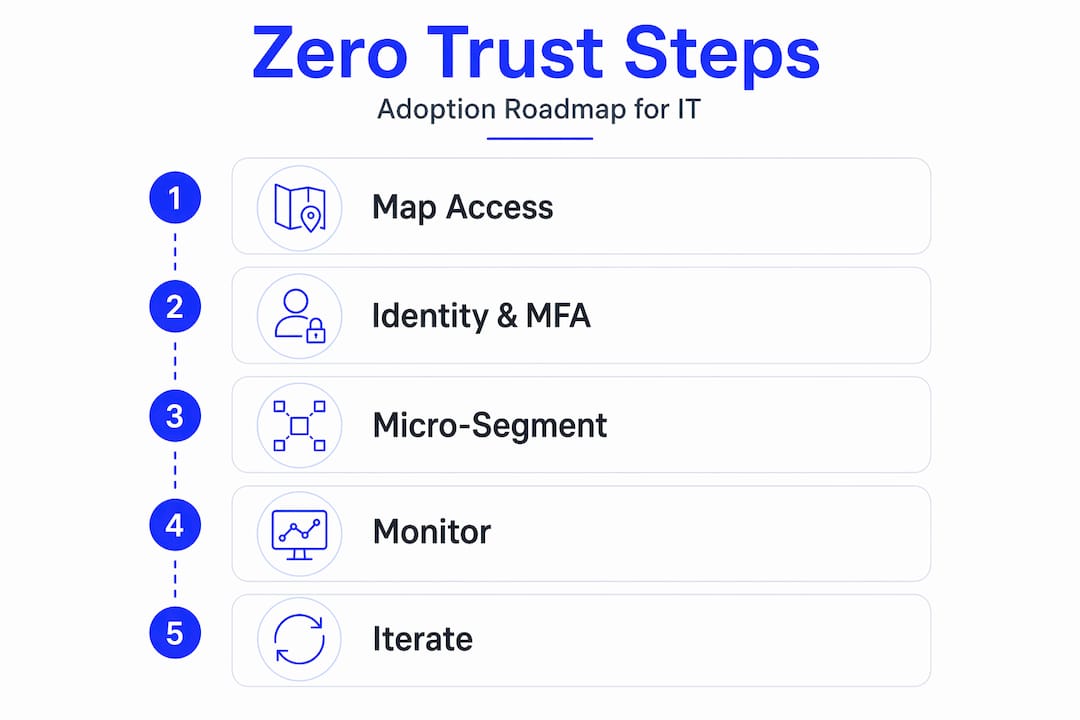
- Map your assets and access. You cannot protect what you do not know exists. Start by cataloging every device, application, user account, and data set in your environment.
- Implement strong identity governance. Multi-factor authentication, especially phishing-resistant MFA, is your first major control. Pair it with single sign-on and regular access reviews.
- Apply least privilege policies. Audit who has access to what and cut it down to only what each person genuinely needs. Most organizations find shocking over-permissioning at this stage.
- Deploy micro-segmentation. Break your network into smaller zones so that lateral movement after a breach is blocked before it spreads.
- Build continuous monitoring. Real-time telemetry and behavioral analytics let you catch threats that get past initial controls.
- Align with your business priorities. Protect your most critical systems and data first. Let risk drive the order of implementation.
Here is a quick comparison to help you see where you likely stand today versus where Zero Trust takes you:
| Area | Traditional security | Zero Trust |
|---|---|---|
| Trust model | Implicit trust once inside network | Explicit verification per request |
| Perimeter | Network edge | Identity and device context |
| Lateral movement | Largely unrestricted | Blocked by micro-segmentation |
| Breach detection | Often slow and reactive | Real-time telemetry and alerts |
| Access control | Role-based, broad | Least privilege, context-aware |
| Compliance readiness | Manual and inconsistent | Built into policy and logging |
The iterative adoption approach is not a shortcut. It is the proven path. Organizations that try to flip everything at once create disruption, lose stakeholder confidence, and often end up with a patchwork that leaves them more exposed than before.
Zero trust, compliance, and long-term resilience
Zero Trust does more than reduce breach costs. It fundamentally improves how your organization handles compliance, incident response, and long-term security management.
From a compliance perspective, the built-in logging and continuous monitoring of Zero Trust give you a detailed, real-time record of every access event. That is exactly what auditors want to see. Regulations like HIPAA, SOC 2, and state-level privacy laws increasingly reward organizations that can demonstrate continuous controls rather than point-in-time compliance snapshots.
When incidents do happen, Zero Trust dramatically improves your response. Logs and telemetry feed policy decisions in real-time, which means you detect threats faster and contain them before they spread. The model assumes a breach will eventually happen and builds around limiting the damage when it does.
Key long-term advantages include:
- Reduced blast radius: Micro-segmentation means an attacker who gets in is stuck in one small zone, not roaming freely.
- Automated policy enforcement: Rules are applied consistently, without relying on human memory or manual configuration.
- Continuous improvement: Zero Trust maturity across identity, devices, networks, applications, and data improves over time as your monitoring and analytics get smarter.
- Adaptability: As your environment grows and changes, Zero Trust scales with it because the model is built around policy, not physical infrastructure.
The organizations that get the most out of Zero Trust are the ones that treat it as a permanent operating model, not a project with an end date.
My honest take on why most organizations wait too long
I have seen this pattern more times than I can count. An organization holds off on Zero Trust because it seems too complex or too expensive. Then a breach happens. Then they spend five times more fixing the damage than the implementation would have cost.
What makes it worse is that the warning signs are always there beforehand. Overpermissioned accounts. No MFA on sensitive systems. A contractor with access that nobody reviewed in three years. Zero Trust would have caught every one of those things.
The uncomfortable truth is that Zero Trust is operationally demanding. You need dedicated people, clear governance, and a willingness to revisit policies regularly. It is not a set-it-and-forget-it system. But the investment in identity governance pays off faster than most people expect, usually within the first year when you start seeing what was actually moving through your environment unchecked.
My strongest advice is this: do not let perfect be the enemy of better. Start with MFA and an access audit. You will discover things that change your entire security posture without needing to overhaul everything at once. The organizations that succeed with Zero Trust are the ones that start somewhere, learn, and keep going.
— Joe
How Transform42inc can help you get started
If reading this article raised more questions than it answered, that is a healthy sign. Zero Trust is genuinely complex, and getting it wrong is costly. Transform42inc works with professional firms to assess their current security posture and build a Zero Trust adoption plan that fits their specific environment and business priorities.
We bring experience across identity access management, micro-segmentation, and continuous monitoring. Our approach is phased and collaborative, so you see real improvements without operational chaos. We help you protect your clients’ data, meet compliance requirements, and build the security foundation that supports real growth. Explore our technology consulting services or visit Transform42inc to schedule a conversation about where your organization stands today.
FAQ
What is the zero trust principle in simple terms?
Zero Trust means no user, device, or system is trusted by default. Every access request is verified based on identity, device health, and context before anything is granted.
Why choose zero trust over traditional security?
Traditional security assumes everything inside the network is safe. Zero Trust checks every request individually, which cuts breach costs by 38% and catches insider threats that perimeter defenses miss entirely.
How long does zero trust adoption take?
Zero Trust is a multi-year iterative process. Most organizations begin with identity governance and MFA, then expand to micro-segmentation and continuous monitoring over time.
Is zero trust only for large enterprises?
No. Professional firms of any size face insider threats, phishing attacks, and compliance requirements. The advantages of Zero Trust apply equally to small and mid-sized organizations protecting sensitive client data.
What is the first step in a zero trust adoption guide?
Start with a full inventory of your users, devices, and data assets. Without knowing what exists and who can access it, you cannot build effective access controls or enforce least privilege policies.
Recommended
- What Does Zero Trust Mean? A Guide For Miami CPAs
- Zero Trust Security For Miami CPAs: Protect Data And Grow
- Zero Trust Security: 56% Fewer Insider Breaches For FL CPAs