94% of Healthcare Organizations Experienced a Cyberattack in the Past Year: Why Medical Practice Network Segmentation is Your Best Defense
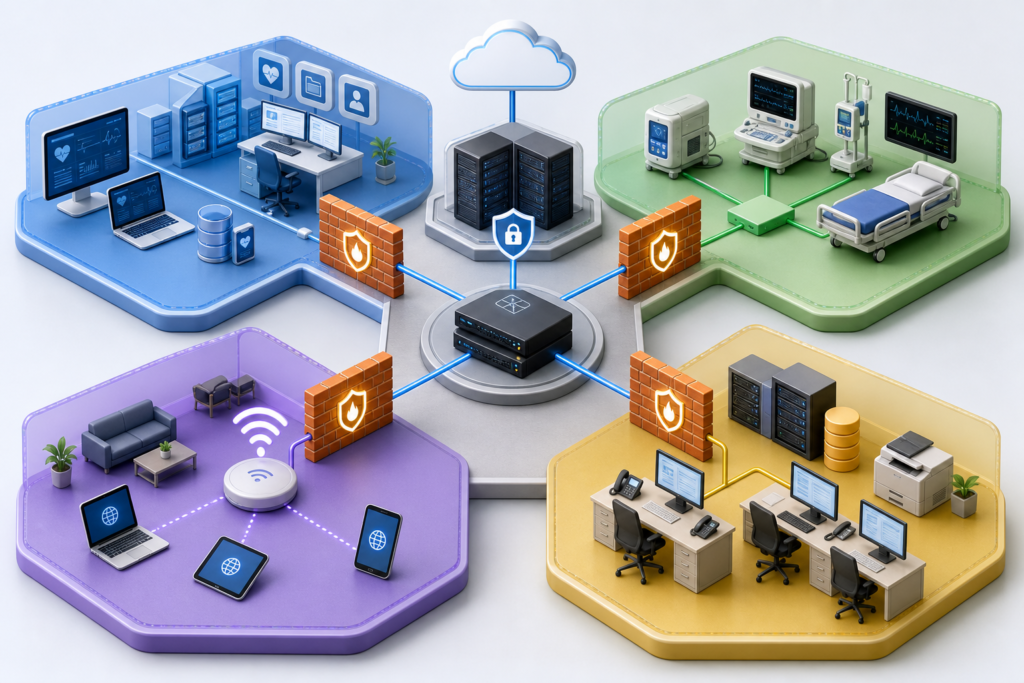
Medical practice network segmentation is the process of dividing a healthcare facility’s computer network into smaller, isolated subnetworks to prevent unauthorized access and contain potential security breaches. By isolating Electronic Health Record (EHR) systems, medical devices, and guest Wi-Fi, practices ensure that a single compromised device cannot lead to a total system failure or a massive HIPAA data breach. At Transform 42 Inc, we view segmentation not as an optional upgrade, but as the foundational architecture required to meet HIPAA Security Rule §164.312 technical safeguards.
I am Joe Crist, CEO of Transform 42 Inc. As a Service-Disabled Veteran-Owned Small Business, we bring a mission-critical mindset to IT infrastructure. In the military, we don’t leave the perimeter open; in your Miami medical practice, you shouldn’t either. If your front-desk computer can “talk” to your MRI machine or your patient check-in tablet, your network is flat, and your practice is at high risk.
The Danger of the Flat Network in South Florida Healthcare
A flat network is a configuration where all devices—from the receptionist’s PC to the life-saving infusion pump—reside on the same broadcast domain. If a staff member clicks a phishing link on a workstation, ransomware can spread laterally across the entire office in minutes. In a segmented environment, that threat is trapped within a single zone, protecting your healthcare IT infrastructure and patient data.
In Miami, we face unique challenges. Between the high density of medical providers and the annual threat of hurricane season, your systems must be resilient. A flat network is fragile. If one device malfunctions or becomes infected, it can saturate the bandwidth for the entire office, taking down your EHR during a critical patient encounter. We apply the same discipline we learned as a Service-Disabled Veteran-Owned Small Business to ensure your “perimeter” is internal, not just external.
Industry leaders like John Halamka, President of Mayo Clinic Platform, have long advocated for the “de-identification” of the network. This means the network should not inherently trust any device. Segmentation is the first step toward a Zero Trust architecture, ensuring that your Epic or athenahealth instances remain reachable only by authorized users on secured devices.
Designing Your VLAN Architecture: The Five Essential Zones
Effective medical practice network segmentation relies on Virtual Local Area Networks (VLANs) to logically separate traffic at the switch level. You should categorize every device in your practice into specific zones based on its function and risk profile. This prevents a guest on your Wi-Fi from even seeing that your EHR server exists.
1. The EHR and Core Data Zone
This is your “Vault.” It contains your servers or the dedicated gateways used to access cloud-based EHRs. Access to this zone should be restricted via strict firewall rules on a Fortinet FortiGate or Palo Alto Networks appliance. Only authenticated staff workstations should have a path to this zone.
2. Medical Device (IoMT) Zone
Internet of Medical Things (IoMT) devices, such as vitals monitors and EKG machines, often run on outdated operating systems that cannot be patched. These must be isolated. Following NIST SP 800-82 guidelines, these devices should never have direct internet access unless required for manufacturer updates, and even then, only through a secure proxy.
3. Administrative and Staff Zone
This zone is for the daily business of the practice. It includes staff PCs, printers, and VOIP phones. While these devices need internet access, they should be blocked from communicating with the Medical Device zone. This prevents a compromised office computer from interfering with patient care equipment.
4. Imaging and PACS Zone
Imaging files are massive and can congest a network. By placing your X-ray or ultrasound machines and their storage (PACS) in a dedicated VLAN, you ensure that large file transfers don’t lag your billing software or patient portal. This also aligns with CIS Controls v8 regarding the limitation and control of network ports and protocols.
5. Guest Wi-Fi Zone
Your patients expect Wi-Fi in the waiting room, but their phones are potential carriers for malware. The Guest Wi-Fi must be physically or logically separated from all internal resources. Using Cisco Meraki or Ubiquiti UniFi, we can create a “walled garden” where guests can reach the internet but nothing else.
Monitoring Medical Device Traffic: Beyond Simple Blocking
Isolation is only half the battle; you must also monitor the behavior of your medical devices to detect anomalies. Because medical devices often cannot host antivirus software, the network must be “intelligent” enough to spot when an infusion pump starts sending data to an unknown IP address in a foreign country.
We recommend tools like Claroty or Armis for real-time visibility. These platforms “listen” to the traffic in your medical device VLAN and alert us if a device behaves out of character. This is a key component of the FDA MedTech Cybersecurity Guidance, which emphasizes the need for post-market management of device security.
Regular vulnerability scanning is also required. We use Nessus to identify weak points in your network configuration before a hacker does. For a Miami practice, this level of diligence is what separates a minor IT hiccup from a practice-ending data breach. Our team at Transform 42 Inc provides the managed IT services necessary to keep these monitors running 24/7.
Comparison: Flat Network vs. Segmented Network
| Feature | Flat Network (High Risk) | Segmented Network (T42 Standard) |
|---|---|---|
| Ransomware Spread | Unrestricted; can infect every device. | Contained within a single VLAN. |
| HIPAA Compliance | Fails technical safeguard requirements. | Meets and exceeds §164.312 standards. |
| Guest Access | Guests share the same airwaves as EHR. | Complete isolation via Guest VLAN. |
| Device Performance | High “noise” and potential lag. | Optimized traffic for critical systems. |
| Visibility | Blind to lateral movement. | Full monitoring of inter-zone traffic. |
Implementation Roadmap: How to Secure Your Practice
Transitioning from a flat network to a segmented one requires a phased approach to avoid disrupting patient care. You cannot simply flip a switch; you must map your data flows first. We follow a disciplined process, much like the operational planning we practiced as a Service-Disabled Veteran-Owned Small Business.
- Inventory and Discovery: Use tools like Armis to identify every device on your network. You cannot protect what you cannot see.
- Traffic Analysis: Determine which devices need to talk to each other. Does the printer really need to talk to the heart monitor? (The answer is always no).
- VLAN Creation: Configure your switches and firewalls to create the logical boundaries discussed above.
- Policy Enforcement: Write the “rules of engagement” for your firewall. For example: “Allow Staff VLAN to access EHR VLAN on Port 443, but deny all other traffic.”
- Testing and Optimization: Validate that all medical equipment is functioning correctly within its new zone before moving to the next phase.
This roadmap ensures that your Miami practice remains operational while significantly hardening your defenses. Whether you are a small clinic or a large multi-specialty group, these steps are the same. We also apply these rigorous standards when providing IT services for law firms and accounting firms, where data privacy is equally paramount.
The T42 Advantage: Security Built on Service
At Transform 42 Inc, we don’t just sell software; we provide the peace of mind that comes from a secure, compliant infrastructure. Being a Service-Disabled Veteran-Owned Small Business means we operate with integrity and a commitment to the mission—which, in this case, is protecting your patients’ most sensitive information.
If you are unsure if your network is flat or segmented, you are likely at risk. Don’t wait for a breach to find out. We offer a free IT assessment to help South Florida medical practices identify their vulnerabilities and build a roadmap toward a secure, segmented future.
Ready to secure your practice? Contact us today to speak with an expert who understands the unique intersection of healthcare, technology, and security.
Frequently Asked Questions
Will network segmentation slow down my EHR performance?
No, when properly configured, network segmentation actually improves performance by reducing broadcast traffic and “noise” on the network. By dedicating specific lanes for high-bandwidth traffic like imaging, your EHR and other critical applications will often run faster and more reliably.
Is network segmentation required by HIPAA?
While the word “segmentation” isn’t explicitly in the HIPAA text, the Security Rule requires “technical safeguards” to protect ePHI and “access controls” to limit data access to authorized users. Segmentation is the industry-standard method for achieving these legal requirements and is viewed as a necessity by auditors.
Can I use my existing Wi-Fi router for segmentation?
Most consumer-grade or “prosumer” routers do not have the robust VLAN and firewall capabilities needed for true medical-grade segmentation. We typically recommend enterprise-grade hardware from vendors like Fortinet or Cisco Meraki to ensure the zones are truly isolated and secure.
How long does it take to implement segmentation in a medical office?
A typical implementation for a mid-sized Miami practice takes between two to four weeks, depending on the complexity of the medical devices involved. This includes an initial discovery phase, configuration, and a phased rollout to ensure there is zero downtime for patient care.
What is the biggest risk of not segmenting my network?
The biggest risk is lateral movement, where a hacker gains access to a low-security device (like a smart thermostat or a guest’s phone) and uses it as a jumping-off point to reach your EHR. Without segmentation, there are no internal barriers to stop an attacker from accessing your entire database of patient records.
Stay Ahead of IT Risks in Your Industry
Weekly insights on cybersecurity, compliance, and IT strategy for accounting firms, law firms, and medical practices.